
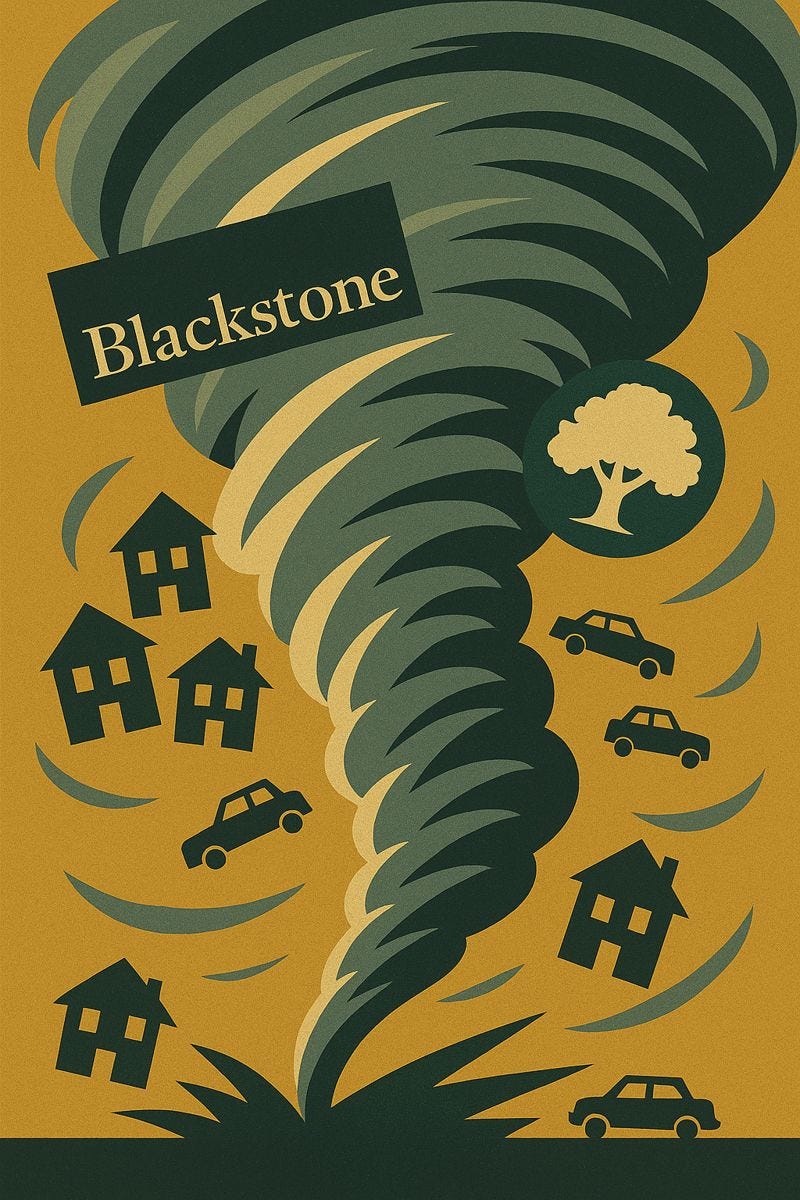
Last week, Oaktree announced that it would enter the reinsurance market alongside Allianz, participating in the insurer’s outward reinsurance program through a Lloyd’s-backed vehicle (Link).
The move might seem out of character for a firm best known for private credit. Writing insurance risk is not an obvious extension of leveraged loans or direct lending.
But Oaktree is not the only private credit player that sees opportunity in reinsurance. Blackstone actually beat them to the punch and struck a similar deal with AIG roughly a year earlier.
The sequencing suggests that reinsurance is becoming increasingly attractive to private credit platforms.
Why is this? And why now?
The answer, not surprisingly, is that now is a uniquely attractive time to be providing reinsurance. Reinsurance premiums today (i.e. returns) are high relative to history while risks have come down thanks to better contracts that push losses further out of the money.
This piece unpacks how that shift came about, what Blackstone and Oaktree are actually underwriting through these Lloyd’s-backed partnerships, and why reinsurance now makes sense to private credit investors.
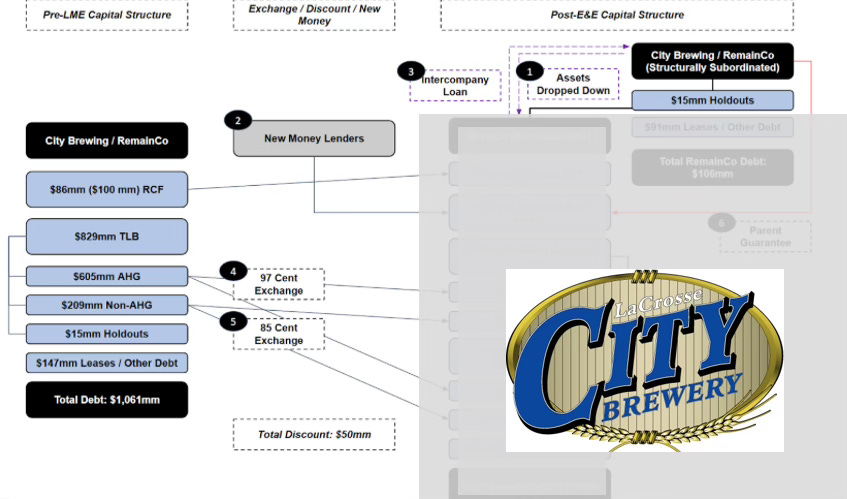
If you feel like your only way to access institutional-level restructuring coverage is through a corporate subscription that costs tens of thousands of dollars, you are not alone. My friend Restructuring is a Hedge Fund Analyst and former Restructuring Banker, and he is the founder of the Pari Passu Newsletter. He realized there was a gap in the institutional-grade restructuring research market. Whereas some providers focus on surface-level transaction summaries only, others provide multiple, disjoint updates that are hard to follow. This is the core insight behind Pari Passu: Provide all-encompassing coverage of the most consequential restructuring transactions. I have read their work, and it is fantastic. I encourage you all to check it out too (you can see above the graphics they use to explain LMEs). Their readers include the most senior credit investors on Wall Street, including the Head of Restructuring at Elliott and the Founder of Harvey Capital (largest credit hedge fund launch in recent years). This Friday, Pari Passu is publishing a deep dive on the double City Brewing LMEs, which include a dropdown, a double dip, and much more. Subscribe now to get their research for free and consider upgrading to unlock their full platform.
Both Blackstone and Oaktree are entering reinsurance through a framework launched by Lloyd’s in 2022 known as London Bridge. The program was designed specifically to allow large pools of institutional capital to support Lloyd’s syndicates without requiring investors to build or acquire a full insurance platform.
At a high level, London Bridge allows third-party capital providers to fund a dedicated Lloyd’s syndicate through a protected cell structure. Lloyd’s supplies the regulatory, operational, and underwriting infrastructure, while the external investor supplies the capital that ultimately pays claims.
For firms like Blackstone and Oaktree, it functions as a turnkey way to deploy capital into insurance risk: the underwriting is done by an established insurer, the oversight is handled by Lloyd’s, and the capital sits in a ring-fenced vehicle aligned to a specific underwriting program.
In the case of Oaktree, that capital is being used to provide reinsurance tied directly to Allianz’s primary property insurance book, including homeowners and commercial property policies. These are the everyday insurance contracts that protect buildings against a wide range of losses from routine claims like fire or water damage to large catastrophe events such as hurricanes, floods, wildfires, or earthquakes. Blackstone’s earlier arrangement with AIG follows the same basic template.
Insurers like Allianz and AIG use reinsurance to share the burden when low-frequency but high-severity events cause losses to spike across many policyholders at once.
The outward reinsurance program that Blackstone and Oaktree are joining sits above the insurer’s own retention and is designed to respond in those bad years, when catastrophe losses would otherwise place disproportionate strain on the balance sheet.
Through the London Bridge structure, Blackstone and Oaktree are effectively acting as capital partners to these insurers, providing reinsurance capacity on the primary book without taking over underwriting, distribution, or claims management.
The insurers keep control of risk selection and pricing while the asset managers supply capital and earn premiums in exchange for absorbing a defined share of the losses when extreme outcomes occur.
Private credit players like Blackstone and Oaktree decided to enter the reinsurance space in the last few years given the historically attractive risk/reward.
A useful way to compare reinsurance premiums over time is through the Guy Carpenter Global Property Catastrophe Rate-on-Line Index, which tracks how much premium reinsurers earn per unit of limit over time.
As you can see, the index jumped materially in 2023 following severe industry losses ($60Bn+) experienced due to Hurricane Ian. Premiums reached levels not seen since 2006 immediately following Hurricane Katrina.
Premiums tend to rise dramatically following large storm events as losses force weaker players out of the market and reset pricing power in the hands of surviving reinsurers.
While rates eased modestly in 2025, they remain far above levels present for most of the past decade.
But not only are premiums better, terms are also materially improved. The easiest way to see this is through how far attachment points (i.e. the loss level at which reinsurance has to pay) have moved up.
According to Guy Carpenter, this structural shift has been a central driver of reinsurer profitability.
In their commentary prior to the January 1, 2025 renewal, the firm noted that in 2024 “global industry catastrophe losses reached nearly $130 billion,” but the “estimated reinsured share of these losses [fell] to 14%, down from the pre-2023 average of 20%” (Link). Said differently: a similar-sized catastrophe year now translates into less loss leakage into the reinsurance layers, because those layers sit higher.
The combination of elevated premiums plus coverage attaching further out is why the risk/reward has become so compelling in reinsurance today.
In credit terms, it’s the equivalent of being paid a wider spread while also moving up in attachment: same general asset class, but a meaningfully better position in the loss stack.
Through a Lloyd’s syndicate, Blackstone and Oaktree are providing reinsurance to AIG and Allianz. Specifically, they are providing quota share reinsurance where the reinsurer takes a fixed percentage of both premiums and losses on a defined portfolio of insurance policies.
These structures are fully collateralized, meaning that Blackstone and Oaktree post 100% of the insured amount upfront, typically in cash or high-quality assets. That capital is available to pay claims as they arise, eliminating counterparty credit risk for the insurer. There is no leverage in the traditional sense; losses are limited to the capital committed.
The amount of underwritten reinsurance provided by both groups is not public, but it is rumored to be in the hundreds of millions for both.
In most years, when catastrophe losses do not breach the attachment point of the outward reinsurance program, the capital provider earns premium and collateral yield with little or no loss activity.
In severe years, losses can be substantial and are absorbed directly by the posted capital. The improved attachment levels described earlier reduce how often this happens, but they do not eliminate tail risk.
Returns-wise, while the exact terms of the Allianz–Oaktree and AIG–Blackstone arrangements are not public, we can make some assumptions based on the economics of quota-share reinsurance in today’s market.
At a high level, returns are driven by three components:
Net Underwriting Margin earned for providing catastrophe reinsurance (Premiums - Expenses / Commission)
Investment income on the fully posted collateral
Losses, which are infrequent but potentially severe
Net return ≈ net underwriting margin + investment income − losses
Net Underwriting Margin
In today’s market, based on what I could find, global property catastrophe reinsurance is priced at high-single-digit to low-double-digit rates on line, depending on geography, peril mix, and attachment point.
A reasonable assumption for a diversified outward program participation is:
Gross premium: ~8–12% of deployed capital
From that, the insurer receives a ceding commission (to compensate for underwriting, distribution, and claims handling), and the syndicate incurs Lloyd’s operating costs. Together, these typically consume:
~25–35% of gross premium
That implies a net underwriting margin in a no-loss year of roughly:
~5–9%
This is the pure “insurance” return, before investment income and losses.
Collateral yield
Because the structure is fully funded, capital is posted up front and invested conservatively. In the current rate environment, that collateral can reasonably earn:
~3–4% annually
This income is structurally different from underwriting profit: it accrues regardless of loss experience (unless capital is drawn down to pay claims, but this typically happens after year-end).
Losses
Difficult to predict. In many years, these would likely be zero. But in bad storm years, losses could be significant and eliminate many prior years of premium income.
Putting it together: no-loss and normal years
In a no-loss year, the economics look roughly like this:
Net underwriting margin: 5–9%
Collateral carry: 3–4%
Total no-loss return: ~8–13%
While this might seem somewhat mediocre for a “historically attractive” moment in reinsurance, this is an intentionally conservative estimate of no-loss returns. It is definitely possible that Blackstone and Oaktree invest in riskier tranches of AIG and Allianz’s reinsurance program and command higher premiums.
Indeed, reinsurance asset managers such as Nephila and Aeolus (owned by Elliott) do this, making conviction bets on Florida wind or California Earthquake.
If Blackstone and Oaktree are following this approach, returns could be solidly in the mid-teens or higher.
Blackstone’s and Oaktree’s move into reinsurance is not a bet on calmer weather. Instead it is a bet on better pricing and structure.
After a decade-long soft market, the reinsurance industry has undergone a rapid reset: premiums are higher, attachment points up, and contracts tighter than they were in the 2010s.
The trade makes sense to these private credit platforms accustomed to evaluating risk / return in corporate credit. Elevated premiums resemble wider spreads. Higher attachment points resemble moving up the capital stack. Annual reset and full collateralization reduce duration and counterparty risk.
The final (and maybe most compelling) feature is diversification. Reinsurance losses are driven by physical catastrophe risk, not corporate leverage, refinancing cycles, or economic slowdowns. For firms whose balance sheets are otherwise dominated by credit exposure, that lack of correlation is powerful.
The aperture of what is considered “private credit” is widening further.
Covenant Lite
No posts
Comments
Nothing yet. Say the first thing.
Sign in to join the conversation.