
A recent analysis by Oliver Wyman shows how dramatically insurance capital is reshaping private credit. According to the firm, 43 percent of the private credit AUM at the seven largest listed private-markets managers is now funded by insurance companies (Link).
That translates to nearly $1 trillion of the $2.3 trillion in credit assets managed by Brookfield, Apollo, KKR, Blackstone, Carlyle, Ares, and Blue Owl.
The figure is impressive on its own, but the trajectory is even more notable since the share was just 32 percent in 2021. This implies that more than half of net inflows into these credit platforms over the past few years have come from insurers.
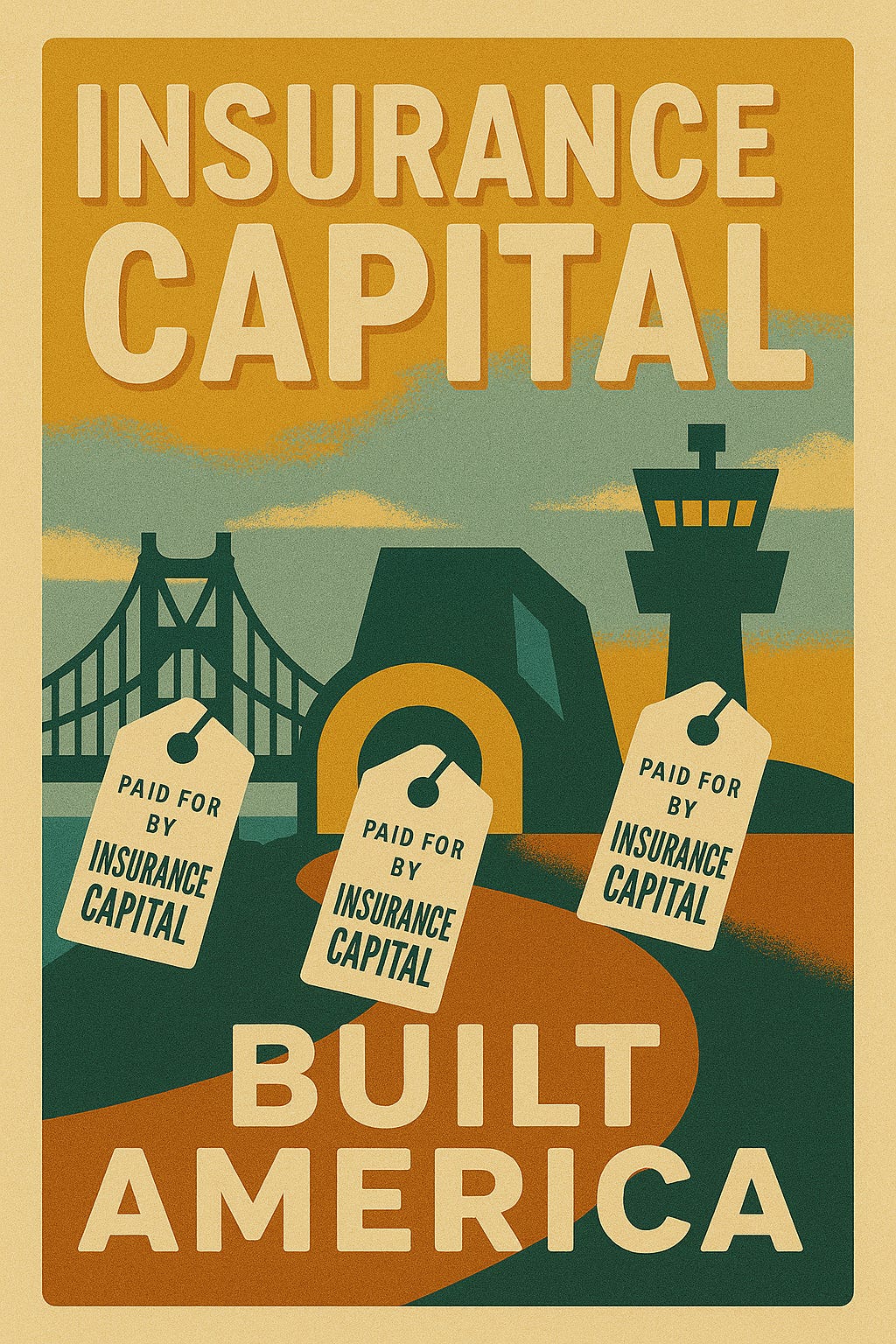
While this surge in insurance capital is often framed as a new development in private markets, in many ways it is actually a reversion to an older model. In the 1950s and 1960s, insurers provided the bulk of the capital for the post-war infrastructure boom in the US, financing bridges, tunnels and airports across the US.
In the 1970s and 1980s, insurers supplied much of the balance sheet capacity behind Michael Milken’s nascent high yield marketplace, a precursor to today’s private credit market (see CL #1: A History of Private Credit).
Seen in this context, today’s surge simply revives a pattern that has shaped American credit markets for decades.
For much of the twentieth century, insurance companies (particularly life insurance companies) were among the most important sources of long-term capital in the American economy.
Life insurers are, fundamentally, manufacturers of long-dated liabilities. They sell two products that create predictable, multi-decade cashflows: term life insurance, which pays out when policyholders die, and annuities, which pay out as policyholders live.
These offsetting risks (mortality on one side, longevity on the other) produce a uniquely stable liability profile. That stability is the insurer’s superpower: it enables them to hold long-duration, illiquid assets that match those future obligations.
Few institutions have liabilities extending out 20–50 years; insurers do, which is why they have always been natural owners of long-dated credit and infrastructure assets.
In the 1950s and 1960s, that structural advantage made insurers the backbone of America’s post-war infrastructure boom. With steady premiums and minimal investment constraints, they poured capital (debt and equity) into suburban housing, apartment complexes, commercial centers, and the bridges, tunnels, toll roads, and airports that connected them.
MetLife literally built Stuyvesant Town and Parkchester in New York, along with Park La Brea and Parkmerced on the West Coast. Prudential’s money bankrolled Levittown, the pioneering Southdale Mall, Dallas’s Brook Hollow Industrial Park, and even the Prudential Center in Boston.
Banks couldn’t hold these long assets without taking maturity risk but insurers could. And with light regulation and broad statutory authority, insurers deployed capital across nearly every category of long-lived infrastructure.
But this same business model created a vulnerability when interest rates surged in the late 1970s and early 1980s. As rates spiked into double digits, policyholders began surrendering their older fixed-rate annuities and universal-life policies since they offered yields far below what money-market funds and bank CDs were suddenly offering.
This mass shift drained insurers of the accumulated account values supporting those products. To stem the outflows, insurers had to raise the crediting rates on new and existing deferred annuities, effectively promising customers returns that matched the rapidly rising rate environment.
But their legacy income assets (mortgages, corporate bonds, and long-dated loans) were locked in at much lower yields. The only way to honor the richer guarantees embedded in those liabilities was to reinvest aggressively into higher yielding assets, which in practice meant sourcing double-digit returns from the emerging junk-bond market.
This is what drove insurers directly into Michael Milken’s / Drexel’s nascent high yield market. Junk bonds offered the double-digit returns insurers needed to plug the widening gap between what they had promised to pay policyholders and what their existing portfolios earned.
And with few regulatory limits on below-investment-grade holdings, life insurers became the dominant buyers of early high yield, financing LBOs, telecom buildouts, and a wide array of speculative credits.
Much of what we now associate with private credit began here, powered by the yield needs of insurance balance sheets under rate pressure.
The forces that pushed insurers into high yield in the first place ultimately exposed the fragility of their business model during a period of extreme rate volatility. As insurers loaded up on junk bonds to support richer annuity guarantees, the character of the asset class itself began to change.
What started as a market for “fallen angels” and growth companies morphed into a financing engine for highly leveraged buyouts, speculative roll-ups, and increasingly marginal issuers. Underwriting standards deteriorated. Covenants loosened. Leverage climbed. But insurers, desperate for yield, kept buying.
Among the most aggressive buyers were companies like Executive Life and First Capital Life, whose investment strategies came to define the era. Executive Life, in particular, embraced high yield as a core portfolio strategy rather than a satellite allocation.
By the late 1980s, the California Insurance Department would later note that the company had become the single largest holder of non-investment-grade bonds in the United States. Its investment staff routinely accepted full allocations on new Drexel offerings, and accounts from bankers described Executive Life as among Drexel’s most reliable buyers of new high yield issues.
First Capital Life followed a similar pattern. Congressional testimony in the early 1990s highlighted the firm’s willingness to absorb entire tranches of new issues so long as they cleared a target yield threshold, often twelve percent or more.
As the quality of issuance declined, their portfolios became increasingly exposed to the weakest segments of the market at precisely the moment when the cycle was turning.
The model cracked as credit conditions began to deteriorate. Defaults increased in the late 1980s as highly leveraged issuers struggled, impairing insurers’ concentrated holdings.
The 1989 collapse of Drexel was the catalyst that ultimately caused the junk bond market to implode.
Drexel’s trading desk functioned as the central market-maker and refinancing engine for high yield. Without Drexel’s placement and support, refinancing channels closed, secondary trading thinned, and insurers were forced to recognize losses or sell into declining markets.
The resulting capital strain contributed directly to the failures of Executive Life, First Capital Life, and other insurers with substantial high yield exposure.
Regulators responded with sweeping reforms. The early 1990s introduced risk-based capital requirements, formal limits on below-investment-grade holdings, enhanced disclosure, and more stringent asset–liability oversight.
These measures effectively ended the yield-chasing investment model of the 1980s. For much of the next two decades, insurers operated with far more conservative portfolios.
But the fundamental advantage of the industry—large, stable, long-dated liabilities—remained.
It just took another pioneer (in this case, Mark Rowan of Apollo) to fully re-recognize and industrialize that insight.
If the 1980s exposed the risks of insurers stretching for yield without adequate safeguards, the decades that followed created the conditions for a more disciplined return.
Similar to the 1980s, the years following the Great Financial Crisis saw insurers struggle to meet the crediting needs of their annuity books via their traditional investment options. In a world of chronically low interest rates, investment grade bonds didn’t offer enough income to make the math work.
Risk-based capital rules, stricter valuation standards, and more robust asset–liability management frameworks had forced insurers to rebuild with greater balance-sheet rigor. But many had become overly conservative and complacent.
Apollo was the first to see this clearly. Under Mark Rowan’s leadership, the firm recognized that annuity liabilities (properly structured, hedged, and managed) were not a constraint but a valuable funding base for private credit.
Athene became the proof of concept: an insurance platform explicitly designed to channel stable, long-term capital into higher-returning, asset-backed credit investments.
Rowan modernized what mid-century insurers had done intuitively, applying contemporary risk controls, diversified origination channels, and institutional underwriting frameworks. The result was a scalable model that aligned insurance balance sheets with private credit in a way the Milken era never fully achieved.
Other managers followed. KKR purchased Global Atlantic; Blackstone partnered with Allstate and later built a broader insurance strategy; Brookfield and Ares expanded aggressively into insurance balance-sheet partnerships.
The result is a new equilibrium in which insurers no longer chase yield reactively, as they did in the 1980s, but instead allocate to private credit proactively, through tightly managed platforms that manufacture the kinds of long-dated, senior secured assets their liabilities are built to hold.
The surge in insurance allocations to private credit since 2021 reflects this structural shift. Insurers are now, once again, central to the industry’s funding model. Their liabilities demand long-duration, predictable cash flows; private credit, especially asset-based finance and investment-grade lending, is engineered to provide them. With sophisticated ALM, capital-efficient structures, and integrated origination, the alignment is tighter today than in the past.
The rise of insurance capital in private credit is often described as a structural innovation. And in many ways it is: balance sheets are stronger, regulatory frameworks are clearer, origination platforms are more sophisticated, and liability management is far more disciplined than in prior eras.
But the broader pattern is not new. Insurers were the country’s most important private lenders in the post-war decades. They financed the urban housing boom, the suburban buildout, the country’s first generation of malls, airports, toll roads, and industrial parks. They were also central to the early development of the high yield market, even if the regulatory and product structures of that era made the model unsustainable.
What is happening today is not the invention of a new paradigm so much as the restoration of an old one. But under far safer, more institutional conditions.
Life insurers remain the only investors with natural 20- to 50-year liabilities, and private credit remains one of the few asset classes able to deliver the long-duration, contractual cash flows that match them.
With the benefit of hindsight, the industry’s re-engagement was ultimately inevitable; the only question was who would build the machinery to make it scalable and durable.
While this might make what Apollo did with Athene seem less innovative, it makes it no less impressive.
Covenant Lite
No posts
Comments
Nothing yet. Say the first thing.
Sign in to join the conversation.