
I’ve seen things you people wouldn’t believe.
Attack ships on fire off the shoulder of Orion.
I watched C-beams glitter in the dark near the Tannhäuser Gate.
All those moments will be lost in time, like tears in rain.
Time to die.
This monologue from the character of Roy Batty (played by Rutger Hauer) in the film Blade Runner stands out as some of the most moving lines upon facing one’s mortality in modern science fiction (and maybe in all of modern cinema, honestly).
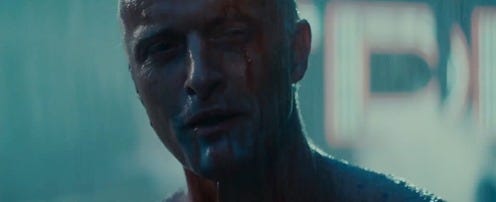
The character is a replicant, a synthetic human, who has shown a great capacity for violence and a lack of empathy toward others (which is explored a bit more deeply in the original novel Do Androids Dream of Electric Sheep? By Philip K. Dick). And, yet, in these final lines in the film before he dies, we see that he’s coming to a realization about the nature of memory and experience in the face of mortality. When we die, human or robot alike, the sum of our memories and experiences in many ways dies with us.
This is certainly part of our great drive to share our experiences in this life.
We don’t just want to be heard and understood while we’re alive, but we want to know that after we are gone there will be some part of us that remains. It might remain in the memories of our families, in the ways we impacted others, or in the various creative works and stories we’ve shared. I think that’s certainly part of my own drive for writing here in The Cosmobiologist as often as I do. It’s also part of why I love hearing from readers regularly. I want to know your story just as much as I want to share mine.
But there is something interesting about how we share our messages and ideas and experiences. There isn’t a 100% fidelity in these things, and many messages change as they are relayed through space and time and based on the receiver who finds them.
I was recently reading a little bit about the Voynich Manuscript (more on that below), and that got me to wondering about the messages we’ve intended and the ways that they’ve been lost or mistranslated through time, and what this can tell us about the messages of ourselves we’re creating now.
Many years ago, during an introductory undergraduate course on history, a professor presented a thought experiment that you might have heard of before:
In a distant future, an advanced civilization unearths a corroded aluminum Coca-Cola can. To them, this singular, mass-produced relic from our era is a rare and enigmatic artifact. They may have some knowledge of our history, but only fragmentary and missing much of our current cultural nuance. They can tell it once held something. But they debate whether the object was a religious chalice, an offering to ancient deities, or perhaps an incredibly precise ritualistic tool.
Could it be that none of them would think it might just be a commonplace object? What if it leads them to assume the Coca-Cola logo was part of our mythology, a key piece of our beliefs?
Now, take those thoughts and consider how we ourselves have looked at artifacts we’ve uncovered from our own distant past. Have we been too quick to assume an image from a piece of pottery ascribes an entire belief system to everyone who lived nearby in those times? What are we likely misrepresenting in our own beliefs about the past?
I’ve heard versions of this thought experiment told with other artifacts.
I imagine professors today reach for an iPhone, or a pair of earbuds, or some other object that will, in time, become just as outdated. But the core of the thought experiment stays the same: how much of what we believe, what we value, what we mean, simply dissolves with the passage of time? How might future people (or aliens!) view us if they only had some artifact from us or if they had uncovered a message from us? And how much have we already misunderstood about the people who came before us, for exactly the same reasons?
Communicating about ourselves through time doesn’t just depend on the message, whether intentionally sent or not, but also on who is receiving the message.
Communication, even between two people standing in the same room, depends on more than words. It depends on shared language, shared symbols, and shared assumptions about what those symbols point to. Strip away any one of those, and a message can change meaning altogether or be entirely lost.
Old English is barely a thousand years old, but most of us can no longer read it without help. Multiply that alteration due to time and cultural/linguistic change by ten thousand years, or a hundred thousand, or by the gulf between two species that evolved in entirely different biospheres, and the original meaning of a message or an artifact may appear utterly alien.
These alterations in the meaning of artifacts and messages through time and space impact how we may or may not be able to communicate with those who are far different from us, both in our future here on Earth or who come from somewhere else entirely.
The impetus for this writing came from a note while I was reading a bit about the Voynich Manuscript: an encoded work from Medieval Europe that has never been decoded.
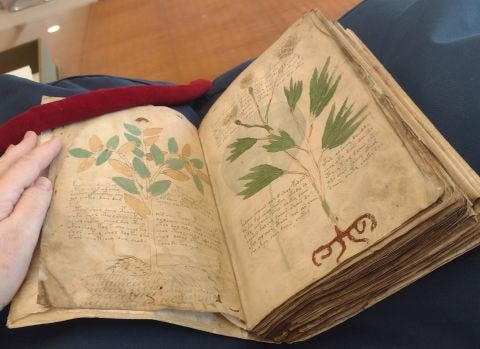
The Voynich Manuscript is a small, illustrated codex, carbon-dated to the early fifteenth century, written in a script no one has ever identified. Its pages show what might be plants, though none match anything botanists recognize as real plant specimens. There are diagrams that might be astronomical, women bathing in pools of green liquid connected by tubes, charts that might be calendars or might be something else entirely. The manuscript has defeated codebreakers, including some of the same cryptanalysts who broke Axis ciphers in the Second World War. It has defeated modern computational linguistics.
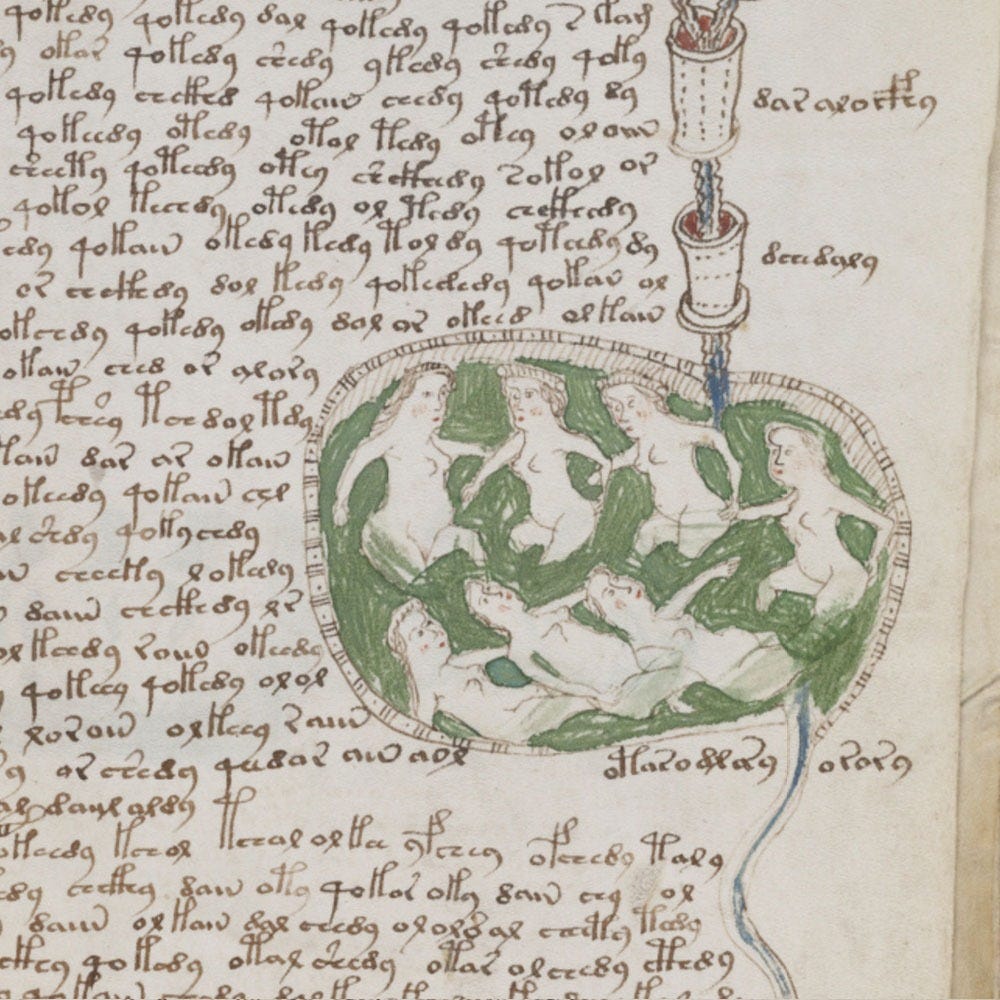
In the case of the Voynich Manuscript, the message/artifact has survived entirely intact.
You can view the entire thing digitized online from Yale University’s Beinecke Rare Book and Manuscript Library. It’s now not only stored physically intact but also has been saved within the digital realm of our technosphere. But even if the message exists entirely as it was created, we have no idea what it means. We can’t read it. And while numerous people have tried to figure out what the intended meaning of the book may be, we still to this day truly do not know. It might have been an overview of plant materials and recipes, astrological and cosmic beliefs, and maybe even an overview for women on the uses of geothermal pools or other bathing setups. But there are so many weird little intricacies that just don’t fit nicely with how we think they should. Some even wonder if the book was intended to be misunderstood, some kind of Medieval hoax. Scholars continue trying to decode this book!
My favorite comment on the video above is from YouTube user @ilionreactor1079:
“Hey, Brother Brian?” “Yes, Brother Andrew?” “Want to drive people crazy in 500 years?” “How would we do that?” “Well, I had an idea for a book...”
Maybe it really was a Medieval hoax or maybe it was hiding some knowledge only intended for a very specific audience (maybe even an audience of one), but we can’t know. We can’t know if it was a joke or not.
There are certainly other messages and ideas lost to time. There are old languages that no one speaks anymore or artistic creations of ancient people for which we can only really guess about their meaning. Etruscan, once spoken across central Italy, survives in inscriptions we can sound out but still can’t fully translate. Linear A, used in Crete centuries before Greek, has never been deciphered at all, even though its sister script, Linear B, eventually gave up its secrets. The knotted cords of Incan quipu, once used to record everything from census data to history itself, are still only partly readable, their full grammar lost along with the people trained to read them. Here’s a fantastic video from Ed Barnhart on the quipu and what we know and don’t know about them:
There are many examples of messages, beliefs, languages, or ideas our ancestors held that were lost to time for various reasons. The ancient cave paintings we find at places like Lascaux and Altimira are tens of thousands of years old. They show the remarkable impact of the environment on our distant ancestors who painted them. But, even if we like to ascribe the paintings to our own thoughts on how those beings understood hunting, seasons, mating, and other facets of their world, we truly do not know and will likely never know what they imply about individual and group beliefs and ideas from those early humans and our close relatives.
Another fun example of something that was lost in time but then uncovered can be seen in the decipherment of the Rosetta Stone.
French soldiers found the Rosetta Stone by accident in 1799, while building a fort. It carried the same decree in three scripts: Greek, which scholars could still read; Demotic, which they couldn’t; and hieroglyphics, which had been unreadable for over a thousand years. It was obvious almost immediately that the writing on the stone could lead to modern scholars finally understanding some language from ancient Egypt. It took over 20 years (and some rivalry of the translators) to decode the ancient Egyptian languages based on the Greek.
The ancient Egyptians who carved the stone had no way of knowing that Greek, a younger and (at the time) less prestigious language, would outlast their own. If it hadn’t, though, then Demotic and Hieroglyphics might still be empty messages to us.
And that should make us wonder if there are parts of our language, our art, our creations and artifacts now that might be lost to the future or might be translated in ways we’ve never intended.
We are, right now, trying to compose a message meant to outlast Ancient Greek by a far wider margin and with the knowledge that those receiving it may need help in coming to comprehend the dangers it implies: the message is that our nuclear waste storage sites are literally lethal for many biological creatures on this planet.
Nuclear waste remains lethal for ten thousand years or more, and in 1981 the U.S. Department of Energy assembled a group of linguists, archaeologists, materials scientists, and even science fiction writers to design a warning that could survive that long. And in the work, they had to admit that future people (or whatever comes after us) might not be able to read our language, and certainly wouldn’t understand the intention of the current symbol we use internationally to signify radiation.

The proposals from 1981 as well as from a 1993 Sandia National Labs report have ranged from fields of menacing granite spikes to a kind of revived priesthood, tasked with preserving the warning as ritual long after its original language had died.
For attempting to sculpt messages using languages that could be decoded from the physical structures of the storage site, in hopes that the messages may be deciphered, one draft message itself reads:
This place is a message… and part of a system of messages ...pay attention to it!
Sending this message was important to us. We considered ourselves to be a powerful culture.
This place is not a place of honor.. .no highly esteemed deed is commemorated here …nothing valued is here
What is here was dangerous and repulsive to us. This message is a warning about danger.
The danger is in a particular location... it increases towards a center... the center of danger is here… of a particular size and shape, and below us.
The danger is still present, in your time, as it was in ours.
The danger is to the body, and it can kill.
The form of the danger is an emanation of energy.
The danger is unleashed only if you substantially disturb this place physically. This place is best shunned and left uninhabited.
That’s a whole lot of message to attempt to encode in physical structures that would later need to be decoded by someone or something that potentially never knew English.
But it is intriguing to think that there continue to be attempts to figure out how to best convey the danger and the meaning of our nuclear waste storage sites to a future that might be radically different from us now.
And we see the same issue when attempting to sculpt messages intended for alien intelligences.
The Arecibo message, broadcast in 1974 toward a cluster of stars 25,000 light-years away, encoded basic mathematics, the structure of DNA, and a rough image of a human being in a stream of binary data. The Pioneer plaques, attached to spacecraft launched in 1972 and 1973, carry gold-anodized diagrams of a man and a woman, our location in the solar system, and a schematic using the wavelength of a specific transition in hydrogen that should be universal enough to serve as a standard measure. The Voyager golden records went further still: greetings in 55 human languages, music from Bach to Chuck Berry, the sound of a baby crying, whale song, thunder.
These are beautiful objects and beautiful gestures.
But they might also be almost impossible to interpret.
We did our best in most of these cases to try to find some common communication. The Arecibo message is an array of 1679 bits of information that an alien intelligence would have to then know to decipher into a two-dimensional grid of 23x73 units. The plaques and Golden Records include the hydrogen “rulers”. And in these cases, we’ve tried to include some standards like basic math or physics. But things like nucleotides, human anatomy, our language, our music, or pictures from our world could all be utterly alien to whoever or whatever might one day receive these messages.
As we continue thinking about the kinds of messages we could or should send for aliens out there or for humans in our own future, there are many of us who are thinking more earnestly about the potential issues with how our messages may be misunderstood or entirely indecipherable to the distant future.
If humans of the future or some intelligence aliens out there ever receive our messages, would they be able to interpret them? Or would our messages be lost to time like the Voynich Manuscript or maybe in need of some kind of translating object like the Rosetta Stone?
What do you think? Do you think we need to be more thoughtful in how we compose messages intended for the future?
And we should wonder: how much of what we are as a civilization could be lost, much like the experiences and memories of Roy Batty, being lost to time like tears in rain?
As always, thanks for reading, and stay curious!
No posts
Comments
Nothing yet. Say the first thing.
Sign in to join the conversation.