
“For small creatures such as we, the vastness is bearable only through love.”
-From Carl Sagan’s Contact
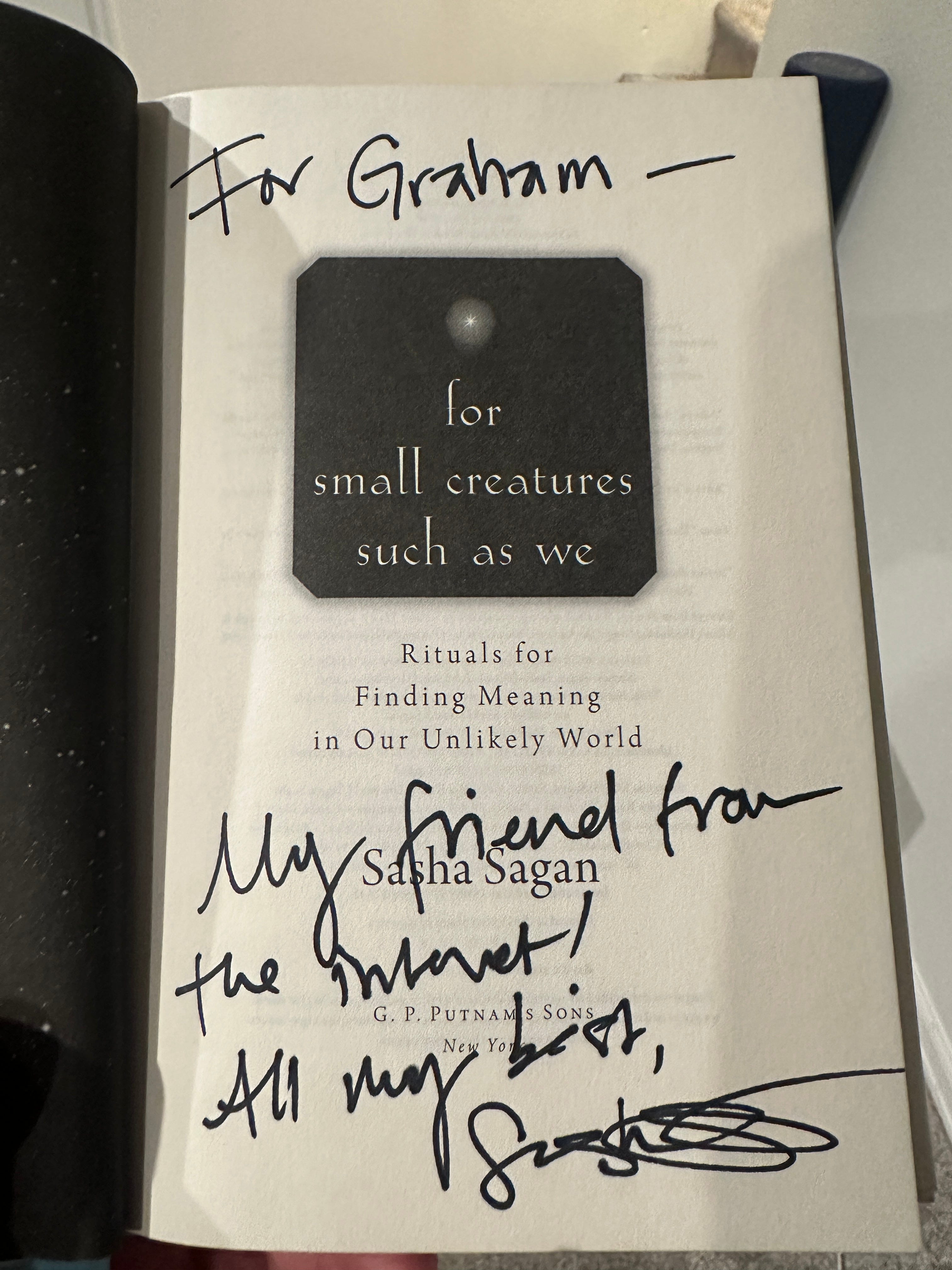
One of my favorite book inscriptions I have in my collection came from Sasha Sagan. When she first published For Small Creatures Such as We, I had the pleasure of catching her on her book tour. At the Boulder Bookstore here in Colorado, she signed my copy of her book as “For Graham — My friend from the internet! All my best,”
That was a different time. We were both active on Twitter and had chatted back and forth a few times in messages there on her book release as well as a number of other topics (that was long before Musk took over the platform and ended its days as a meeting place for many different kinds of people). I was so excited for her book when it came out, and it left nothing wanting.
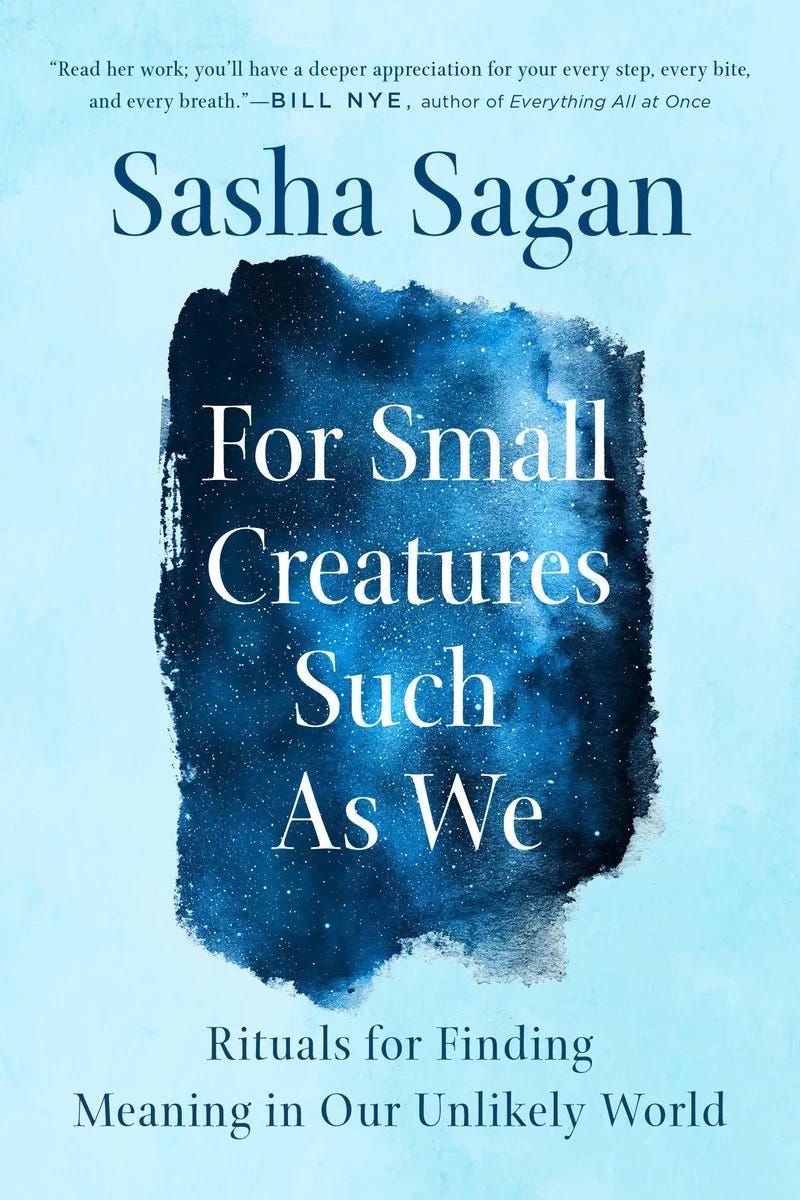
For Small Creatures Such as We explores the nature of ritual and our shared search for meaning among all of this [waves arms around at everything].
We’re now continuing our 2026 Astrobiology and Panzoic Book Club with a deliberate change of register, and a dive into this lovely writing by Sasha Sagan.
Our last few non-fiction readings asked questions about the laws of nature, what life is, and how evolution may function on the cosmic scale. But we’re now going to shift our focus a bit toward the nature of meaning and finding our place together here in this universe.
Coming to accept that we are small creatures on a rather out-of-the-way planet in the galaxy, brief inhabitants of an enormous and indifferent cosmos, how do we actually live and find value in the act and art of living? What do we choose to celebrate and honor? Why do we place so much value in marking a birth, a marriage, a death, a solstice, a birthday, and other events rooted in our biology and the orbital dynamics of our world?
With Sasha Sagan’s book, we’re now going to ask these questions together.
The subtitle for the book is Rituals for Finding Meaning in Our Unlikely World, and that’s an apt fit for the character of the book and the places it’s going to take us together.

The title of Sagan’s book comes from Contact, the novel her parents created together. And it comes from one of those quotes that hits so hard and so dearly that it’s easily one of the most reproduced from among Carl Sagan’s body of work:
“For small creatures such as we, the vastness is bearable only through love.”
We read Cosmos together to kick things off in this book club, and in that older writing by the older Sagan we explore the nature of our universe and our historical explorations of our place among all of this. So it’s fitting that we now turn our attention to what these explorations say about us and how we’ve come to develop ritual and a sense of celebration of our lives and our natural world through our collective actions on this planet.
We’ve explored the sense of ourselves as being “small creatures”, so now we’ll explore the kinds of love that make this all bearable.
Here’s a brief description from the publisher about the book:
Sasha Sagan was raised by secular parents, the astronomer Carl Sagan and the writer and producer Ann Druyan. They taught her that the natural world and vast cosmos are full of profound beauty, and that science reveals truths more wondrous than any myth or fable.
When Sagan herself became a mother, she began her own hunt for the natural phenomena behind our most treasured occasions--from births to deaths, holidays to weddings, anniversaries, and more--growing these roots into a new set of rituals for her young daughter that honor the joy and significance of each experience without relying on a religious framework.
As Sagan shares these rituals, For Small Creatures Such as We becomes a moving tribute to a father, a newborn daughter, a marriage, and the natural world--a celebration of life itself, and the power of our families and beliefs to bring us together.
I’m excited for us now to have a chance to read this together.
This month is going to be a little different than in previous months for our book club.
Due to my own work and travels, I’m not going to recommend a reading pace for this one. Instead, I’ll do my best to share a few of my own thoughts in emails to all of our readers. We also have a WhatsApp group and a Discord server for the book club and for our shared readings where we can explore a bit more in depth together.
I’m still exploring the best ways to coordinate the readings for the club while also trying to value my own time and work on curating, moderating, and in writing my extensive notes and articles about each book.
For those who want to join, there are now two tiers to the book club:
Anyone who wants to join and read along can do so for free! The book club is a labor of love and one worth sharing with everyone. We have over 150 members in our email list. Some people join to read one or two specific books along with us, while others have been going deep on every read. The free group allows everyone to hear some regular updates from me as well as to receive invitations to share their thoughts in Substack posts, in Twitch livestreams, or in videos from me. To join, just reach out to me with your email or submit the Google Form.
For those who want to go deeper, there’s a more intimate version of the book club reserved for paid subscribers to The Cosmobiologist. This includes access to our active WhatsApp group and Discord server where we have almost daily conversations about the reading, as well as an invitation to join our monthly group Zoom sessions where we discuss the books we read together. These spaces have become rather close-knit, and I want to keep them that way. I’m offering a discounted annual rate for anyone who wants to come in as a paid member of the book club ($42 per year). This is also linked in the Google Form for those who sign up. Also, for students or those impacted by financial constraints, please message me privately if you want to join but can’t afford the cost yet.
JANUARY: Cosmos, by Carl Sagan
FEBRUARY: Project Hail Mary, by Andy Weir
MARCH: Time’s Second Arrow, by Robert Hazen and Michael Wong
APRIL: The Three Body Problem, by Liu Cixin
MAY: Life as No One Knows It, by Sara Imari Walker
JUNE: Solaris, by Stanislaw Lem
JULY: For Small Creatures Such as We, by Sasha Sagan
AUGUST: Dawn, by Octavia E. Butler
SEPTEMBER: The Secret Life of the Universe, by Nathalie Cabrol
OCTOBER: The Andromeda Strain, by Michael Crichton
NOVEMBER: Myths to Live By, by Jospeh Campbell
DECEMBER: The Sparrow, by Mary Doria Russell
Note: We’ll revisit the current schedule in late August to see if we want to make collective group changes. Only those in the paid tier can vote on book selections.
I hope you’ll join us for this read.
Until next time, stay curious!
No posts
Comments
Nothing yet. Say the first thing.
Sign in to join the conversation.