
I’m not proud of what actually got me to sit down and write this. I woke up to one of my articles landing on the wrong side of Substack (if that’s even a thing).
The article in question:
Some of the delightful commentary:

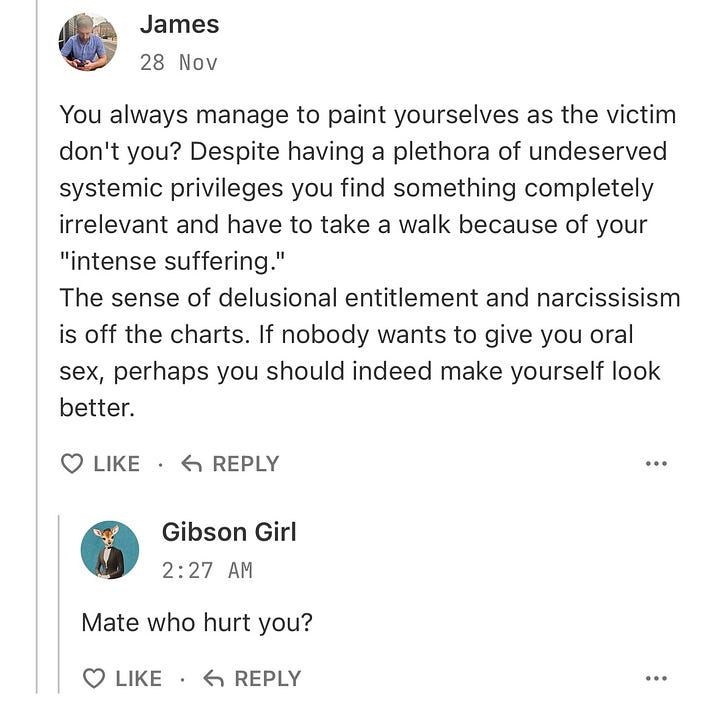
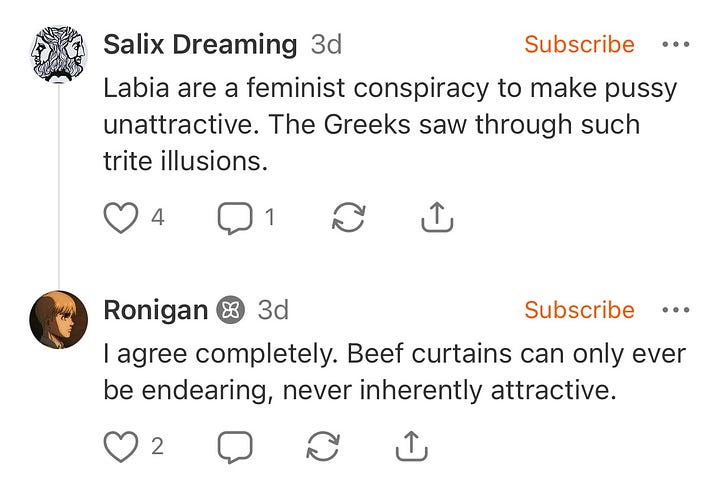
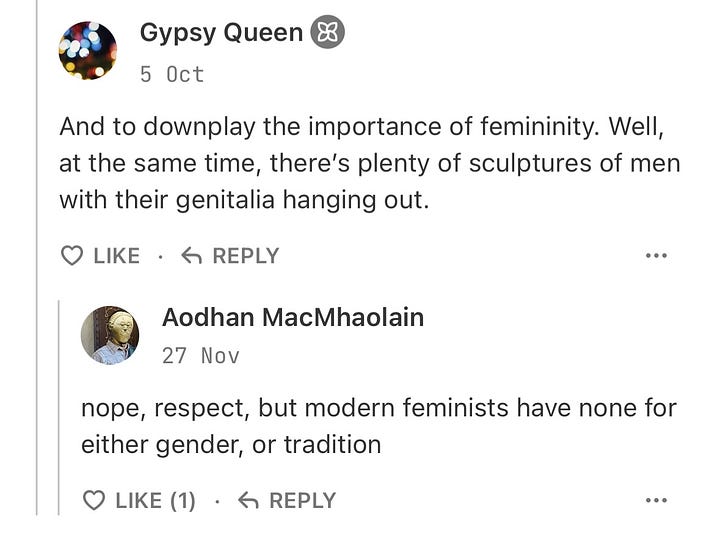
Nothing like some reddit-bro misogyny to yank you out of writers block! Firstly, stating that labia are a feminist conspiracy is the most wild case of telling on yourself and secondly as I’m now a decade in to studying ancient history I reckon I’ve got a decent amount of respect for tradition??? Possibly too much???
This one was genuinely quite funny though:
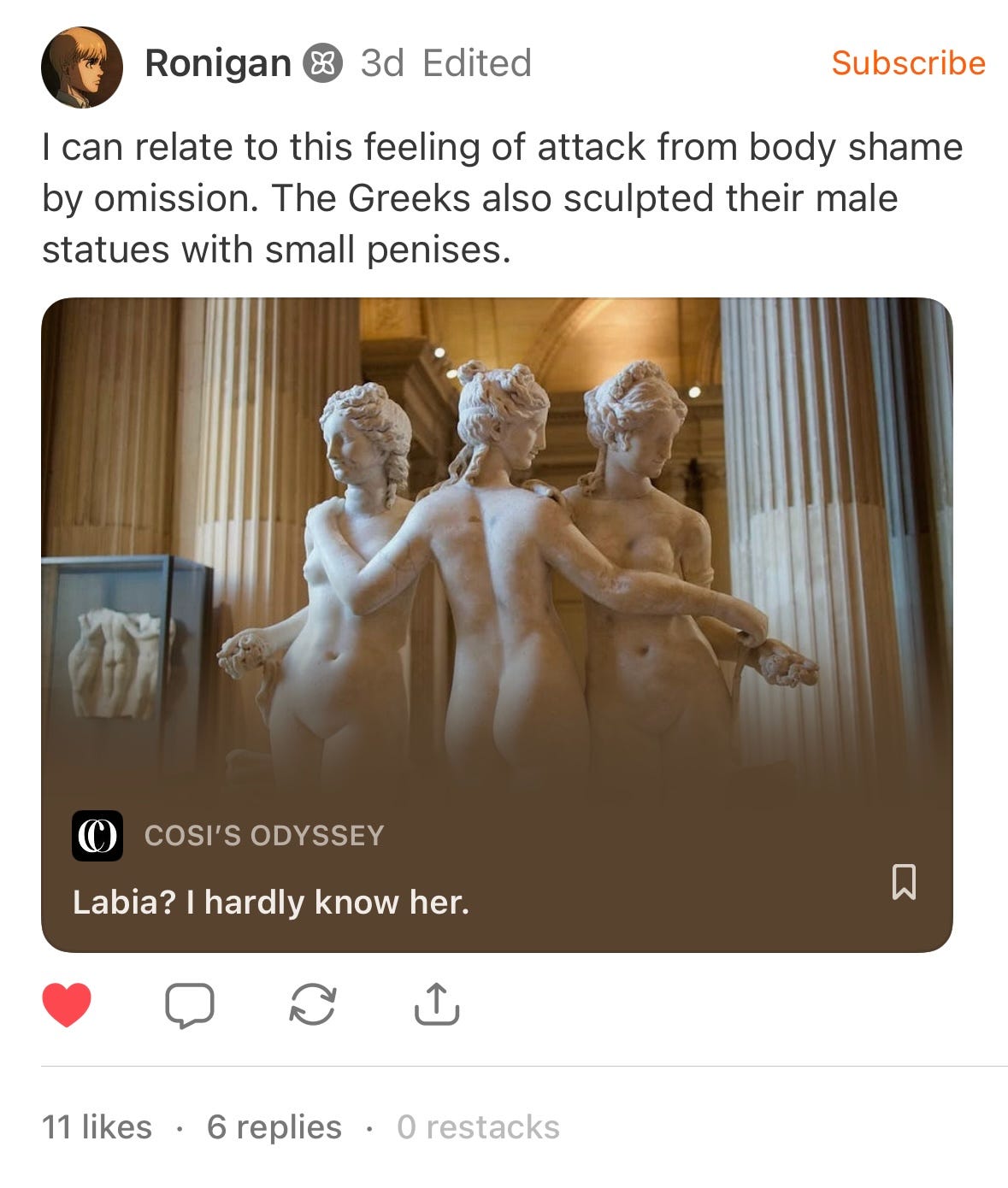
Another piece from a thousand years ago (2022) has also been upsetting some men on here (I’m honestly not sure how they’re even finding it but hey ho):


So now that we’re on the topic of women being disgusting, settle in because do I have a story for you! (We’re going quite niche with it so feel free to show off your obscure mythological knowledge at your office Christmas party or use it to tease/lightly threaten your spouse).
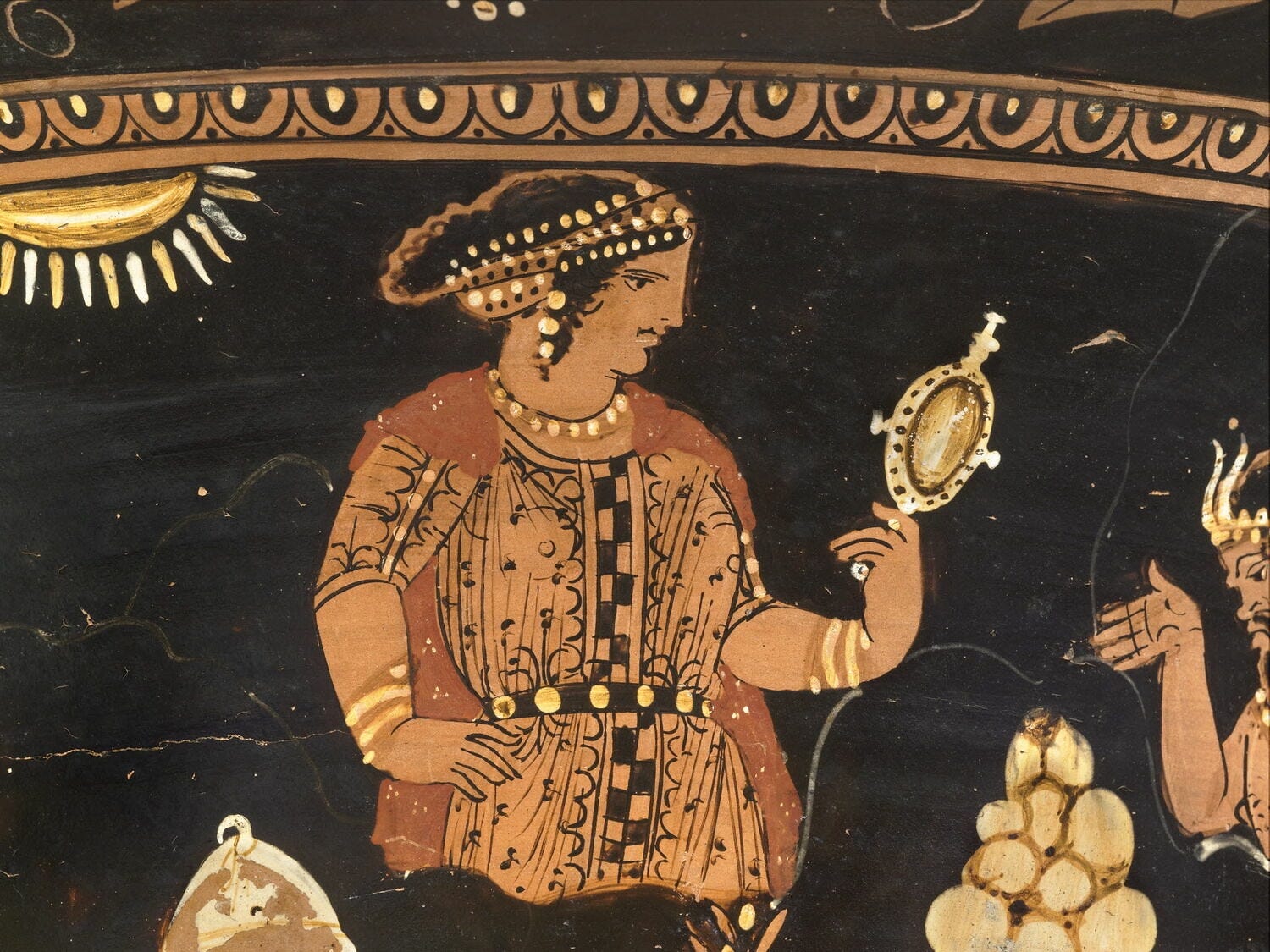
Allow me to introduce the women of Lemnos who pissed off the wrong goddess (not that there’s a right one to piss off). They had the bright idea of scorning Aphrodite, neglecting the goddess of love and sex, and she did not take it well. Surprise surprise.
In response to this rejection, Aphrodite cursed the Lemnian women with a foul stench. Their husbands didn’t exactly get turned on by their newly fragrant spouses so they set themselves on some women they’d captured from Thrace, taking them as concubines. The Lemnian women, in turn, took a leaf out of Aphrodite’s book and responded to this rejection not-exactly-in-kind (if you’ve read a few of my newsletters you may be used to the disproportionate responses of mythological characters but this one may take the cake). They took it upon themselves to murder every single man on the island, husbands, fathers, sons, the whole kit and kaboodle.
Quintus Smyrnaeus, writing in the 4th century AD, provides us with this description:
“[N]o compassion would they show to their own wedded lords—such madness shakes the heart of man or woman, when it burns with jealousy’s fever, stung by torturing pangs. So with souls filled with desperate hardihood in one night did they slaughter all their lords; and on a widowed nation rose the sun.”1
Aeschylus refers to the story 800 years earlier with a bit more subtlety:
γυναικῶν φρεσὶν τλημόνων / παντόλμους ἔρωτας, ἄ- / ταισι συννόμους βροτῶν; συζύγους δ’ ὁμαυλίας / θηλυκρατὴς ἀπέρωτος ἔρως παρανικᾷ / κνωδάλων τε καὶ βροτῶν.
‘[Who will refer] to the passions of daring women, partners of ruin for mortals? The desire without love which dominates the female perverts the wedded unions of animals and of humans.’2
I’m not really sure what he means about animal weddings BUT the whole women-are-the-bane-of-mankind thing is pretty clear (I guess this makes that viral article about women ruining the workplace somewhat less groundbreaking…?). Okay back to the myth itself.
Aphrodite was really on one; according to some versions she was actually responsible for the murderous rage of the Lemnian women, as well as their fetid fragrance. A much later version actually claims that the Lemnian women worked TOGETHER with the Thracian women to commit mass murder so there’s a glimmer of ancient girlhood for you. Aeschylus and Sophocles both penned versions where Jason and the Argonauts rocked up to Lemnos after all this went down, coming face to face with the now husband-less women who threatened them with violence and death unless they married them and performed their marital duties immediately.

Please indulge me as I invite a few more gals to the party, the party being the mass murder of men by women and the gals being the Danaides. Apollodorus tells the tale of 50 sisters, 49 of which behead their husbands on their wedding night.3 They were forced into marrying the 50 sons of Aegyptus and honestly I can see the logic of this from a purely practical standpoint. Although their father was no doubt smiling and waving as this was going down, daddy Danaid is actually the one who armed his daughters, giving them daggers to hide away until the crucial moment. The Danaides got served with a rather peculiar punishment in the Underworld as a result of this, condemned to fill a perpetually leaky vessel (a la Sisyphus and his boulder but more wet and wild 💦).
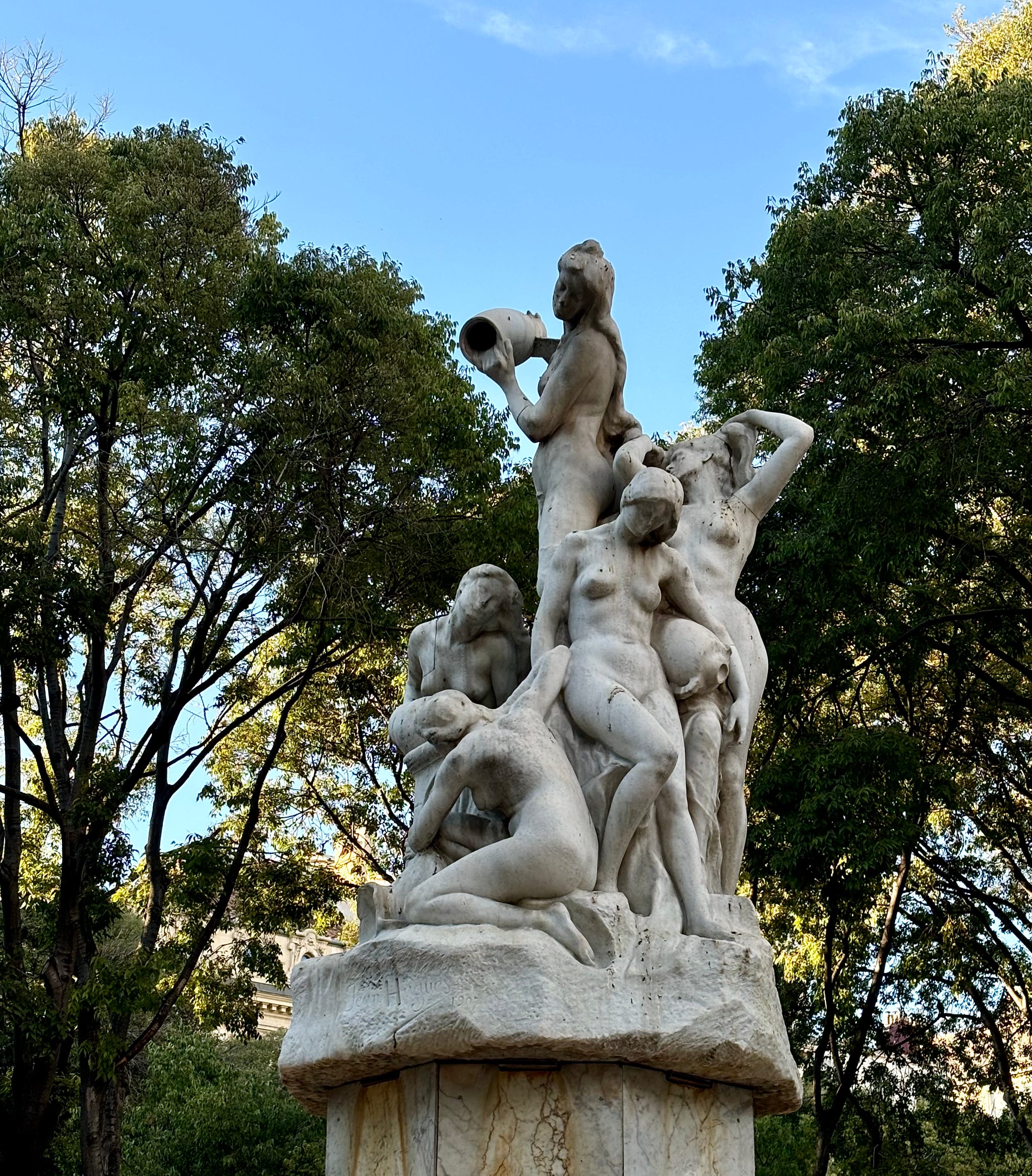
Above is a rather beautiful fountain in Marseille that provides us with a handy visual aid.
But what do the Danaides have to do with our smelly protagonists?? WELL you may have caught the fact that only 49 out of the 50 Danaides actually slice and dice their husbands; Hypermestra gets cold feet and her husband wakes up with his head still very much attached to the rest of him. The Greeks were terrified of women, particularly when operating as a group, but they were big fans of sneaking in an exception, a cooperative, compliant counterexample that could provide a glimmer of hope or relief. #NotAllWomen
Amidst the Lemnian women there was one that wasn’t quite up to murdering every single man on sight. Hypsipyle decides to save her dad Thoas, smuggling him away in a boat.
Nereida Villagra writes:
“It is important that the Greek imaginary had space for this counterexample. In other words, even though the group of women is dangerous because they end up killing their husbands, sons and fathers, and, eventually, the whole community, there is room for an exception. There is hope for coexistence of the two sexes: Hypsipyle’s respect for the patriarchal order.”4
The tension between an individual woman versus the collective calls to mind another bit of tension or uneasy coexistence in the ancient Greek mind, summed up rather elegantly by Page duBois:
“[T]he Greeks often imagined women to be secretly violent and enraged. The notions of violence, of Clytemnestra the murderess, of the flesh-eating Amazons, and of the Amazonian Lemnian women go along dialectically with the view of them as fields, tablets, ripe fruit, doves: all these images of passivity are dialectically connected to the other, less often expressed, images of butchery and murder.”5
Forget the whole Madonna-Whore thing, women are either doves 🕊️ or BUTCHERS 🪓 (there is no third option).
It is important to note that it is in fact the sexual desires of the MEN that bring about their demise rather than those of the Lemnian women (although the version where Jason and his Argonaut buddies rock up and the women essentially threaten them with death unless they take them to bed immediately is worth keeping in mind). Clytemnestra, for example, killed her husband after shacking up with his cousin but she got her comeuppance in the end (at the hands of HER son). The Lemnian MEN, however, are the ones that fucked around (and they certainly found out).
Reference List
duBois, Page. Sowing the Body: Psychoanalysis and Ancient Representations of Women. University of Chicago Press, 1988.
Martin, Richard P. “Fire on the Mountain: ‘Lysistrata’ and the Lemnian Women.” Classical Antiquity 6, no. 1 (1987): 77–105.
Thornton, Bruce S. Eros: the Myth of Ancient Greek Sexuality. 1998.
Villagra, Nereida. ‘Female Group Violence in Greek Myth: A Case Study on the Lemnian Androctony and the Crime of the Danaids’ pp. 405-416 IN Violence in the Ancient and Medieval Worlds. Leuven: Peeters Publishers & Booksellers, 2019.
Quintus Smyrnaeus, Fall of Troy 9. 368 ff (trans. Way).
Aeschylus, Choephoroi 596-601. See also Apollonius Rhodius 1.609-616. On the role of the Lemnian Women in Choephoroi see Froma Zeitlin, “The Dynamics of Misogyny: Myth and Mythmaking in the Oresteia,” Arethusa 11 (1978) 155.
Apollodorus. The Library. 2.1.5 and Campbell Bonner, “A Study of the Danaid Myth,” Harvard Studies in Classical Philology 13 (1902): 131.
Comments
Nothing yet. Say the first thing.
Sign in to join the conversation.