
Hello and merry December. I hope you’re having a lovely Thursday wherever you are in the world but if you happen to live in the United Kingdom this is a wee reminder that I also host in-person events ‼️ I’ve got a panel discussion coming up with 3 incredible historians on the 19th of February and I would love to see you there. Details can be found here: Empresses, Queens, and Conquerors: A History of Women who Ruled.
I’ve essentially compiled all the classical references that make me chuckle like a smug twat every time I hear them in a movie or tv show. Now you, too, can pat yourself on the back because you’re oh so clever.
In all seriousness these kinds of references are one way in which the field of classics is subtly (or not-so-subtly) weaponised in order to make the “in group” feel good about themselves, leaving the out group—those that don’t nod or smile knowingly—feeling inferior, confused, or both.
This was inspired, in part, by a lovely message I received from a new subscriber a few weeks ago who asked how I felt about class and classics. I replied, how honest do you want me to be? It’s a massive question that we can fight about later and what we’re covering here is really the tip of the iceberg but if you have any specific thoughts about this topic you know where to fling them.
Without further ado, I bring you the early Christmas gift that literally no one asked for, my abridged, non-exhaustive, wildly subjective classics glossary. They’re alphabetical because it feels chic and because I had no idea how else to order or group them. Let’s go.
Starting off strong, the son of Peleus and the nereid Thetis, the greatest of all the Greeks warriors, Achilles had a rather bizarre childhood. Some babies get forced to listen to Mozart in the womb, others get dunked in a river like a teabag. Thetis was your typical concerned mother but she happened to be immortal and therefore had access to a few extra resources. Our mother of the year grabbed baby Achilles by the ankle and submerged him in the River Styx, rendering him invulnerable everywhere except his ankle.
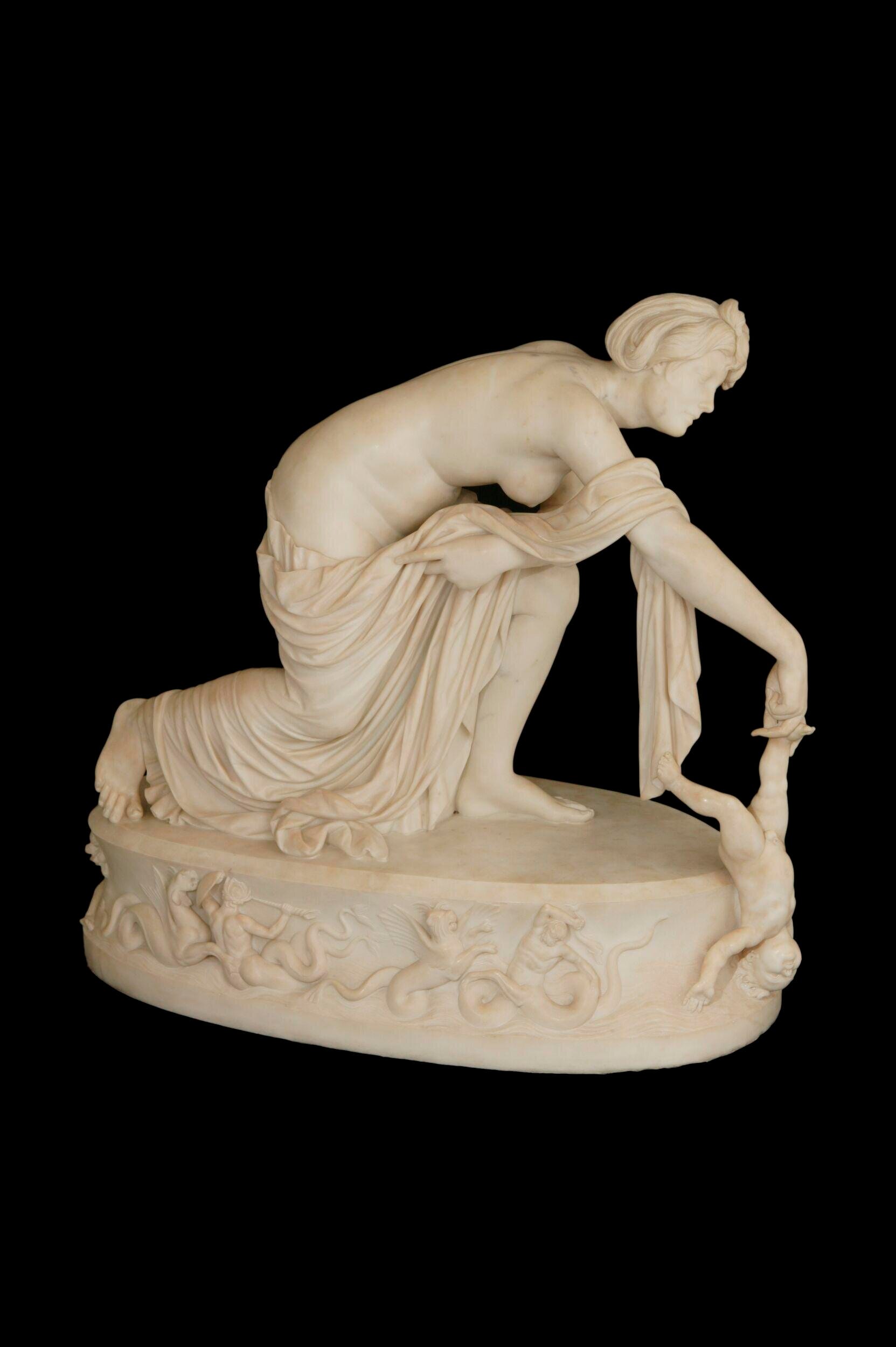
That one vulnerable spot is his undoing in the Trojan War; his ankle gets pierced by a poison arrow fired by Paris (as if you needed another reason to dislike the guy who kidnapped Helen and scuttled back to Troy like a selfish, idiotic crab).

Phil from Disney’s Hercules sums it up perfectly, Achilles had it all going on but his one weak spot is what killed him. So the phrase Achilles’ Heel is widely used when describing a single, often hidden weakness that undermines the strength of an otherwise formidable person, group, organisation etc.
I’m aware this one doesn’t immediately give niche mythological reference but it is! Roll the damn clip:
This is a reference to the gruesome death of Julius Caesar, but it actually comes from Shakespeare’s play by the same name. A creepy soothsayer warns JC, saying “beware the Ides of March,” ides being a Roman term used to describe the day that falls roughly in the middle of each month (Caesar was assassinated on March 15th). Nowadays it’s used to warn against impending betrayal, particularly a betrayal that could’ve been avoided.
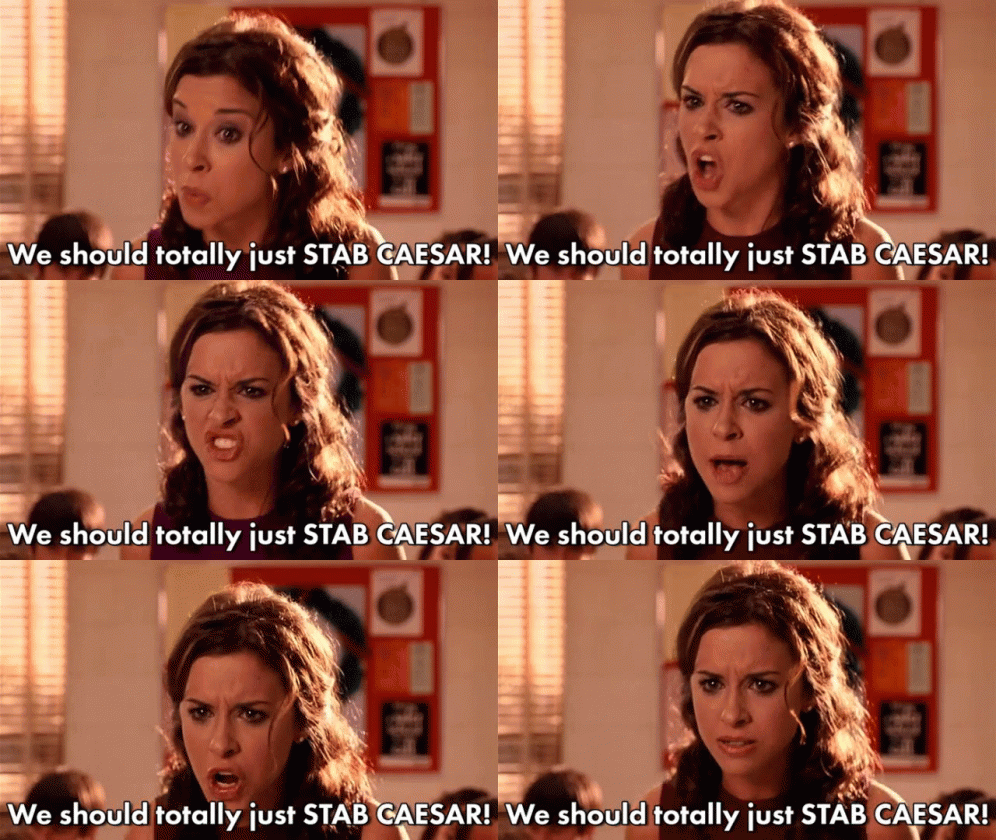
Regina should’ve seen this coming.
Okay this is one of my faves and it actually comes up a lot. The latin phrase panem et circenses can be traced back to Juvenal’s 10th Satire, composed about 2000 years ago. He writes:
“[T]he people who once upon a time bestowed military commands, high civil offices, legions, and everything else, now restrains itself, and instead, eagerly hopes for just two things: bread and circuses.” (10.77-81).
Juvenal is referring to the monthly free grain allowance given to Roman citizens as well as the gladiator games and chariot races but it’s not exactly a stretch to come up with a modern equivalent (or twelve). It’s a great phrase used to describe how the ruling class would keep the rest of the population docile and politically disengaged, eroding the notion of civic duty by providing distraction and superficial appeasement.
This one is a bit less bleak. It’s actually kind of sexy. And not only because it’s to do with Julius Caesar.
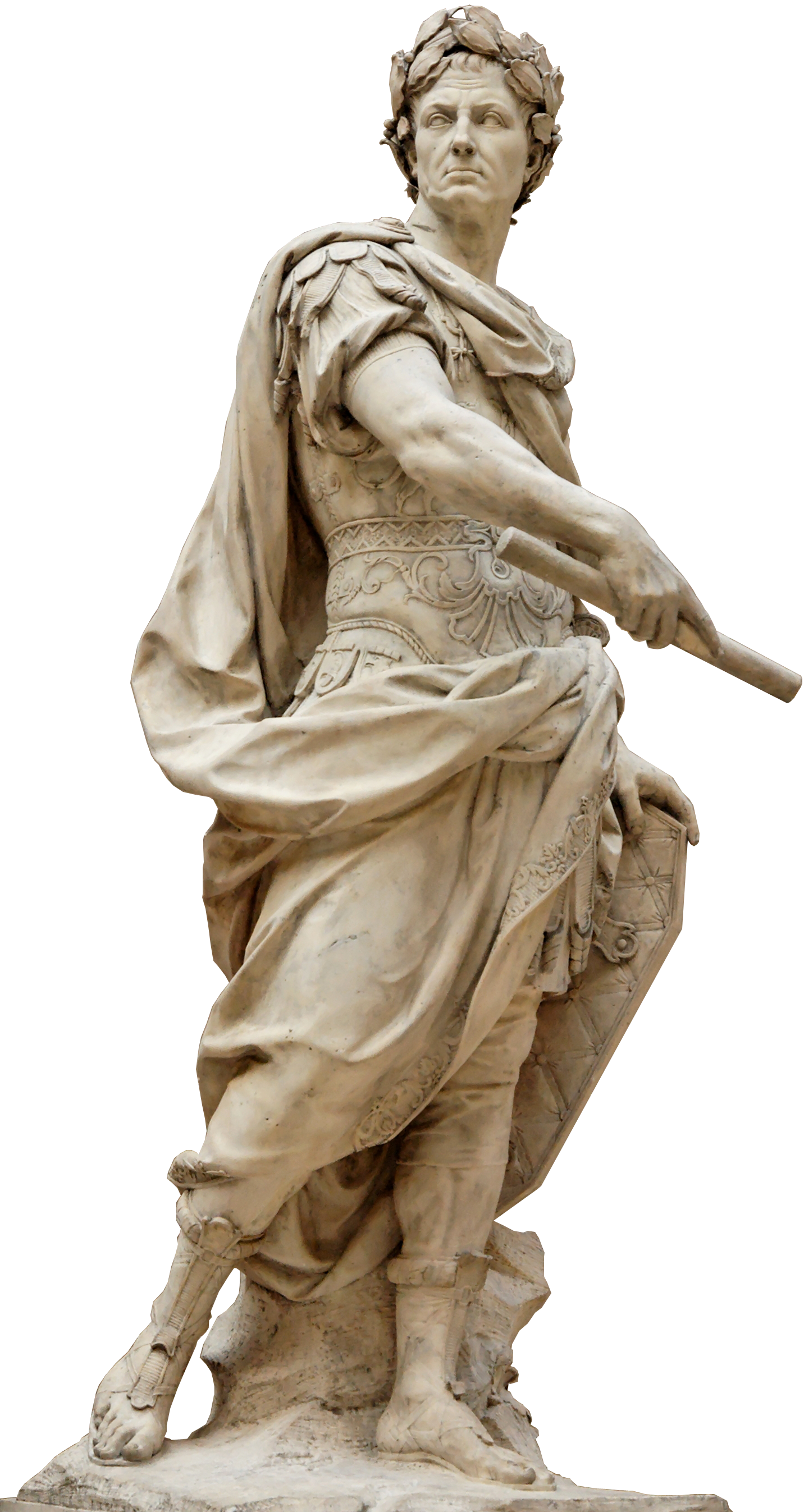
A formative problematic fave for many a young classics student.
The phrase ‘Crossing the Rubicon’ comes from a particular moment in 49 BCE where Julius Caesar crossed the river Rubicon, a decision which many argue precipitated the civil war that brought down the Roman Republic. A bunch of ancient sources describe this moment, with varying degrees of embellishment, but even the most restrained versions recount how Caesar paused at the river, considering the consequences of his next choice, before uttering the famous phrase ‘The die is cast’ (Alea iacta est in latin), and forging on. It essentially means to go past the point of no return, often with dire consequences.
While we’re on the topic of dire consequences, let me sneak in one final Caesar-based entry (we’ll be back in the land of Greek mythology shortly). Again this comes to us from Shakespeare as opposed to the Roman sources, it’s the line said by JC as he’s bleeding out when he spots Brutus, his friend and ally. Et tu, Brute? meaning you too, Brutus? Suetonius gives us another version where his final words are Kai su, teknon? (You too, my son? in Greek). A cursory google reveals this is all still HOTLY debated (people really give a shit about Rome) but the details are not why we’re here, we are here to ARM you with nerdiness in order to enrich your holiday binge watching. Echoes of this particular moment can be found all over the place but it’s hard to go past this:
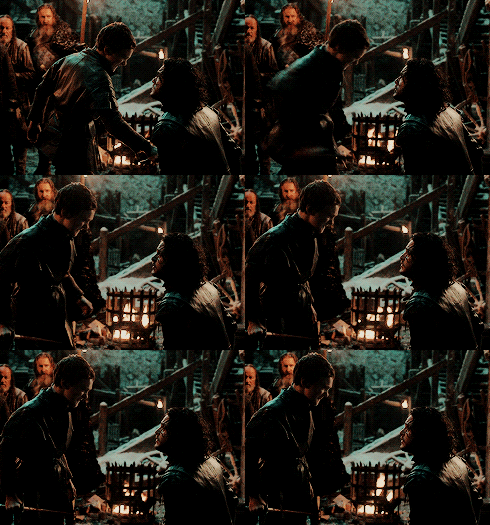
Jon Snow literally looks up and says “Olly” right before the kid stabs him. I know his parents were killed by wildings and all that but come on.
Et tu, Brute? or just referring to someone as Brutus can be a fun substitute for the perhaps more Christmassy option of calling someone Judas.
You could, for example, work this in if your cousin eats the last bit of turkey you’d had your eye on.
Scandal mention!!!!

It is a true blessing to find a reason to discuss Olivia Pope and Greek mythology in the same sentence. A Christmas miracle. The Face that Launched a Thousand Ships is a phrase that refers to the one and only Helen of Troy (technically Helen of Sparta but every time someone corrects this it reminds me of people that change Hercules to Herakles, like technically you are correct and if you’re writing within an academic context go for it but otherwise what is the POINT of your fussiness. Unless it’s to make other people feel dumb which brings us back to the point of this newsletter 🧐🧐🧐🧐).
Helen of Troy, whether she eloped or was abducted by Paris, is credited with starting the Trojan War, a conflict which involved a fleet of 1000 Greek ships (technically 1,186 according to the infamous/heavily-memed catalogue of ships in Homer).
I think I’ve touched on this in another newsletter but the famous line actually comes from a tragic play written in 1604 by Christopher Marlowe:
“Was this the face that launched a thousand ships / And burnt the topless towers of Ilium?”
I feel like there’s at least a dozen gods and mortals that I’d point the blame stick at before Helen but that’s neither here nor there.
Another excellent phrase that I actually covered back in April:
If you can’t be bothered to read that, here’s the TLDR from April me:
“Fiddling while Rome burns essentially means doing fuck all while something disastrous is going down. Actually, slightly worse than doing fuck all, the phrase really describes when leaders focus on distractions (or distracting the people) when there are far more urgent matters that need to be dealt with.”
This is actually quite a sad one BUT it comes up a lot so we do have to cover it. I’m not sure how familiar you are with the story of the Minotaur, Theseus, Ariadne and the whole labyrinth situation but this phrase references a rather grim subplot. King Minos not only offends Poseidon to the point where the god makes his wife Pasiphae mad with lust for a bull (sorry but we really do just need to breeze past that), Minos also keeps the renowned architect and craftsman Daedalus on retainer. And by on retainer I mean as his prisoner. He’s essentially a hostage. And if that wasn’t bad enough, he’s the poor fucker who got tasked with making a cow suit, complete with strategically placed glory hole, so Paisphae could get her bovine rocks off, later giving birth to the Minotaur as a result. To make matters somehow worse, Daedalus also had a young son Icarus stuck in this prison with him. After Theseus slays the Minotaur and escapes the labyrinth Minos is so paranoid he freaks out and flings them both into a tall tower with no way out. Daedalus crafts two sets of wings, held together with wax, to facilitate their escape. He warns his son not to fly too close to the ocean or the sea spray will mess with the wings and not too close to the sun either as the heat will melt the wax. Young Icarus, however, drinking in his first taste of true freedom with the sun on his face, ignores his fathers warnings, flying closer and closer to the sun until the wax melts and he falls to his death.
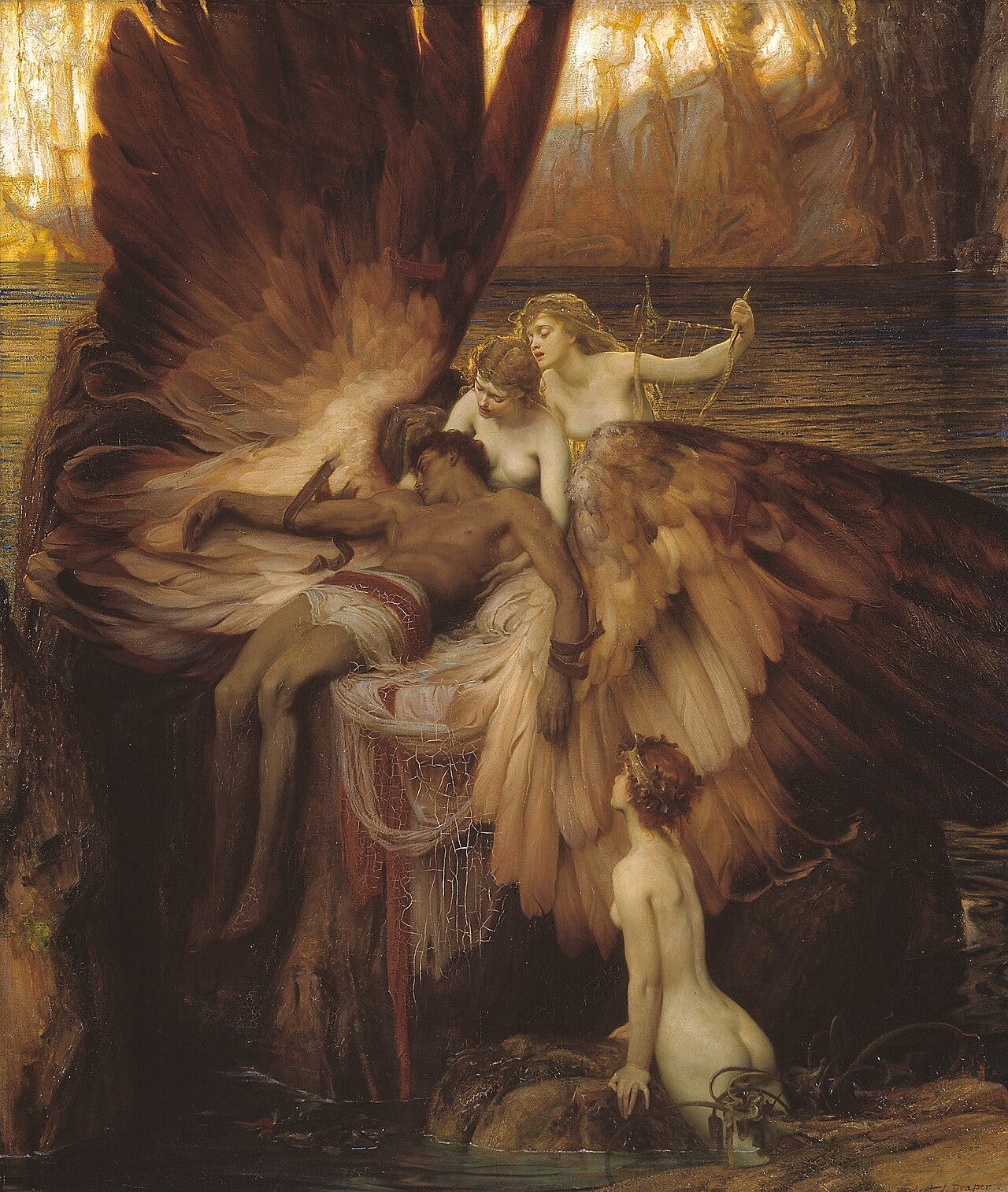
Horrible, tragic stuff that gives us the idiom of flying too close to the sun, i.e. overreaching and/or ignoring warnings at your own peril.
Let’s lighten things up a bit. Enter Alexander the Great. And a really famous knot. Alexander was marching through Anatolia (modern day Turkey) in 333 BCE when he reached Gordium, an ancient capital city that had held onto a chariot belonging to the ancient founder, Gordius. According to tradition, the chariot was yoked to the pole with an intricate, sturdy knot that could only be untied by the future conqueror of Asia. Alexander heard the story, took one look at the knot, whipped out his sword and sliced it in half.
Now I do not CARE if this is 100% historically accurate, it is a sensational story which provides us with the phrase “cutting the Gordian knot,” i.e. a bold solution to a complicated, convoluted problem 🗡️
This one brings us back to Icarus and honestly a whole plethora of other mythological characters but I first came across this word in the magical world of Rick Riordan’s Percy Jackson series. Every modern-day demigod had a fatal flaw (Percy’s was excessive loyalty 🥺) but the classic one really is hubris (ὕβρις in ancient Greek), meaning arrogance or excessive pride. This trait got mortals in a lot of trouble over and over again (I actually am having to stop myself from listing examples because this newsletter is already quite long and we’re only at H).

In this episode of Gilmore Girls, Rory drops in the phrase “the height of hubris” when she’s debating a character played by Leslie Odom Jr. aka “pompous Princeton guy.” Say what you will about Rory Gilmore (and there is a LOT to say), she won me back a bit here.
Another classic, the multi-headed monster defeated by Hercules who had a super fun trick where every time you chopped off its head, two would grow back in its place.
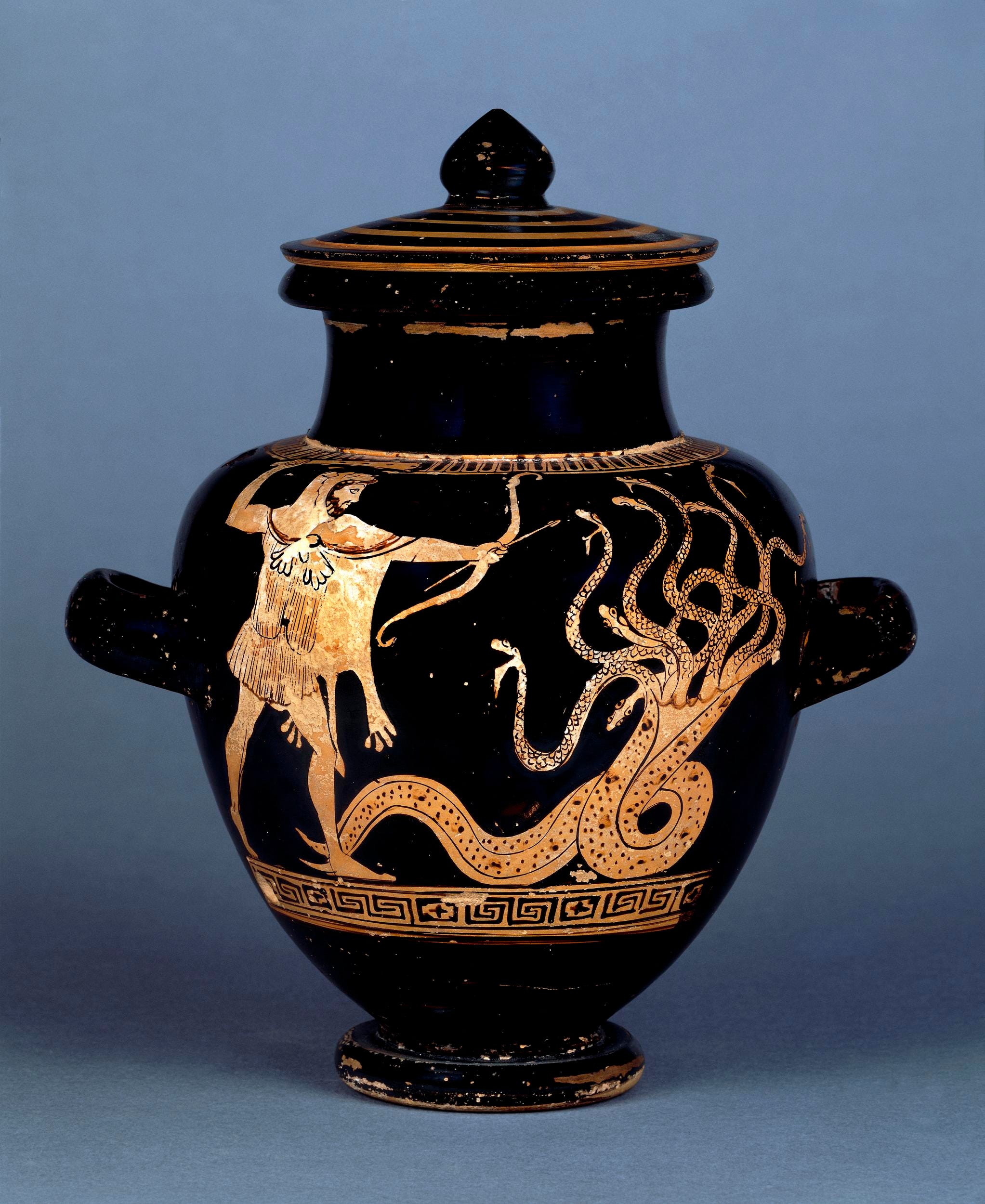
Describing something as a hydra or hydra-headed can be used when it’s a problem or issue that multiplies when confronted directly. Nowadays it’s used to describe everything from extremist organisations to illegal streaming websites.
Firstly it was a jar. I know, I know, my whole thing is don’t be a lemon about the details but I feel like I need to arm you with the specifics when it comes to this one. Pandora, the first mortal woman, was responsible for all the evils in the world (classic 🍎🐍). According to Hesiod’s Theogony she was sent by Zeus as a countermeasure after Prometheus gave mortals the gift of fire. She ended up opening her pesky jar, releasing all manner of evil into the world, while hope remained inside. Her jar became a box in the 16th century when a Renaissance humanist by the name of Erasmus mistranslated the word for pithos (πίθος) into pyxis (πυξίς). An understandable mistake that continues to grind the gears of modern classicists to this day. Whether you go with box or jar, the phrase essentially means an action that leads to an avalanche of unforeseen and disastrous consequences.
This refers to a particular part of Homer’s Odyssey where Odysseus and his men sail by the Sirens, glorious man-eating bird-women that lure sailors to death with their song. If you’re after a deep dive into artistic representations of these creatures, April-me sorted you out:
But for our purposes, a siren song is anything alluring that will lead to disaster or destruction. E.g. the siren song of 4 breakfast mimosas when you still have to sit through Christmas lunch with your extended family.
This is an incredible descriptor and it feels delicious as you say it. Seriously. Say it.
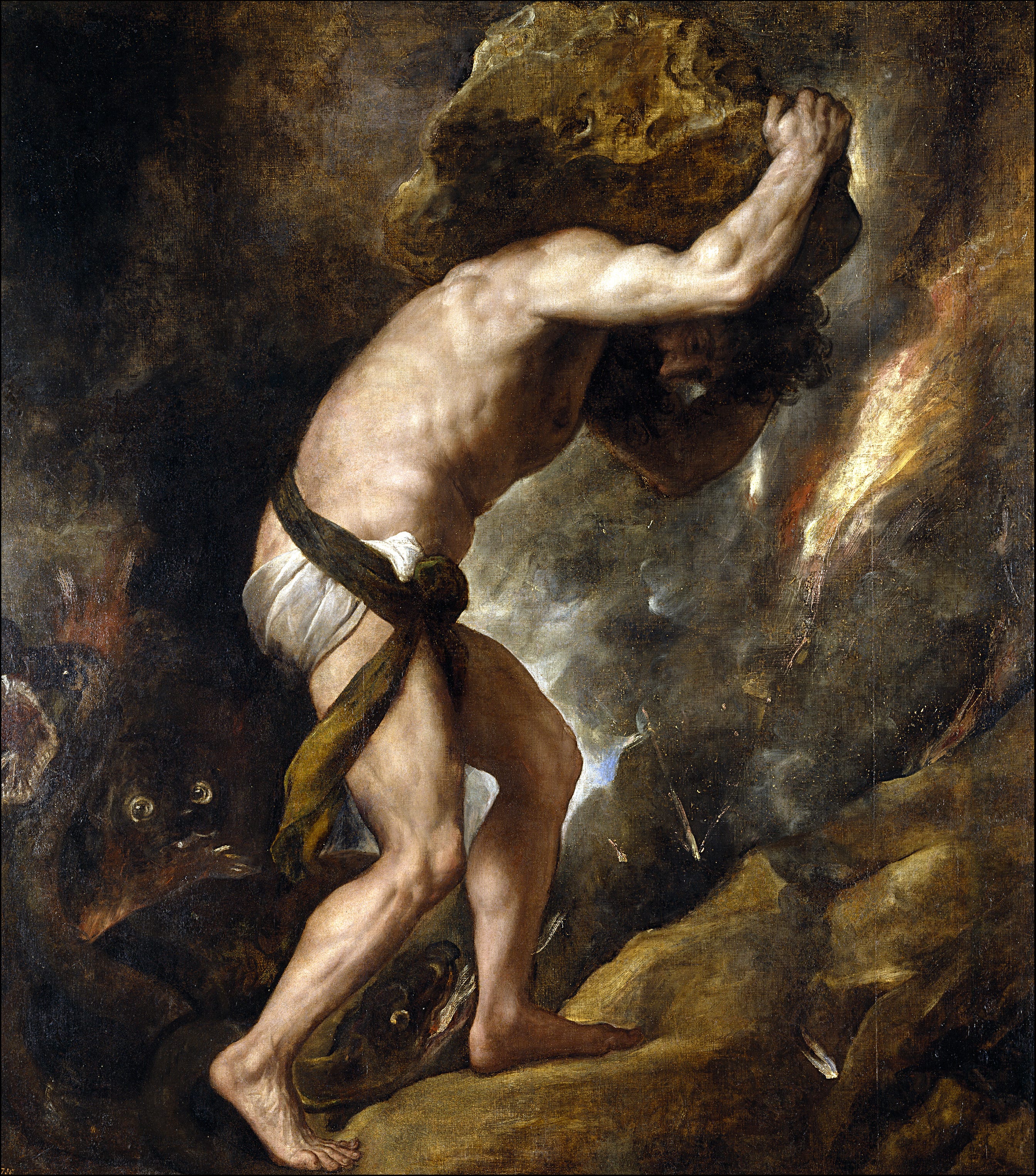
This particular adjective comes from the myth of Sisyphus and his pet rock (pictured above). Sisyphus was a rather slippery fellow, he “cheated death” a bunch of times which would piss off the gods on a normal day but he didn’t cheat death like that weird guy who’s doing too many ice baths, he actually, literally chained up Thanatos, the god of death. When he finally made his way to the Underworld, the gods designed a particularly devastating punishment, forcing him to carry or roll a boulder up a steep hill over and over and over again (the boulder was magically enchanted to slip out of reach and roll back down every time he got to the top). Whether this punishment was just a divine screw-you or some deeper message about the inevitability or relentlessness of death, describing something as Sisyphean nowadays means it is a task that is both laborious and, ultimately, futile.
Okay this one is niche. Or maybe it’s not. I honestly don’t know but what I do know is that my dear friend Nat dropped this reference in with a knowing smile and I chuckled along with her but the chuckle was a LIE (we were watching Shrek 2 on her sofa and I had to google it on my way home).
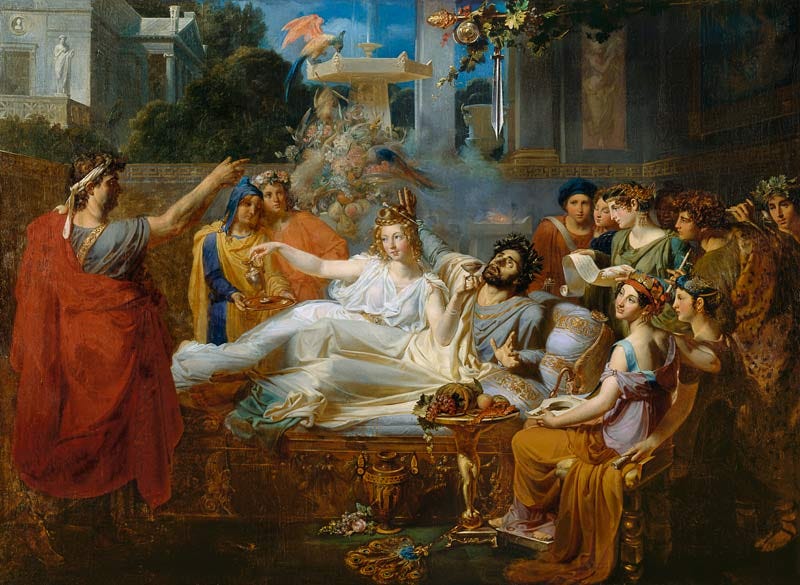
The sword of Damocles comes from an ancient Greek tale where the main character Damocles is gushing all over king Dionysius I, who, for whatever reason, offers to trade places with his subject for the night. Damocles has an absolute whale of a time—getting grapes popped directly into his mouth and all that—but the king, who had a bunch of enemies, arranged for a sword to hang over Damocles’ head for the duration of the evening, suspended by a single horse hair to convey just how dangerous it was to be king and how constant vigilance was required. I’m not sure exactly how long he lasted but Damocles ended up begging Dionysius to reverse Freaky-Friday the pair of them. The phrase now refers to the constant threat faced by those in positions of power (uneasy is the head that wears the crown 👑).
Now this is more of a motif found WITHIN a myth rather than a specific, contained phrase or adjective but the whole idea of a look-back having disastrous and/or deadly consequences can be found in sources that range from the bible to Apple TV’s Severance. (I wrote a whole thing about Greek mythology 🤝 Severance but I feel like I’ve already linked too many articles within the main body so I’ll whack it at the end if you’re curious). The super, somewhat irresponsibly abridged version of the myth is as follows:
Orpheus’ wife, Eurydice, dies tragically of a snakebite.
Orpheus is beside himself with grief so travels to the Underworld to get her back.
Orpheus somehow manages to convince Hades and Persephone to release Eurydice, with one simple caveat. He can walk out of the Underworld, with her right behind him, but under no circumstances can he look back to check that she’s really there.
Surprise surprise, he looks back, and sees the love of his life getting dragged back to the Underworld.
Stepping away from TV and film, here’s a palate cleanser in the form of Hozier lyrics:
I’d be the voice that urged Orpheus
When her body was found
I’d be the choiceless hope in grief
That drove him underground
I’d be the dreadful need in the devotee
That made him turn around
And I’d be the immediate forgiveness in Eurydice
Imagine being loved by me— First verse of Talk by Hozier
This one makes me angry but it is important. Also I just googled my substack + pygmalion and it turns out I’ve already screeched about this back in 2022 so I’m going to shamelessly self-plagiarise (and link the full thing at the end).
“You’ve heard of Build-A-Bear, but can I interest you in Build-A-Bitch? I hate it here.” — me, 3 years ago
The lean TLDR is the sculptor Pygmalion falls in love with his creation (in large part because she’s pure/unsullied unlike the actual women Pygmalion is around), he prays to Aphrodite to bring her to life and the goddess obliges and they live happily after. Our modern version is the “Pygmalion effect,” which is the psychological phenomenon where high expectations can lead to higher performance. I’m not sure it fully maps onto the ancient myth but I think you can definitely find some instances where you can rebuke someone by telling them they’re not bloody Pygmalion and you’re not a lump of marble.
And, finally, let’s wrap up with another classic. This phrase refers to a key moment in the saga of the Trojan War (but it’s not actually mentioned in the Iliad and only briefly in the Odyssey). The Greek soldiers are really at the end of their rope when Odysseus has the bright idea of tricking the Trojans. The Greeks bail, sailing away with their tails between their legs, and leave the Trojans a beautiful gift, a gigantic wooden horse. Again, this moment could be the subject of a newsletter in and of itself but the key part is the Trojans receive this gift, bring it inside the city and start celebrating, not realising that a bunch of Greek soldiers are inside said gigantic horse, waiting until everyone’s wasted to STRIKE. Describing something as a Trojan Horse therefore refers to a deceptive gift or betrayal disguised as goodwill.
That’s a wrap folks! Full stockings, good tidings, to all a good night etc. In all seriousness thank you so much for reading ❣️ I hope you enjoy an excessive amount of ham this holiday season (or some sort of ham-equivalent if you’re not a pork person).
I am rather curious, do you use any of these in your day-to-day life? Also did I miss a super obvious one?
xxx
Bonus bits :)
I’ve saved an Icarus meme and some life-affirming lines by Albert Camus for the three of you that will make it this far.


Ooh and here’s the Severance newsletter:
And the Pygmalion one from the archives:
References
Aldrete, Gregory S. “”Bread and Circuses”: Ancient Rome, Modern Science Fiction, and the Art of Political Distraction.” Film & History: An Interdisciplinary Journal 51, no. 2 (2021): 4-20.
Rondholz, Anke. “Crossing the Rubicon. A Historiographical Study.” Mnemosyne 62, no. 3 (2009): 432–50.
Comments
Nothing yet. Say the first thing.
Sign in to join the conversation.