
Some stories can’t be told with existing technology — until now. And when “now” arrives, it doesn’t arrive quietly.
I have spent more than thirty years inside Hollywood productions — on the set, in the edit suite, in the board rooms where budgets die and visions are negotiated down to something less than what anyone originally dreamed. I have watched directors compromise. I have been the person delivering the news that a sequence is not physically or financially achievable. I have seen the quiet grief on a creator’s face when reality forecloses the story they came here to tell.
That world is ending. Not slowly. Not in some comfortable, manageable way. It is ending the way technological revolutions always end the old order — faster than institutions can adapt, faster than careers can pivot, and with a thoroughness that will make the pre-transition era feel as distant as silent film.
What I want to do in this piece is something more ambitious than a technology briefing. I want to place this moment in its proper historical context, examine what is genuinely new about what is happening right now, and speculate — honestly and without false comfort — about where this leads. The industry is moving faster than its own self-understanding. That gap between capability and comprehension is, historically, where the most consequential mistakes are made.
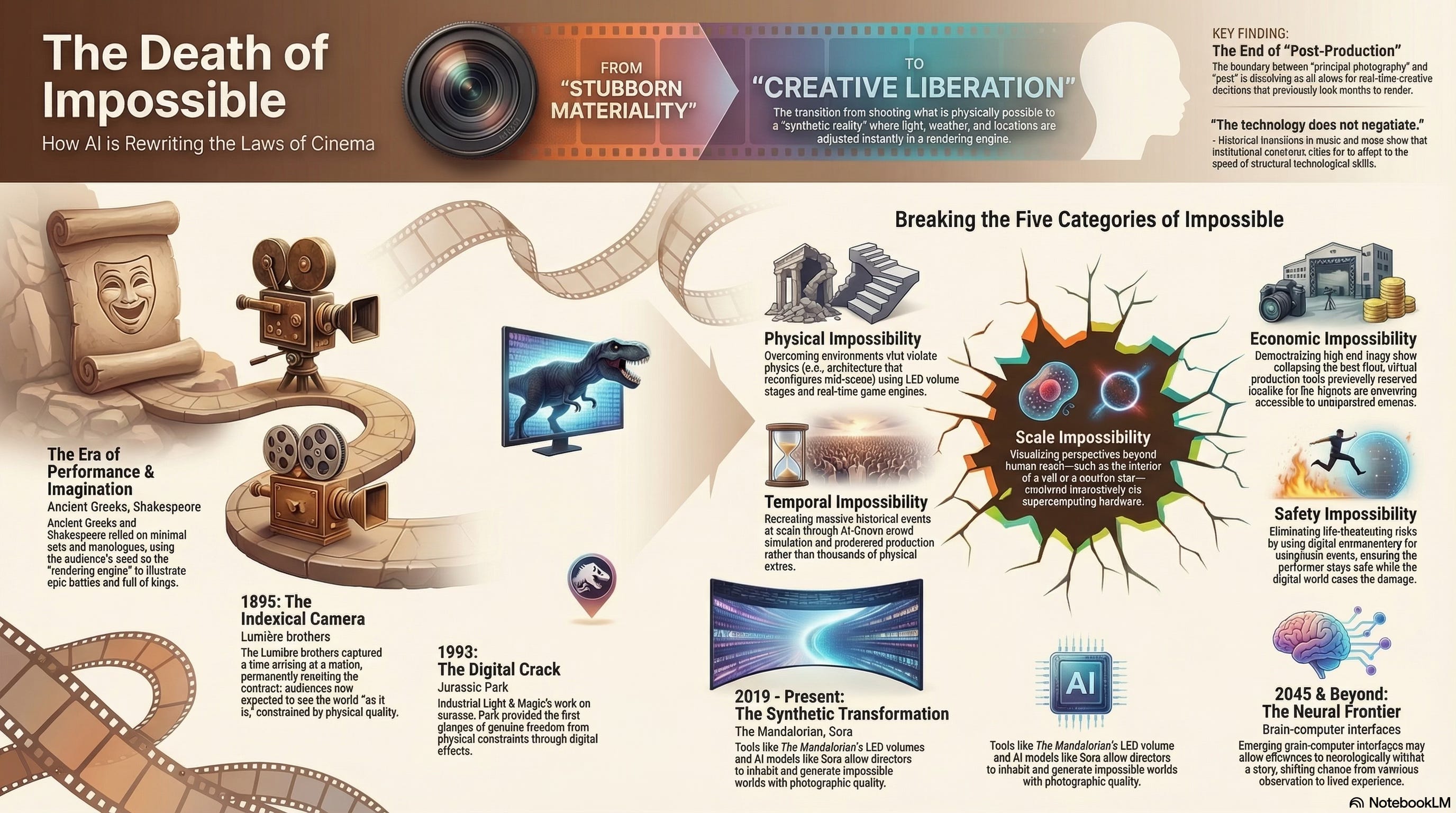
For most of human history, storytelling was cheap and performance was everything. The ancient Greeks staged the fall of Troy with twelve actors, a chorus, and masks. Shakespeare gave you the entire Agincourt battlefield with five men and a monologue about imagination doing the work. The limitations were not failures of ambition — they were features. The gap between what the words described and what the audience could see was filled by the most sophisticated rendering engine ever built: the human mind.
Cinema changed this bargain permanently. The moment the Lumière brothers pointed a camera at a train arriving at a station and women in the front row flinched, the contract was rewritten. Now the audience expected the world on screen to be the world. Not suggested. Not implied. Shown.
This was both cinema’s greatest gift and its most punishing constraint. For a century, the physics of what you could put in front of a camera governed the stories you could tell. You needed the location, the weather, the bodies, the explosion, the creature — actually, physically, expensively present. Even the most technically sophisticated workarounds — matte paintings, miniatures, practical effects, optical printing — were fundamentally exercises in deception that required extraordinary craft to sell, limited applicability, and enormous cost.
The digital revolution of the 1990s cracked this constraint open. Industrial Light & Magic’s work on Jurassic Park in 1993 is the moment that most industry veterans cite as the first glimpse of genuine freedom. But even digital effects remained, for two more decades, a post-production luxury affordable only at the top of the budget pyramid. The impossible was technically achievable but economically stratospheric. Most stories were still compromised by what could be shot.
Then, between roughly 2015 and 2024, something qualitatively different began to happen. The tools democratized. The costs collapsed. And artificial intelligence entered the pipeline — not as a gimmick, but as an architectural transformation.
We are now living in the first moments of a world where the gap between imagination and realization is not being reduced. It is being eliminated.
Before we can understand what technology is solving, we need to be precise about what made content “impossible” in the first place. There are five distinct categories, and they are not all solved by the same tools.
Environments, objects, or events that violate the laws of physics. Rooms larger than the buildings that contain them. Architecture that reconfigures mid-scene. Gravity that bends the wrong direction. For most of film history, these were the domain of drawn animation — the only medium that could make physics optional. Digital rendering and real-time game engines have now extended this freedom to live-action contexts. LED volume stages — The Volume on The Mandalorian being the most visible example — allow performers to physically inhabit impossible worlds rendered at photographic quality in real time.
Stories requiring access to past or future time periods. Historical recreation used to mean massive set construction, period-accurate wardrobe for hundreds of extras, and an inherent approximation. The Battle of Gettysburg on screen was always a suggestion of Gettysburg, constrained by budget, location availability, and the impossibility of actually recreating 160,000 men on a Pennsylvania ridgeline. Today’s procedural generation and AI-driven crowd simulation can populate historical scenes at scales that were previously economically impossible. And the direction of travel here is remarkable: we are approaching the point where archival footage of historical events can be seamlessly extended, colorized, upscaled, and integrated into new narrative contexts.
Perspectives or scales beyond human experience. The view from the surface of a neutron star. The interior of a living cell. A planet consumed by its star. These stories require the audience to occupy a viewpoint that no human being has ever occupied and no camera can ever reach. Real-time rendering engines running on hardware that would have been classified as a supercomputer fifteen years ago now render these environments interactively, allowing directors to explore impossible spaces with the same freedom they would have on a physical set.
Stories requiring resources that exceed practical budget limitations. This is the category that has constrained the most human stories — not because the imagery was technically impossible, but because only studios with nine-figure budgets could afford it. The democratization argument here is real at the margins: virtual production tools that cost tens of millions of dollars to deploy on a major studio production five years ago are now accessible to a broader range of productions. The direction of travel — toward lower cost floors for complex imagery — is clear, even if the popular claim that independent filmmakers now have full parity with studio productions overstates where the technology actually is today.
Content requiring dangerous or life-threatening scenarios. Practical stunts still kill and injure people. The more dangerous the content — the crash at 120 miles per hour, the collapse of a burning building, the military engagement — the more the safety risk inflates the cost and limits the creative options. Virtual production eliminates these risks entirely. The stunt performer stays safe; the digital environment takes the damage.
Here is where I want to slow down and be specific, because the discourse around AI in film production tends toward two equally unhelpful extremes: breathless utopian proclamations, and defensive dismissal from workers protecting their livelihoods. Both are emotional responses. Neither is useful for understanding what is actually happening.
What is actually happening is a stack of separate AI capabilities that are individually significant and collectively transformative. Let me walk through each layer.
OpenAI’s Sora, Runway’s Gen-3, Pika, Kling, and a dozen competing systems represent the first generation of tools that can produce broadcast-quality video from text or image prompts. As of early 2025, the outputs are detectable as synthetic by trained observers under close examination — temporal consistency, complex physics, and fine motor detail remain genuine technical challenges, not simply problems of more training data. The timeline for when these systems become truly indistinguishable from photographed footage is genuinely uncertain, and anyone who gives you a confident year is speculating.
What is not uncertain is the direction. The cost floor for complex imagery is collapsing. A scene that currently requires a location, a crew of sixty, two days of principal photography, and substantial production costs can be generated synthetically and refined iteratively. This is not a marginal efficiency gain. It is a structural transformation of the production cost model — and the transformation is already underway, regardless of where exactly the quality threshold currently sits.
The director of photography does not disappear in this world — but the role transforms. The DP becomes a prompt architect, a quality supervisor, a technical director of synthetic imagery rather than a physical light capturer. Some roles face existential pressure. Others expand. The ratio is shifting faster than the industry’s organizational structures can absorb.
The performance capture work on the Planet of the Apes series, Avatar, and Gollum established that digital characters could carry dramatic weight. What has changed is the cost floor and the quality ceiling. De-aging technology has dropped from eight-figure post-production budgets to mid-five-figure costs in the span of five years. Fully AI-generated digital humans are approaching the point where they can carry leading performances in feature-length content.
The Screen Actors Guild strike of 2023 was, in retrospect, the first major institutional collision between the old regime of performer scarcity and the new regime of performer abundance. The agreements signed provide some protections. They are almost certainly holding actions rather than solutions — because the technology does not honor agreements signed in 2023 when it reaches capabilities in 2028 that were unimaginable when the ink dried. This is not an argument against the agreements. It is an argument for continuing to negotiate, vigilantly, with a clear understanding of what is actually coming.
The creative question this raises is genuinely unresolved: can a synthetic performance generate genuine emotional resonance in an audience at the level that has historically defined the art form? My honest read of what I have seen over the past eighteen months is that we are closer to that threshold than most industry veterans are comfortable acknowledging.
The least understood and most consequential AI capability in the production pipeline is not visual. It is narrative. Large language models are now capable of generating feature-quality dialogue, breaking story structure, analyzing pacing, identifying plot inconsistencies, and producing coverage reports that rival those produced by development executives. These tools are already embedded in the development process at most major studios — quietly, without public announcement, and often without full acknowledgment even internally.
The craft of writing remains irreducibly human in its highest expression. But the volume of writing that feeds the development pipeline — the treatments, the coverage, the pitch documents, the outline variations — can now be produced at machine speed. The ratio of human creative input to raw output is inverting. What this means for the staffing models that have defined the development executive track for forty years is a question the industry is not yet having honestly.
Adobe Premiere’s AI-assisted editing features, Descript’s transcript-based editing, and Blackmagic’s DaVinci Resolve neural engine represent the early deployments of AI in the post-production pipeline. The direction of travel is toward systems that can assemble a rough cut from dailies, suggest pacing adjustments based on emotional arc modeling, and generate music, sound design, and color grades from stylistic prompts.
These systems are today powerful assistants. The gap between “powerful assistant” and “primary system overseen by human supervisor” is closing, and the timeline is measured in years, not decades. The post-production pipeline of 2030 will be recognizable in outline but unrecognizable in staffing ratios.
The Mandalorian premiered in November 2019 and was, in production terms, a watershed moment disguised as a streaming television show. For the first time, a major production had replaced physical location shooting — for most of its exterior sequences — with real-time rendered environments displayed on a massive LED volume. The actors stood in a studio in Los Angeles. The environments around them were Tatooine, the frozen wastelands of some unnamed moon, the forests of a distant planet. And critically: the lighting was real. The reflections in the helmets were real. The interaction between the physical and the virtual was seamless.
This matters for a reason that most technology coverage misses. The LED volume did not just make impossible environments accessible. It changed the on-set creative dynamic in ways that are still reverberating through the industry. Directors can now change a location during a shooting day — not by moving the company to a different set, but by updating the environment in the rendering engine. Cinematographers can adjust the time of day, the weather, the atmospheric conditions in real time, in response to what they are seeing in the monitor, in collaboration with the actors and the director, without stopping production.
This is a creative liberation that veteran cinematographers describe in almost philosophical terms. The gap between “what if we tried this with a sunset instead of midday light” and actually seeing it has been eliminated. The creative conversation that used to happen in pre-production — constrained by the physical reality of what would be possible on the day — now happens on the day, in real time, with full photographic fidelity.
The next generation of this technology — light field capture, volumetric video, more sophisticated real-time rendering — will extend this further. We are moving toward production environments where the distinction between physical and digital space becomes a creative choice rather than a technical constraint. Directors will choose whether to shoot in physical space or virtual space based on what serves the story, not based on what is feasible.
The Mandalorian established that virtual production could replace the location. The Sphere in Las Vegas is establishing something more radical: that the venue itself can become the content. When U2 performed at the Sphere in 2023, they were not performing in front of a backdrop. They were performing inside a story — a 160,000-square-foot wraparound visual environment synchronized to the music, engineered to make the audience feel they were inside a collective hallucination. The production pipeline required to create that experience has more in common with a feature film than with a traditional concert. It required pre-visualization, asset creation, real-time rendering, and the coordination of creative disciplines that the live entertainment industry had never previously had to integrate.
This is not an isolated experiment. It is a proof of concept for a new category of experiential entertainment that sits at the intersection of live performance, cinema, theme park, and video game — and that the existing industry categories are entirely inadequate to describe. The Sphere format will proliferate. Versions of it will appear in arenas, in theme parks, in permanent installations, and eventually in formats we cannot fully anticipate. Each one will require a production apparatus that borrows from film, television, gaming, and live events simultaneously, and that cannot be staffed, scheduled, or budgeted using the frameworks native to any of those individual industries.
Transmedia storytelling — the practice of building narrative worlds that extend across film, television, gaming, social platforms, live experience, and physical merchandise simultaneously — represents a parallel evolution in the definition of what a production is. The Marvel Cinematic Universe is the most visible example, but the model is proliferating downward through the budget pyramid as the tools to build and maintain narrative worlds become more accessible. A transmedia production is not a film with ancillary products attached to it. It is a living narrative infrastructure that generates content continuously across multiple platforms, maintained by creative teams working in disciplines that have historically had almost no overlap.
What the Sphere and transmedia pipelines share is a challenge that the industry has not yet developed adequate frameworks to address: how do you produce something when the thing you are producing does not fit any existing category? How do you staff it, schedule it, budget it, and measure its success when the benchmarks were built for single-platform, fixed-duration, linear content? These are not rhetorical questions. They are the operational reality facing every studio, streamer, and live entertainment company that is trying to compete in the emerging attention economy — and the industry is currently solving them through improvisation rather than methodology.
This is where I want to engage in the kind of speculative thinking that the industry generally avoids, because speculation makes executives uncomfortable and makes labor negotiators nervous. I am going to do it anyway, because the future is arriving whether we speculate about it or not, and the industry that thinks clearly about where this leads will have an advantage over the industry that refuses to look.
I want to be clear about what I am doing here. The following is not prediction in the strict sense. It is structured speculation — an attempt to follow the directional logic of current technological trajectories and identify where they lead if they continue. Some of these trajectories will be disrupted by factors I cannot anticipate. All of them are worth thinking about seriously.
Generative video will be indistinguishable from photographed footage for the vast majority of commercial content. The category of “visual effects” will cease to be meaningful as a separate budget line — everything will be composited, everything will be enhanced, and the boundary between “principal photography” and “post” will dissolve.
Development department will be restructured for today not the 100 year old way
AI-generated synthetic performers will appear in leading roles in major studio features. This will not initially be disclosed in the marketing materials. The first time a film wins a major acting award for a performance that was substantially synthetic, it will trigger a cultural reckoning about authenticity, authorship, and what exactly we are rewarding when we reward a performance. That reckoning is worth beginning now, before the moment of crisis forces it.
The physical crew size on a typical feature film will decline meaningfully. The work will not disappear — it will transform. But the ratio of creative supervisors to production workers will shift substantially from what it was in 2020. The displacement will be uneven: the most skilled technical roles will be amplified by AI tools, while the volume of mid-tier execution roles will contract. This is not a comfortable prediction, but it is the honest one.
Interactive and adaptive narrative will emerge as a genuine commercial medium. The failure of early experiments like Netflix’s Bandersnatch was a UX failure, not a concept failure. When AI can maintain narrative coherence across thousands of branching pathways — adapting dialogue, pacing, and character behavior to individual viewer choices in real time — the experience will be compelling enough to generate genuine audience engagement. The storytelling grammar for this medium does not yet exist. The writers who develop it will define an art form.
Beyond ten years, confidence intervals widen dramatically. But the directional logic remains worth following.
Neural interface technology — direct brain-computer connections of the kind that multiple companies are now developing — will begin to change the model of passive viewing in ways that are difficult to fully anticipate. The audience member will not merely watch a story. They will, in some meaningful sense, inhabit it. The distinction between author and audience will blur in ways that will require entirely new frameworks to understand — legal frameworks, creative frameworks, psychological frameworks.
Harari wrote that the most dangerous word in twenty-first century technology is “upgrade.” He meant it in the context of human biological enhancement, but the word applies with equal force to cinematic experience. When the audience can be neurologically immersed in a story — when the fear, the joy, the grief of a fictional character can be delivered not as vicarious emotional response but as something closer to lived experience — we will have crossed a threshold that changes the fundamental relationship between storytelling and its audience. Whether that change is emancipatory or exploitative will depend almost entirely on choices made by the people building the infrastructure now.
I have sat in enough industry panels, development meetings, and technology briefings over the past five years to know the shape of the institutional response to this transformation. It follows a pattern that historians of technological disruption will recognize immediately: early denial, followed by grudging acknowledgment, followed by an attempt to contain and control the new technology within the structures of the old regime, followed by the discovery that the old regime’s structures are incompatible with what the technology actually does.
The guild negotiations of 2023 produced agreements that provided meaningful protections for writers and actors against unauthorized AI replication. They were hard-won and important. They were also, almost certainly, holding actions — not solutions. The technology does not negotiate. It does not honor agreements signed in 2023 when it reaches capabilities in 2028 that were unimaginable when the ink dried.
The deeper error — the one I see made consistently by even the most sophisticated industry executives — is the assumption that the transformation will be linear and visible. The assumption is that there will be a clear moment when AI transitions from “a useful tool” to “a structural disruption,” and that this transition will announce itself in a form that allows institutional adaptation.
Transformations do not work this way. They work through accumulation of small changes, each of which seems individually manageable, until the accumulated weight of all of them together crosses a threshold that produces a phase transition — a qualitative change in what the industry is, not just how it operates. The music industry did not understand what was happening to it in 1999. The newspaper industry did not understand what was happening to it in 2004. The taxi industry did not understand what was happening to it in 2011. In each case, the technology announced itself years before the institutional collapse — and in each case, the institutional response was to manage the symptoms rather than reckon with the structural change.
There is also an error of omission that I find particularly costly: the industry’s failure to build the measurement infrastructure that would allow it to understand its own transformation quantitatively. You cannot manage a transition you cannot measure. You cannot make rational resource allocation decisions in an environment that is changing faster than your intuition can track, if you have no systematic data on what is actually changing and at what rate.
The most telling specific example of this is not a creative failure but an operational one. Every production generates thousands of data points daily — call sheets, production reports, cost reports, scheduling data — that are compiled into PDFs, archived, and never analyzed. The industry spends enormous sums collecting data about its own operations and then treats that data as compliance waste rather than intelligence. OCR and machine learning have now removed every technical barrier to extracting meaning from that archive. The patterns that predict schedule slippage, correlate with cost overruns, and reveal where coordination failures are consuming shooting time are sitting in files at every major studio and streaming platform, unread. What remains is a purely cultural barrier: the industry has never learned to think of its own operational history as an asset. Until it does, it will continue managing its most consequential transition by instinct alone.
I want to spend a moment here on something that is sometimes crowded out of the technology discourse by the weight of capability claims: what human beings actually bring to storytelling that no AI system, in any foreseeable timeframe, replicates.
It is not craft. Craft — the technical execution of narrative, visual, and performance elements — is precisely what AI excels at and what it will continue to develop. It is not even creativity in the narrow sense of generating novel combinations of existing elements. AI is already competent at this and will improve.
What AI does not have is stakes. It does not have a body that will die, a family that will grieve, a community whose conditions of life shaped its perception of the world. It does not have the experience of joy so intense it becomes unbearable, or loss so complete it redefines everything that came before. These are not poetic abstractions — they are the source material for every story that has ever made an audience feel something true.
The director who watched her father die at sixty-two and makes a film about mortality is bringing something to that work that no generative model trained on a corpus of prior films about mortality can replicate. The screenwriter who grew up in a community that does not appear in mainstream media and insists on telling its story accurately is performing an act of witness that has no synthetic equivalent. The performer who breaks open in a take and exposes something they did not know was in them until that moment — that is not a capability gap that more training data will close.
The AI revolution in filmmaking does not threaten human storytelling at its deepest level. It threatens the vast middle of the industry — the competent technical execution of formula content that has always been the industry’s commercial foundation. What it cannot touch is the work at the edges: the stories that only a particular human being could tell, the performances that come from somewhere that cannot be modeled, the creative decisions that are expressions of a specific consciousness engaging with a specific set of human experiences.
The industry’s task — which it has not yet begun to perform systematically — is to build structures that protect and amplify this irreplaceable human capacity while harnessing, rather than resisting, the technological capabilities that can handle everything else. The tension between these two imperatives is the central creative and institutional challenge of the next decade.
There is a line that has anchored my thinking throughout this piece: the observation that the only remaining limitation on storytelling is the scope of human imagination itself. It is both inspiring and, on reflection, deeply unsettling — in exactly equal measure.
Inspiring, because creative freedom has always been what the industry’s greatest practitioners wanted most. The directors and writers and performers I have worked with across three decades were not limited by lack of ambition. They were limited by physics, by budgets, by the stubborn materiality of the world. Removing those constraints is a genuine liberation.
But human imagination, liberated from the constraints of physical and economic reality, is not exclusively a force for beauty and meaning. It is also a force for manipulation. For the manufacture of false experience. For the exploitation of emotional response at a scale and precision that the industry’s most sophisticated practitioners are only beginning to reckon with.
Consider what is actually being built. We are constructing tools that can generate infinitely convincing synthetic representations of reality — of people, of events, of emotional experiences — at declining cost and increasing fidelity. The deepfake, which has already demonstrated its capacity to destabilize individual reputations, democratic processes, and personal relationships, is the primitive early version of these tools. The mature version will be indistinguishable from recorded reality by any means currently available to ordinary people.
Cinema has been able to sidestep a fundamental philosophical question for its entire existence: the question of what it means to believe what you see on a screen. We were able to sidestep it because the camera was, at its origin, an indexical instrument — a device that recorded photons that had actually bounced off physical objects in the real world. Even the most spectacular visual effects were built on a foundation of photographed reality. The audience’s trust in the moving image rested, ultimately, on this indexical foundation.
That foundation is being removed. Not gradually. Not with adequate warning. The industry is dismantling the epistemological basis of its own authority — the claim that what you see in a film bears some relationship to what actually exists or occurred — in pursuit of creative freedom and cost efficiency, without having thought seriously about what the world looks like when that authority is gone.
Harari warns us, across his work, about the gap between human capability and human wisdom. We are extraordinarily good at building new powers and extraordinarily bad at building the ethical and institutional frameworks that would allow us to use those powers wisely. The history of technological disruption is largely a history of capabilities outrunning wisdom — of the atom split before the implications of nuclear weapons were understood, of social media deployed before anyone had thought seriously about what it would do to democratic discourse.
The AI revolution in filmmaking is not exempt from this pattern. The capability to create infinitely convincing synthetic realities is arriving before we have built the frameworks — creative, regulatory, ethical, economic — to manage what it means. The philosophical question of authenticity in representation, which philosophers have debated abstractly for centuries, is about to become an urgent practical question with enormous consequences for how human beings understand the world they live in.
What happens to a society’s shared sense of reality when its most powerful emotional experiences are synthetic? What happens to empathy when it can be manufactured at will and delivered on demand? What happens to historical memory when the past can be reconstructed, corrected, improved? These are not science fiction questions. They are production questions. They are arriving on the timeline of product roadmaps, not philosophy seminars.
I have been in this industry long enough to know that the response to disruption is usually either panic or denial, and that neither is useful. What is useful is clarity — about what is actually changing, about how fast, about what it means for the craft and the business and the culture. Clarity requires the willingness to look at the transformation directly, without the protective filters of institutional interest or professional identity.
The impossible is dying. The imagination gap is closing. The tools to tell every story that has ever been constrained by the laws of physics, the limits of budget, or the danger of physical execution are arriving with a speed that the industry’s institutional culture is not equipped to absorb. The question is not whether to engage with this transformation. The question is whether to engage with it intelligently — with clear eyes about what is being gained and what is being lost — or to experience it as a series of shocks, each one managed by instinct, each one arrived at without adequate warning, each one leaving the industry slightly less prepared for the next.
The most important stories have always been impossible stories — tales that transcend the boundaries of everyday experience to reveal deeper truths about human nature and possibility. We are about to discover whether the industry that tells those stories has the self-awareness to understand what it is becoming in the process of gaining the power to tell them.
No posts
Comments
Nothing yet. Say the first thing.
Sign in to join the conversation.