
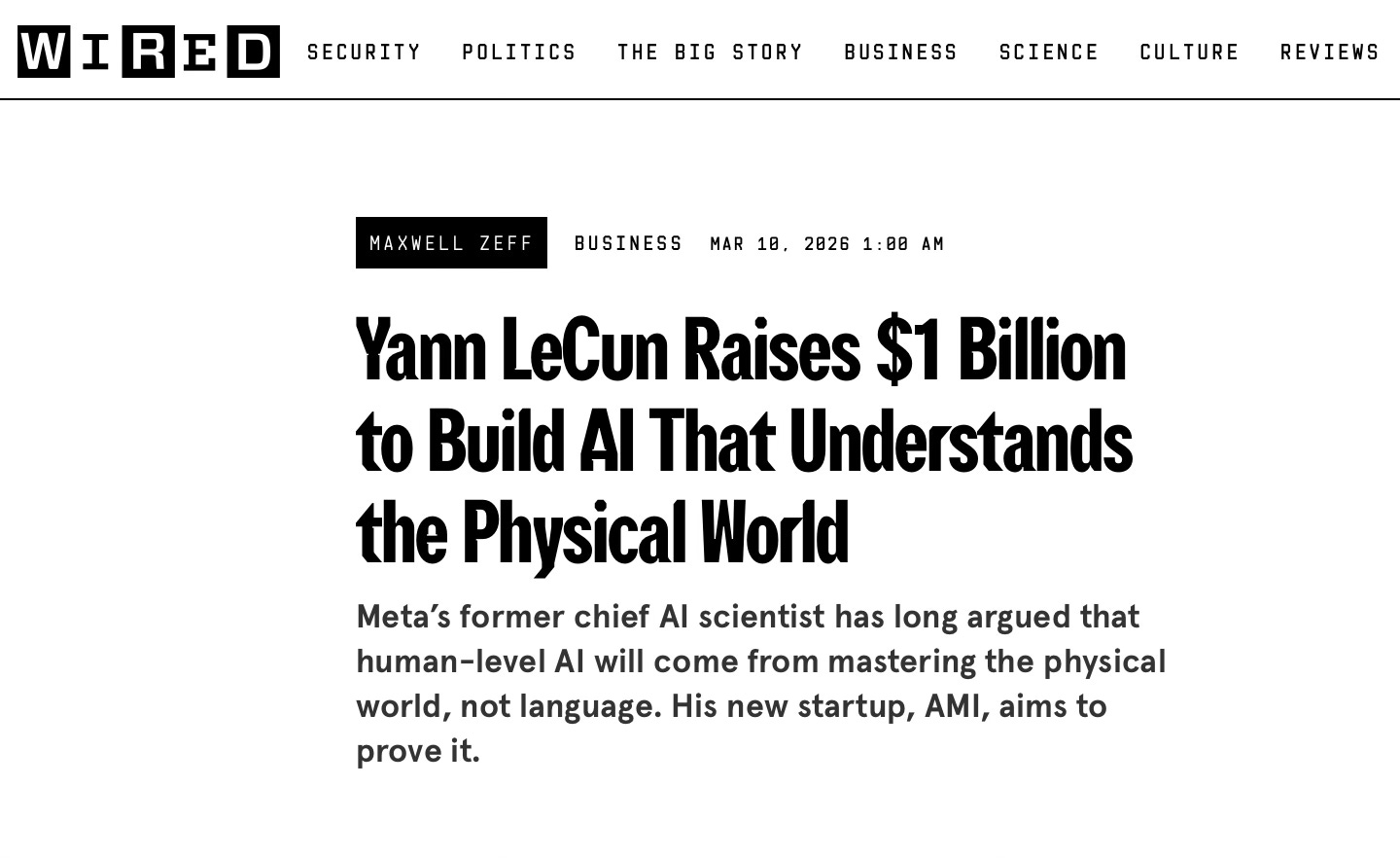
Yann LeCun left Meta in November 2025 with a specific argument. Not a vague one. A technical one. Large language models predict tokens. They do not understand causality. They do not understand the three-dimensional world that physical action takes place in. You can make them bigger, train them longer, throw more compute at them, and they will still lack the foundational architecture to reason about the physical world with reliability.
He raised $1.03 billion to prove it.
I am not going to argue with LeCun about architecture. His track record earns him the benefit of the doubt on that. What I want to talk about is the problem that sits underneath the architecture problem, the one his billion-dollar bet does not address, and the one that anyone trying to apply AI to complex physical operations is actually fighting every day.
LeCun’s argument is precise: the architecture of LLMs is wrong for physical-world reasoning. His solution, JEPA (Joint Embedding Predictive Architecture), learns abstract representations of how the world works rather than predicting the next token in a sequence. It is designed to develop something closer to genuine understanding of physical causality.
Assume he is right. Assume the architecture works exactly as intended and AMI ships a model with genuine physical-world reasoning capability several years from now. Here is the question nobody in the coverage this week was asking: what does that model know about what is happening on a film production on day fourteen?
Not “does it understand physics.” It does. “Does it know what a particular combination of operational signals means in the specific context of this production, with this crew, on this schedule, in this location?”
Those are different questions. The second one has nothing to do with architecture.
I spent years as SVP of Production and Production Technology at NBCUniversal overseeing scripted television series. I now build production intelligence software for film and television. Here is what understanding a physical production actually demands.
Consider a costume department that begins falling behind on alterations in week two of a six-week shoot. Three days behind on a five-scene setup. Is that alarming?
It depends entirely on what else is happening. If principal photography on those scenes is not scheduled until week four, the answer is probably no. If the production is losing location access at the end of week three, it is a serious problem. If the director has a documented pattern of requesting last-minute wardrobe changes on complex scenes, the three-day gap may already be too narrow regardless of the schedule, because the margin for director-driven revision is gone.
None of that is a physics problem. A world model with perfect physical causality cannot resolve it. The resolution requires knowing how this production’s specific constraints interact, how this director works, how similar scheduling gaps have played out on comparable productions. That knowledge is not in the documents the model reads. It is in the accumulated operational history of physical productions, validated by practitioners who have seen enough of them to know which combinations are benign and which ones are the beginning of a cascade.
This is the meaning problem. And it is completely orthogonal to the architecture problem.
AMI’s own CEO, Alexandre LeBrun, was candid about the timeline this week: this is not the kind of startup that ships a product in three months and posts revenue in six. World models are a long-term scientific project. The path from JEPA’s architecture to commercial deployment in complex operational domains is measured in years, not quarters.
That is not a criticism. LeCun is playing a long game, and the investors backing him understand that. But it reveals something important about where the applied work is actually happening right now, and who is doing it.
The gap between “AI that understands physical causality” and “AI that understands what a specific operational signal means in a specific physical industry” is not going to be closed by AMI’s research. It requires something different: domain-specific operational data, experts who can validate which patterns matter and which do not, and the time-consuming work of encoding that expertise into systems that practitioners in high-stakes environments will actually trust.
This is not a capability problem. The models are capable enough to do the analytical work. The bottleneck is context, not compute.
There is a second dimension worth naming directly, because it is one the physical operations world has already learned the hard way.
Experienced practitioners in high-stakes physical operations do not trust AI that speculates. This is not stubbornness. It is rational professional behavior. A line producer who takes an AI-generated risk signal at face value, acts on it, and turns out to be wrong has compromised her relationship with the director, the department head, and potentially the studio. The cost of a false positive in a physical operation is not a software bug. It is a human relationship, a crew’s morale, a day’s work.
When we ran a pilot of our production intelligence platform last year with a real production in New Zealand, we found that every AI response containing hedging, generic framing, or unnecessary qualification was immediately rejected by experienced practitioners. Not engaged with skeptically. Rejected outright. The professionals using it were not interested in what the AI thought might be happening. They wanted to know, with specific evidence, what the data showed, and why that particular combination of signals warranted attention.
That precision is not a function of model architecture. It is a function of validated operational context, the kind that tells a system not just what the numbers are but what they mean given everything else that is true about this production right now.
No foundation model ships with that context. It has to be built, from real operational data, with real domain experts, against real outcomes.
Here is the thing the AMI announcement does that matters most for people building applied AI in physical industries: it validates the category.
For the last two years, the argument that “general AI cannot reliably serve complex physical operations without domain-specific validated context” has been a claim made by people building in this space, to investors, in pitches, against the skepticism of people who reasonably asked whether general models would simply improve fast enough to make the point moot.
LeCun, one of the most credentialed researchers in the history of the field, just put $1 billion behind the argument that general models have fundamental architectural limits when it comes to the physical world. He is arguing it at the research level. The applied version of the same argument is: even when the architecture is right, you still need the operational context. Both layers of the problem are real.
The research layer is what AMI is building. Years from now.
The applied operational layer is what gets built with real production data, real domain expertise, and real practitioner validation. That work is happening now, on productions that are shooting today, with documents being processed and patterns being encoded and experts being asked to explain which signals they would have caught and which ones they would have let go.
AMI’s CEO said this week that he expects “world models” to become the next buzzword, and that every company will claim to be one within six months. He said it with a smile, because he knows the real work is harder than the vocabulary.
He is right about that too. The vocabulary inflates. The actual problem persists.
The actual problem, for anyone running a complex physical operation, is not that AI lacks the right architecture. It is that the right architecture, when it arrives, will still need to be taught what your operation means. That teaching is not something a research lab in Paris can do for you. It requires the people who have spent careers learning to read the signals, and the patience to encode what they know before the window to do it closes.
That window is open now. Not for much longer.
---
*John Corser is CPO and Co-Founder of [filmIQ.ai](https://filmiq.ai), a production intelligence platform for film and television. He is the former SVP of Production & Production Technology at NBCUniversal and a Daytime Emmy Award winner.*
No posts
Comments
Nothing yet. Say the first thing.
Sign in to join the conversation.