
I thought I had cancer when I first got my nontás (boobs) in. Correction—boob in. I was eleven and woke up with an unbelievably sore and swollen mosquito bite on my left pectoral.
“It couldn’t be boobs, it’s only on the left.” Therefore, the logical conclusion to jump to was cancer… Terminal.
After my mom laughed at with me and explained the other would grow in, I began my decades-long fraught relationship with my chest. I’d felt a deep, sinister feeling that there was something wrong with my body. Surprisingly not in a gender-dysphoric way, but insecurity about my inverted nipples.
Inverted nipples are when one’s milk ducts are so tight that they pull the nipple inward rather than the outward-protruding nips we all know and love. And ever since I hit puberty and became aware that I did, in fact, have boob(s), I noticed that they pointed inward. Turtled from the world, and retreated into the warmth of my chest cavity. And with that growth, sprouted a shameful obsession that was unrelenting. A self-disgust around looking differently.
There aren’t any medical problems with having innies. It’s just aesthetically different—and can cause challenges with breastfeeding babies. This wasn’t an issue for me.
Upon growing a second tit—that came in quite uniformly, I might add—I’d searched ways to correct it. These ways included massage, suction, coaxing them out—though mine were too severe for any of these methods to be successful. Piercing them (which looks both adorable and badass and is another method of inverted-nipple correction) was not an option for me as I’d been refused by a piercer. He said it needed to be able to be drawn out by hand, and my pesky lefty was determined to humiliate me yet again.
And finally, the last method is by surgery—a nipple correction procedure. I’d done extensive research and feverishly wanted this operation done by the time I was thirteen. The only issue with how they do it is that they sever the milk ducts, making it impossible to produce milk, let alone feed a baby.
This would be an issue for me.
Not because I actually wanted babies—ever. While playing house with my cousins in Kahnawà:ke, you’d never catch me pretending to be a mom, holding a babydoll to my chest, or pushing around a stroller. No. I was the Broadway star, or the college student working in a coffee shop and living that coolgurl city life.
This would be an issue for me because of the enormous pressure as a Mohawk person to have Native babies. To rebuild—repopulate—the Mohawk nation. And it is meant quite literally.
Thanks for reading Cornbread Cheeks, by Devery! This post is public so feel free to share it.
It’s said that pre-colonization, there were an estimated 10 million Indigenous people in the Americas. But by 1900, our population was down by 97%. I am a descendant of the remaining 3% of people who survived. These numbers aren’t abstract to me.
There are fewer than ~40,000 Mohawk people left in the entire world. We have literally endured our own societal collapse and have emerged from the other side. Though my reserve is one of the largest in the country, a meagre 8,000 people, the pressure to continue our lineage and legacy is tremendous—and having babies is the pastime.
I have witnessed five births first-hand. I’m talking in the room and one over Zoom. I know random-ass shit, including intimate details of foods you’re supposed to avoid during pregnancy, at what age babies can consume solids, how to avoid lactational mastitis, and how dangerous a single strand of hair can be to a newborn infant. I know way too much about birthing babies for someone who doesn’t want to have them. And I’ve learned it through osmosis.
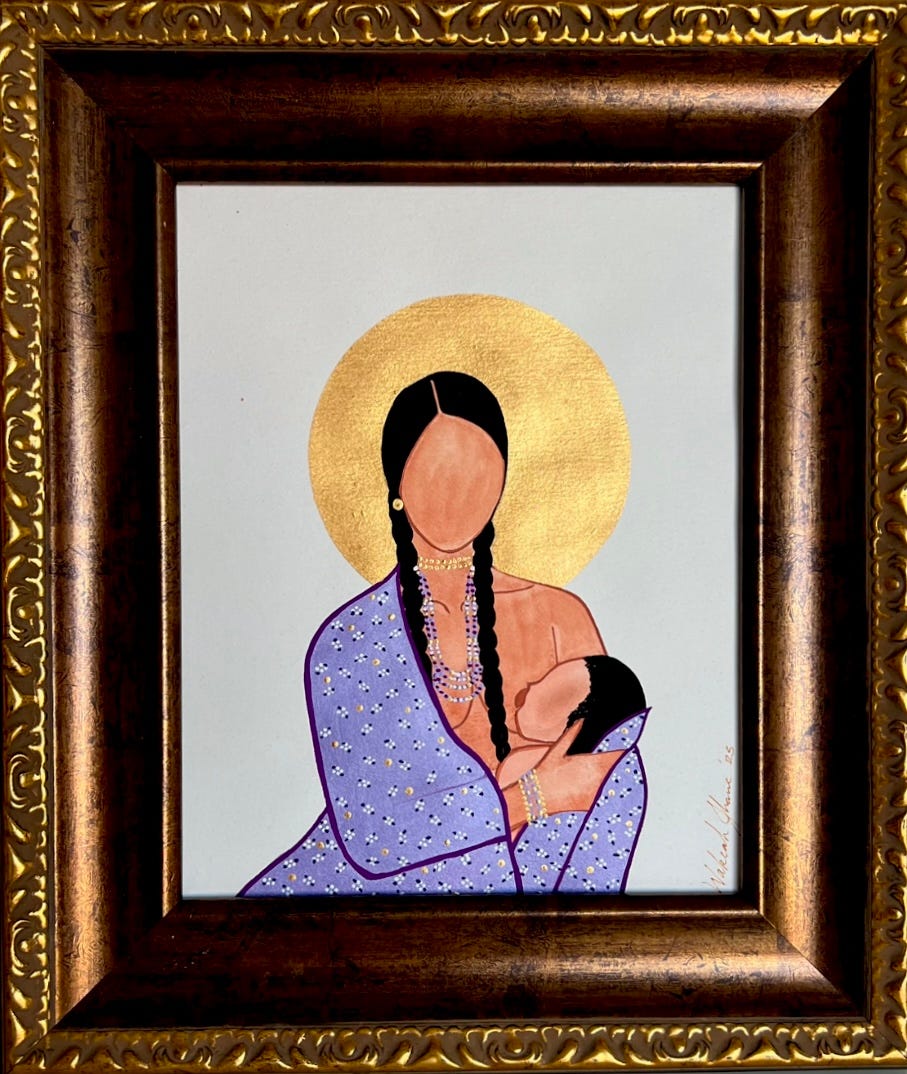
When I imagine my community, I envision powerful women who are both sacrit™ and unsentimental. Who are soft and feeling—but only behind closed doors. Who are ready to verbally or physically throw down at a moment’s notice, all while carrying a toddler on their hip and a baby on their tit. I know these women. I revere these women. To come short of that vision—that expectation—feels like failure.
And I feel the pressure. Laterally and ancestrally. The responsibility that my body somehow doesn’t belong to me, but to the Mohawk nation to continue surviving and growing after our people’s apocalypse. We did not survive genocide for my ancestry to end with me. And to deprive a potential future, hypothetical baby, the life force that is my breastmilk was just too much for me to bear.
So I held off from surgery for decades. I bought a breastfeeding pump to try and suck my tits outward. I avoided any nudity clauses in my contracts and wrote in riders that would hire a body-double for me should it ever come to it. I’d wear extra padding in sports bras and swimsuits to hide myself—even at queer, nude beaches. I’d had a constant script running on-repeat in my brain. Changing in fittings, praying no one would look at the shape of my chest through tight shirts.
My nightmare was exposing myself on camera. That I’d bare it all in a tasteful, love-making scene—and would find photos of myself online, on lists written by dude-bros reading “10 Actresses with Weird Boobs.”
I’ve seen these lists. I’d frantically searched them in my terror-research binges of peril and insecurity. Each mention more cruel than the last.
But I had decided that I would only allow myself to pursue nipple correction surgery once I was past my child-rearing age—after my nontás had belonged not to myself, but to fictitious babies who’d deflated them dry. That way, my body could finally belong to myself and I was free to do what I wanted—but strictly after I fulfilled my duty as a Mohawk “woman.”
But a turning point for me was in therapy.
Queerness has a funny way of carving out an alternative space for oneself. The word “sexuality” is deceiving. It’s limited to just that: who you’re attracted to sexually. What it doesn’t encompass is how it forces you to stop and consider your true feelings about who you are, who you’re attracted to—that it extends to every corner of your life. It ensures that you’re living in an embodied way that aligns with your true values and desires.
bell hooks described queerness,
“not as being about who you’re having sex with (that can be a dimension of it); but ‘queer’ as being about the self that is at odds with everything around it and that has to invent and create and find a place to speak and to thrive and to live.”
By virtue of being queer, it challenges systems that are upheld, and doesn’t discriminate on whether those systems are western or Indigenous. With therapy, I uncovered and was confronted with myself. My true self. My true desires. And my desire not to have children.
With my therapist, I’d recounted how I’d literally prayed to Creator in my early twenties that I’d inherit my family genetics—of ovarian cysts and early hysterectomies—as a way of my choice being made for me.
The choice not to have children.
Obviously, this is fucked up to wish for. But it indicated to me that I really didn’t wanna have fucking kids.
What I also uncovered was my desire to birth stories. To lean into my role as Auntie (a non-gendered term, in my opinion)—to those blood-related and not. And that I can still become a worthy community member, and eventually— elder, who contributes to our culture and growing future. That bearing children is only one of many ways I can show up for my nation.
Rather than preserving my body for little beings I thought I owed, I made the decision to have this nipple corrective procedure done. It was a commitment toward myself and my own voice and agency by booking the appointment.
Now, it must be said that inverted nipples are not weird or bad. I think they can genuinely be adorable, and more power to anyone who rocks them proudly. I believe there should be more representation of innies on screen to normalize different nips. But in my case, my body is already doing so much fucking representating—being a “first”: a first Mohawk, Indigenous person, an Indigiqueer person…I just couldn’t add Repping Innies to the Masses onto my rolodex. I’ll leave that plight to another valiant, inverted soldier.
But if the decision was the hardest part of my chest-journey, the actuality of the surgery was not much easier.
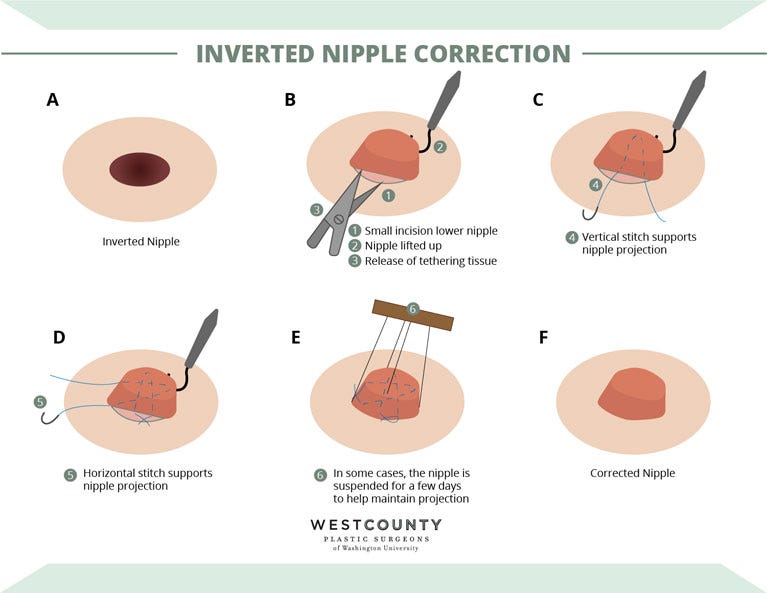
I showed up for my appointment—the gaudy sheen of plastic surgery offices is a whole other topic I could unpack—and was processed in my hospital gown. The process of “correcting” an inverted nipple is as follows:
A small incision is made at the base of the nipple-areolar complex.
The restrictive, shortened connective tissue and milk ducts are cut, allowing the nipple to project.
Sutures are placed underneath to keep the nipple in an outward position, preventing it from reverting.
The incision is closed with dissolving stitches.
If you’re like me and have a fear of surgery, this is terrifying stuff. Especially while awake for it.
The process went differently from how I imagined. The freezing needle hurt worst because the area is so sensitive, with thousands of tender nerve endings. I noticed a burning and sharp pain move through every neuron, stinging before it eventually dulled.
But it was when they sliced the milk ducts—which weren’t painful, but I could feel the taut strings wound too tight—and then their release; that felt like a tidal wave of emotions, followed by a vacuum of silence.
It’s strange to describe, but it was like something spiritual was severed within me. Something ancestral that had flowed through my body, now rendered defunct in this physical act that encompassed my childless choice. And there was grief, loss, and a sense of acceptance as the warm blood pooled down my front.
But there was also a profound silence—like the looped record had scratched to a halt. That never-ending noise: the worry, the shame, the fear of ridicule, the self-hatred, the obsession—went silent, and it has yet to return. That has been the part that’s felt like freedom.
After healing, I think my nontás are adorable. Which is new for me. I’d grown so used to the discomfort of my chest that the confidence is unfamiliar. What was most surprising is the newfound appreciation I hold for what they looked like before.
I’m definitely more susceptible to getting cold now, since these nerve endings are exposed to the elements in the big, wide world.
Now, at the gym, I don’t recoil in fear that somebody’s done a double-take at my bra, and I look forward to the feeling that I actually have the option to go topless in a scene if it calls for it. It lets me be more free as an actor and as a person.
And ultimately, my gender, my Mohawkness, my choice not to procreate—are simultaneously reflected on my chest for all to see.
Well—maybe not all. But perhaps you’ll get to see ‘em if you catch these tiddies in the movies.
Sources:
https://hmh.org/library/research/genocide-of-indigenous-peoples-guide/
No posts
Comments
Nothing yet. Say the first thing.
Sign in to join the conversation.