
The Ancient Greeks, and indeed many other former civilisations, had no word for the colour blue.
This seems incredible, particularly for this race, many of whom were island dwellers and therefore surrounded by the deep blue itself. Not to mention that, while much of the man-made surroundings will have changed over time, they lived beneath one of the most sublime examples of blue this world has to offer.
There was once a school of thought that the lack of a specific word meant they were unable to even see the colour as we do. But only a little research starts to debunk this as we find the, much more feasible, explanation that they in fact had many words to describe different hues of one of the most wide-ranging colours to exist.
In Greek, there is ‘kyaenos’ which is used to describe darker blues, and ‘glaukos’ for lighter shades. In Roman, ‘caeruleus’ describes sky blue and ‘cyaneus’ is their word for darker hues.
Homer famously described the ocean as ‘wine-dark’ and, really, it is quite literally a sea of shades. Unbelievable blue in places but also green, grey, foamy white and even translucent in the shallows.
Blue is naturally a quite elusive colour - it appears rarely in animals and plants, and was never a colour that could be manufactured as a dye. It was the invention of Prussian Blue in 1706 (accidentally) that brought it to the art world in a big way synthetically.
But why such a focus on the etymology of a colour?
Through my work, a lot of energy is spent finding new and engaging ways to help clients tell their story. It’s a pursuit which I’ve bene even more aware of since the advent of AI, which seems to actively go in the opposite direction.
If you give an AI LLM a series of statements, or details, as part of a prompt it will respond by grouping and generalising to pull out what it sees as the core points. You instantly lose quite a bit of detail.
I know this as I recently used ChatGPT to quiz me about my new Content Canteen service. I wanted to test my messaging and understand what exactly I was offering and to whom. It came up with 10 really good questions to give credit where it’s due but then came the surprise. I dictated my answers, feeling pleased with what came up. It then ‘created’ some content I might like to use to market my service.
I was struck by how little of the original detail from my answers was included. Instead, there was a summarised, cleansed, quippy and staccato version, in full AI-speak ready to go. I remembered that the machines aren’t driven by the need for depth or variety. They simply strive for speed.
I hated it.
It made me feel lost. I went back and copy-pasted my original answers into a word document and started working on knocking them into shape.
I guess researching the etymology of blue made me realise that we can easily oversimplify things when we start to construct language for mass use.
The sea, the sky, my eyes, a forget-me-not flower - they’re all blue. But the blues I saw in the sea on a recent Greek Island holiday needed more than that. There was every shade from indigo to cerulean, azure and sapphire. They were mixed with greens and greys that shared an element of blue and created new, unnamed shades which all swam before me.
We owe it to our audience to tell our story through a rich and colourful lens. With so many different perceptions out there, we can’t hope to reach everyone with one, generic description. Language is a tapestry where threads and patterns keep us interested and engaged. A print is never as textured or interesting as the original.
We’d do well to remember that as we write, for business or pleasure.
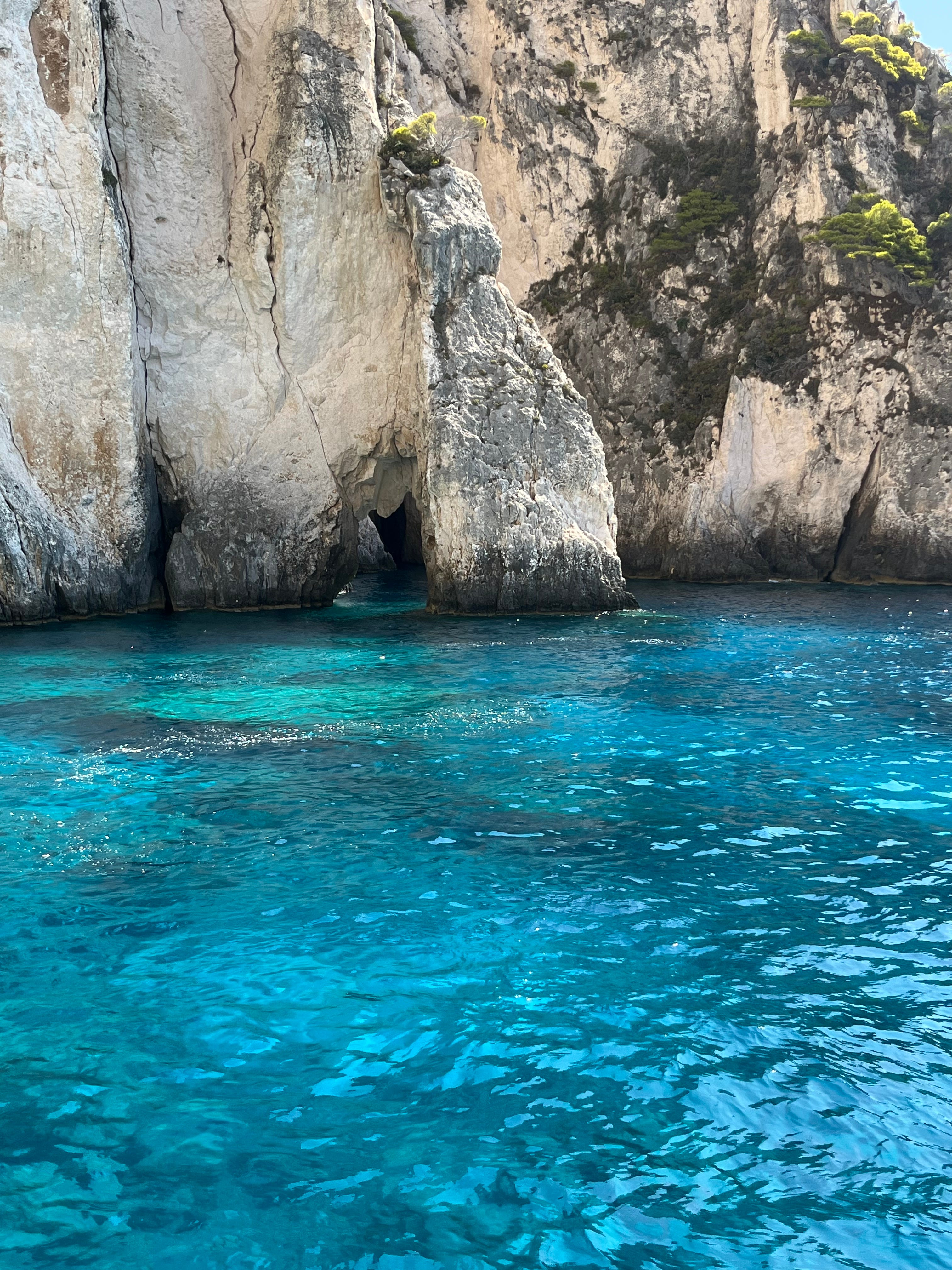
Swimming in the sea of blues off the coast of Zante/Zakynthos, summer 2024.
No posts
Comments
Nothing yet. Say the first thing.
Sign in to join the conversation.