
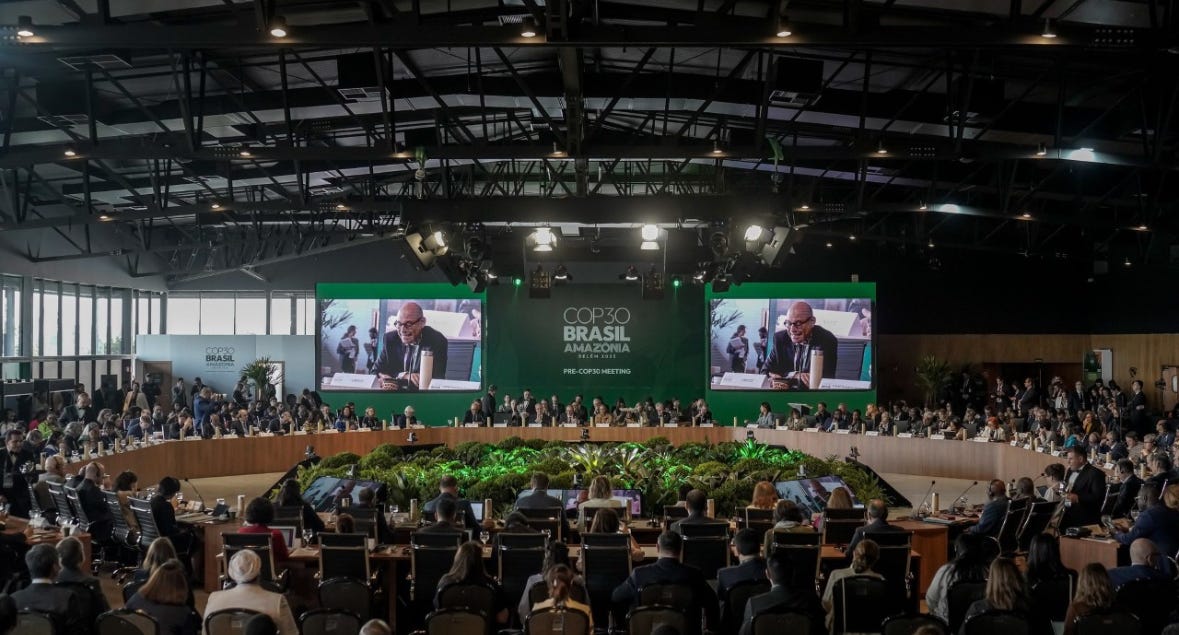
Being an observer at COP, especially a student observer still trying to find her bearings within this sprawling, shape-shifting conference, means constantly having to pull back and ask: What even is a COP? What is its purpose, and what actually comes out of it?
I still feel like I only understand the tip of the iceberg- and it took me hours and hours too. Hence the fact I am just now publishing this blog.
Not to mention, the COP is not one thing. It morphs depending on who you are and what you’re here to do. It is, all at once:
A once-a-year in-person gathering for international NGOs that otherwise work entirely remotely, with staff scattered across the globe.
A rich research site for academics (like us!).
A full-time job for pavilion staff running events from morning to night.
A playground for photographers capturing every handshake, headline, and protest.
An influencer’s dream—yes, they are everywhere—curating content for audiences who will never step foot inside the venue.
A home base for advocacy groups organizing, strategizing, and building collective power.
And an opportunity for lobbyists of all kinds to shape narratives, influence text, and quietly advocate for their interests in hallways and back rooms.
With all these parallel worlds colliding under one roof, it’s easy to lose sight of what sits at the center of the entire convention: the quiet, tense, highly technical negotiations taking place behind closed doors, where the global response to climate change is shaped word by word.
And yet, after more than 30 years of these talks, the results are mixed. Yes, there has been progress, renewable energy is accelerating, climate finance has grown, and every country is now part of a shared framework. But emissions are still rising. Temperatures are still climbing. The gap between ambition and action remains massive.
So what are these negotiations actually doing? What do they produce? And why do negotiators spend hours debating the choice of a single verb or arguing over bracketed text that feels impossibly small compared to the scale of the crisis?
Everything that happens at a COP traces back to three foundational treaties:
1. The UNFCCC (COP) — adopted in 1992
Created the COP itself and set the overarching goal of preventing dangerous climate change.
2. The Kyoto Protocol (CMP) — adopted in 1997
Introduced binding emissions targets for developed countries and created the first carbon markets. Its governing body still meets, though its influence now is largely legacy.
3. The Paris Agreement (CMA) — adopted in 2015
Sets the global temperature goal (“well below 2°C” and pursuing 1.5°C).
Requires countries to submit Nationally Determined Contributions (NDCs) every five years.
Establishes the Global Stocktake to assess the world’s progress toward slowing global warming every 5 years.
Sets a Global Goal on Adaptation: a fund to help build resiliency in the wake of inevitable climate change impacts
Requires developed countries to provide climate finance.
Creates mechanisms for international cooperation, including carbon markets.
Today’s COPs run all three governing bodies, COP, CMP, and CMA, simultaneously, creating the dense, overlapping negotiation tracks that define the conference. Two technical bodies, SBSTA and SBI, take on the heavy-lift of detailed negotiations, though I won’t go deeper into that labyrinth here.
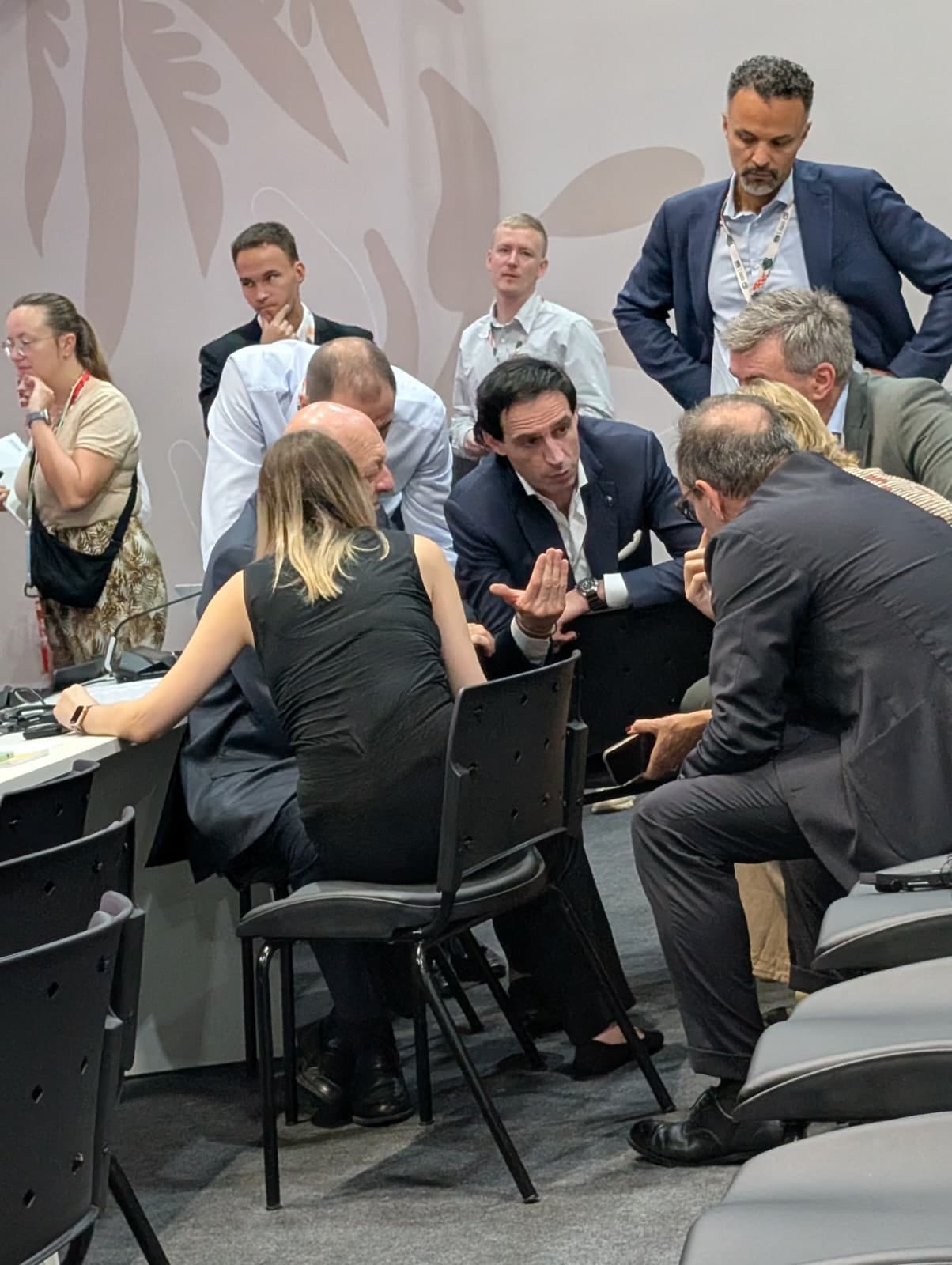
Most negotiations now focus on implementing, strengthening, or clarifying the Paris Agreement. Negotiators spend their days (and nights) working through agenda items like:
Mitigation: emissions reductions, energy transitions, NDCs
Adaptation: support for countries facing climate impacts
Finance: mobilizing, tracking, and reviewing climate funds
Loss & Damage: addressing unavoidable climate harms
Transparency: how countries report and verify progress
Article 6: rules for carbon markets and international cooperation
At COP30 there are dozens of simultaneous tracks, each trying to move forward a specific element of the three treaties. But in essence, they all circle back to the core goals: limiting global warming, building resilience, and channeling finance where it’s needed.
Most COPs produce 50–80 decisions: many technical, a handful political or symbolic.
Negotiations happen line by line. Every verb is deliberate:
“Shall” vs. “should” → legally binding vs. recommended
“Encourage” → voluntary
“All Parties” vs. “Developed countries” → who is responsible
What can look like tedious wordsmithing is actually the architecture of global climate governance. Because decisions are adopted by consensus, any country can object to any line, giving every word the potential to make, or break, a negotiation decision.
While COP decisions are technically legally binding, they lack teeth. There is no enforcement mechanism: no international court, no sanctions, no penalties.
Instead, the system rests on transparency, peer pressure, and political will. This is a classic challenge of global governance: treaties can set ambitious goals, but without centralized authority, progress depends on whether governments choose to act.
Yet COP outcomes still matter. They:
send strong political signals that shape national laws and policies,
guide investment and planning toward clean energy and resilience,
establish financial and technical support for developing countries,
influence businesses, investors, cities, and civil society.
One negotiation I followed closely this year was the Gender Action Plan, which seeks to mainstream gender across the UNFCCC and ensure climate policies are gender-responsive. Advocates pushed for an ambitious update because strengthening this framework can encourage countries to improve gender-equality policies at home.
COP30 also saw a rise in discussions about trade as a tool for climate accountability, particularly the EU’s Carbon Border Adjustment Mechanism (CBAM).
A Carbon Border Adjustment Mechanism (CBAM) (also known as a Carbon Border Adjustment Tax, or CBAT) is a fee or tariff levied on imported goods based on the greenhouse gases emitted during their production.
Such a policy can serve multiple purposes, such as reducing emissions to restrain climate change, preventing distortions between countries with differing emissions standards, and spurring domestic industries to reduce their emissions as well.
The EU plans to formally implement the financial obligations on January 1, 2026, as part of its goal to reduce emissions by 55% by 2030.
Unsurprisingly, this sparked tension: China and India criticized the EU for mixing climate policy with trade policy, raising questions about equity, fairness, and geopolitical power.
COP is chaotic, sprawling, and often frustrating. But at its core, it is still the only global forum where every country comes together to negotiate the collective response to the climate crisis.
However imperfect and however slow, it is still the closest thing we have to a collective plan.
No posts
Comments
Nothing yet. Say the first thing.
Sign in to join the conversation.