
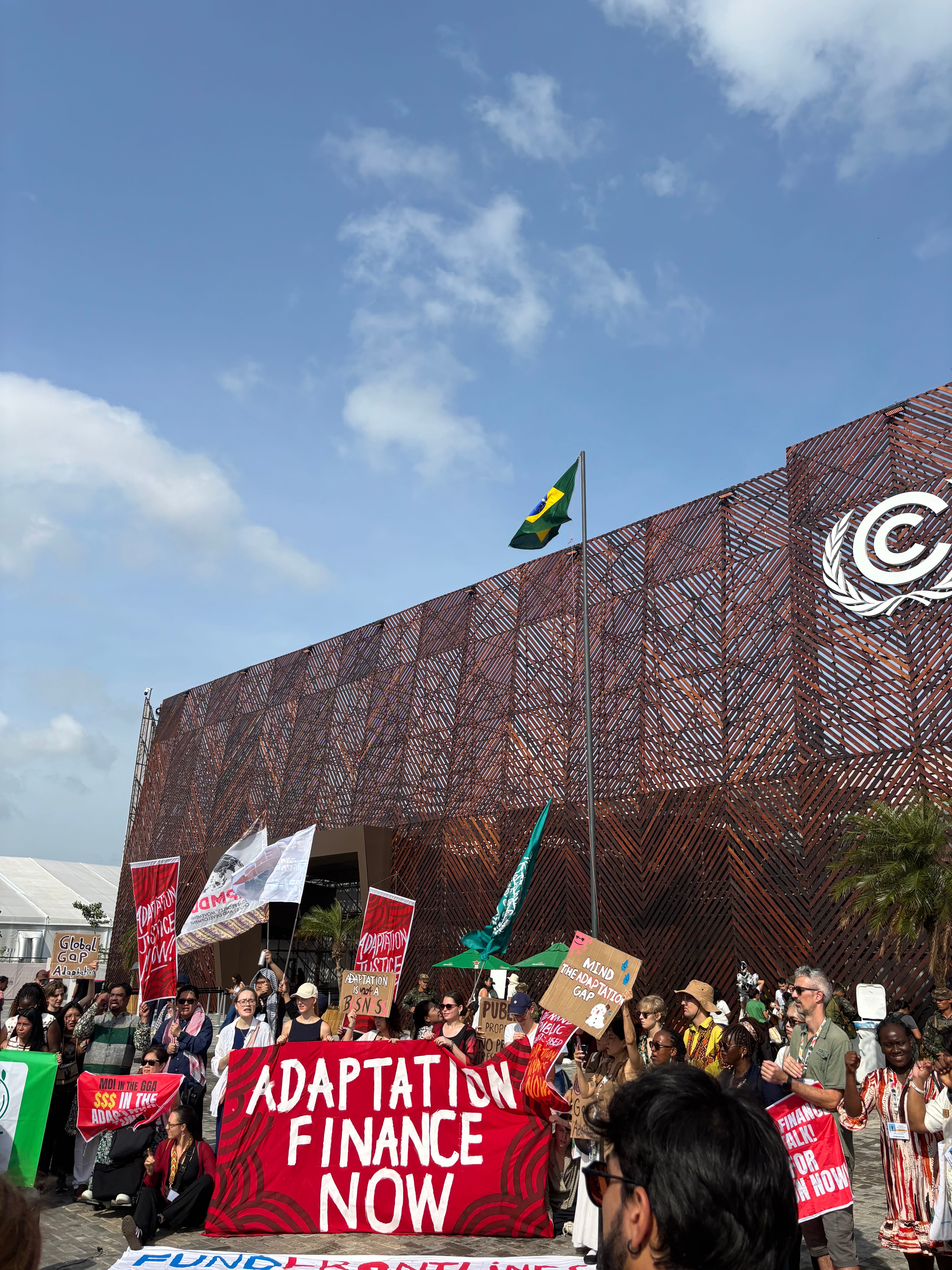
If there is one thing that COP30 is for sure bringing, it’s the heat. Each day it’s upwards of 90 degrees and humid, and the venue has spotty air conditioning and airflow. As I sit here, my third day amid the unique bustle of the climate summit, delegates, journalists, civil society members from all corners of the world, people’s hand-held fans wave desperately in the thick, humid air, and sweat trickles down my back. I can’t help but think how fitting these conditions are: a living metaphor for the realities of climate change itself. That maybe this discomfort is productive; an uncomfortable reminder of what’s at stake.
Overwhelming is an understatement when it comes to being on the ground at COP. Year two, I find myself baffled once again by the vastness of this conference—the sea of people I walk amidst each day, the thousands of simultaneous events: negotiations, consultations, press conferences, side events, pavilion talks, exhibits, and more. Today alone, I walked over twelve miles just within the venue, darting from one event to the next.
It’s this vastness that brings me both inspiration and despondence. Inspiration, because witnessing, really seeing, the 50,000+ people here, each devoting their life’s work to some unique nuance or dimension of the climate crisis, is a powerful reminder of the magnitude of effort underway. Despondence, because despite this collective presence, the scale of what remains to be done still feels unfathomable and the overall commitments to action, especially on the larger negotiation scale, lacking implemented ambition.
This year stands in contrast to recent COPs in authoritarian host countries — activism isn’t limited to the controlled space inside the conference walls, like last year in Azerbaijan for example. There have been protests frequently outside the venue, throughout Belem, and there is going to even be a big “People’s March” tomorrow.
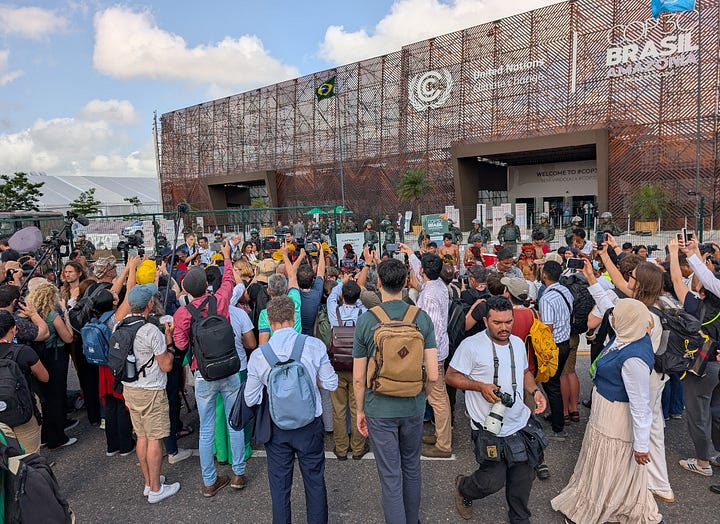
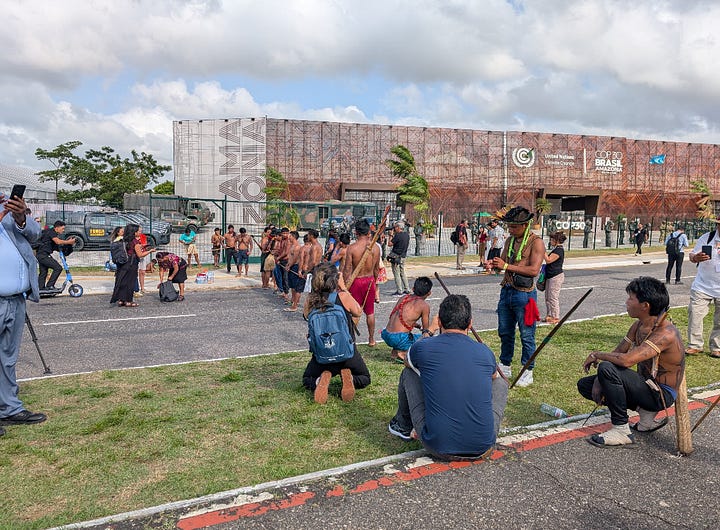
However, on Tuesday, a peaceful demonstration broke into the conference. A group of Indigenous protestors stormed into the venue, storming the entrance and kicking down doors. They were demanding stronger action to stop deforestation and mining in the Amazon rainforest, carrying signs reading “our forests are not for sale.”
Two security guards were injured.
According to the BBC, “it is a highly unusual security breach at a conference that has strict protocols.”
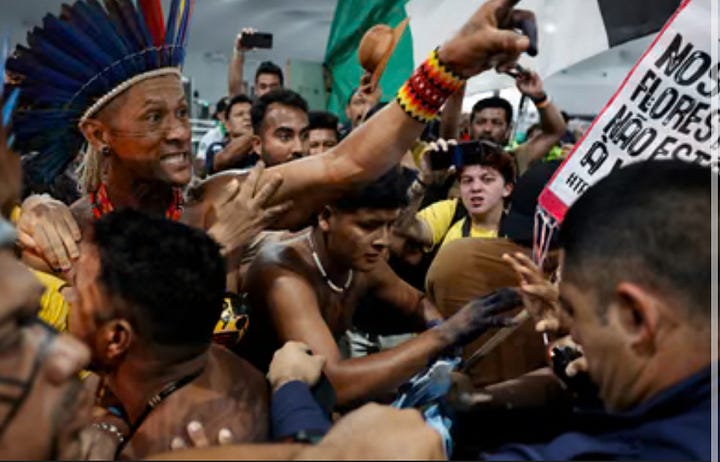
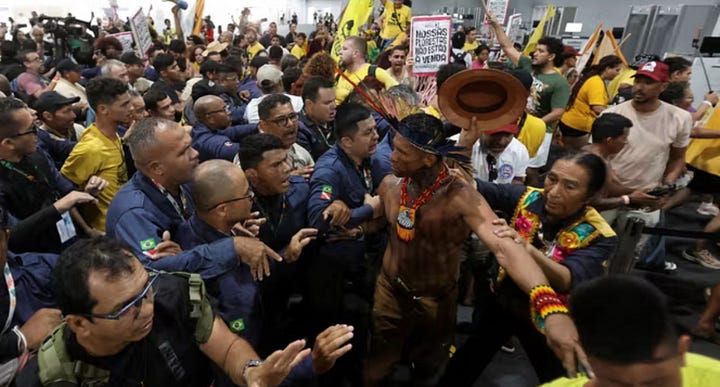
I was not in the venue at the time, but my classmates said all they received were alerts in COP group chats on WhatsApp, saying to evacuate the venue.
Since then, the front of the venue has been constantly barricaded with not just Brazilian police, but armed military.
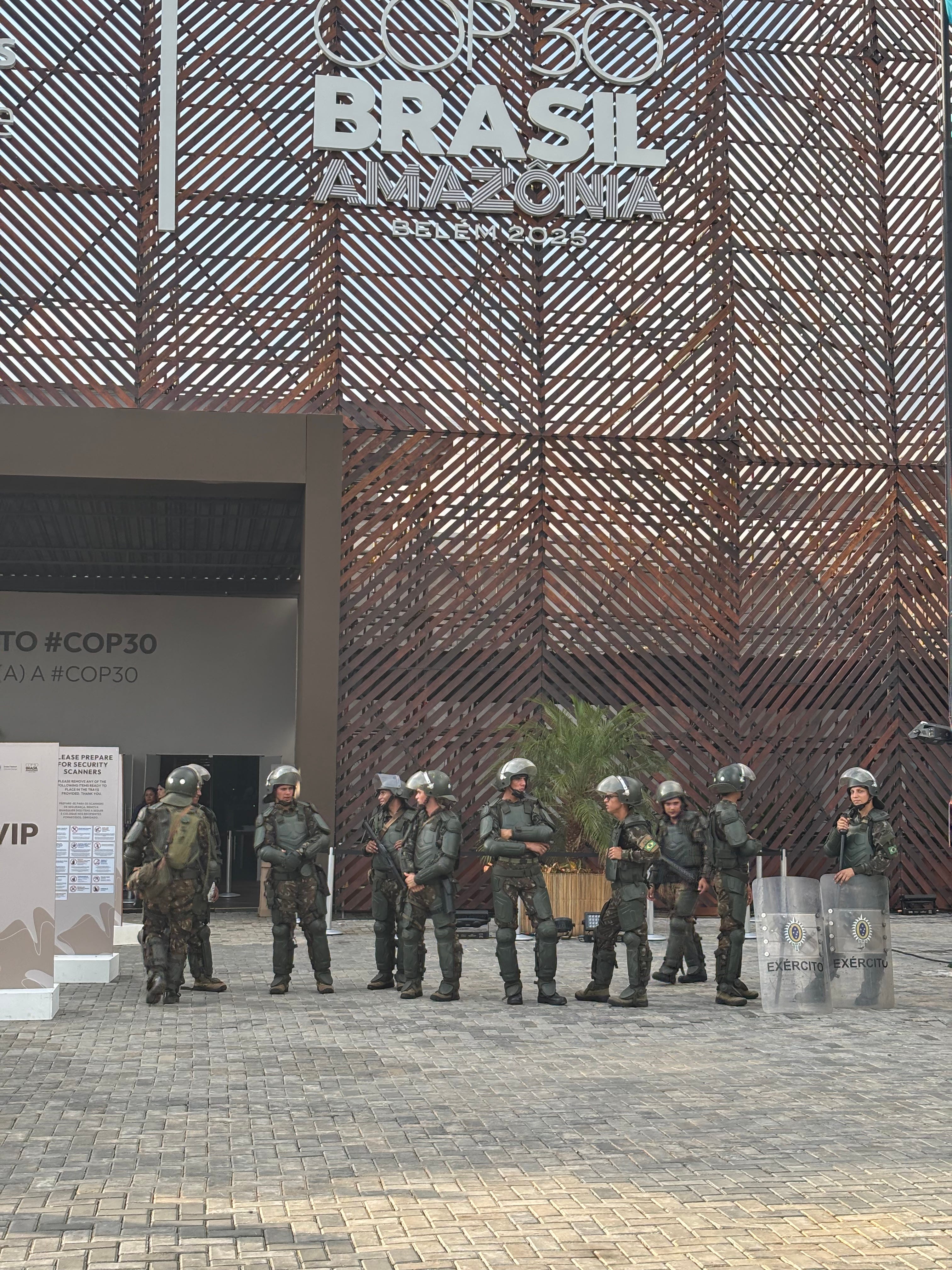
This morning, the entrance to the venue was blocked again, by a peaceful Indigenous protest. It disrupted entrance to the conference, and security guards had to divert people to enter through the Green Zone or through the exit doors. It took my professor 2 hours to get inside this morning. When we heard the alerts of the lines, my classmates and I came later to the venue and still faced long lines to get inside.
Overall, the U.S. political presence is far smaller than expected, largely because of the government shutdown. Amelia VanderLaan, a former U.S. diplomat now in the State Department’s climate office, has been staying at our apartment and told us that the 17 members of Congress slated to attend COP had to cancel so they could be in D.C. for the shutdown vote. She’s now stepping in for some of the events and meetings they were meant to cover. Amelia lost her job in May when Trump took office and is currently pursuing her master’s at Harvard.
She helped to organize an incredible panel yesterday for U.S. students at COP, bringing together several former American diplomats and negotiators. The room was packed, at least 50 people, mostly students. If anyone is representing the U.S. here, it’s the university students here!
The three former negotiators, now working in NGOs, spoke candidly about the somber reality of not being here in their former roles. They urged us to get involved locally to help drive the “blossoming of subnational climate action and policy” that’s urgently needed.
In a pavilion event, I also heard from two previous state department workers who now run SEEC, the Sustainable Energy and Environment Coalition, a nonprofit that supports a coalition of 100 congress members advocating for strong environmental policy. They explained how their work helps fuel the resurgence of subnational climate action by supporting lawmakers in finding creative ways to pursue concrete, proactive climate solutions in their states, and at the federal level whenever possible.
On Tuesday, Gavin Newsom, Governor of California, came to COP, and he was constantly trailed by crowds and speaking to rooms packed with eager listeners- the United Nations security detail had to follow him everywhere, and I guess was having a hard time getting him to events on time due to the constant swarm of people and media. This is largely due to him being one of the only prominent American officials here, and for his loud opposition of Trump.
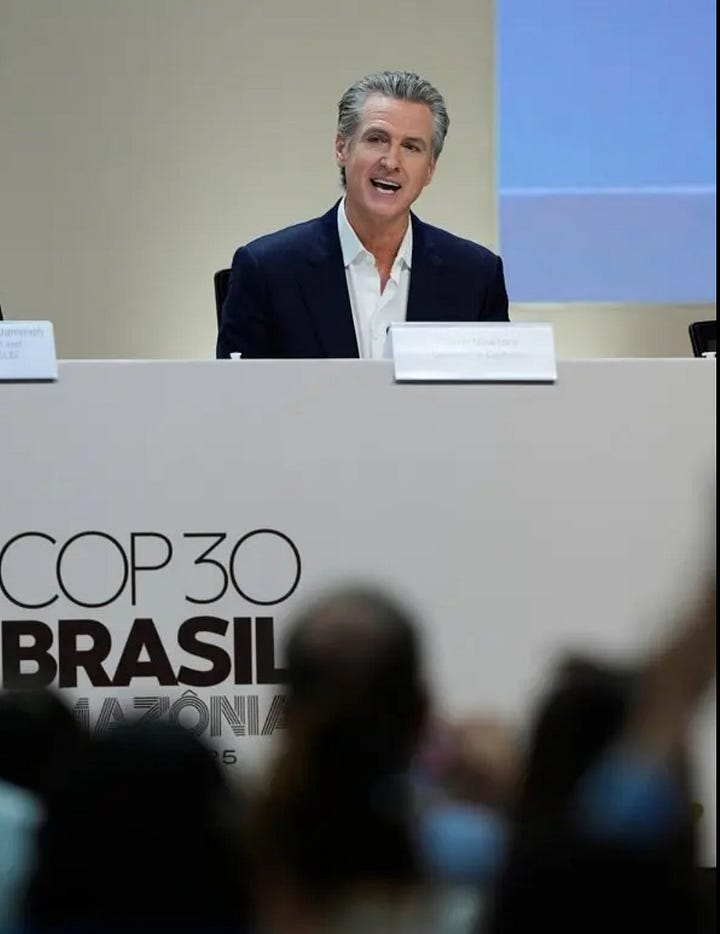

I unfortunately got stuck in the airplane, delayed for hours on tarmac in Miami due to “airport infrastructure delays,” because of the government shutdown, but my other classmate here Noah, saw Newsom many times throughout the day, noting the celebrity treatment of Newsom.
In the articles I’ve read, the press conferences I’ve watched, and the conversations I’ve had with people here, I was struck to learn that Newsom didn’t just call Trump’s withdrawal from the Paris Agreement ‘an abomination.’ He went further, framing Trump as a threat to America’s global competitiveness by allowing China to dominate the renewable energy sector. Newsom cast himself as a ‘stable and reliable’ climate leader and warned that Trump is jeopardizing U.S. leadership in electric vehicles, solar manufacturing, and other clean-energy technologies of the future. In his view, this isn’t just about climate policy, it’s about losing economic and geopolitical power.
With Chinese exports of solar panels, wind turbines and batteries hit records this year, which experts are saying show how economic development is going in the direction of renewables.
In another press conference I attended, USCAN, the United States Climate Action Network, which is also representing the U.S. here at COP, shared their perspective on the presence of Governor Newsom and Governor Grisham.
Feelicia Guillen, a youth member of USCAN from New Mexico, spoke passionately and directly about her own governor. She argued that Governor Grisham’s presence at COP is a clear example of greenwashing, calling it hypocritical for her to step into the spotlight as a climate leader while continuing to use ‘the same playbook as the extractive fossil fuel companies’ by doubling down on oil and gas and promoting “false climate solutions” like carbon capture. Guillen insisted that Grisham cannot “claim climate leadership when she continues to hurt our communities back home.”
Similarly, many people are questioning whether Governor Newsom’s presence at COP is fully legitimate. While he has stood up to Big Oil and is one of the most outspoken politicians resisting Trump’s attacks on human rights and climate action, he has also reversed several of his own climate commitments. He has expanded oil-drilling permits and championed hydrogen and carbon capture, technologies many climate advocates consider dangerous false solutions that ultimately extend the life of fossil fuels.
Critics of both Newsom and Grisham are asking: Will they return to the U.S. and actually uphold the commitments they’ve spoken about here? Or will Belém simply become another photo op serving their political agendas?
These criticisms are valid. Real climate leadership can’t be measured by who shows up to COP30, but by who stands up to Trump at home and implements meaningful climate action on the ground. At the same time, it’s worth asking to what extent simply showing up is itself a positive step—one that still deserves some recognition.
On Wednesday, I attended a press conference with Al Gore, former U.S. Vice President turned prominent environmentalist on how to translate climate science into climate action. He focused on Climate TRACE,, his climate-data initiative that uses satellite and remote-sensing technologies to provide comprehensive, free emissions data around the world. Gore explained that precisely pinpointing greenhouse gas sources not only helps hold companies and facilities accountable, but also enables high-emitting sites, like industrial cattle feedlots, to connect with similar facilities that have successfully reduced their emissions.
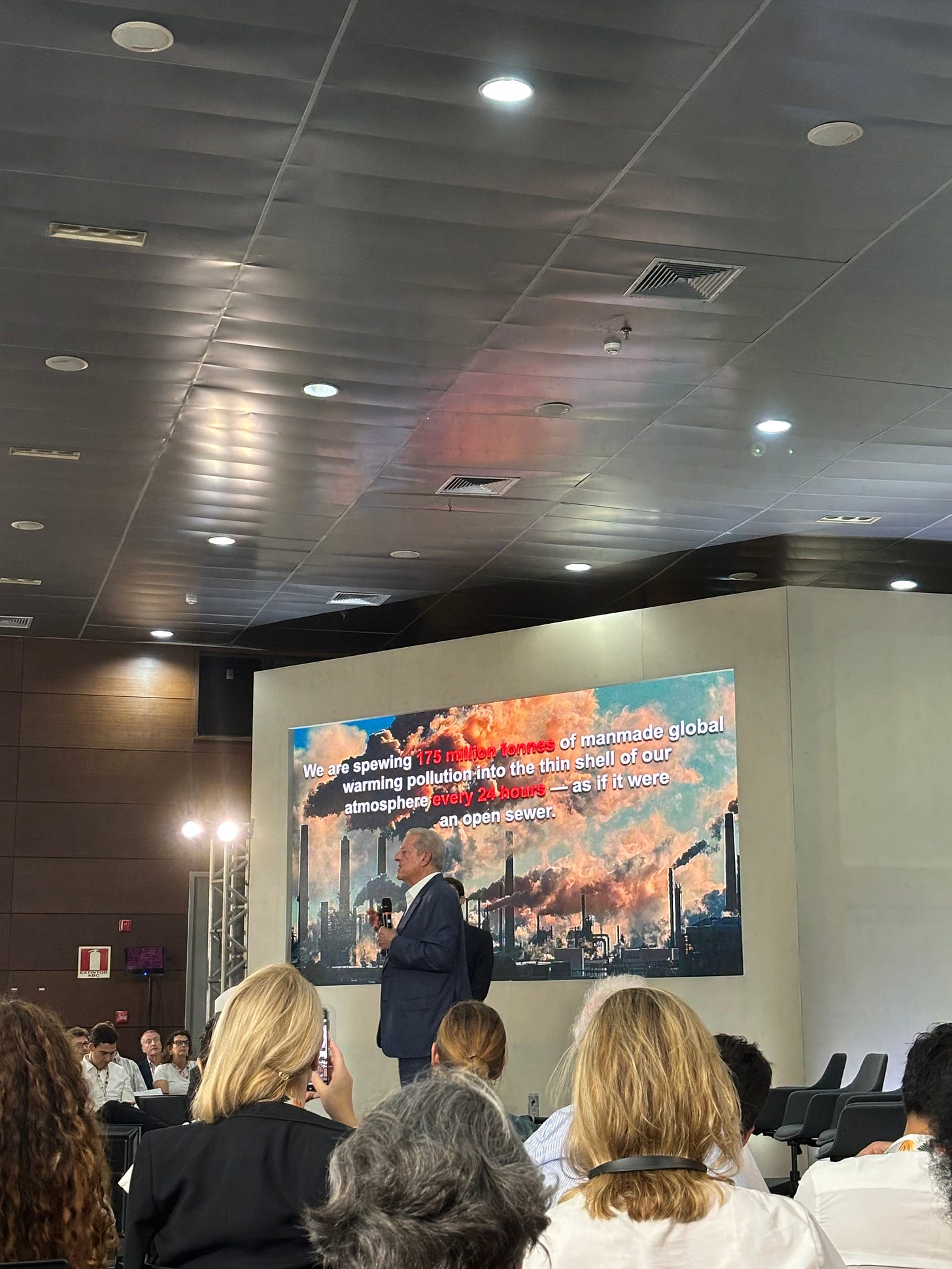
While I could dive into the technical details of the presentation (and I can, if people are interested), what stood out most was how Gore began: by calling out the United States, and more specifically, U.S. billionaires, naming Bill Gates directly.
Recently, Gates has shifted his stance on climate change, arguing it won’t be “humanity’s demise.” He now calls for a ‘strategic pivot’ in climate action: moving away from near-term emissions-reduction targets and instead focusing on improving human welfare by addressing poverty and disease.”
Ah, another billionaire minimizing the impacts of climate change… is anyone actually surprised?
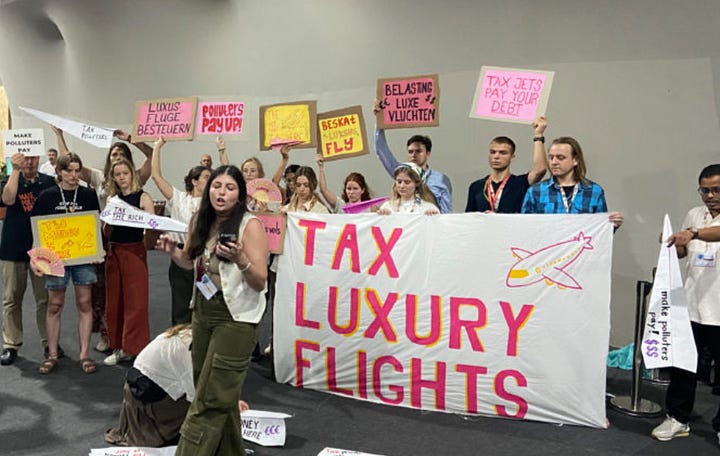
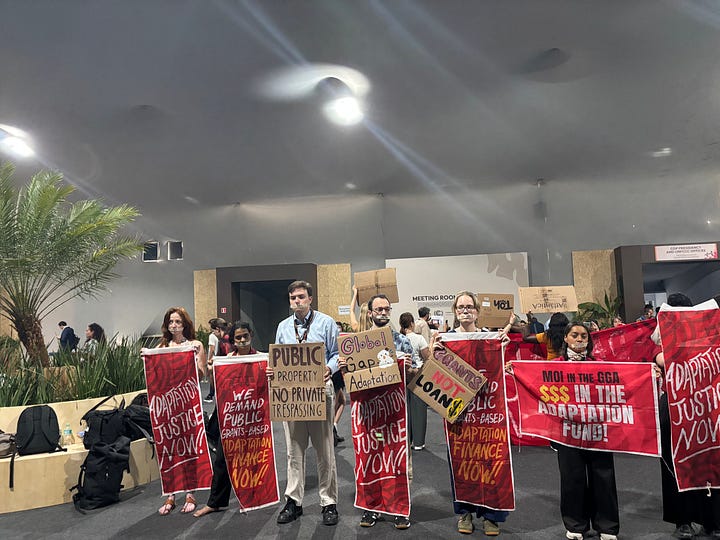
Throughout the venue each day, civil society protests erupt—brief, galvanizing flashes that cut through the blur of the hallways, calling for public, grant-based funding for communities on the frontlines, for justice, for real ambition. The other day, I walked past one demanding we “tax the rich.”
It’s no wonder Bill Gates has softened his view of the climate crisis, caving to the wave of Trump-era denialism.
We spend so much time asking individuals to make changes; drive electric cars, take public transit, compost. And while those choices absolutely matter and help build collective norms, they alone won’t “move the needle” on emissions or mobilize the finance needed. If we’re serious about climate action, the 1% must be held accountable.
According to Oxfam, the world’s 50 richest billionaires generate more carbon emissions through their investments, private jets, and mega-yachts in just over 90 minutes than the average person produces in an entire lifetime. Forty percent of those investments are tied to oil, gas, mining, cement, and shipping. Since 2015, the richest 1% have increased their wealth by $34 trillion.
So when we talk about the gap in global climate finance, I’ve started to wonder: why is the burden placed almost entirely on countries—especially developing countries—to fund climate mitigation and adaptation, when a global wealth tax could easily raise the $1.3 trillion that negotiators and activists here at COP are calling for?
As the protestors made clear, the climate finance negotiations need to include measures to “tax the rich,” “tax luxury flights,” and “make polluters pay.”
Why is the role of the super-rich in super-charging climate change so rarely discussed?
Off to yet another side event, back into the swarm.
BUT: More to come in the next blog… including:
How climate policymaking and action are being obstructed in subtle, often surprising ways here at COP
The current status of fossil fuel representation
The hypocrisy surrounding the PR firm hired by COP
Key updates on the major negotiation tracks at COP30
The People’s March on Saturday!
No posts
Comments
Nothing yet. Say the first thing.
Sign in to join the conversation.