
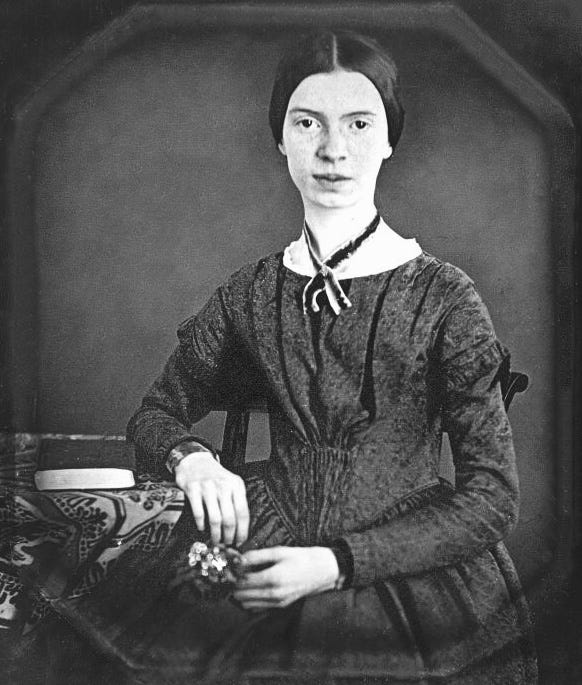
For such a beloved poet, Emily Dickinson can be perplexing.
On the one hand, her work is found in any children’s book of verse: musical, metrical poems about birds, boats, and virtue. On the other hand are her many “slant” pieces whose meanings have confounded scholars for two hundred years. Having read Dickinson from a young age, I was surprised when revisiting her poetry in college and graduate school to find it so… oblique.
Dickinson did not want to be pinned down. Her poems resist simplistic interpretation, not in the manner of philosophical abstraction, but like a butterfly drifting from flower to flower before vanishing with the wind. Poem 980:1
Text within this block will maintain its original spacing when published
Love - is anterior to Life -
Posterior - to Death -
Initial of Creation, and
The Exponent of Earth -
Apply any available definition of the word “Exponent” here and you will conclude with a different poem each time. The force of Dickinson’s poems often emerges in the juxtaposition of multiple meanings, which meanings the poems seem to invite. They are polyvalent, suggestive, prospective.
Another way to think about it: Dickinson’s poems are more centrifugal, tending away from a center, than centripetal, tending toward a center. A fine example of a centripetal poem is Richard Wilbur’s “A Baroque Wall-Fountain in the Villa Sciarra” which, though brimming with fluid motion and sparkle, remains firmly grounded in its central image of a stone wall-fountain. Each stanza works to crystalize the image we only glimpsed in the poem’s title. Dickinson’s poems, by contrast, tend outwards, toward the horizon.
Take her pithy 278 for example:
Text within this block will maintain its original spacing when published
A word is dead, when it is said
Some say -
I say it just begins to live
That day.
Who says a word is dead when it is said? I don’t know whom Dickinson has in mind here, but I can think of a few postmodern philosophers who had similar views about the impotence of language. For Dickinson, however, to speak or write a word is to let it loose on the world, to let the world loose. Hope is a thing with feathers…
Birds are centrifugal creatures. They defy gravity, ascending, singing, tending up, up, and away. In poem 4 Dickinson writes about a spring robin that seems to sing just for her. When summer comes and the bird moves on, the speaker comforts herself with the thought that the creature will be back in due time:
Text within this block will maintain its original spacing when published
Yet do I not repine
Knowing that Bird of mine
Though flown -
Learneth beyond the sea
Melody new for me
And will return.
Dickinson is not merely noting the cycle of seasons, since she expects the Bird to return with “Melody new for me.” The promise of a new melody resembles the potential of the spoken word in poem 278. Just as a word has only begun to “live” once it is said, so, too, the Bird’s return adds something new to our encounter with reality, not the repetition of last year’s song. No two springs are identical. No man ever stepped in the same river twice, etc.
For all this, I find Emily Dickinson a profoundly generative poet. Through her distinctive, will-o-the-wispy idiom, she opens the world afresh each time I open her. Her verse is the Word that lives beyond its day, the Robin who returns season after season with “melody new for me,” as though learned beyond the sea. And just as the thought of that Robin’s return gave Dickinson hope—“Yet do I not repine”—her capacious, centrifugal poems assure us there is always more to life worth finding out and writing about. From 373:
Text within this block will maintain its original spacing when published
This World is not Conclusion.
A Species stands beyond -
Invisible, as Music -
But positive, as Sound -
Emily Dickinson, The Poems of Emily Dickinson, ed. R.W. Franklin. Cambridge, MA: The Belknap Press of Harvard University Press, 1999.
No posts
Comments
Nothing yet. Say the first thing.
Sign in to join the conversation.