
Friends: I intended to publish this meditation yesterday but, in typical dad fashion, ran out of time. Still, I hope it encourages you on this first Monday morning of yet another summer solstice. Pax! —Cameron
When we adopted our son, kind people said things like, “That kid just won the lottery” and “He doesn’t know how lucky he is.” Though sincere, such remarks tend to overlook the pain inherent to human adoption, a process rooted in layers of loss. Of course, my wife and I intend to give our son the best life possible, and to support him as he grapples with his unique origin story; we will not, however, be reminding him of how lucky he is to grow up removed from his biological family or have us as parents, angels though we are. With time and prayer, we trust he will come to see God’s mercy in it all.
But there’s another thing those remarks miss. Before adopting, Jenny and I underwent five years of conscious infertility without a single positive pregnancy test. We came to adoption slow and haggard. Most couples adopt out of superabundant benevolence, we thought. Not us. Our motives were mixed at best. So, when we eventually received word that a birth mother had chosen us to permanently parent her child, we felt we had won some cosmic lottery, and when we brought home that baby boy from the hospital, we knew we were the lucky ones.
He made us parents. He made me Dada.1 I used to grimace whenever I heard parents (usually moms in birthday posts on social media) thanking their children for the “privilege” of parenting them. It felt backwards. Shouldn’t kids be the ones genuflecting before the adults who bore them into the world and change their diapers and foot the bill of life? Yes. And: parenting is an ineffable privilege.
I get it now. I see him eating peanut butter toast at the kitchen table, his hair matted from sleep. My heart swells again. I want to kiss him. He is just eating toast and I want to kiss him. I go to him and bend to one knee and hold the back of his soft head with one hand, kissing his temple. He cries in the night. I go to him and hold him in the dark. In his perfect, broken English, he tells me of the bad dream that woke him. Something about a frisbee. I say it was only a dream, my Son. I am here now.
It’s not just that we love our children. We also love the versions of ourselves they enable us to become—the burdens and blessings ingredient to the relationship. Our children make us parents.
It is the same with God, only better.
Throughout scripture God insists on relating to his people as Father. The Hebrew Bible continually speaks of the nation of Israel as YHWH’s firstborn son.2 In the New Testament, Jesus instructs his disciples to pray to this same God as “Father,”3 and Paul reveals that God’s plan of redemption in Jesus includes our “adoption as sons.”4 The parent-child relationship is perhaps the Bible’s central image to illustrate God’s disposition toward his people. Only here God’s children do not make him a Father. Rather, Christians confess that the Father-Son relationship is somehow intrinsic to God’s very being, which is essentially relational.
God the Father and God the Son have existed in an eternal communion of love so complete Augustine called it—the love—a third co-eternal person, God the Spirit. The Spirit is the vinculum caritatis (bond of love) between the Father and the Son. The Father eternally begets the Son in love, such that the Son just is the Father’s glory, “the radiance of the glory of God and the exact imprint of his nature” (Hebrews 1:3). Praying to his Father in John 17, Jesus asks that his followers would “see my glory that you have given me because you loved me before the foundation of the world […] that the love with which you have loved me may be in them, and I in them.” In other words, the Son is inviting us to participate, somehow, in the eternal Trinitarian communion of love.
This, too, is ineffable.
When we are united to Jesus by faith, Paul says God pours his love into our hearts by giving us the promised Spirit of adoption.5 We become God’s spiritual children. As a result, God sees each of us as his only-begotten Son. He delights in us. I daresay he is proud of us, proud to be our Father. For the love he has for us is the selfsame love he has lavished upon his Son from all eternity. Christians rightly speak of living to the glory of God. But we should not lose sight of the more fundamental reality: God’s children are his glory and joy.6
Grasp that for a spark of a second and your heart will sing forever.
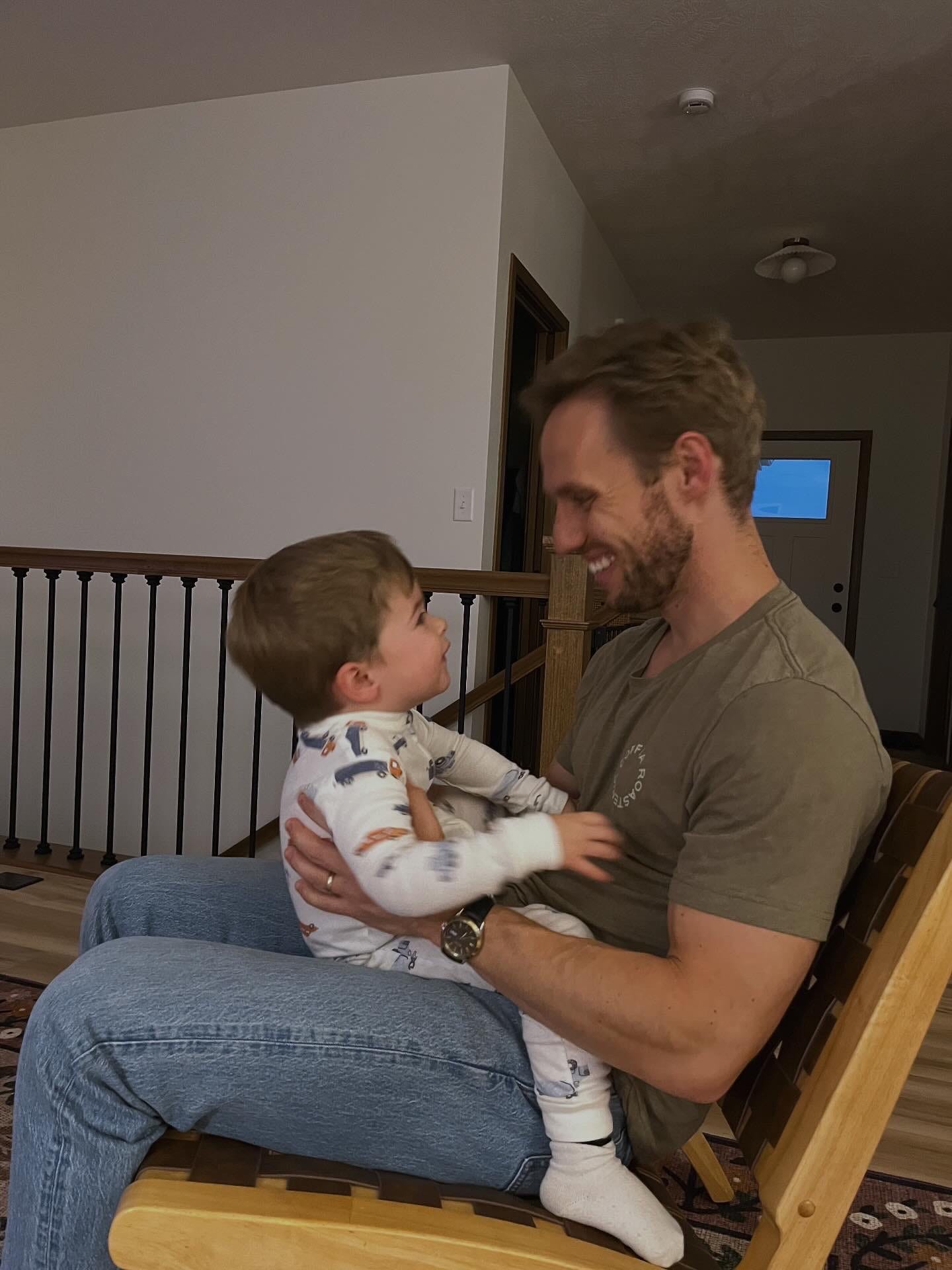
“See what kind of love the Father has given to us that we should be called children of God; and so we are” (1 John 3:1).
It is also true that his biological mother “made us parents” through her sacrificial choice of adoption, but that is another essay.
Exodus 4:22; Deuteronomy 14:1; Jeremiah 31:9; Hosea 11:1
No posts
Comments
Nothing yet. Say the first thing.
Sign in to join the conversation.