
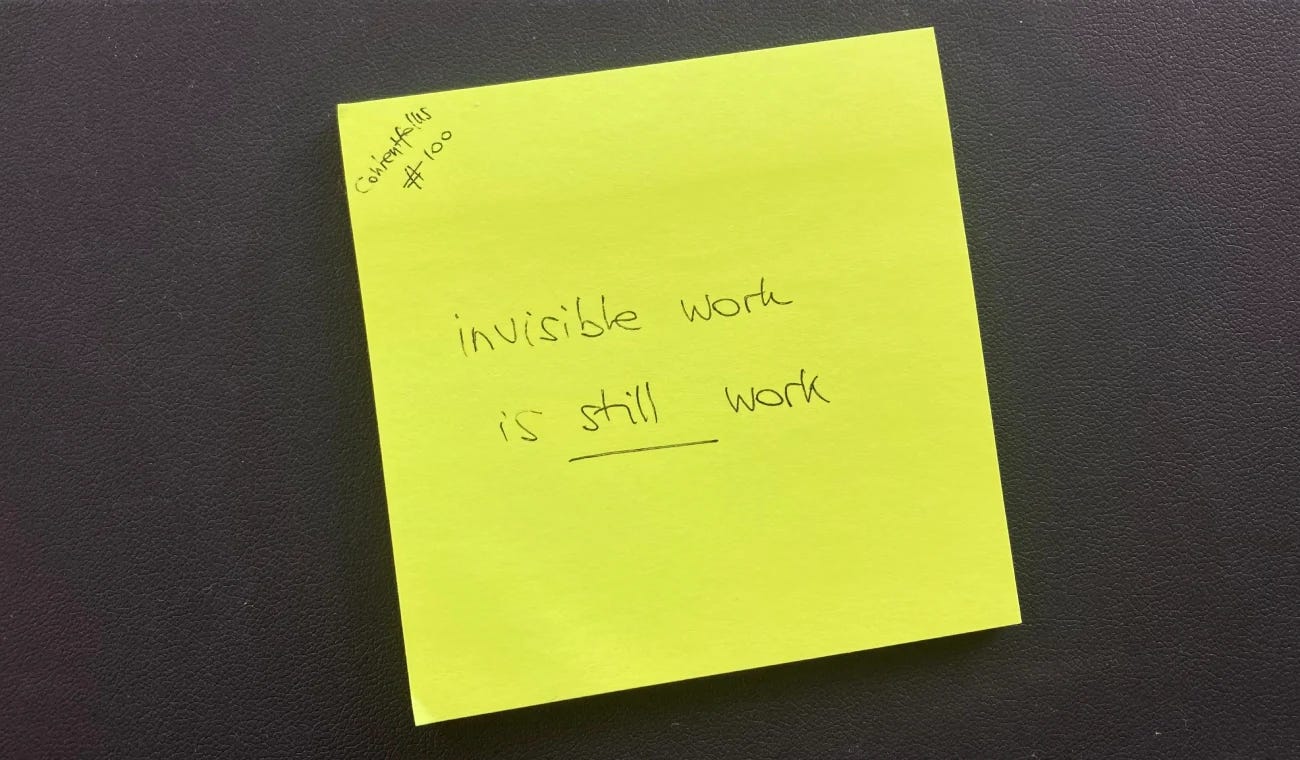
You are reading contentfolks—a monthly(ish) blend of sticky notes, big marketing ideas, and small practical examples. Thank you for being here! ~fio
Hey there 👋
Imagine this: you just finished a house renovation and invite your friends over to see the result. They ooooh and aaaaah at the new wall colours, marvel at the bright sun room, praise the custom furniture, and even compliment the art on the wall.
Then, they leave—and the real job of maintaining the house begins. From now on you will hoover, mop, dust, wipe fingerprints off light switches and mirrors, change lightbulbs, get the boiler serviced, oil the wooden floor, touch up the scuffs on the wall, on and on and on and on...
…but nobody ever comes back to marvel at the unclogged drains, the tight doorhandles, or the dust-free shelves. Maintenance is invisible, ongoing, and hardly glamorous—and it doesn’t often get noticed or praised, even though it is literally what keeps the house running.
Which is a convenient metaphor for how most of us spend at least some of our time doing the invisible, ongoing, and hardly glamorous work that holds everything together. Things like:
Refreshing old but high-value pages
Replacing broken links
Updating naming conventions
Aligning CTA tone
Fixing broken embeds
Writing internal documentation
Replacing outdated product screenshots
Etc.
Etc.
Etc.
None of this is ever as ooooh and aaaaah-worthy as a website redesign or a brand campaign launch—and yet, a lot of it is essential to keep things going.
One of the mistakes I made early in my career was to treat this work as obvious. Because of course it was obvious to me that you don’t just set-and-forget a content system, that things will break without upkeep, and that maintenance doesn’t happen on its own.
You know who it wasn’t obvious to, though? Everyone else who was not in the weeds as much as I was, including (and especially) leadership. This was tactical, routine work that didn’t feel worth mentioning. I just got on with it—and because I rarely brought it up, it stayed mostly invisible. The lesson I learned: if you don’t actively surface the work, people might assume there is no work.
Now, I tell people. My maintenance and optimisation work is on the marketing roadmap; I have a quarterly ‘documentation update Friday’ block in my calendar; and you better believe my manager was in the loop last week when I spent half a day fixing 404s, cleaning up redirects, and manually building internal links across our commercial site.
If you’re ever doing any of this unglamorous, behind-the-scenes work, don’t make my early mistake: don’t assume it’s obvious, don’t assume it’s seen. Tell the folks who need to know that things don’t just run smoothly on their own. Someone’s doing all the maintenance—might as well make sure they know it’s you 😉

No posts
Comments
Nothing yet. Say the first thing.
Sign in to join the conversation.