

In a special Content Aware takeover, DJB Strategies' Audience & Product partner Harry Clarkson-Bennett looks at the problem large and established media brands face in grabbing the interest of younger audiences. While it's easy to point the finger at AI for a decline in engagement, research shows the problem is more down to habits and preferences than down to answer engines and overviews.
Some stark new facts have reveal much to ponder for publishers wishing to bring younger audiences to their door. AI bot traffic grew 187% between January and December 2025, while human traffic grew just 3.1%, together showing how the economics of the open web are changing rapidly.
LLMs have accelerated this change, but audience behaviour - particularly among Gen Z and Millennials - has been shifting for years, pre-dating the rise of AI answer engines. Today’s 18-34-year-olds spend more time online, yet are less interested in news and publisher brands than any previous generation. For younger audiences the feed has replaced the homepage, and while AI has accelerated the shift it didn’t create it.
To understand the scale of the challenge, we at DJB Strategies analysed Similarweb audience data across 15 leading UK publishers, comparing 18-34-year-olds with audiences aged 35 and over across a three-year period.
We saw that in every publisher segment, younger audiences declined faster than older ones. Overall website traffic fell by between 12% and 32%, but younger audiences fell faster still, becoming a shrinking slice of a shrinking pie. The steepest declines were among popular news publishers:
Popular: down 34.2%
Premium: down 30.7%
Public service: down 16.9%
While observational third-party audience data has limitations, particularly around estimated volumes and the exclusion of app usage, the direction of travel is consistent: younger audiences are moving away from publisher websites.
The problem isn’t limited to younger audiences. Habitual publisher traffic - users who visit directly or search for a publisher by name - is also declining. Across the same Similarweb dataset, direct traffic declined in every publisher segment over the three-year period:
Popular: down 33.1%
Premium: down 23.4%
Public Service: down 19.9%
The same pattern appears in branded search too. Google Trends show sustained declines in searches for publisher brands - one of the clearest indicators of audience habit.
From a 2013 benchmark, all the major publishers have seen a decline in searches which use the title name in queries, of between 60% and 91%. Correlation isn’t causation, but the scale of the decline is difficult to ignore.
Across the most recent 2023-2026 window, branded search declined by between 25% and 56% for every publisher with sufficient search volume to measure. The Daily Mirror fell furthest (−56%), followed by The Sun (−54%). The remaining titles either recorded smaller declines or had insufficient branded search demand to produce a meaningful trend.
Rather than being a new phenomenon, publisher loyalty has been weakening for years.
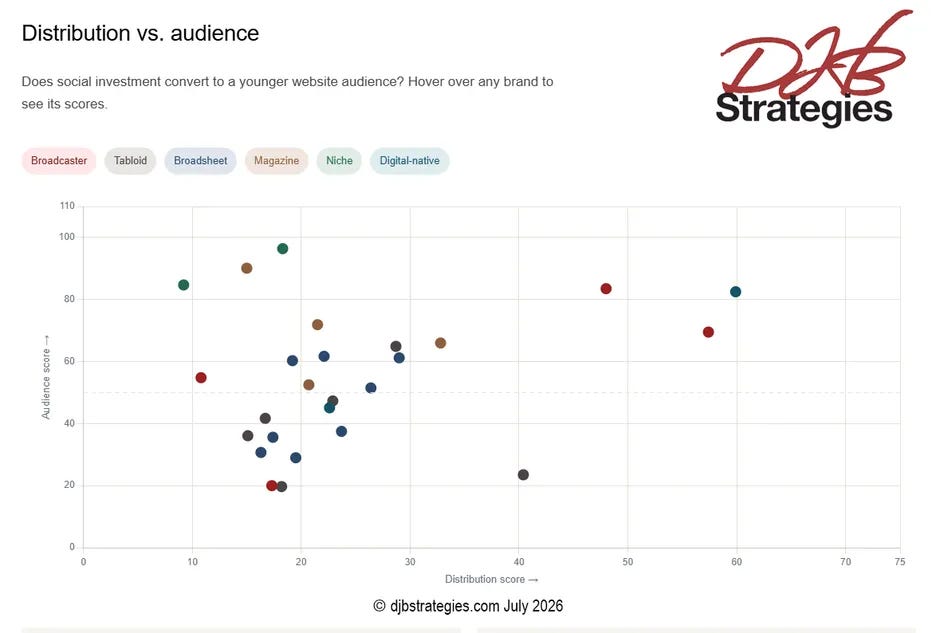
To understand what separates the leaders from the rest, we created the Emerging Audience Index. It combines independently sourced audience, engagement and distribution data into a comparative view of younger audience performance across more than 25 UK publishers.
1. Retention separates the leaders
The strongest publishers know how to attract and retain younger audiences.
Among the highest-performing brands, younger readers behave almost identically to older readers once they arrive. Among the weakest, they spend almost 40% less time on site, view 22% fewer pages and are 13 percentage points more likely to leave immediately.
The challenge isn’t simply attracting younger audiences, it’s also about giving them a reason to come back.
2. The leaders build portfolios
The strongest publishers - Sky Sports, LADbible, and the BBC - create more opportunities to be discovered.
On average they and other leaders operate twice as many specialist social brands, and cover 50% more content categories than the weakest performers.
Younger audiences increasingly discover content through specialist interests rather than broad publisher brands, and recommendation systems reward that.
3. Wider distribution doesn’t guarantee success.
While sheer scale matters, it’s not the decisive factor in winning the interest of younger audiences.
TechRadar is a good example of this. It has the youngest audience for its website in the study despite operating just six specialist social accounts, one of the smallest footprints in the Index. Good Food demonstrates the same principle.
By contrast, several publishers with some of the largest social ecosystems perform comparatively poorly because their younger audiences engage less deeply once they arrive.
The lesson seems to be that content still matters more than anything, particularly the right content. Distribution creates awareness, but it is product and personalisation which create loyalty.
The evidence suggests publishers don’t simply have a younger audience problem, but rather they have a habit problem.
Build around people, not publications. Younger audiences increasingly follow individuals rather than institutions. Our advice is that publishers should explore and develop recognised voices, creators, and specialist products alongside the master brand.
Design for repeat behaviour. Habit is no longer something to be taken for granted. Cater to the choices an audience wants, with audio, video, newsletters, games and other return-driving products which create engagement that compounds into long-term commercial value.
Treat product as a strategic capability. Editorial quality remains essential, but the product experience - personalisation, recommendations, notifications, and things like newsletters - are core audience capabilities rather than product enhancements.
Own the customer relationship. As search and social become less reliable acquisition channels, registered audiences and first-party data become hugely important strategic assets which strengthen loyalty, and bring better personalisation capabilities and greater commercial resilience.
When looking at where it might be going wrong, look past the end goal of how to reach younger audiences to firstly focus on where it is in the audience journey that you are losing them.
While some publishers have an awareness problem and aren’t well known among the younger audiences they want to reach, others are well-known but have a retention problem. This is really important to dig into because the investment priorities are entirely different.
The right response depends on where you see that gap. Good ways to learn that are by benchmarking things like audience composition, social distribution, and on-site engagement, to analyse the habits and journeys of those who do engage with your content so you can see first and foremost if the issue is awareness, retention, or both.
There is no doubt that AI has made these conversations more urgent, but it didn’t create them. Publisher habits have been weakening for years, and younger audiences which have grown up in vastly different media landscapes than 10 or 20 years ago increasingly discover content through interests, individuals, and algorithms rather than institutions.
The evidence shows that the publishers which are adapting most successfully are out there building the right products, in the right places, and with the right content experiences younger audiences actively choose to return to.
I think we have moved beyond being able to rely on inherited loyalty being able to underpin the future of existing titles, or driving growth. What is clear from our research is that a well-designed product and experience, alongside content that strikes the right note, matters most.
The good news for brands of all sizes is that is something any of them can do. But they have to do it.
LINK: THE EMERGING AUDIENCE INDEX
To speak with us about our work with publishers, or for access the data and insights in the DJB Strategies Emerging Audience Index, drop me a line at harry@djbstrategies.com
Harry Clarkson-Bennett leads DJB Strategies' audience practice and its product practice. Most recently SEO Director at The Telegraph, Harry brings more than a decade of audience leadership across agency, affiliate and publishing. He advises clients on defending and growing audience as AI remakes search, and builds tools media leaders can use every day. He writes the Leadership in SEO newsletter and contributes to Search Engine Journal and Lumar.
Promo image credit: Alamy
FURTHER READING

End the workaround era
A sports editor with nowhere to put match scores will use the body field, while a site user who wants to filter results by scores is going to be frustrated as the site can't filter free text. A common problem, with a common cause: the CMS treats every piece of content as identical. Glide's innovative Article Types give each content type its own super-definable fields, workflows, taxonomies, and API output, so editorial teams stop forcing structure by hand and the front end stops guessing what it's been given. When a CMS knows what's in it, things are much easier.
Read
Zawya launches on Glide
Middle East and Africa business news site Zawya.com has launched on Glide, making it the fourth London Stock Exchange Group (LSEG) title to run on the platform. The migration moved 4 million articles (including a back-catalogue stretching to 2005), consolidated six upstream news feeds into one workflow, and connected bilingual English-Arabic publishing across editorial teams in three countries - all managed from one CMS instance. Zawya joins DealWatch, IFR, and PFI, meaning four financial-markets publications serving four continents in three languages now share one authoring environment.
Read
Human voice beats AI
The UK Association of Online Publishers (AOP) has a new study which looked at the impact of AI overviews on traffic. It's not good. The long-term AI Publisher Impact Study tracked 10.8 billion pageviews across eight major UK publishing groups, revealing that organic Google Search referrals fell 7.1% in a single quarter in 2025, the same in which Google's Search revenue grew 12%. If the trend continues, pageviews from Google will be halved by Q3 2027. Not everyone is in the same boat though: news publishers saw only (!) a 5% decline, and consumer and B2B sites dropped 18%, while how-to and guide content fell over 20%. On the upside, opinion, commentary, and interviews content managed to actually grow - the non-AI stuff. As is surely now default thinking in publishing and media, content which has an explicit human touch and point of view can deflect AI substitution the best, while things a chatbot can clone or summarise easily are most at risk. AOP boss Richard Reeves dives in.
Read
Engagement IRL
According to a YouGov study, over a quarter of UK adults believe their media consumption negatively affects their wellbeing, with the biggest complaint being spending way more time than they plan to. It hits younger adults worst, where nearly half of 18-24 year olds report sleep disruptions and reduced attention spans. The report is the fourth in a series on media consumption habits, having covered TV, streaming and social media usage, short-form vs. long-form video consumption, and whether smartphones impact attention spans.
Read
Bans, quinze, et scans
France has become the first EU country to ban social media for children, specifically the under-15s. The bill passed this week also bans mobile phones in high schools, with carve outs for accessing educational sites and sources, and is due for enforcement from the start of the new school year in September. Typical enforcement questions remain over how to verify users via techniques like face scans and ID matching without causing more harm than good.
Read
Is the newspaper editorial vanishing?
Pulitzer nominations for newspaper editorials have dropped from 101 in 1995 to just 25 in 2026, and now being merged into a broader category on opinion pieces. Some of the largest US newspaper companies have already pulled back, with one of them, Gannett, saying how editorials were an oft-cited reason for cancelled subs. Opinions may be free, but they rarely come without cost. A former USA Today editor-in-chief claims the reduction represents a loss of newspaper soul and proposes a low-cost alternative for newsrooms still holding power to account, particularly as research shows most Americans still value press criticism where it's needed. Nieman Lab shares more details.
Read
The technical SEO checklist
The list of technical checks and improvements for better SEO never quite ends - so how do you prioritise? Clearing 301 redirects, taking milliseconds off Core Web Vitals, and removing ancient meta keywords might all be on your list, but will they be worth it? Search Engine Land suggests you should meet at least one of three criteria: directly impact revenue, enable other work which impacts revenue, or prepare your site for AI-driven search, and overall prioritise what's needed over what's most obvious.
Read
No more Mr. Nice EU
The EU Commission has published guidelines on transparency obligations for providers and deployers for the EU's AI Act, which come into effect on August 2nd. Providers must let users know when they're talking to a chatbot, watermark AI-generated media, disclose deepfakes, and label AI-generated text on public interest matters unless a human has reviewed it. Standard editing tools such as spelling and grammar correction are safe, but anyone with a consumer-facing bot, image generator, or voice tool in Europe has a small window to get their affairs in order.
Read
Bin there, done that
Books data company ISBNdb is helping AI labs get their hands on guaranteed slop-free books from before the AI era, pre-2022, at up to a million books per order. They are then scanned, shredded, and recycled, which according to a federal judge makes the practice legal fair use because the originals were destroyed. The company has strict NDAs to make sure buyers stay anonymous, as the words "AI company" and "destroys books" isn't likely to generate good headlines. Rare book sellers report huge bulk orders since April, while ISBNdb believes that what they're doing is not literary or knowledge destruction, but merely the book completing its lifecycle. 404 Media shares more.
Read
Another WordPress attack
Two chained vulnerabilities in WordPress 6.8 and 6.9 allowed unauthenticated remote code execution on stock installs, no plugins required. Patches were released Friday, but exploitation began on Saturday and by Sunday researchers found tens of thousands of attempts and over 100 backdoor admin accounts. If you waited until Monday to patch, check how it went. While WordPress did force auto-updates for affected sites, users should still check for any rogue admin accounts, malicious plugins, and suspicious files.
Read
Billions for piracy, not copyright
A federal judge gave the final approval to Anthropic's $1.5 billion settlement with authors and publishers, the largest in US copyright history. Each work will get around $3,000, with the estimate being 500,000 titles. The issue for many creators is the fact that the judge ruled that the training of AI on copyrighted text is fair use - the issue was the way Anthropic got the works, and not how it used them. Other lawsuits, against Google, Meta, Midjourney, and OpenAI, are still ongoing.
Read
A double-edged ruling
A US federal court has axed Google's lawsuit against SerpApi, a company that scrapes Google's search results, rejecting their attempts to use the DMCA to control who has access to publicly available pages. SerpApi called it a win, but for publishers who are watching, the situation is a bit uncomfortable because if public pages can be legally scraped - even with the owners objection - then the same logic protects AI companies who want to scrape publisher content.
Read
Sony doubling down on lawsuits
Sony Music has filed a second lawsuit against Udio, claiming that 30,117 sound recordings have been copied for training, without any permission. While during Discovery in the first trial from 2024, Sony has used audio fingerprinting and found only "a small portion" of what they claimed was used, however Udio has admitted that its models were trained on a large amount of recordings which "presumably included" some of Sony's catalogue. While Universal and Warner already settled with Udio, Sony is still holding its ground and seeking up to $150,000 per work infringed.
Read
Four studies, one message
Four different studies published in July, conducted by Manifold, Promptarmor, Semgrep, as well as a team of independent researchers, have reached the same conclusion: while the AI models all behave differently, they are plagued by common security failures.
Read
Pop slop splurge purge
Over the past year, Spotify has removed more than 75 million "spammy" AI-generated tracks. The company has nothing against authorised remixes, AI-assisted mixing, and legitimate AI compositions, but it does have beef with mass uploads, fake metadata, voice cloning, and artificially short tracks designed to grab the royalties. As the detection improves, so will the spam operations, blending in minimal human edits to evade filters.
Read
Comments
Nothing yet. Say the first thing.
Sign in to join the conversation.