
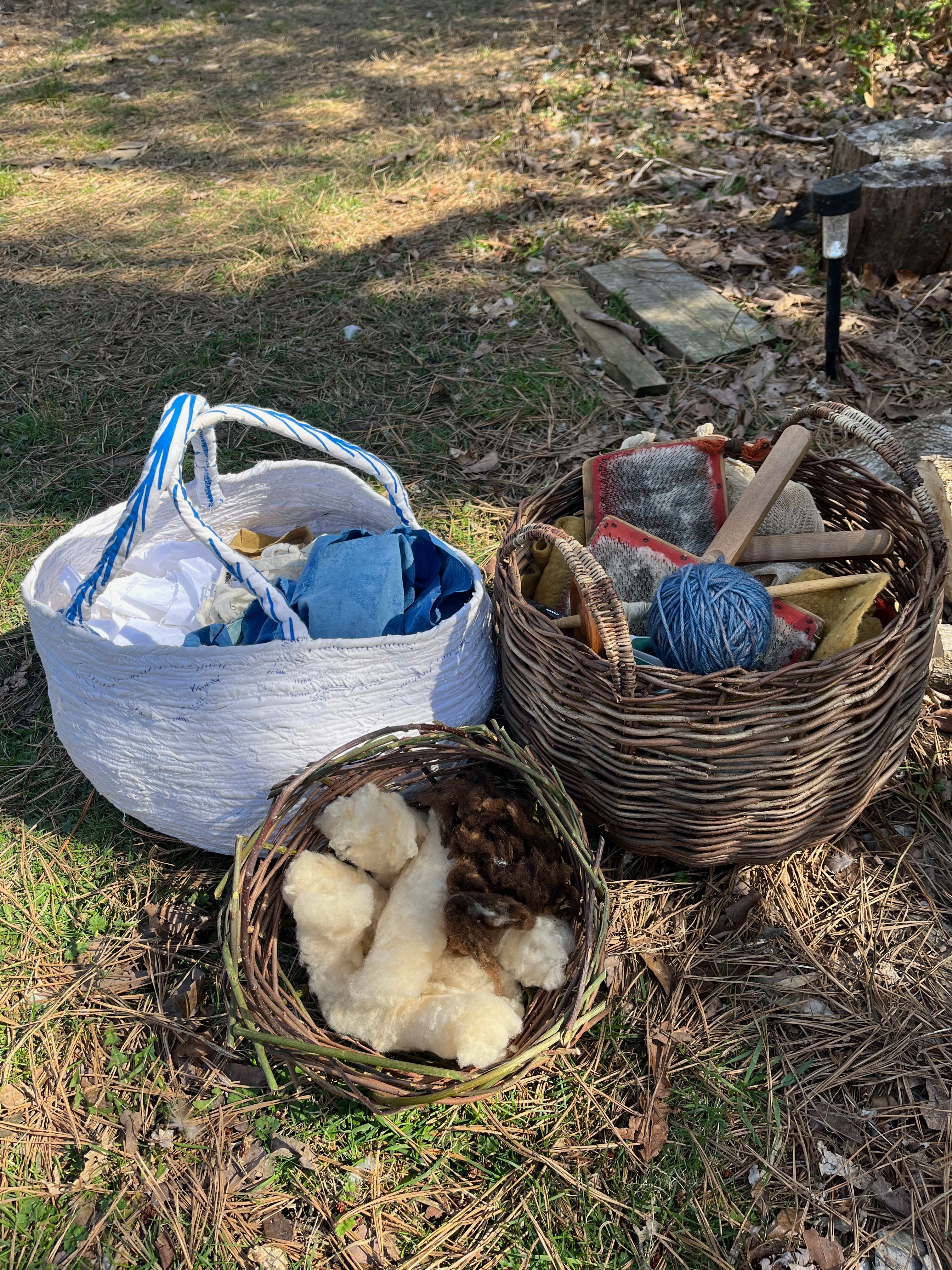
Note to the reader: On instagram today I was remarking on how my practice is really just sticks, sticks for dye, spinning, knitting, not to mention baskets. With community encouragement I share my unedited essay from my masters degree. The class theme was Baroque art, thus the odd adherence to a particular time theme and my slippery ways of curving the topic into things I am actually interested in. Perhaps someday I will author an essay called approaching a comprehensive theory of stick aesthetics. Also I talk often with dear Taylor of thicket chaos theory and would be remiss not to link to her work.
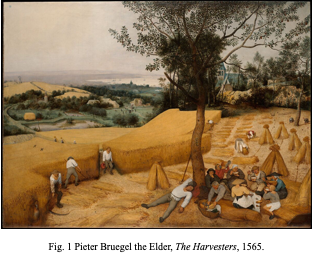
A craft historian looking at paintings of the Baroque period would be hard pressed to find evidence of peasant-tended land. As wealth and land were consolidated in the trajectory toward colonial market capitalism, evidence of peasant life in wane, especially in painting. Farm fields would provide evidence of land tending like the peasant life of Breughel’s The Harvesters (1565), though these harvest scenes were largely left in the late Renaissance. Landscapes of the era depict vast swathes of nature rather than the patchwork of farm field and cultivated nature that made up the European landscape. As the economic and ecological character of western Europe was shifting, the attitudes about land itself and evidence of agriculture waned in favor of other painted themes.
Prior to the Renaissance and Baroque periods. Much of Europe was organized into kingdoms that were controlled by one lord and were tended and planted by peasants, tenants, and serfs. In the feudal states, a commonperson’s relationship to land was through a process of cultivation. As Craig Pearson and Judith Nasby write in A Cultivated Landscape, “It was beyond the wall gardens of the manors, palaces, and monasteries where human activity had the greatest impact on the landscape. Manors and clusters of hut dwellings for peasants and animals were embedded in widely cultivated landscapes.” Much of the land was thus tended and adjusted to fit the needs of its inhabitants. Though land was owned by the lord, land use was shared among the peasants and the lord was responsible to them. Nature is not a conglomeration of all things other than human, which is generally the western perception. Much of the “nature” of Europe even at the time was highly cultivated, resulting from the boom of agriculture in the 11-14th centuries and the desertification of European landscapes. The population boom decimated Europe’s native woodlands for firewood and changed the character of the land. The baroque period saw continued heavy use of land products like timber to support growing city centers. Painting was studied and taught in city centers too, which were supported by the unseen agricultural labor of the peasant class.
Wealth, which was consolidated throughout the Renaissance and into the Baroque period, bought one proximity from “true nature.” Peasants grow medicinal herbs and food in gardens near their homes. The garden movement was a product of rising interest in horticulture and the consolidation of wealth. This is seen in the gardens of Versailles, sprawling estates, the enclosure movement and the rising popularity of the lawn. Enclosure was a slow process of coercing peasants off their land and consolidating it into lots of hundreds of acres that were owned and controlled by lords. Where once, peasants shared common land in exchange for work, money instead of labor was becoming the primary form of exchange.
The Baroque period is known for history and genre paintings, especially those that emphasize Christian morals and middle class values. Nature became something other than itself, transmuted into a symbol rather than as a pure depiction. Painting of the period was considered to be a mimesis of the natural world. Painting, which can lean from pure representation into romantic ends, was liberated from the realm of pure reality and therefore never included the reality of the land and nature. Though nature is consistently transformed to meet human needs, Baroque painting emphasized a form of nature that was allegorical, merely a backdrop for middle and upper-class scenic depictions, historical paintings, and subjects that were dressed up for high class consumption. The work of the period is also characterized by a romantic flair for the tended landscape. Still lives and other paintings that include baskets can be a stand in for the material culture of peasant life, practice, materials and tended land in the Baroque period. By examining the materials and weave of baskets in still life painting, we may better understand the interaction between craft and land in the Baroque period.
Baskets are found in all cultures and traditions. Prior to metalsmithing, weaving, and ceramics, baskets were used to carry water, food, and to cook in. During the Baroque period, cloth was difficult and laborious to produce. Baskets were most often used for carrying food and other items. Particularly in the Baroque period, wicker became popular for use in furniture, especially for baby cradles among the wealthy. In the 17th century, baskets were used not only of hyper function purposes (fish snares, harvest vessels) but also for more fashionable ends, as the purses or carrier bags of today. There are many different styles of basket and many materials that are able to be woven into baskets.
Wicker, a woven pattern, is divided from weaving willow. According to the Oxford English Dictionary, a basket is “a vessel of wickerwork, made of plaited osiers, cane, rushes, bast, or other materials. Bast is flax, hemp, jute and similar plant fibres. Osiers or withies are specifically flexible willow twigs or branches.” The terminology can be intermingling and at times interchangeable, but this description is useful to understand basket architecture, that is how they are made and the materials they are made with. Baskets are made with many different techniques, some of which involve the counter-twisting method of making cordage and other the use the properties of straight fresh twig shoots.
Much of osier is purposefully cultivated by coppicing willow, hazel, or dogwood on a short yearly cycle. Coppicing and pollarding are similar practices of cutting a tree either to the ground or to above grazing animal head height respectively. In searching for evidence of peasant activity on the landscape, in addition to farmfields, I was searching for trees that have the knobbly appearance of pollarding, and I found two within the period.
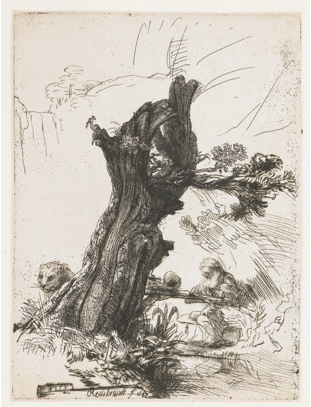
Different trees respond better or worse to this kind of treatment. Willow is particularly receptive to this cycle of cutting. In coppicing, the tree is cut to the ground in winter, when all the energy is stored in the roots during dormancy. In spring, the tree sends its energy into producing shoots for maximal leaf production. The shoots tend to be quite long, reaching up toward the sun. These sticks are flexible and have a higher water ratio than older woodier sticks. William Bryant Logan explores this altogether lost practice in his book Sprout Lands, writing,
Not only are sprouts ‘important’ in pruning, I found, they are the reason there are any trees or shrubs at all, and they are the reason that there are any people at all. For all but the last two centuries of human history, the whole point of pruning was to produce sprouts … for when these sprouts grew up they gave people firewood, charcoal, building wood, ship timber, fence posts, slender willow whips (called withies) to tie knots with, hedges, fodder, fiber, rope, and baskets … without them, human beings would not have made it past the Neolithic.
Baskets are still made from cultivated plants, though the craft like much of creation in this current global climate is obfuscated through a series of mechanical processes that have severed the tied between hand and land wince the industrial revolution. Peasant interests and the changes the land people experienced through the long shadow of history are worth studying alongside the elevated and canon visual culture because we live in a time that calls us to pay closer attention to the land, something that we have shunned since the conglomeration of wealth and power allowed us to. As Patrick Joyce writes in Remembering Peasants, “At one time, not so long ago in the greater scheme of things, the vast majority of people on the globe were workers on the land, so that it can be said that almost all of us are in one way or another the children of peasants.” This time of ecological devastation that far beyond the scope of our imagination calls us to the land, to recall our latent ancestry and practices. The time calls for basket making.
By examining the baskets found in still life paintings, a scholar interested in peasant material culture can begin to understand different craft techniques and materials, adding meaning to the interpretation of each painting and the class associations that the painter of each was interested in. Different styles, materials, and techniques of basketry offer incite into available and prized plant material and fashions of the Baroque period.
The first example is Judith Leyster’s Still Life with a Basket of Fruit (1635-40). This basket is propped up and highly staged with fresh fruit. It differs from the more extravagant still lives of the period and yet the basket is a very technical in its weave. The material is likely willow woven as wicker. The border is four rod wale which indicates the basket is made by an artisan and as such likely was expensive. Much of what we lose in an overly available material culture is the understanding that every material and item before industrialism was made by hand. This scene seems dated and as though it could be assembled from a thrift store. However, the basket at the time was likely a marker of wealth. the wicker of this basket is bright and even, suggesting that either a yellow varietal of willow was used or the willow’s bark was scraped fresh, prior to drying, resealing and weaving.
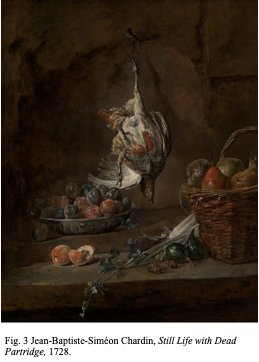
The second work, Still Life with Dead Partridge, has a rougher woven basket. The base of the basket is likely made from gathered twigs. The rim of the basket also indicates this, especially in the small, unclipped sticks and a simple three stick twist of the handle. The body of the basket appears to be made not from sticks but from reed or grasses of some kind that are twisted and woven in to the form. This baskets suggests that its construction is more utilitarian than the last which was highly ornate and stylized. The basket’s setting also indicates a lower class home with a dark stone background, dim light, and more common fruit bounty. The material of this basket point to the types of baskets found in peasant and land tending homes in the Baroque period.
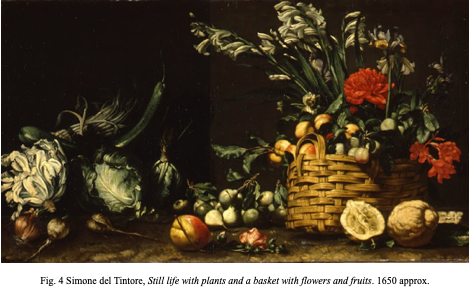
The next basket in this case study is Simone del Tintore’s Still life with plants and a basket with flowers and fruits. The basket in this still life is rendered very clearly. It is likely made from pounding young green wood (perhaps hazel) and stripping the wood layer by layer. I am reading the material as such over reed or another material because of the way in which del Tinore rendered the nodes, spots on the wood where new branches form inside tree branches. Though the weave of the basket suggests more commonplace use, the laborious process it take to make this type of basket indicates a more specialized and skillful hand made this. The surroundings of the basket also suggest a sumptuousness of material wealth. The overcrowding of fruit, flowers, and vegetables indicate ample resource or, at the very least, a bountiful harvest or growing season.
The final basket of this case study expands the range and style of baskets explored so far. Roloef Koets’ Still life with Parrot features a dreamy and lighter scene overall. Pink is at the forefront of the color presentation of this painting. The basket is arranged at an angle similar to the Leyster painting. This basted similarly is made from light or debarked willow or vine in a twining weave. The embarrassment of riches, jewels of fruit, and the parrot suggest a more globalized cultural knowledge and a higher class sensibility. This basket too was likely made by an artisan and has a tight, kept woven look to it.
The study of historic basket types, fashions, and material culture can allow artists and scholars to reconnect and understand a culture that is land based in a time where land has been forgotten and abused in the name of progress. While hardly comprehensive, this study aims to provide a brief overview for further scholarship on the interactions of land and class in European culture. While this type of study is not typical in the art historical discipline, interdisciplinary may provide more insight for a discipline to more inclusive of all types of material culture, rather than sorting them by class distinction.
I (in my artist hat) will continue to make baskets in Appalachia and learn more about types and materials of baskets and where they have come from. Even in Appalachia, there are different styles of white oak basketry that can place a basket to a particular county over another based on an overhand twist. The culture of basketmaking is global and has much more material to write on for a scholar in search of a better understanding of material culture.
Braudel, Fernand. Capitalism and Material Life, 1400–1800. Translated by Miriam Kochan. New York: Harper & Row, 1973.
Joyce, Patrick. Remembering Peasants: A Personal History of a Vanished World. New York: Scribner, 2024.
Logan, William Bryant. Sprout Lands: Tending the Endless Gift of Trees. New York: W. W. Norton & Company, 2019.
Pearson, Craig, and Judith Nasby. The Cultivated Landscape: An Exploration of Art and Agriculture. Montreal: McGill-Queen’s University Press, 2008. https://doi.org/10.1515/9780773574908

No posts
Comments
Nothing yet. Say the first thing.
Sign in to join the conversation.