
Snakes. Scorpions. Sharks. From a young age, Rachel Graham has always been interested in marginalized, "scary" animals. In this episode of Constant Wonder, she and host Marcus Smith discuss how she embarked on her quest to change people’s mindsets about sharks—fascinating and threatened creatures that regularly fill her with awe.
From being surrounded by a real-life sharknado to swimming alongside curious whale sharks, Rachel has had many peaceful, once-in-a-lifetime encounters with these megafauna. As part of her work with the non-profit conservation organization MarAlliance, she partners with local fishermen and coastal communities to protect vulnerable marine wildlife.
Rachel Graham grew up fascinated with the sea in Tunisia and has spent over 30 years working in marine conservation across Latin America, Africa, and Micronesia, partnering with organizations like the UN, the Smithsonian, and the Wildlife Conservation Society before founding MarAlliance in 2014 to advance grassroots marine science and conservation.
Based in Central America for decades, she has worked closely with traditional fishers to balance community livelihoods with the protection of threatened marine wildlife, earning recognition including the Whitley Fund for Nature Gold Award and a Pew Marine Fellowship. She holds a PhD on the whale shark from the University of York and says she's proudest of her two sons, who share her love of the sea.
Marcus Smith: I’m Marcus Smith and this is the Constant Wonder podcast. We focus on the wonder found in creation, anywhere and everywhere. Along the way, we meet amazing people whose experiences of awe inspire us to look for it constantly. A lot of wonder has shaped the life of our next guest, who is, among many other things, a lover of sharks.
But before we get to anything very specific about sharks, an icebreaker might help. So first, let’s hear just a little bit about snakes.
Rachel Graham: I really take my hat off to my mum, Christine, who said, “Sure, no problem. You can keep snakes. Just keep them in your room.” And I said, “No problem.” Except there was one evening where the boa got out, and my mother had organized a big party, and as everybody filed into the house, she said, “Wonderful. Here’s a drink, and we have a special task for everybody, which is: Rachel has lost her boa. It’s in the house somewhere, so let’s all go find the boa.”
Marcus Smith: The leap from snakes to sharks isn’t as big as some might think— at least, it wasn’t for Dr. Rachel Graham. All you have to do is see both animals in the category of creatures that humans tend to marginalize simply by not caring enough about them. As things turned out for Rachel Graham, she did not become a herpetologist, although she still loves snakes with all their relatives. Instead, she became a marine biologist, who by her own admission, has an affection for animals that many other people might find repugnant. If you happen to find sharks or vipers or even stinging or biting insects odious, despicable, well, there’s a chance she’s going to persuade you to give that up.
She makes a convincing case that it’s just not helpful, neither to them nor for us, to think like that. Her life mission seems to be to safeguard marine habitat where animals like sharks can thrive. And knowing she can’t do it single-handedly, she persuades others to join alongside her. In this episode, as you listen to Rachel Graham tell how she became fully absorbed in the lives and well-being of animals at risk, sharks in particular, I suspect you’ll get a little absorbed, too.
It’s almost inevitable because she’s so devoted to these creatures.
Rachel Graham: I think I’ve always been drawn to marginalized animals in part because I’m an only child and I’m very, very curious, and I make friends very, very easily, but I have a very strong sense of empathy and compassion, and I can never understand why people can be so utterly horrid about certain wildlife. Now we can include cockroaches in there. That’s where I draw the line. But with bats and snakes and sharks, of course, people have this horrific, irrational fear of them. And I like to try and understand why, especially when they’re really not out to get you and they’re highly evolved animals who are coexisting with us on the planet.
Marcus Smith: Rachel Graham’s sympathy is far-reaching across a number of at-risk species, from loggerhead and hawksbill turtles, to hammerheads and giant manta rays. I should mention skates and sawfish, too, close relatives of sharks and rays with their skeletons of cartilage. They’re all called elasmobranchs, but more about that later.
Rachel is founder and executive director of a nonprofit called MarAlliance, which works to preserve the habitats on which these and other marginalized marine animals depend.
A brief excerpt from the Jacques Cousteau theme song. To jog your memory, if you happen to be old enough, it was used in television specials that aired for a decade, from 1966 until 1976, and then, of course, for years afterwards in reruns. I watched a lot of those specials, as well as nature specials produced by National Geographic, and at one point, I became completely smitten by manta rays— although, to this day, I’ve never seen one in real life. If you have, count yourself exceptionally lucky. It’s just not the most common experience. And there’s so much to gush about just thinking about these elegant swimmers. Mantas have what you could call charisma and, as a bonus, their babies look like cute little puppies. They are, in fact, called pups. And few other sea creatures mirror the flight of birds so nearly. That happens when they fling themselves out of the water— they do indeed become airborne for several seconds.
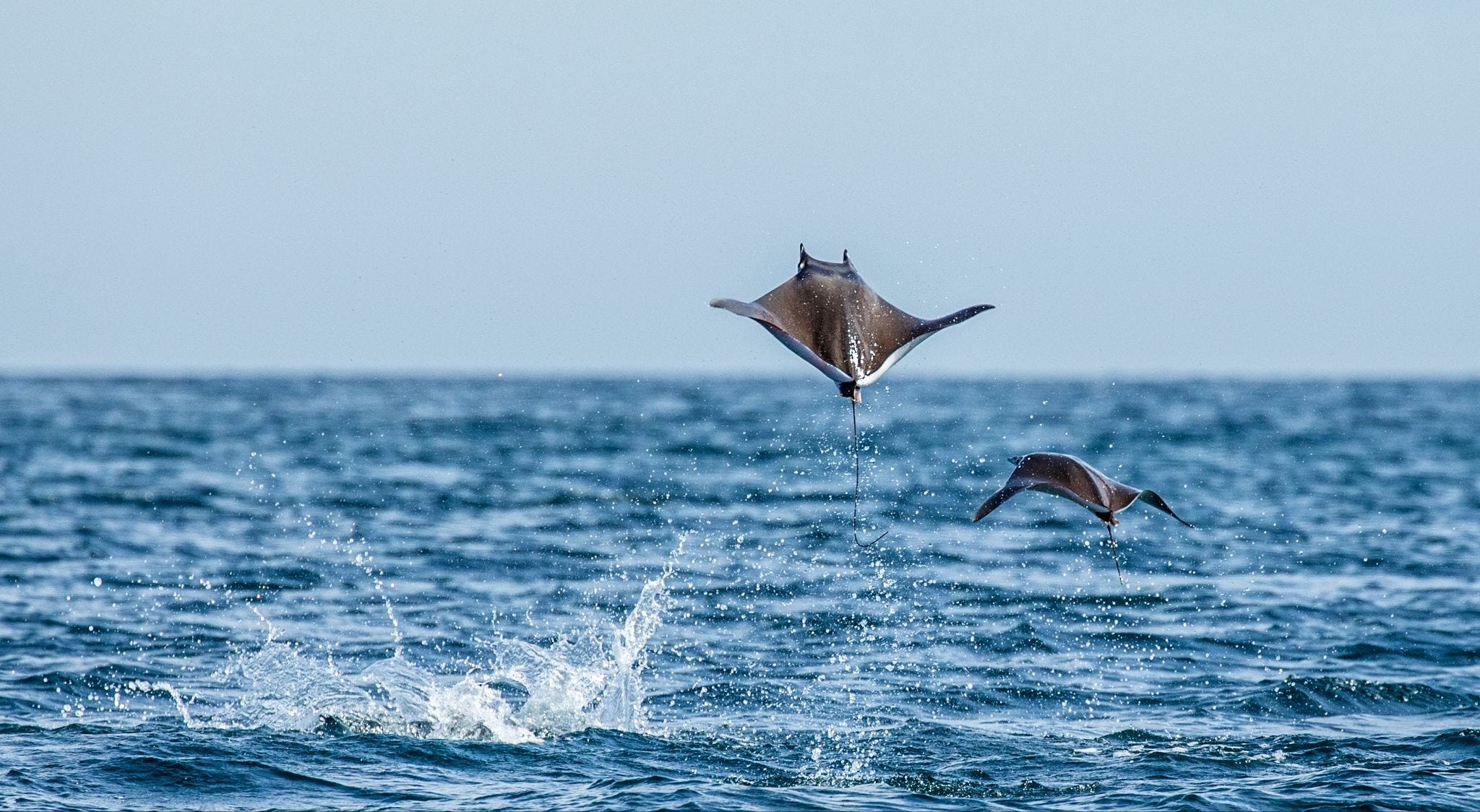
Now, I know I’m talking a lot about manta rays. Once you get going on it, you can hardly stop yourself. But at some aquariums, people are found around pools or tanks where you’re allowed or even encouraged to touch other species of ray. I’m not talking about mantas now. The only aquarium in the United States with manta rays is in Atlanta, Georgia. But at one of these hands-on tanks, smaller types of rays make their laps through the water, rising intentionally toward your outstretched hand as they pass you. I’ve seen this. I’ve touched these kinds of rays in aquariums. But I also happen to have a fond memory of seeing rays in the wild, so that’s where I began my conversation with Rachel Graham.
It’s about 1975. I’m a Boy Scout. I’m living in San Diego, California, and I’m in a canoe on the saltwater at a place called Mission Bay, and we’re just gliding across the surface of the water, and I pull up my paddle, and I’ve got another fellow scout behind me.
And with the paddles out of the water, for the first time I actually peer down to what’s below the canoe. We’re in shallows, and so it’s only maybe four to five feet deep at the very deepest, and I see a school of small rays, stingrays. I’ve never forgotten that. I’ve never been in that situation before that time, nor since.
That was just the one moment of my encounter with so many stingrays so close. That kind of a moment… I know that you have had many more of those moments than I have, just by virtue of the nature of your job, and I want to talk about a few of them. Maybe we go to Sinai first, just off the Sinai Peninsula, and an encounter that was, dare I say, life-changing for you?
Rachel Graham: Absolutely. The Sinai encounter was indeed life-changing. So Sinai is absolutely a magnificent place. It’s this incredible desert area that’s sandwiched between Egypt in the west, and then you’ve got Israel in the northeast, and Jordan in the east, and magnificent mountains that drop into a scintillating azure sea.
And you’d think, “Well, what could ever actually live there?” But once you actually put your head underwater, it’s this explosion of life and biodiversity. It’s a key biodiversity hotspot, and little did I know at the time that it also holds a whole host of great fish, big groupers, snappers, emperor fish, and sharks. And I’d heard about this incredible assemblage of gray reef sharks that would happen around December, January.
It was supposed to be a mating aggregation. And I thought, “Oh, sharks!” I’ve always been fascinated by sharks ever since I was a very little girl. And off I went with a dive group, rolled over backwards from the boat. Down we went, past the beautiful multi-hued soft and hard corals, purples and pinks and whites, and pushed away from the wall at a place called Ras Mohammed, which means ‘Mohammed’s head.’
And it is this one site that’s jutting out from the tip of the Sinai Peninsula into the Red Sea. And I’m looking, staring into the deep blue. I am at home. To me, it is my sanctuary. And little did I know— I hadn’t been diving for very long at that point, but I was so excited. But I turned around to look for my fellow divers, and then I turned back around to the deep blue, and the deep blue is now filled with sharks.
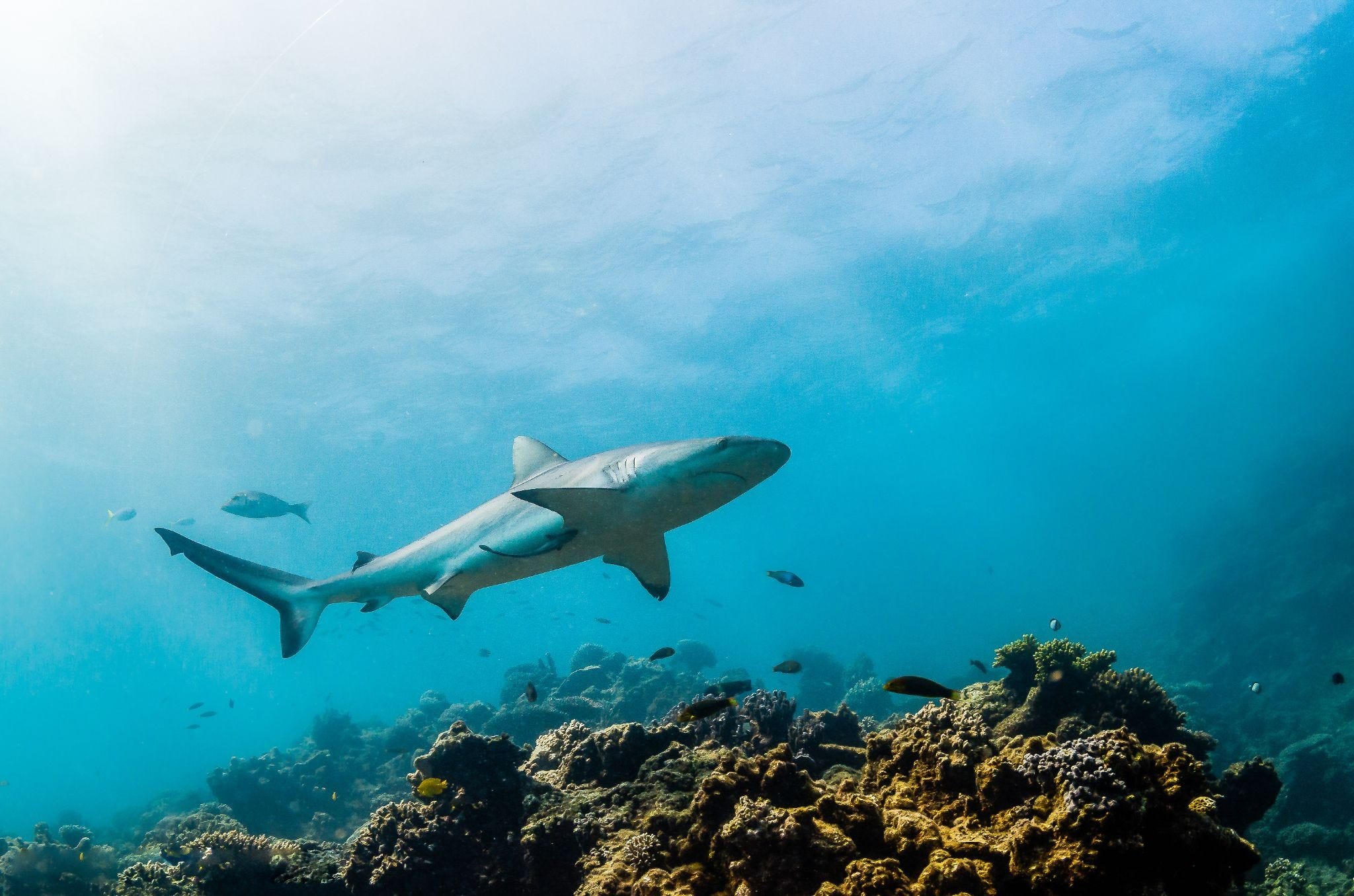
There were these gray reef sharks that were up to six and a half feet long, seven feet long, crisscrossing one another. And they start buzzing me and passing me by, inches away from my body, my hands, my feet, my face. But do you know something? I felt such calm and such relaxation and happiness. Nothing like what people describe in Jaws ever came through my mind.
All I could think about was how these sharks have had such a bad rap for so long. And that was the moment at which I said, my life, my future, it will be intertwined with sharks.
Marcus Smith: The way you just described it about the calm, the peace that you felt, you’ve also described this in the past as something that made you laugh.
Rachel Graham: Oh, yes. Sharks, oh, my goodness, sharks do make me laugh. They do have different characters, and I’ve had the really good fortune of coming across some sharks that are a little bit more bold and curious, and others that are a little more timid. I started my career with sharks, actually, with the biggest shark of them all, and I will never forget how the first whale shark I had an encounter with. It seemed like, “Oh, okay, my size is not intimidating enough for you? I’m going to be doing a jumbo 747 over your head, and see how that changes your perspective.”
And it did. I mean, all 25 feet of it just swam directly over my head, and it really felt like you were at the end of a runway and a Boeing 747 was actually lifting off over you. I couldn’t help myself. I wanted to touch it. So I lifted up my hand to try and touch its belly. And it couldn’t even see me anymore.
Its eyes were 12 feet down the other way. And yet, it sucked in its stomach. It could feel where my hand was. It sucked in its stomach, its belly, and it just made an indentation of where my hand would be so I could never actually touch it. And it just silently glided over my hand. And every time I tried to lift my hand higher to touch it, it would just suck in its belly a little bit more until it had swum away. And I said, “I’m hooked. I love these whale sharks.”
So in Sinai, my serendipitous encounter with 50-plus gray reef sharks in a mating aggregation was the first indication that, yeah, I think my life is going to be intertwined with sharks. But it took me several more years and many professional experiences before I found myself underwater again, working in a large international project looking into fish spawning aggregations, which is where fish come together in large numbers to reproduce.
And a lot of people may not know, but many of your snappers and groupers that you might find on your plate actually reproduce by letting go of eggs and milk in the water column, and then those eggs get fertilized, rise to the surface. And what we discovered was that whale sharks were coming in in fairly sizable numbers for that area, over 25, 30 animals, to gobble up that caviar near the surface.
And it was during that particular project that I completely fell in love with whale sharks, and we found out a lot more about this largest of fish.
Marcus Smith: Was it there near Belize where you talk about a whale that had the strange habit of poking people’s bellies with its face, its mouth or something?
Rachel Graham: Mr. Facey. Ah, yes, what an amazing whale shark, and I even managed to capture Mr. Facey on film. So whale sharks can be quite curious, and they’re certainly not really scared of anybody. The only things they seem to be rather scared of are orcas, actually, as we’ve come to discover more recently.
One day—he was about 18, 20 feet long—one whale shark came up. He was a juvenile male, and maybe looking for a date, who knows. But he came up and decided to swim directly towards my two assistants at the time, Julie and Mia. And he looked at them, gave them the small eye—an eye, by the way, which is indeed very small—and it’s a little bit spooky because they can roll their eyes back into their head. No kidding.
Rachel Graham: And he decided, “Okay, I’ve seen enough of them,” and swam over to me. And I’m there with my camera gear and everything, and he proceeds to park his snout right in my belly, and we’re at 70 feet deep. I’m thinking, this is a very odd first date. And he just sits there, 70 feet deep.
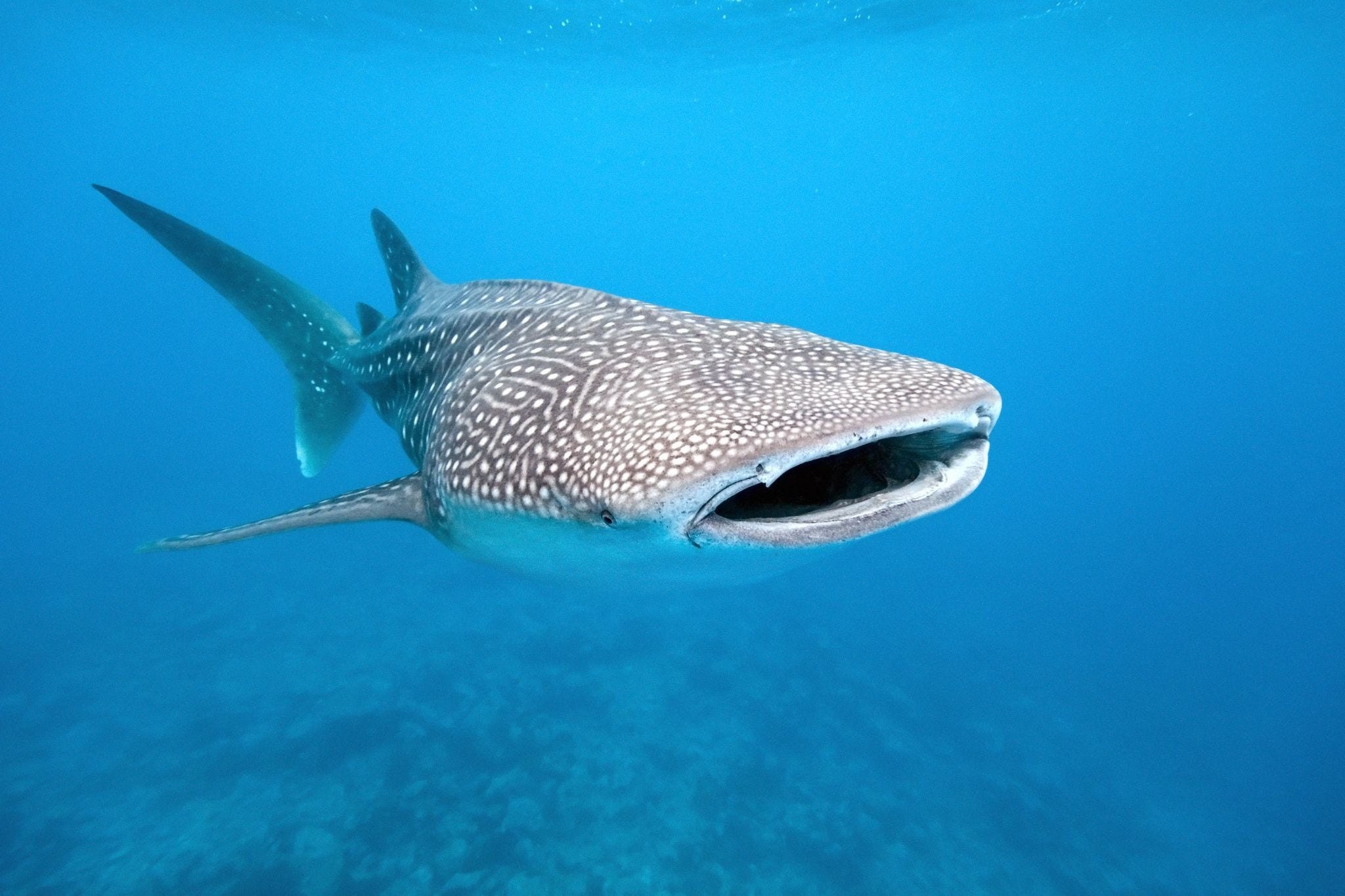
I love to do my Mr. Facey talk, which is, “Hello. What’s this?” And I’m like, “Dude, really, I need to move away from here.” But he wouldn’t let me go down or move to the side, so I ended up having to climb over his head. And that meant that I was literally crawling on the top of his lovely five-foot broad head that’s speckled with white dots and just lovely, lovely design, and pushing off of his first dorsal fin.
And do you know what? He just hung in the water with this kind of like, “Where’d she go? Oh, where’d you…” And then he’s like, “Oh, there you are.” And he’d swim back around, and he’d do the same thing to me again. And he did this three times until I practically ran out of air, and I found I had to go up to the surface.
So they can be very curious. They’re very attracted to electrical simulation, which he was probably getting from the strobes on my cameras, et cetera. But it was interesting that he did that to me, not to the assistants. And I love Mr. Facey, and we’ve seen him occasionally around the Western Caribbean.
Marcus Smith: Over time, Rachel got to know this creature better, and the name ‘Mr. Facey’ always seemed apt. It’s a description of someone who’s cheeky, someone with an attitude, and the name just stuck. She could recognize him every time she saw him, and not just by virtue of this cheeky behavior. Mr. Facey and every other whale shark out there has a unique spot pattern on the side of its body, almost like a thumbprint to identify every individual.
Rachel Graham: And because of that, over ten thousand animals have been identified worldwide. And in our region, through the work of many colleagues over the course of twenty years, including Mr. Facey, we know we have about two thousand two hundred whale sharks in the Western Atlantic.
Marcus Smith: Could you tell us a little bit about the anatomy of the whale shark as, as it relates to— if its face is near your gut, it’s not going to be able to really chew on you.
Rachel Graham: No. So whale sharks are, being the largest fish in the sea, remarkably, there’s an inverse correlation with the size of the food that they can eat. And usually they can’t ingest anything larger than the size of your finger down their gullet. And they are mostly planktivorous, and so that means that they’re straining plankton out of the water, and then they’re coughing it into their gullet and swallowing it.
They can also eat fish eggs. They eat small jellyfish, small squid and such. But really, they pose no threat to people. And so it’s a wonderful intro to the world of sharks to be able to actually meet a whale shark in person because there you’re overwhelmed with size, beauty, grace, like Mr. Facey, great curiosity, and yet at the same time, they haven’t the least bit of interest in you in terms of food.
And in fact, I’d like to stretch that out and just say the vast majority of sharks are really not in the least bit interested by people. And I think it’s worth mentioning that when you do have an incident or an encounter and unfortunately a very rare fatality, globally less than ten during the year, it often is mistaken identity or people are fishing in turbid waters and they don’t let go of their fish, and that’s usually how those incidents happen.
So whale sharks give you the opportunity to swim with the largest fish in the sea. It is a shark, and it will feed your sense of wonder and take you back to being a child.
Marcus Smith: Dr. Rachel Graham, shark lover, shark expert, one of the world’s most vocal advocates for the preservation of their habitats. She’s our guest for this episode of the Constant Wonder podcast. I’m Marcus Smith.
[BREAK]
This is not just fun and games. This is a serious business of tracking animals. Is the population going up? Is it declining? You’re doing science. I’m wondering, in that work you do, if it ever just becomes normal, or if you still have time to just sort of climb over the top of a whale shark and feel incredulous that you’re even there.
Rachel Graham: Every time I’m in the water with a shark, be it a whale shark, be it its closest cousin, the puppy dog of the sea, the nurse shark, or others, I’m still wowed. That wonder, that excitement never goes away. And by the way, I don’t climb on top of whale shark heads anymore. That was just under duress. I had no other option. I try to always tell people, “Hands off the wildlife, please.” But I have never lost that sense of wonder, the sense of curiosity, and in fact, I think those are two key elements to driving forward my work with sharks on a professional level, and this is very important to have that sense of wonder and curiosity.
Why? Because right now, the state of sharks is very poor indeed. 37% are now threatened with extinction, and sharks and rays, collectively known as elasmobranchs. And we have a lot of work to do to try and restore populations and rewild the seas with these incredible species, which count over 540 for sharks and over 650 for rays.
A lot of people don’t realize how diverse elasmobranchs are in terms of species. So I think you need that sense of wonder to keep you going, especially when you see the impact of large scale fisheries around the world on these species.
Marcus Smith: Never before have I had the opportunity to say the word ‘elasmobranch,’ so today is a good day for me just because it’s such a fun word.
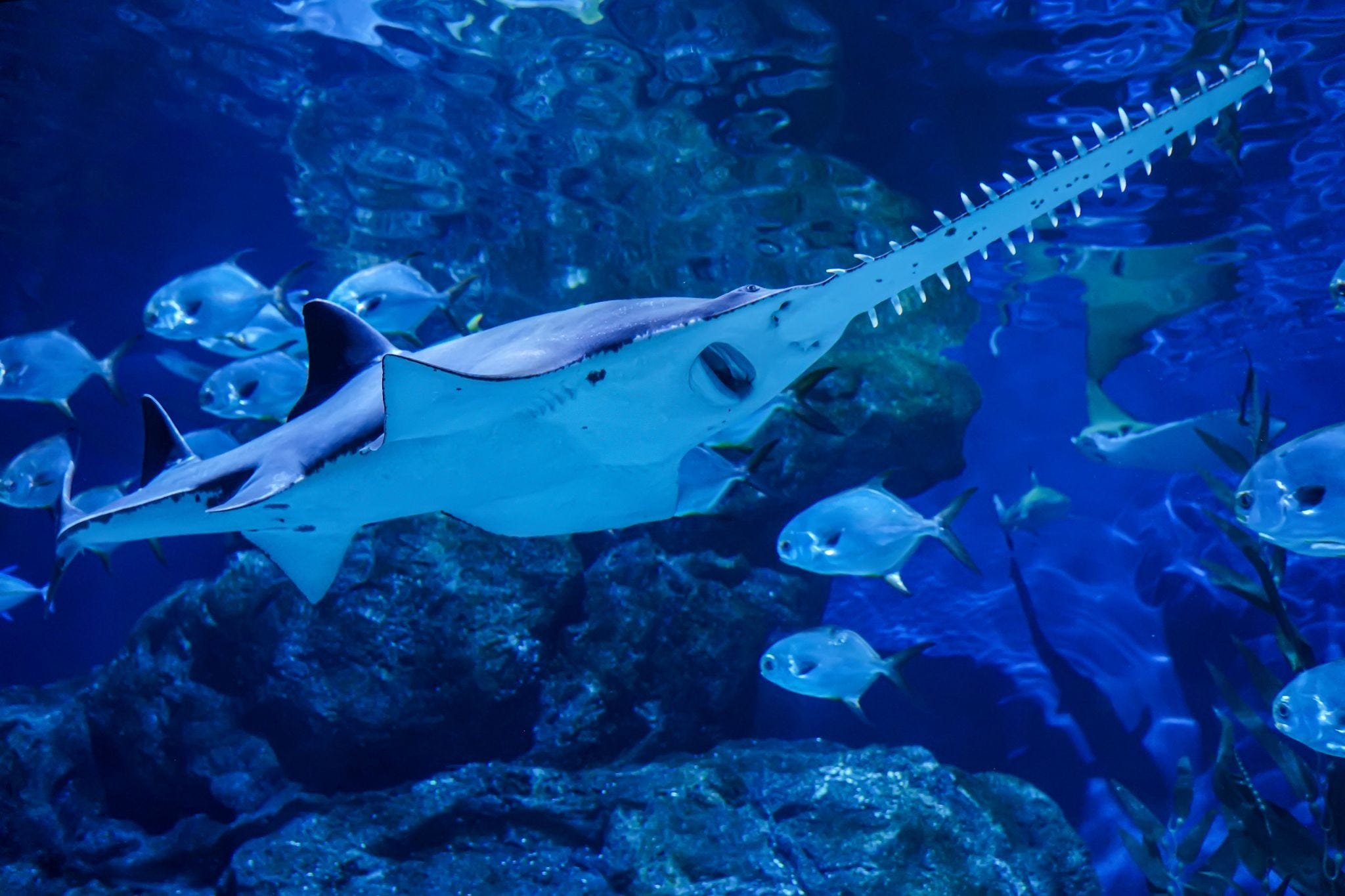
Elasmobranch. It has a specific meaning from Greek. It just means ‘a thing with gills that look like metal plates,’ or at least scientists who used Greek thought so. So just to reiterate what elasmobranchs are beyond that, we’re talking with Rachel Graham about a subclass of animals that includes sharks and rays, but also skates, and I cannot fail to mention the improbable elasmobranch called, for obvious reasons, a sawfish.
Rachel insists none of these creatures, with rare exception, is normally a threat to humans. But like many other people, I do fear stingrays, and sawfish, I’m assured, are docile, but man, that appendage for a nose that looks like the most wicked chainsaw anybody’s ever seen. It could easily bring on a nightmare or two.
Rachel Graham: All of these sea creatures have populations under intense pressure, many of them critically endangered. Elasmobranchs first emerged over four hundred and fifty-five million years ago, which makes them actually far more ancient than the early dinosaurs, insects, mammals, or even trees. But sharks and company are on the ropes now.
Marcus Smith: And if you know even just a little bit about ecological history, it probably didn’t have to be this way. A little story here just to illustrate why. In my youth, I was all but spellbound by an account of an expedition, the Thor Heyerdahl Kon-Tiki expedition of 1947. They went from Peru to Polynesia.
Kon-Tiki was essentially a raft of balsa wood with a sail. You may remember a 2012 motion picture about it all. The promotional images for that film featured an enormous, charming whale shark that bonded with the raft and swam along for quite some time. Far less charming was the attitude of the human seafarers toward smaller shark species.
Heyerdahl and his crew would reach into the water to yank shark after shark onto the deck to suffocate. He wrote that they were clearing the water of sharks to be on the safe side in case any one of us should fall overboard. Now, I’m not exactly sure how big that slaughter really was, but there’s another type of regularly targeted fish that first caught the attention of a horrified young Rachel Graham. It became an indelible memory for her that she’s told about fairly often. If you’ve never felt sympathy for tuna, Rachel’s story could upend that for you.
Rachel Graham: I think a lot of the work that we do, especially in the natural world and in conservation, has been shaped by some kind of visceral experience that we’ve had or some kind of a wondrous experience that we’ve had in our youth. I’ve been fascinated by marginalized animals for a very long time, and I include in that the sharks, the bats, the snakes, and more. But I’ll tell you something that was a gut punch to me.
When I was about seven— I grew up in Tunisia, in North Africa, and we were on the coast and watching the tuna run, and they have these… they’re known in Italy as mattanze. I cannot remember what the Arabic word is. But they’re setting out nets to catch tuna during their annual migrations, and what I saw was just this massive capture of incredibly frightened tuna, blood everywhere as they were clubbing them, and water and blood swirling around my legs. I was horrified. I could see men with clubs and nets, boats herding. I saw tuna in the water. That’s where I was seeing the blood, and hooks and clubs and it’s like those Game of Thrones slow-mo war scenes where, when you replay your memory, you’re just, Oh my goodness. Everything goes in slow motion, and you just see the violence of it and the gore of it.
Marcus Smith: The way you paint the picture, I’m imagining that they have gone out with their nets, and they were sort of corralling and pulling the catch closer and closer to shore so they can make the kill.
Rachel Graham: Yes. That’s exactly it. I mean, they were cutting off the migratory path, corralling the animals, and then trying to get them into ever shallower waters where it was easy for them to handle and to dispatch them.
I just remember very bright sun. I just remember very bright beach and just the general feel of… it was overwhelming. It was a gut punch. And on that point, I then learned that the next year… we were talking about maybe seeing the tuna, but I was too impacted by it. I didn’t want to. And then we found out that there were no tuna because they’d caught a vast majority of them in previous runs, and so there were no tuna runs.
Marcus Smith: You processed this as a seven-year-old, eight-year-old?
Rachel Graham: Yes.
Marcus Smith: You put together the fact that one year the tuna were there, the next year they were not there, and you had been there to see how the fisheries worked?
Rachel Graham: I didn’t process it. To that point, I had just heard that the tuna were not running anymore.
And, so of course, as a curious child, you’re like, “Well, why?” And this is a question that so many people ask, “Why aren’t the fish showing up? Why don’t we catch as much?” And I love what Daniel Pauly, who is an eminent fisheries and fish ecologist, said. He said, “Because we’ve eaten them all.”
Marcus Smith: And now that you’ve just said the word child, I do want to go back again here. As a child, bats, snakes, before you even got to sharks. And there was a room in your parents’ apartment where you said, “That’s going to be the animal room,” and your parents went with that? Describe that child.
Rachel Graham: An intensely curious child. Curious about everything. Being an only child also… yes, I had friends, but my friends were mostly in nature, mostly wildlife. But when we moved to Tunisia, we were in the middle of the old city, in Medina, in Tunis, and I loved animals, and my parents knew that, so they dedicated one of the rooms in this very old, sprawling apartment to the animals.
I had ducks, bunnies, hamsters, guinea pigs. You name it, I had it in there. Now, at that time, snakes were not on the roster, but I did have scorpions, because we would get scorpions from the Sahara. My ability to keep snakes happened a little later on, and I really take my hat off to my mum, Christine, who said, “Sure.
No problem. You can keep snakes. Just keep them in your room.” And I said, “No problem.” Except there was one evening where the boa got out, and my mother had organized a big party, and as everybody filed into the house, it was a very big party, she said, “Wonderful. Here’s a drink, and we have a special task for everybody, which is Rachel has lost her boa. It’s in the house somewhere, so let’s all go find the boa.” And everybody thought it was a big joke until, of course, the person who hated snakes the most found the boa in a closet. I’ve never heard such a scream before, but yeah, it just shows that not everybody likes snakes as much as I do.
Marcus Smith: And the party attendees were not told about the scorpions, I trust.
Rachel Graham: I didn’t have scorpions at that time. I had done away with the scorpions, put them back in the Sahara.
Marcus Smith: But you said that “We brought back scorpions.” Does that mean your parents joined you in bringing them home? You would take a what, an excursion, a field trip with your parents out?
Rachel Graham: Well, my father is a photographer, and my mother became a photographer as well, and we had one of those VW pop-up top campers that we got off of the line in 1971 in Frankfurt, and that’s what we traveled down in, via Sicily, across a ferry that I thought at the time was going to sink, into Tunisia, and it was with that VW camper van that we would make these huge forays into the Sahara and other parts of Tunisia, and we saw the most incredible wildlife.
And it was a time when there weren’t many folks from Europe that were visiting those areas. And in fact, those were the backdrops for Star Wars and The English Patient and Raiders of the Lost Ark.
Marcus Smith: But you beat the film crews to the deserts there, I think.
Rachel Graham: We did beat the film crews. However, we were living there when Star Wars… we were living up in Tunis, but we had heard that there was this big film set-up going down in the Sahara, and boy, we’d all like to go and visit it.
And we didn’t really know what it was. And then, of course, it came out, and it was Star Wars, and they’re talking about Planet Tatooine, where Tatooine is actually a village in Southern Tunisia.
Marcus Smith: If wonder didn’t first well up during childhood, well, nobody would use the expression ‘childlike wonder.’ And a childhood spent in Tunisia? I think that’s just as viable a venue for these formative moments of life as any other place on Earth. We’re going to hear more from Rachel about her early encounters with the enchantments of nature, the sorts of things that eventually tugged her as a grownup in the direction of marine biology. I’m Marcus Smith, and this is the Constant Wonder podcast.
Shark lover Rachel Graham is with us. Dr. Graham is founder and executive director of a nonprofit. It’s called MarAlliance. They work to preserve various crucial habitats on which many endangered marine animal populations depend. As Rachel and I were talking about sharks, we had a bit of a bonding moment, quite coincidentally, actually.
We discovered that we both cherished a set of the very same books in childhood, back when we were old enough to read, but—and you may remember how this was—when illustrations were still the biggest thrill in a book.
Rachel Graham: When I was very young, my parents had an encyclopedia set, and I was mesmerized by the marine life depicted in that encyclopedia. It was prepared for children, the World Book Encyclopedia. Color spreads, the full-page spreads showing different types of species.
Marcus Smith: You had that too?
Rachel Graham: I had the World Book. That was a gift from my American granny, and we got it shipped over to Tunisia, and the World Book Encyclopedia was my world.
I’m an only child, and so I spent years devouring it from A to Zed.
Marcus Smith: Yes! And what you do at a certain age is you’re overwhelmed by the pictures. And eventually you get into the text, but I would open up the spread that would show things, well, elasmobranchs, for example, from the sharks to the hammerhead sharks to the rays to the sawtooth, the skates.
I would look at these things, and I just want to talk hammerheads with you because from my childhood, I just thought that was so exotic and so bizarre with the eyes out on the, these extreme appendages. What on earth is going on with a hammerhead?
Rachel Graham: Oh, I absolutely love hammerheads. I mean, of course, whale sharks have a special place in my heart, but hammerheads, oh, so well-evolved! That head, known as a cephalofoil, a very odd head that you’ve seen in Pirates of the Caribbean, all kinds of people reproduce them in every way, shape, and form. But they’re highly evolved to be able to smell chemical trails, for example. So you’ve got your olfactory bulbs that are far apart, and they’re able to actually follow a chemical trail because there’s distance between the two nares where the water is flowing through, and they’re getting the sense of what’s in the water. And they’re better able to triangulate where their prey might be.
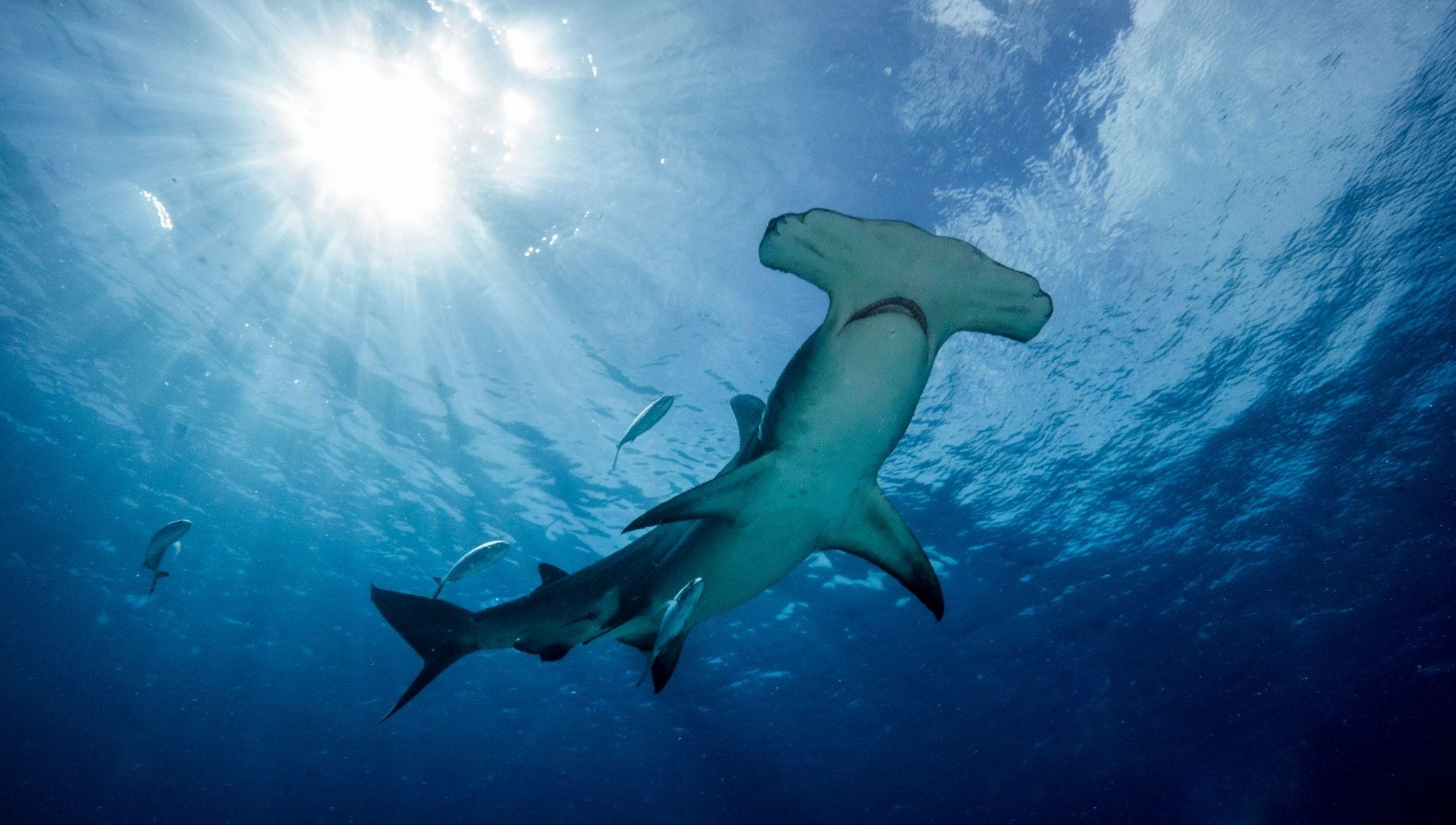
Those heads also provide them with lift, so when they’re swimming forward, it’s almost like the wing on a plane, and it keeps their head up because all sharks pretty much are negatively buoyant, and so they need adaptations to give them some lift. So they’re not having to constantly swim really hard in order to maintain their place in the water column.
Marcus Smith: I’ll risk a quick aside here just because Rachel mentioned Tatooine. Well, ever since she said that, I just can’t quite get Star Wars out of my mind. I want to say that a hammerhead would fit right in with the motley crew of exotic space creatures in the cantina on Tatooine. But more seriously now, how could you not think of hammerheads as marvels of engineering? They’ve evolved, as Rachel has described them, in a miraculous way to hunt their prey by triangulation. Because of that wide head assembly, which Rachel called a cephalofoil, maybe these sharks could be called ‘headwings’ instead of hammerheads.
But I’m not likely to win anybody over with that idea because how people tend to like drama in something that sounds menacing, even if we all know this animal doesn’t attack by hammering anything. I just assumed they didn’t, when I was a kid, even. Just imagine the pain of putting your eye on a hammer and then going off and striking something.
Kids aren’t dumb. Anyway, these sharks have sharp teeth, and that’s what they use. But back to their naming and their reputation. ‘Headwing’ just doesn’t hype things enough to boost the brand. And I just love saying ‘hammerhead.’ It feels so good. And savoring that illustration of one amid all the other sharks halfway through Volume S.
If Dr. Rachel Graham has taken such delight in hanging out with animals that often get shunned, we’re now going to turn our attention briefly to one of the most shunnable of sharks, unless I suppose you happen to be a fan of, oh, an animal like a pit bull. The bull shark actually looks ever so slightly like a pit bull, IMHO, or at least has a reputation just as fierce. Yet for all of that, Rachel has a warm spot in her heart for this creature, which is considered by many to be the third most dangerous of sharks coming in after tiger sharks and great whites.
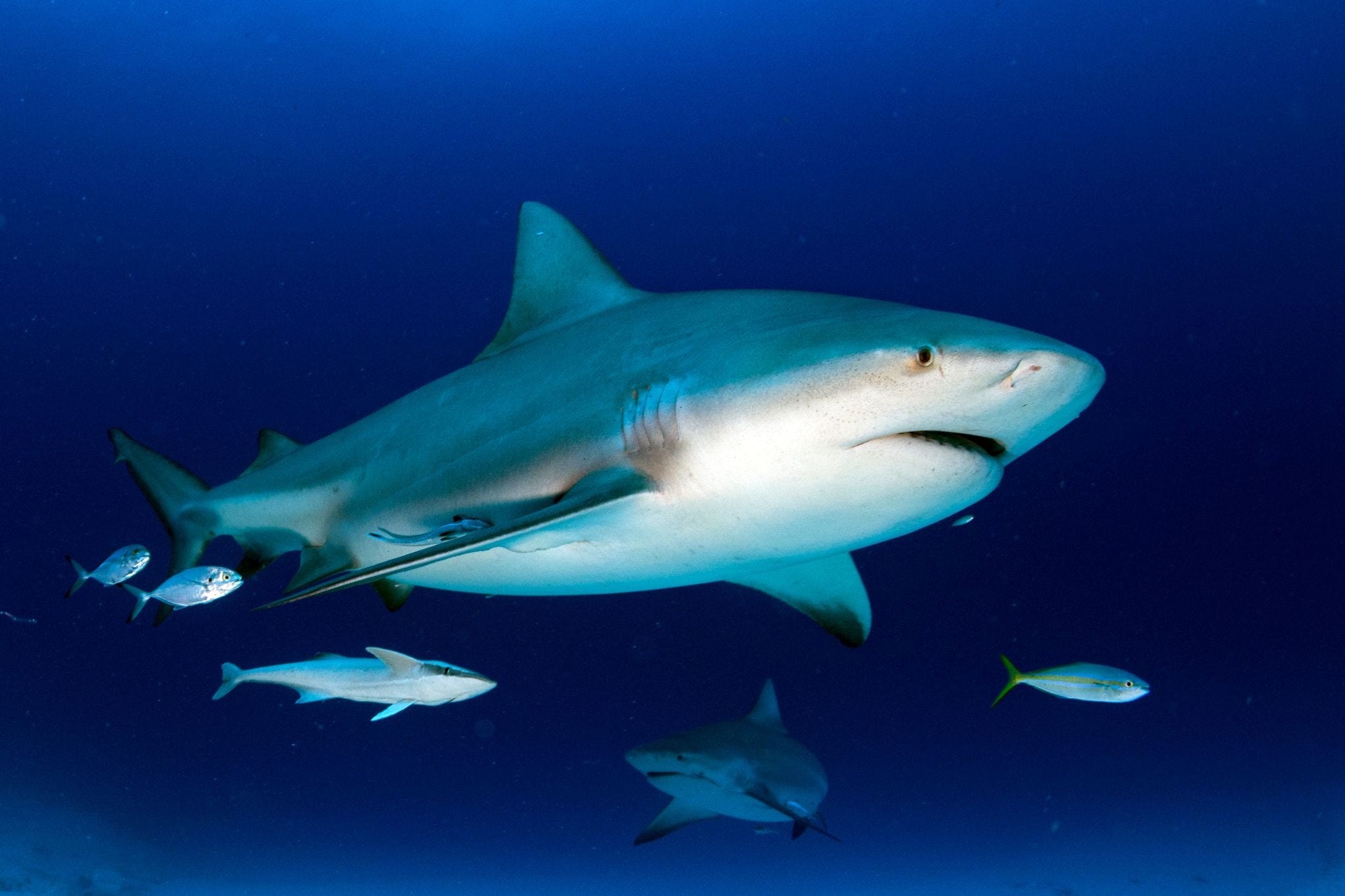
Rachel Graham: Just a few days ago, I was diving off of the World Heritage Site, also known as Coiba National Park, and it is a biodiversity hotspot for Panama. I roll over backwards, I go down, the water is a little bit greenish. It’s quite cool, actually. There’s a thermocline, so it’s going down to about 19℃, which is generally speaking pretty cool at this time. I’m very quietly settling myself on the bottom because what I’m hoping to see is one of my other favorite sharks.
I think all sharks are my favorites, but they’re another favorite shark. And these are bull sharks. And sure enough, in no time flat, one bull shark starts sweeping by. It’s about six feet long, another one seven feet, another one about six and a half. And before I had to move on to another site to check on one of my acoustic receivers, I’d seen five bull sharks in the end.
It was absolutely fantastic and not in the least bit interested in us, just probably looking for some good fish to feed on and swooped by, checked us out and then went on their merry way.
Marcus Smith: Biologists depend on reliable data, and getting that good data often comes from tagging animals that are moving around. Personally, I don’t know if I’d rather tag a tiger or a shark. I’ll do herbivores, thank you very much. Rachel Graham, she could tell you a lot about tagging. The basic idea, of course, is that tracking animals helps you find out their patterns of feeding, their cycles of migration.
Rachel Graham: You get a sense for the ebb and the flow of their lives over time and over space. And especially important, you get to learn where this natural ebb and flow are disrupted by humans. All of this tagging business, if it’s done thoroughly, can reveal if wildlife conservation measures that we have undertaken are, are really even benefiting the wildlife and safeguarding the ecosystems.
Nobody wants to waste time or money chasing after solutions that just don’t line up with reality. Just to give you an example, we find out that manta rays are actually not using the marine protected areas in Mexico that were in part set up to protect them, and they’re mostly outside of the protected areas and in the middle of key shipping lanes.
So what needs to happen there? Well, you could try to negotiate with the manta rays and say, “Dudes, could you please move into the marine protected areas?” But they don’t respond to WhatsApp or email, and not only that, they find that their food isn’t as good there as it is, maybe, in the areas that are part of the shipping lane.
So then what you need to do is expand the marine protected area and then negotiate with shipping companies, just like they’ve done with the right whale in the Northeast US, to see whether you can divert traffic, et cetera. So you’re in the field making nice to manta rays so you can tag them, and then you have to go on land, and you’ve got to love the maps too if you’re following migration.
Marcus Smith: Are you running the gamut of those kinds of activities?
Rachel Graham: I am a huge map fiend. I love maps. Everything for me is very visual, and especially when you can start overlaying the maps with all kinds of other environmental conditions. So you’re looking at what is the sea surface temperature, what is, for example, the chlorophyll a, which is a proxy for potential food for these large planktivorous animals.
Then you start to see, oh, maybe there’s a trend here. Maybe this is why they’re avoiding this particular area, but they’re really focusing their time in this other area where there seems to be a lot more food and the temperatures are warmer than 27℃, which is something that they prefer.
Marcus Smith: Now, your activities are in large measure about reversing population decline. And so you work, yes, in the field and, yes, with maps, but you’re also dealing with populations that might not really be on board yet with what MarAlliance is trying to do. Would you tell us that story of… I think this is a hammerhead shark story, too, where you had a taxi cab driver conversation. You changed somebody’s point of view, I guess.
Rachel Graham: Yes. That story with a taxi cab driver named Mauricio White in Panama, no less. He was fishing for snappers and everything over in the Caribbean side of Panama, near Colón. And one day, he was giving me a ride, and he said, “Guess what?” “We caught some hammerheads, and they were baby hammerheads.”
And he’s taking his hands off of the wheel, and I’m thinking, don’t do that, please, because who knows what we’re going to crash into? But he’s showing me the size of the hammerheads. I’m getting completely excited because we’re looking for nursery sites for these critically endangered scalloped hammerheads wherever we work because one of the easiest ways to try and repopulate sharks is to try and protect those nursery areas where they are pupped, where they are born, and where they grow up during some of the most vulnerable periods of their life.
So he’s telling me about these baby hammerheads, and I, of course, I gingerly ask him, “So, after you hook them and you pull them out of the water and you’re looking at them, what did you do with them?”
And he said, “Well, I released them, and I made my friends release them, too.”
And I said, “You did? That’s great!” Because I don’t finger point. I don’t want to tell people what to do. I want people to make those decisions themselves.
He said, “We’ve had so many rides together. I’ve taken you to the airport back and forth and all the rest, and you always talk sharks, and you told me all about hammerheads and everything, and I know how endangered this species is, and there’s no way we were going to keep it. Of course, we’re going to put it back in the water.”
And I thought, “That’s, that’s how this happens.” When you inspire, you educate, you engage, you get people excited. In his spare time when he goes fishing, he’s taking down data for us and letting us know what he’s finding, what he’s seeing, so that we have more eyes, more people, more excited people out there who actually want to conserve their own resources as Panamanians.
Marcus Smith: I asked Rachel to tell me more about building alliances with others, mostly about her approach, because she seems to be unusually successful in winning others over to wildlife conservation.
Rachel Graham: It’s just an approach that I… full credit to my mother. She would take me into the field with her work and with women and microenterprise in the Middle East and North Africa and in other parts of Africa.
And it’s an approach where you put yourself into other people’s shoes, which should be the basis of any good social or microenterprise work. You listen, you address priorities, and you try to come up with win-win strategies. My big focus is, I really want us in MarAlliance, my organization and my team, to be a big part of rewilding the seas with long-lived threatened marine megafauna, like sharks and rays and turtles and such.
But that is not always the priority for the communities we work with, and we work with communities because they’re on the front line of any conservation efforts. If they’re not engaged, if they’re not on board, then you haven’t a hope in hell for sustainable conservation. So it’s taking what I learned with my mother on the terrestrial realm, and then applying it really in the marine realm.
And so working first and foremost with fishers and fishers’ families, and finding out what their key priorities are in the marine realm, and seeing how we can find a match between what we’re trying to do, which has repercussions not only locally, nationally, regionally, and internationally, but also what are some overlaps with their priorities as well.
So that has led to a whole program that I’ve run for over 20 years where I ask them, “So what are you curious about? What are things that make you wonder in the sea?” They are the explorers of the sea that are unfortunately the unsung heroes of marine exploration. They come up with great ideas, great questions, and it’s many of these questions that have helped drive research around the world, specifically whale shark research.
I mean, those basic questions of, are they coming here every year? Is it the same whale sharks? Are they male? Are they female? Are they spawning? Where are they pupping? All these questions have formed the fundament of most of our research, for example, with whale sharks around the world. And now they’re an integral part of our team.
So we make decisions on what we’re going to be doing next based on a mix of their curiosity, what community needs are, and what global needs are for that particular species.
Marcus Smith: As I learned more detail about sharks from Rachel, two things emerged quite clearly for me, kind of like dorsal fins jutting up out of the water. Dorsal fins, by the way, they generally number two. There’s the classic first dorsal fin. That’s the one everybody recognizes. Then there’s a smaller one further down by the tail.
So the first big fact that emerged for me is that these species can live very long lives. The second less conspicuous fact, which goes very well with the little dorsal fin, is that we still know surprisingly little about sharks on the whole. For instance, it turns out we don’t really yet know exactly how long some species are able to live. But I’ll let Rachel handle this whole issue of lifespan.
Rachel Graham: So this is what makes sharks and rays really very special, is that they tend to have what we call ‘slow life histories.’ They take a long time to mature. In the case of— we were talking earlier about bull sharks or nurse sharks, it takes them about 15-years-plus for a female bull shark or nurse shark to actually reach sexual maturity. We don’t know how long many of them can live. We do know the great white can live over 70 years. We’re able to estimate at least 100, potentially over 130 years for a whale shark. But really, the winner-takes-all species is the Greenland shark, which by measuring the eye lens or doing a dating method on the eye lens, which doesn’t change over time, they were able to determine that Greenland sharks can often reach over 400 years in age.
And potentially, because there’s a margin of error in, in the dating approach, they can potentially reach at least 540 years. And the thinking is that they’re not reaching sexual maturity until 150 years. So I always like to say, imagine you have to wait 150 years for your first date. People can do the math. That’s why we’re seeing such horrific declines in sharks. And there’s another thing to remember. As we develop these skills to age these animals, we’re finding that many of the fin fish, the fish that you buy in the supermarket, the red snappers, the barracuda and more, are actually a heck of a lot older than you could ever imagine.
Marcus Smith: I’ve never spent any time considering the age of red snappers, but Rachel’s mention of it, that led me to look it up. Do you want to take a guess? Recent research indicates they can live to be over 80 years old. Obviously, not all of them survive that long, and with very aggressive fishing, fewer and fewer these days get a chance.
Rachel Graham: Some of these species, also, it takes them two years to gestate their young, and they’ll have very few young. In the case of manta ray, it’s a whole year, and most often they produce one pup, as we call them, that shoots out like a little burrito, a rolled up carpet, unfurls its wings, and then flaps off.
Marcus Smith: Is that a live birth? It doesn’t come out of an egg case?
Rachel Graham: So most sharks and rays actually give live birth. About 70% of sharks and rays, so over 1,200 species, give birth live, and manta rays are one of them, coming out like a little baby burrito.
Marcus Smith: If a landlubber like me can give a little bit of thought to the age of red snappers, well, why shouldn’t I also be able to reflect for a little while on the live birth that happens with a manta ray baby and its mother? The offspring, they come out all rolled up, and that makes perfect sense to me.
Their wing-like pectoral fins, those need to unfurl out in the open water. You can actually see this happening on a couple of extraordinary YouTube videos. I highly recommend going there. I watched one just yesterday, and you get the sense that a manta pup is like a human fetus. It’s all confined in a tight space for such a long time before birth, it’s just not easy to unfold.
That outside world, it’s a whole new game, and it takes a while before you can stretch. And if Rachel Graham’s description, ‘baby burrito,’ isn’t enough of a mic drop for you, well, the whole situation got me thinking of the possible scenario for, let’s say, a large litter of sawfish emerging from their mother. They’re elasmobranchs, too. How are they born? Think of the parallel rows of thorny teeth running the length of those little baby noses. Once again, YouTube to the rescue. I recommend watching the first-ever filming of sawfish live births. It’s footage taken by members of an expedition to The Bahamas. The researchers were from the Florida State University Coastal and Marine Lab, with participation from NOAA, the National Oceanic and Atmospheric Administration.
I felt a great deal of relief for the mother when I learned that the babies at birth have a temporary sheath. It’s quite thick. It covers their needle-sharp teeth, and it doesn’t fall off for a week or two after birth. That long, bill-like protuberance, that nose thing, it’s actually called a rostral blade, I’ve just recently learned.
You don’t have to remember that, but I think ‘rostral blade’ is fun to say. Not quite as fun to say as maybe ‘teeth sheath.’ Thank goodness for the teeth sheath!
Sincere thanks to Dr. Rachel Graham for joining with us to give us a glimpse of her work, and to share her obvious wonder for these life forms of the sea.
She’s founder and executive director of MarAlliance. That’s a nonprofit dedicated to saving habitat for threatened marine animals. Today’s episode was produced by Eric Schultze and Meimi Teeples, with sound design by Addie Mangum and Kevin West. I’m Marcus Smith. Constant Wonder is a production of BYUradio.
Comments
Nothing yet. Say the first thing.
Sign in to join the conversation.