
Gaelynn Lea plays the violin like a cello — a technique she discovered almost by accident, one that would eventually carry her from a small-town orchestra to NPR’s Tiny Desk Concert and, later, to composing the original music for Broadway’s revival of Macbeth, starring Daniel Craig and Ruth Negga. In this episode of Constant Wonder, she talks with Marcus about her unconventional technique, the unexpected opportunities it opened up, and how her songwriting continues to evolve.
Gaelynn Lea has carved out a singular place in contemporary music since winning NPR Music’s Tiny Desk Contest in 2016. With her haunting songs and cinematic arrangements of live-looped fiddle tunes, she has captivated audiences around the world and gone on to compose the original score for Macbeth on Broadway, starring Daniel Craig and Ruth Negga. Her work moves fluidly across genres—she has collaborated with Michael Stipe, The Decemberists, Wilco, LOW, and Pigface.
Gaelynn is one of the leading public voices on Disability Culture and accessibility in the arts, with appearances on PBS NewsHour, On Being with Krista Tippett, The Moth Radio Hour, and two widely-viewed TEDx Talks. She also co-founded RAMPD and the Music Inclusion Ensemble, helping to reimagine what inclusion and disability excellence can look and sound like in the music industry. A 2024 recipient of both the Whippoorwill Arts Fellowship and the Disability Futures Fellowship, Gaelynn continues to shape culture with artistry, imagination, compassion, and conviction.
In 2026, Algonquin Books published Gaelynn Lea’s debut memoir, IT WASN’T MEANT TO BE PERFECT.
Editor’s note: The original episode was interspersed with segments of Gaelynn Lea’s music. These songs are included where they appear in the episode.
Marcus Smith: I’m Marcus Smith and this is Constant Wonder. Join us as we quest for the awe and wonder of knowing we are part of something infinitely larger than ourselves.
You’re listening to a performance by singer-songwriter violinist Gaelynn Lea. It’s a composition titled “Rebuild.” Gaelynn Lea is a versatile artist capable of haunting, ethereal instrumental music, such as you’re hearing right now, also of traditional fiddle music and old folk tunes, as well as original lyrics that sometimes pierce, sometimes encourage, and often fiddle with your heart. We’ll enjoy hearing her sing some of those lyrics later on this episode of Constant Wonder.
Gaelynn found herself in the national limelight upon winning NPR’s Tiny Desk Concert Competition in 2016. But before we get to that turning point in her career, there’s a remarkable backstory about the making of a musician. It starts the way a lot of artists’ lives do, not with any grand design, but with a moment of pure, unplanned wonder. So that’s where we’ll begin, the moment when both Gaelynn and I actually, respectively, met our first stringed instruments. A lot of elementary schools traditionally offer their pupils a musical instrument showcase. You may have attended one of these in your own childhood.
Gaelynn, I remember so clearly when I first touched a string instrument. And it was a monster. It was a string bass. And the short story is that the local junior high school was going around to all the elementary schools and demonstrating what the instruments could be, and what you might want to play when you grow up.
And I thought, “I want to be in an orchestra. I’ve got to be in an orchestra.” So there was a summer program, and I got enrolled in it. And I still remember the fellow, his name, Steven Ball. He was the son of one of the music directors at the junior high. He walked across the room carrying the string bass, and handed it to me.
I was shaking because, number one, I was afraid I would damage it, you know? I was just afraid I’m going to harm this thing. But I didn’t know what to expect.
Gaelynn Lea: I… kind of the same exact thing. The junior high orchestra came to our elementary school and played for us. And I didn’t know until I heard them that that would be something that I would fall in love with.
But I just remember the beautiful wooden instruments, and they were all playing in unison. And the sound, so many harmonies. I think it really truly was, like, “Old MacDonald Had a Farm” or something. It wasn’t the Mozart piece. But I just remember being blown away by the sound, and just really, really wanted to try it.
Marcus Smith: That wood with a string instrument, it’s just a wonder to touch it. I don’t know why that is. The beauty of it, the sheen… Can you relate to that?
Gaelynn Lea: I can. The grain of the wood is just really unique, and every instrument’s so different. I remember that sense more when I got the violin that I played for many, many years.
I was in eighth grade, I believe, when we upgraded to a used violin in our local shop. But it was mine. And I played it for so many years. Up until last year I played that thing. So that really just kinda felt like an extension of my body by the time I put it down.
Marcus Smith: You’re not the first interviewee on this show to say that the instrument was an extension of your body. Is that just sort of a figure of speech?
Gaelynn Lea: When you play an instrument that long, you know exactly how to move to make it do what you want it to do. And so it just kind of… I mean, I don’t know. Like, when I accidentally hit the case, I say, “Ouch.” Or when I’m playing vibrato I notice, because I like to whistle, and I whistle with vibrato.
I’m a good whistler.
Marcus Smith: You, you realize, do you not, that this begs for a demo of what your whistling is like? My father used to whistle with a vibrato. I can’t whistle with a vibrato.
Gaelynn Lea: Oh, you can’t? Oh. Yeah.
[whistle break]
I don’t know. It’s fun. I like whistling.
Marcus Smith: How far back does that go? Does that go back to childhood?
Gaelynn Lea: Yeah, it does. My dad’s a great whistler, and he taught me at a pretty young age, like four or five, and I’ve been… When I play my violin, my tongue does the little vibrato thing, and I notice when I’m playing a long, slow note on my violin that my tongue does the same vibrato.
I think it is connected somewhere in there. When I’m playing violin, I feel like it’s… Yeah, it really does feel like part of your body. I don’t know how else to explain it. The thing about stringed instruments that’s different than percussive instruments or maybe even wind is something about it really feels vocal, you know?
Like, it feels like its own voice. And so I’m not surprised—I mean, I was surprised the first time I noticed that I was basically whistling and playing, doing vibrato. But I think it’s because it does feel like a voice.
Marcus Smith: I tried to pick up a cello a few years back, and it was a beautiful feeling, and it was a terrible sound.
Gaelynn Lea: I mean, here’s the thing. I am a firm believer that you need to give a stringed instrument three years of your life before it starts cooperating really. And so I don’t know how long you played cello, but I bet it wasn’t three years, was it?
Marcus Smith: It was two.
Gaelynn Lea: Aha. Yes, that’s the reason then. No, it just took so long. I mean, I remember even through I played fifth and sixth and seventh grade, and squeaked and squawked, I was with my friends, so it was fun, but it wasn’t something I felt very good at, and I also never practiced because my parents didn’t really make me, and I just didn’t.
And then, right around the middle of eighth grade, I remember suddenly being able to do stuff I couldn’t do before, and that’s when it got really exciting. And then I started practicing a lot in eighth grade because it suddenly felt worth it. And so that’s when my mom came in and said, “It doesn’t hurt to hear you play anymore,” which is a compliment and an insult at the same time. But, you know.
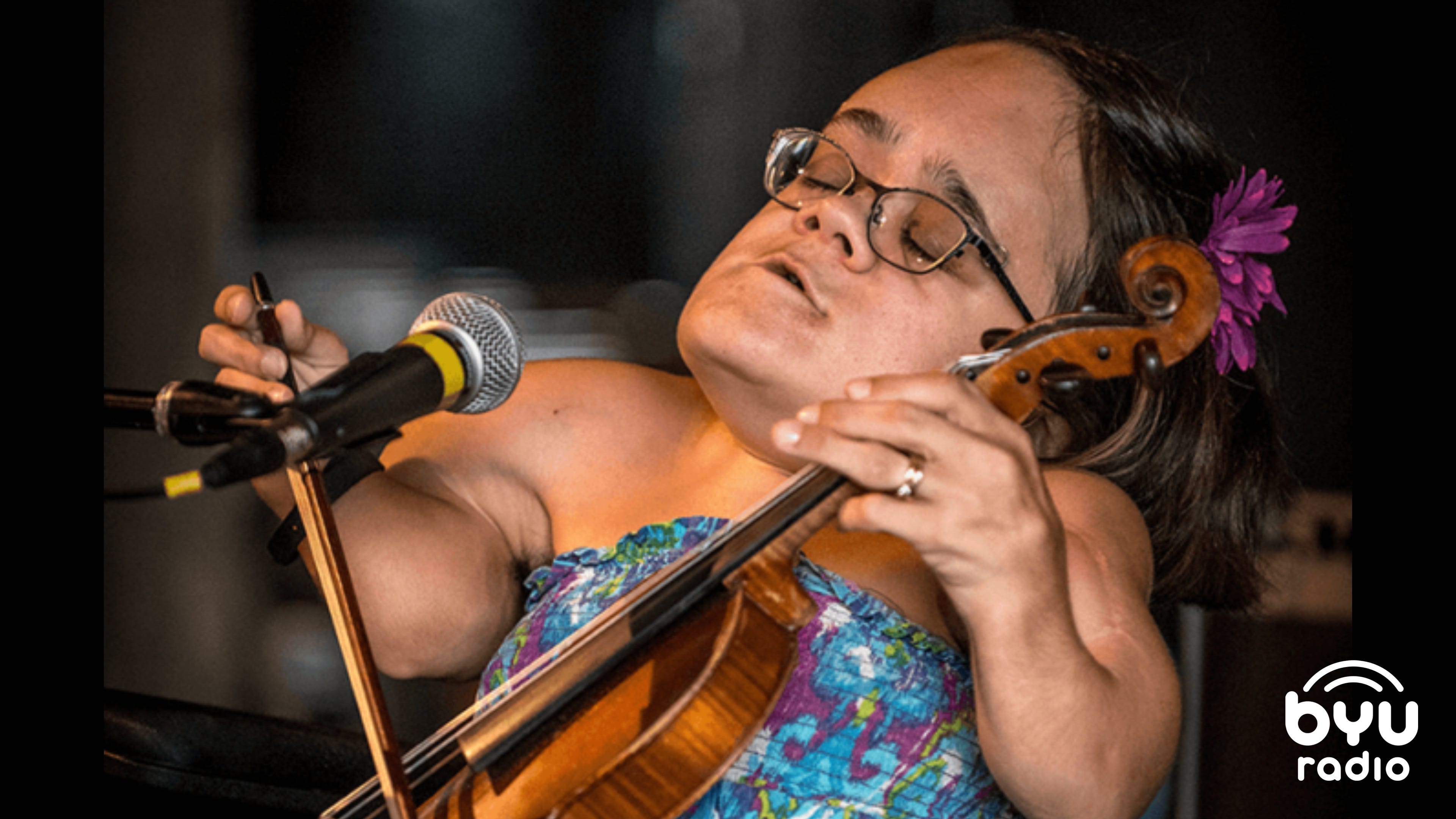
Marcus Smith: Gaelynn doesn’t tuck her violin under her jawbone or hold it off the left as other violinists do, horizontally and perpendicular to the body. Her unconventional grip on the instrument is as ingenious as it is unorthodox. It took some trial and error undertaken together with her orchestra teacher, a Mrs.
Sommerfeld. Before the two of them settled on an idiosyncratic approach, Gaelynn needed a little extra attention for reasons she’ll tell you about herself. For one thing, she’s unusually small in stature.
Gaelynn Lea: The thing we haven’t talked about yet is that I have a disability called brittle bones disease, or osteogenesis imperfecta.
It’s a disability where the bones are more fragile. And in my case, a lot of them broke before I was born. So they healed at incorrect angles in the womb. And so my arms and legs are both bent, kind of like I’m seated in the lotus position. My legs are crossed and my arms are bent. And I decided not to get them fixed.
My parents, which I appreciate, gave me the chance to choose. Not every parent does, but mine didn’t feel comfortable making such a big decision for me as a youngster.
Gaelynn Lea: I really have grown up in a fun and creative world, and I didn’t really feel that maybe walking was my biggest priority.
By the time I was 13, I had decided I wasn’t going to do the surgeries. So when I was 10 and I wanted to learn the violin, it was really in large part due to the creativity of that music teacher, Mrs. Sommerfeld, because as a kid with a disability, one thing that I think gets misunderstood is that the idea of adapting is scary or overwhelming, and it’s not, because every day you’re adapting the way you do everything, especially if your disability is as visible and significant as mine, because I’ve used an electric wheelchair since I was two and a half years old.
Like, I’ve definitely… My disability impacts how I do daily tasks, so adapting or finding a new way of doing something is just literally baked into my life. But for the teachers, that’s not always the case. I got extremely lucky that Mrs. Sommerfeld was intrigued, I think, by me, because during the music listening test we all had to take, I was the only student that year that got a perfect score.
And so I know she felt like, “I bet if we could find a way for her to play, she would be able to do it.” So she was open to experimenting. We tried the violin on my shoulder, and no violin, no matter how small, was small enough so that my arms could reach it. We tried the cello, but it was just too big, and the angle of my hand didn’t really work for how the bow had to run across the strings.
I couldn’t get my hand down far enough. And so together, we came up with this idea of, well, the cello, if it was smaller, would work. So we were like, “Well, why don’t you try violin like a cello?” So I play my violin upright in my wheelchair. I still had trouble with the bow hold, even with a violin, so we ended up changing my bow hold to actually an underhanded bass bow hold, and that works with my anatomy.
Once we figured that stuff out, I mean, that’s a big deal that she was that creative. But once we figured that out, to me, it just felt like learning an instrument. You had to figure out the physics of it all, and then once you know that, it’s just about practicing and tweaking things. She was willing to help me figure out fingerings and bowings that maybe didn’t work, because I had a smaller bow than my peers.
I have a half-size bow. And then I had private lesson teachers all the way through high school that also helped me figure out the fingerings and the bowings that worked, but it’s not as different or difficult as people think. Once you find the path forward, the rest of it is just about practicing and tweaking things as you go.
Marcus Smith: Well, did the approach to the instrument, which was highly unconventional, it was working for you, and you made those adjustments that you were talking about. Did the approach to the instrument in any way determine the types of genres that you would pursue? Did you go into fiddle music, for example, because of the way you played the violin as a cello?
Gaelynn Lea: I would say a little bit.And the other big difference, which I didn’t mention, is I only use three of my fingers for bowing. I don’t use my pinky finger because of the angle of my hand. And so I would say classical music, I played it all the way through high school, and I was in the elite orchestra and everything, but still, it was a lot harder for me.
I had to move around the fingerboard a lot more. I had to shift and do things differently than my peers because of the speed of the notes. By the end of high school, I knew that that wasn’t the path I wanted. I could have done it. I just knew that I didn’t want to practice that much because it took me longer than everybody else to get the pieces to the right speed.
And I just—it wasn’t fun for me. So I was like, “That’s not the way I want to go.” I loved fiddle music because not only are the melodies extremely catchy, and they can be adapted, and they often are adapted depending on who’s teaching you, but there’s a lot of harmonies. And so if a piece was too fast or wasn’t really working—I don’t want to get too in the weeds, but if you’re bowing like a cello, it’s not as easy to bounce between the strings as it is for somebody whose bow is resting on the strings already.
There’s a lot of gravity at play. And so I’m not the fastest fiddler. I wouldn’t be a bluegrass champion unless, again, unless I felt like practicing nine hours a day or something. So what I like about fiddle music is there’s a lot of harmonies that you can pick out and add to the group sound. And then when I discovered looping, that really suited the kind of player that I am because I’m really good at harmonies, and I really love counter melodies, and creating these layers.
And then my true love is lyrics. I just love combining lyrics with melodies and then figuring the violin part afterwards. Usually, the violin’s the last piece of a song when I make a song.
Marcus Smith: Let’s talk about your parents and their musical influence on you, because they were steeped in music.
Gaelynn Lea: Yeah, they were. My parents are both very musical. They met in a musical, in the play Brigadoon, which is a musical set in a magical village in Scotland, and they were both in the chorus. When I was 10, they started a dinner theater, and they did three shows a year for 20 years, and most of those were musicals.
So we grew up around performing and music. I have three siblings as well. And then my dad and mom have always done music programming at our church. They belong to a Presbyterian church. My mom’s the choir director, actually. So, like, music has just always been a really big part of our lives. My dad, when I was really little, I would sit in the back of our car as he was driving around, and he would sing a chain of notes like la, la, la, la, and then have me sing it back to him.
And he would make the chains longer and longer to try to stump me, and I realize now that probably is part of the reason I developed a good ear.
Marcus Smith: I wish I could just see that today, you as a little girl in the back, and your father driving, and paying attention to the road, but communicating with you without words. Music can do that, right?
Gaelynn Lea: Yeah, it can. I mean, it’s a really powerful thing. My grandfather… when I was in my mid-20s or early 30s, my grandfather passed away, and he was in hospice for six days. And for three days, he hadn’t talked or anything, but I would play for him every day on my violin.
He liked hymns, and so I would play old hymns for him and stuff. And one day I was playing “Amazing Grace,” and he started kinda moaning, and the nurse ran in because she thought maybe he was in pain. And so she leaned over, but I kept playing because I was just being in the moment, and she realized he was singing with me.
And by the end of the song, it had gotten so loud and clear that he was really singing the words to “Amazing Grace” with me, and that’s the last sound he ever made. It was really, it was ridiculous, but bittersweet.
I always thought music had depth. I loved listening to music. As a teenager, I was really obsessed with Simon & Garfunkel, and I would cry and know all their words. And in college, I discovered bands like The Decemberists and Neutral Milk Hotel and other bands. I think for me, the turning point came that performing music could feel kind of like a spiritual thing.
So I didn’t really perform in front of an audience until towards the end of college. In 2011, I met Alan Sparhawk of the band Low. He had seen me jamming at a farmers market, and he said, “You know, I want to do a project with you. Would you be willing to?” And I said, “Sure.”
So he actually introduced me to the looping pedal, which is a recording device that sits next to me, and I push the button down with my leg, and it records what I play. And I think getting all those layers of sound built up and creating these swirling sonic sculptures really unlocked something in my brain, so I started writing music.
And this is a long way of saying is that when I started writing music and then eventually singing it, it kind of feels when you’re performing, especially when you’re singing, even more so than with the violin in some ways, it’s like the energy comes down through your head, and you push it out through your chest and into the audience.
And it was weird because people really connected to the music in a way that really, really wasn’t… It felt like not only did I not expect it, but it just felt so outside of my power. You know what I mean? Like there’s a bigger force that’s at play when you’re performing music and letting the energy go through you.
So that was kind of an eye-opener. I wrote a song called “Someday We’ll Linger in the Sun” in 2013 and started performing it, and eventually, that’s the song that I entered into the Tiny Desk Contest. And that song in particular was the first song I wrote where people really responded emotionally to it in a way that I didn’t… I mean, you make something, and you think, “Oh, this was fun to make,” or, “This means something to me,” but you don’t really foresee it meaning something to other people.
That was the first time where I started thinking, hmm. Music, you can’t really capture its essence. You just have to be a channel for it.
Marcus Smith: A soulful voice that’s often ethereal, plaintive, haunting, a violin that was never meant to work for her body, and a talent for crafting lyrics that strike you at the core. These all fit seamlessly together in the music of Gaelynn Lea. You’ve already heard mention of her NPR Tiny Desk concert, so we’re almost ready to have her tell that story of her big break as an artist.
I’m Marcus Smith, and this is Constant Wonder.
[BREAK]
Marcus Smith: Before you made it to the Tiny Desk Concert with NPR, you were already teaching fiddle.
And there is a great reward that you sense not just from being somebody who listens to music, somebody who generates music, but somebody who teaches music. Was there a time when you just suddenly said, “Oh, that’s cool. I want to be a teacher”?
Gaelynn Lea: Yeah, that came out of some sadness, actually. One of my childhood acquaintances died of a pretty aggressive form of cancer, and I remember thinking, if I had, like, five years left, not like one year, not like a week, but if I had five years left, what would I want to be doing for a living?
Because I was not very happy. I was an insurance agent, actually, and I had done a bunch of other clerical jobs, and they weren’t terrible, but I never felt passionate about them. And I remember just thinking, “What would I want to do?” And I knew that I wanted to do something involving music, but I couldn’t really see a path forward for performing because I was local, and nothing really paid.
It wasn’t a living. And so I was talking to my best friend, who taught horseback riding lessons, and I said, “I really want to do something with music, but I don’t know if I could make a living. I wish I could do what you do.”
And she’s like, “Well, you can. You can teach people how to play the violin.”
And I was like, “What?” And so for a while, I had to think about it, because I do play very differently. I don’t know if I would want to take on a classical student that was planning to audition for Juilliard or something because there’s techniques that I’m sure do not translate 100%. But one thing I felt pretty comfortable teaching, because I enjoyed it, and am good at it, and felt like I understood it enough, was fiddle music.
So I taught fiddle lessons for three years. I worked with students of all ages, like six to 65 or older. I really loved the diversity of ages, and I taught mostly beginners to intermediates, and really loved helping students develop their basic skills and then an appreciation for music. And then I learned a lot from my students.
One of them in particular, she was like, “I had a bad day yesterday, but I poured a glass of wine, and sat on my deck, and I played for three hours, and I felt so much better at the end.” And she wasn’t doing it for performance or to get discovered or to be the best. She was just doing it because it enriched her life.
And I think sometimes musicians who do it for a living do feel sometimes the pressure of succeeding or whatever, and music is so much bigger than that. I mean, as you know, I’m sure, music is just foundational, and so it doesn’t need to be tied to success. It can be just you go play on your deck because you’re feeling kind of down, and it makes you feel better.
And so I loved teaching for that reason, the different people I got to meet.
Marcus Smith: I want to jump to that phone call from NPR. But first, you were somewhat hesitant, maybe even reluctant, or didn’t even think it was within the cards for you to even submit an audition tape. How did that come about?
Gaelynn Lea: Well, so I live under a rock. I never keep up on anything. So I remember two of my fiddle students were like, “Hey, National Public Radio is having a contest. You should enter.”
And I was like, Oh, that’s sweet of them, but eh, that’s not really my thing. I don’t know. What would I do?
And then my best friend, the same one who told me, “You should teach violin lessons,” she said, “Hey, there’s this contest. You should join in.”
By the third time, you’re like, Okay, I feel like the universe is trying to tell me something.
So I said, “Sure, I’ll enter.” So then I couldn’t find a videographer because we had waited. It was pretty short notice at that point, so she helped me film it in my fiddle studio where I taught my lessons. And we submitted it, and it was on the worst quality smartphone, the worst video quality of all time.
But I was like, “Well, this is the best we got. And I said I’m going to do it, so I’m going to do it.” So I entered it with zero expectation of winning
We did do our best. We did three takes, and we submitted the best one, but it was with laughably terrible equipment. And so I just never thought that that was going to be the outcome. Just forgot about it, basically, for a month. And then all of a sudden, I got that phone call.
Marcus Smith: And the phone call was the message that you’re the winner, or come on over, you might be the winner?
Gaelynn Lea: Well, I thought, right before—because I knew they were calling, they had emailed, then we set up a time to talk. I thought maybe I was a finalist. Like, that was as far as I could go mentally. But it turns out they were calling to tell me that I had won, and it was just such a huge surprise. I knew right then and there the rest of my life was going to look really different than I had suspected, which turns out to be true.
So it was a big turning point.
Marcus Smith: Winning NPR’s Tiny Desk Concert competition in 2016 with her song “Someday We’ll Linger in the Sun” meant that Gaelynn was invited to DC to play at the Tiny Desk itself. She chose four songs, a killer outfit, and was filmed at the desk for her national debut. Before the concert, worries bubbled up for Gaelynn that brittle bone disease was one of the reasons her song had been chosen.
She expressed this fear to Bob Boilen, the contest producer and co-creator, and he said exactly what she needed to hear, that several of the judges didn’t watch the video, just listened to the music, and were instantly drawn to it. Her song was chosen because it was a winning song. After the big moment in DC that put her in the national limelight, Gaelynn embarked on a four-city tour sponsored by Tiny Desk.
And after the success of that mini tour, Gaelynn decided to set teaching aside for a while and focus on performance full-time. She and her husband, Paul, sold their home to buy a wheelchair-accessible Ford van and set out on the road, playing at venues across the country. During the last few years, Gaelynn also wrote a memoir.
It’s titled It Wasn’t Meant to Be Perfect, and it describes her journey, which has brought her to full-time composing, performing, and writing And now that people want to know about you and enjoy your music, I would imagine that you have been embraced, and then maybe there have been disappointments for you, too.
Gaelynn Lea: Yeah. I feel overall so lucky and grateful that I have had so much support. I mean, not just in my childhood with my parents and my teachers, but yeah, once we got on the road, the people who come to my shows and who resonate with the music are all just so kind and supportive, and they’re really cool people.
One great way to see the country, especially in this divisive age, is to go do a bunch of shows because man, those people are the nicest. I feel like we got to see the best of a lot of the country, and so I’ve just been very grateful. I think disappointment-wise just comes from the fact that there’s still a pretty big barrier to entry for disabled people in the music industry.
I don’t have a label. I don’t have a music booking person. There’s a lot of things, like the support isn’t built in yet because venues, some of them are accessible, which is obviously the ones that I play at, but a lot of them haven’t done the work to become accessible even though we’ve had a civil rights law, the ADA, for 36 years, and a lot of people just haven’t done anything.
And the only way to enforce it is if somebody like me took the time to sue people, and I don’t have the time to walk around suing people, so it’s a very slow-going change. I think that’s a cultural issue, too. Like, I think people who aren’t close to someone with a disability maybe don’t see why it’s so important.
My friends and my family or people who have disabilities, we realize the big barrier. It keeps a lot of people out.
Gaelynn Lea: In 2018, I made a commitment to only play at accessible venues because, I mean, at the beginning, I was playing at places where my husband was carrying me and my wheelchair up the stage with four other guys, and it’s not safe or practical or dignified, really. There’s no green room or there’s stairs to the venue. And so the people who want to come can’t really get in if they have a disability.
So I played at all sorts of places, and eventually it just became clear to me that nothing was going to change unless I drew a line in the sand for myself. That’s actually the reason I wrote the memoir more than anything, was to try to pull the curtain back on how, first of all, you can have a really joyful and fulfilling and creative life with a disability. Disability doesn’t equal some kind of tragedy. But also that society needs to help. You can’t do it all by yourself, because it will move faster if we all do our part. And I think right now, the biggest disappointment has been that right now, it does still feel that disabled people are often the only ones yelling from the rooftop about, Let’s make this accessible! And it could be a group effort.
A good analogy was it’s like doing a school project and realizing that you’re the only one actually doing any of the work and everyone else is getting the same grade, you know? So, that’s where the tough part’s been, but it’s not the people who have been supportive.
I’ve felt very lucky and I’ve met a lot of really cool people, including other disabled artists, which has been fun.
Marcus Smith: It seems to me if you’ve been to multiple different venues, it’s conceivable that the builders or the makers of a venue would be thinking in terms of we’re going to make this accessible for the audience, but it maybe never crossed their mind at all that a ramp might be needed for the performer to actually find their way up onto the stage.
Gaelynn Lea: Yeah. Okay. So, you know, the ADA was passed in 1990, and that is exactly what happened in the laws. Everything was for the audience. Now, there’s a lot of venues that never even did that, right? You can’t get in the door, you can’t use the bathroom. There’s plenty of places that never, ever took accessibility seriously, but there are places, like what you’re saying, that in the ‘90s, renovated but then didn’t renovate the stage or the green room area.
In 2010, there was an update that corrected that omission, and theoretically, any venue being built after 2010 should include spaces like the green room and the stage. But again, it’s not very enforceable law in America, and so some places do it better than others. Some venues will tell you, “Well, we don’t have any disabled artists.”
And it’s like, well, which comes first, the accessibility or the artist? So I think it’s a cultural change too, that if music-goers got more educated about what made a good music venue, they could start being part of the solution.
And a lot of the best stories, like speaking of constant wonder, my favorite story about this is in 2018, I played at a place called The Feed and Seed outside of Asheville, North Carolina. And the venue owner didn’t tell me, but he needed a stage lift so that I could play there because I had told him it needs to be accessible. I need to be able to get on the stage.
And so he held a fundraiser a month and a half earlier, without telling me, to raise the money for the stage lift, and he bought a stage lift and installed it. And he told me about it. He was so excited. I got choked up because that’s what I want to see. I do understand that music venues aren’t operating often with huge budgets of surplus, especially independent ones, but there are creative solutions like what that guy did.
It didn’t come out of his pocket. It came out of his community because they believed it was important to make it accessible. And it was just like, man, that is such a good example of what is possible.
Marcus Smith: A stage lift unasked for, bought and installed by folks who didn’t see accessibility as someone else’s job. Well, that’s a kind of grace Gaelynn Lee has learned to watch for. It’s evidence that many barriers aren’t permanent, just not yet addressed. In a few moments, you’ll hear Gaelynn speaking to a question that I happen to know she’s often reflected on.
I’m not sure I would spring it on her otherwise. It’s the matter of where music comes from, or more specifically, where her music comes from. I’m Marcus Smith, and you’re listening to Constant Wonder.
[BREAK]
Marcus Smith: So one of your more recent successes has to do with Broadway, actually, and a staging of Macbeth. Did you ever imagine yourself writing something for a Shakespeare production?
Gaelynn Lea: No. I didn’t even think it was real, honestly, for, like, a month. I ignored the emails because I was like, that’s not real. That can’t possibly be true. And then I finally got on the phone, and the poor director…
I was like, “I don’t know. Is this going to be worth leaving town for three months? I’m working on my memoir,” and he’s like, “I don’t know what else to tell you. Daniel Craig is Macbeth.”
And I was like, “What’s he been in again?”
And he’s like, “Oh, my gosh, he was James Bond.”
So it took me a lot of convincing because it did feel so out of left field.
I actually wrote and recorded most of the music in Duluth, where I live, and then I only went to New York when rehearsals started, and we placed the music into the play because it was prerecorded. That experience was awesome, and what was surprising for me is that that also came through inspiration. I mean, ninety percent of the time I’m in the shower when this stuff happens, so I would be just washing up, and then all of a sudden I’d be like, oh, my gosh, I think I know the theme for Macbeth.
I’d be like, “Paul,” my husband, “go grab my phone!” And I would stop the shower and sing it into the phone and then go back to showering. And that’s how the little melodies came to be, and then I would flesh them out in the studio and add all these layers. And the funnest part of that project for me was, I gave each character a theme, basically, that’s how I ended up thinking about the play, and letting their character morph and change the theme over the course of the play.
So Macbeth starts very, you know, kinda regal, almost classical sounding, and by the end it’s very distorted, and dark, and not pretty at all. Very, like, grindy and it bounces all over the ears because I wanted to show that he was kind of going on this downward spiral. Lady Macbeth is in the same way, but she more kinda drifts off.
It was really fun to use the themes as characters, almost. You know, Banquo comes back as a ghost, so Banquo’s theme comes back distorted with, like, a different melody that’s one note off, that sounds just kinda unpleasant.
So I had a lot of creative juices flowing for that project that, in a way I wasn’t sure if it would be fun. I took it thinking I’ll learn something. But I did really enjoy it. The themes made it a lot of fun, and that play is very epic, so there’s tons to go off of.
Marcus Smith: You know, it’s so fun listening to you because on the one hand, you talk about inspiration and these kind of lofty notions of where the art comes from, and then you sound so pragmatic in just the way you talk.
It’s almost like you care a whole lot, and yet there’s a devil may care kind of flavor to your delivery. Did you know that about yourself?
Gaelynn Lea: Me? I just think from what I have witnessed, the more you try to control the art stuff that we’re talking about, like the less fun it becomes or like the more pressure you put yourself under, and then you lose sight of what really matters.
And I’m not saying that I have always succeeded at, at keeping that kind of a level head about it, but it’s played out again and again in my own life, where the times where I start to take it too seriously are the times I look back and think, “Man, I was really off track there,” you know?
And so I, as much as anyone, get frustrated by being like, “Man, does it ever get easier?” The career stuff, you know. Even now, I’m still grinding out for a living every month, and that’s where I’m at. But if you start feeling like the universe owes you or something, or you put too much weight on it, it’s not really yours. Music is for everybody. I think all creativity is.
Marcus Smith: Do you know when the muse is going to strike? Do you know how to help it strike? I mean, earlier you were talking about how the music comes from somewhere, and it comes, you said, down through the head, and you push it out with your voice as you’re singing, and it reaches the audience. Do you know any explanation for that muse?
Gaelynn Lea: I mean, I have come to think because— okay, so I just got done writing a memoir. It’s called It Wasn’t Meant to Be Perfect. That was a five-year project, and it was creative because writing is creative, but it was very different than writing a song, right? And so I expected there to be very little overlap on the creative energy, but that’s not actually what happened. There were certain times where, you know, I’m sitting in a chair or in the shower, and all of a sudden, bam, I know how I want to end this chapter.
And you get the same kind of tingly feeling that you get when you realize this is a great song line. Because the way songs have always come to me is they come in a snippet. They come in one line with a melody already attached, and they just come down from somewhere else. I don’t know where it comes from.
I mean, I have my guesses. It’s maybe from your higher self or your soul, but it certainly isn’t like your brain because it definitely gets downloaded in a way that feels very weird. And so writing the book was like that too, not every moment. Sometimes it’s more labor, but there were moments of creative inspiration that I wasn’t expecting.
So I’ve come to believe that creativity or God or the soul or whatever that is, right, is up there, and there’s a veil between us and that, and you poke a little hole through the veil, and you pull down creative energy. And sometimes you poke the hole accidentally, and you’re like, “Ooh, a song idea,” and you pull it down.
Sometimes you deliberately sit down and try to, try to poke that hole, and you pull it down. The reason I think it’s, like, a big, huge layer of energy is because I have felt that same feeling of creativity writing my book, painting, performing, writing music, playing violin. It’s all the same DNA, this energy.
So I think the muse has to be from that other place to be genuine. You can tell if a song is fine, and it doesn’t move you, and then a song that moves you, I feel like, came from that space. I think there’s a difference. I got a commission to write a song, and I did, and I didn’t feel that same energy, and I barely ever perform that song anymore because to me it doesn’t feel like it has the same DNA of stuff that felt inspired.
And so, to get in touch with that muse, I think you have to go with any little creative impulse. I always tell little kids, because I do a lot of school performances, I always tell little kids, like, “Do not judge your ideas when they pop into your head. Just write them down or sing them into your phone or your tablet or whatever, and let them be there. And then go back to them and work on them.”
Because I think that creative spark, that little… That’s the part that’s the divine inspiration part, and then it’s our job to build it out from there. I don’t write songs by sitting down and writing songs. I always write from inspiration, and that’s kinda scary because you’re like, man, is it going to happen again? Am I going to feel that again? I don’t know.
Like, for me, I wrote a couple songs this summer, and one of them in particular, I think I’ll probably record eventually, but I’m not actually a super prolific songwriter because I do it this way. But I’ve learned that I can still connect with creativity in other ways, like writing essays and writing a book or working on paintings, and there’s a lot of ways to touch it.
So you just gotta stay creative and not ignore inspiration when it pops up.
Marcus Smith: I have experienced music as good music, as divine, as inspired. We have these superlatives for it. We try to talk about it, and we really can’t. But there have been times when I’ve just been arrested and could hardly move because music was so powerful. Are there other domains of life that you have experienced that equal that kind of powerful wonder?
Gaelynn Lea: Oh, yeah. I mean, I think nature, for sure, is a place where you can feel that, and it’s not every day, every moment, every time you’re outside, but there are moments that are like that. I think sometimes witnessing the interactions between people has done that to me, like little kids, watching kids, and once in a while, there’s this thing that just stops you in your tracks.
Or being open, keeping your heart open, you interact with that energy in other ways, too. I think music is powerful because it is a deep part of us, and if it gets woken up, it’s very intense, and we notice it, but I think you can find it in other ways. I think the key is trying to stay open to wonder, really, and let yourself be surprised when it happens, you know?
Marcus Smith: Gaelynn Lea is a composer, musician, and disability rights advocate who from her birth, or actually from even before her birth, has had the rare genetic disorder osteogenesis imperfecta, commonly referred to as brittle bone disease. Her memoir is a valuable demonstration of disability’s ability: an ability to inspire, serve as a wellspring of creativity, and generate a unique, one-of-a-kind contribution to the world.
Her memoir’s title is It Wasn’t Meant to Be Perfect. This episode was produced by Jes Scoville with assistance from Lydia McElroy. Sound design was by Gracie Smith. I’m Marcus Smith. Constant Wonder is a production of BYUradio.
Comments
Nothing yet. Say the first thing.
Sign in to join the conversation.