
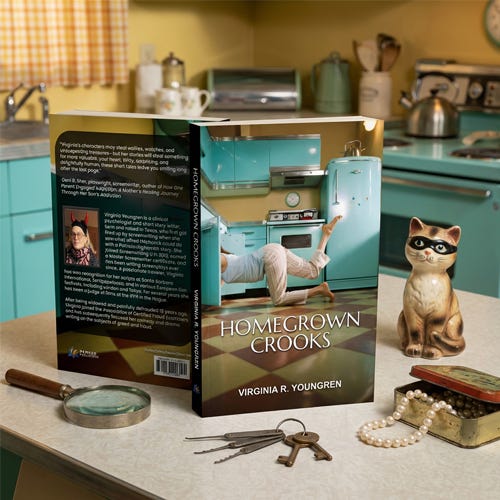
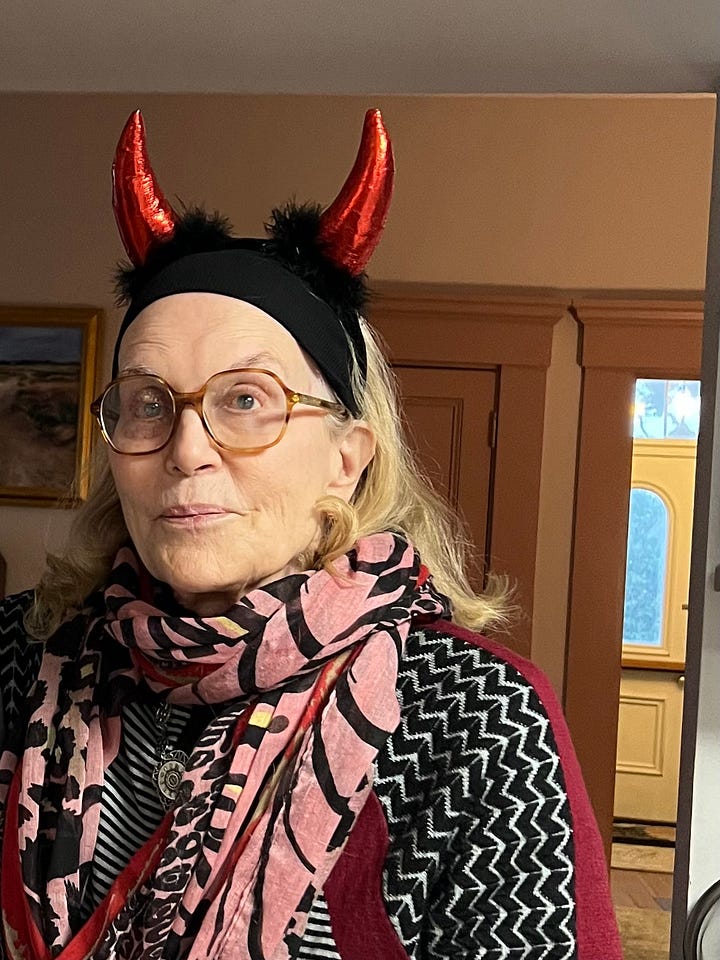
The multi-talented Virginia Youngren is a clinical psychologist and an award-winning screenwriter. She has recently published a new collection of short stories, Homegrown Crooks, and is just the sort of retirement-age client I love to work with.
Youngren is an Author Business Accelerator client and in our first couple sessions, we discussed a good business model for her, specifically in light of her new book, which she wants to heavily promote as a foundation for a larger and ongoing author career (she has multiple projects in the works).
In our talks, some interesting particulars surfaced:
She lives in the Boston/Cambridge area, so in a very literate area with many bookstores.
She is a member of the Association of Certified Fraud Examiners, something she pursued after once falling victim to fraud herself.
She’s willing to do events, but currently heavily favors an interview format.
As an interesting person with many credentials, I knew that Virginia herself was marketable, and I knew that a collection of short stories provides plenty of marketing challenges.
Then this item came to light:
Her stories are all about fraudsters (homegrown crooks). The petty and consequential thieves around us. The conmen and shady dealmakers. The strangers we unwittingly let into our lives…but shouldn’t have.
So, the fraud angle is super interesting.
Interesting in and of itself—wide appeal to the world at large;
Interesting because of Virginia’s own fraud story and the fact that it spurred her to join the professional association of fraud examiners—human interest angle; and
Interesting for marketing purposes because it suggests teaching others about fraud and avoiding it, especially fellow senior citizens—the kind of mission that gets authors events, press attention, and paid opportunities in ways that can be just plain harder for fiction.
Virginia has been reading this Substack for a while, which meant she came into the Accelerator already thinking strategically about her author business. She was game to promote Homegrown Crooks and do events—but early on she identified an important guardrail: she’s more comfortable in an interview format than presenting solo.
Launch party. For her book launch party, Virginia had a friend interview her in front of the crowd. It worked beautifully. The format felt natural, the conversation flowed, and the audience got more of Virginia than a prepared solo presentation might have delivered.
From there, the next step was obvious:
Podcasts. Podcasts are already among the lowest-hanging PR fruit available to authors—high reach, low barrier, and an interview format by nature. For Virginia, they’re a natural fit twice over and she can pursue bookings on two entirely distinct tracks:
The author and writing track—short story collections, fiction craft, the psychology of character, screenwriting crossover—aimed at literary and creative podcasts.
The fraud track—fraud awareness, consumer protection, the psychology of con artists, her personal story and professional credential—aimed at true crime, personal finance, consumer advocacy, and senior-focused podcasts.
Don’t answer the phone. Don’t open the door.
Those are Virginia’s top two fraud prevention tips! And a great opening line for an author talk, sure to get some immediate laughs. Her mentioning these tips in one of our talks helped us come up with this deceptively simple, reusable marketing idea:
Pull one fraud prevention tip from each of the eight stories in the book.
It’s an idea that can be used on repeat, repurposed for many situations.
It works for events, on-air interviews, print publications, and social media.
It ties very valuable tips directly to her work, creating interest in buying the book and reading her stories.
Here’s how we devised applying it as first steps in a promo campaign:
LinkedIn. Write a series of posts for LinkedIn (once a week for eight weeks), going into depth on each prevention tip, and tying one of her stories in at the end (with a link to buy the book). Note: This idea pushes a content calendar into place.
PR. Write a press release and various press pitches around this list of 8 Fraud Prevention Tips to send to local, regional, senior-focused, and appropriate niche publications, promoting the three angles (utility, book intrigue, human interest).
AARP. Go for the motherlode of exposure, AARP Magazine, with monthly targeted pitches to different reporters and different sections of the publication. Virginia is just the sort of fascinating, everyday person they cover and her content is just the sort of information they share.
The brilliance and simplicity of the eight fraud prevention tips naturally evolved to become the backbone of Virginia’s event strategy. She is now developing a slideshow built around the eight tips—one per story, one per slide—that gives her events structure, visual interest, and a clear throughline regardless of format.
Her plan is to start with the interview format plus the slideshow. A librarian, program coordinator, or bookstore staffer can ask the questions, the slides provide a concrete backdrop, and Virginia will do what she already does well—talks about fraud, her stories, and her experience with the intelligence and warmth that make her a fun conversationalist. And in a market like Boston/Cambridge, with its density of independent bookstores, Virginia’s fraud-angle slideshow-plus-interview offers stores something more programmable than a standard reading or signing.
Here’s what’s very cool about Virginia’s thinking on these events. As we talked it through, she began anticipating her own evolution. She believes—and I agree—that once she’s done enough events in the interview-plus-slideshow format, she’ll feel comfortable leaving the interview structure aside and presenting alone.
This is the building confidence through repetition that I’ve seen so much working with authors and love to write about here.
Virginia’s business model doesn’t end here—she has more to build and refine and we’re still working on it. But as you can see, she’s already off to a strong start.
Virginia’s case is instructive for all fiction authors. Many works of fiction—especially those rooted in an author’s professional expertise, personal experience, or deep subject matter knowledge—contain one or more missions tucked inside the story, waiting to be amplified in your marketing. And authors with multiple books may find an entirely different mission in each one.
If you write fiction, it’s worth asking yourself:
What does your fiction know that you know?
What expertise, experience, or credential lives inside your story that readers, organizations, or communities might find useful?
Are there multiple public services hiding in your plot?
How will you convey this and in what formats?
Who needs what your fiction teaches, beyond readers who love the genre?
Do different books in your catalog point toward different missions and different audiences?
A mystery writer who spent twenty years as an ER nurse has medical knowledge embedded in her fiction—and possibly a separate mission around healthcare advocacy embedded in another title. A thriller author who was a foreign service officer has geopolitical insight in his work and perhaps a second mission around diplomatic history or international policy. A literary novelist who survived addiction has hard-won wisdom threaded through her narrative and maybe an entirely different mission in a second book about family estrangement.
Missions are whole other entry points for marketing, the kind that get you more readily booked, quoted, funded, and remembered—sometimes in directions you never imagined when you wrote the book.
Virginia found her book’s not-so-hidden mission quite easily, what about you?
What’s the mission—or missions—hiding inside your fiction? What do your stories know that you know—and who outside your typical readership might need to hear it—and how can that inform and expand your marketing opportunities?
Virginia’s fraud angle didn’t surface in a vacuum—it emerged through strategic coaching conversations designed to find exactly that kind of hidden opportunity. My Author’s Business Accelerator is designed for published authors ready to look beyond “how do I sell more books” to the deeper strategic questions: what is this book actually for, who needs it, and how do I build a sustainable author business around what I find? In eight sessions (with a flexible schedule to work around your life), we’ll identify the missions, angles, and opportunities hiding in your books, develop the outreach strategy and event model that bring those missions to life, and build the complete author business model that generates income from multiple directions simultaneously. Not group coaching or generic advice—it’s a strategic partnership built around your specific books, your specific expertise, and your specific opportunities. Learn more about the Business Accelerator.
After 30 years in publishing and coaching, here’s what I know: Authors who build sustainable businesses around their books are the ones who consistently apply good strategic thinking to their specific situation. That’s what 450+ articles in this archive deliver. A paid subscription is $97 a year or $10 a month. One volume sale you wouldn’t have thought to pursue, one speaking fee properly negotiated, one partnership you knew how to propose—any one of those pays for years of this subscription, ten times over.
Comments
Nothing yet. Say the first thing.
Sign in to join the conversation.