
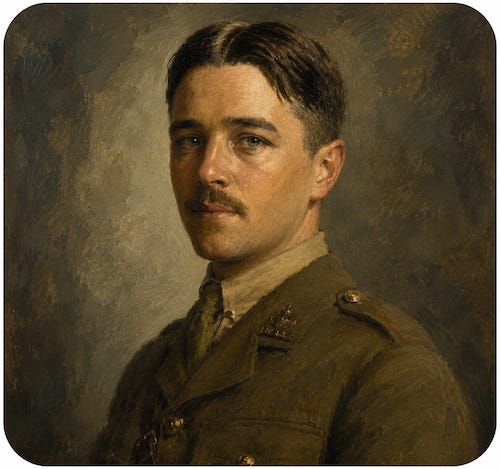
Wilfred Owen was killed in World War I, one week before Armistice (November 11, 1918), at the age of twenty-five. By the time he died, he had published a mere five poems. Still, we remember him. We remember his voice, his imagery, his poetic style, his passion and compassion. No other poet captured the horror of the trenches and the poisonous gas as vividly as he did. No other poet captured the pity and the waste of so many young men who came home wounded in body and mind. Wilfred Owen (1893-1918) wrote down what he witnessed and experienced on the battlefield. His was an honest and authentic voice, but also a voice steeped in the rhetoric of pre-war Georgian poets who wrote mainly about the beauty of nature in gorgeous sweet cadences. Perhaps, the power of Owen’s voice stems from this tension between the naked horror of what he describes and the rich rhetoric he uses to capture the consequences of war. Owen famously wrote: “All the poet can do today is warn. That is why true Poets must be truthful.” As readers, we hear the conflict of a young man who still believes in the “true Poet” and who can, in spite of everything, remain “truthful.”
The brilliant war poem “Dulce et Decorum Est” opens with a straightforward description of soldiers in a battlefield as they march on endlessly. It closes with a question. Between the two parts, the reader follows the slow and agonizing death of a young soldier who didn’t get his gas mask on in time. The use of deadly gas in warfare was relatively new in WWI, and the horror of it is captured with the suddenness of staccato and repetition as in “Gas! GAS!” and the repetition of “drowning.” The use of repetition also serves to prolong the moment. It drags on and on. This is no quick death, and the memory of it will haunt the speaker of the poem for the rest of his life. It also haunts the reader. Who, in the end, can resist questioning the Roman poet Horace’s notion that “It is sweet and fitting to die for one’s country”? Not only has the poem gone from a description to a question; it formulates an answer.
Text within this block will maintain its original spacing when published
Dulce et Decorum EstText within this block will maintain its original spacing when published
Bent double, like old beggars under sacks,
Knock-kneed, coughing like hags, we cursed through sludge,
Till on the haunting flares we turned our backs,
And towards our distant rest began to trudge.
Men marched asleep. Many had lost their boots,
But limped on, blood-shod. All went lame; all blind;
Drunk with fatigue; deaf even to the hoots
Of gas-shells dropping softly behind.
Text within this block will maintain its original spacing when published
Gas! GAS! Quick, boys!—An ecstasy of fumbling
Fitting the clumsy helmets just in time,
But someone still was yelling out and stumbling
And flound’ring like a man in fire or lime.—
Dim through the misty panes and thick green light,
As under a green sea, I saw him drowning.
Text within this block will maintain its original spacing when published
In all my dreams before my helpless sight,
He plunges at me, guttering, choking, drowning.
Text within this block will maintain its original spacing when published
If in some smothering dreams, you too could pace
Behind the wagon that we flung him in,
And watch the white eyes writhing in his face,
His hanging face, like a devil’s sick of sin;
If you could hear, at every jolt, the blood
Come gargling from the froth-corrupted lungs,
Obscene as cancer, bitter as the cud
Of vile, incurable sores on innocent tongues,—
My friend, you would not tell with such high zest
To children ardent for some desperate glory,
The old Lie: Dulce et decorum est
Pro patria mori.
The scene of the dying man also leaves a lasting impression because it is aided by the stunning use of literary devices such as alliteration, assonance, and onomatopoeia. It is a poem to be heard as well as read. Consider the repetition of initial consonant sounds in lines like “Men marched asleep. Many had lost their boots, / But limped on, blood-shod. All went lame; all blind.” Vowel sounds often return as well, such as in “Of gas-shells dropping softly behind.” The repeated O-sounds in “Of/Dropping/Softly” strive to make the line cohesive, while the irony that the deadly gas arrives “softly” contradicts such connectiveness. On the one hand, the beauty of the language serves as an invitation to linger on each sound, each syllable, each word, and each line of the poem. On the other, it accentuates the caesuras, which divide lines in two separate parts. These caesuras add a sense of disjointedness and Modernism to the poem. Simultaneously, a cohesive impression is established by the use of rhyme and rhythm. The rhyme scheme of ABABCDCD etc. heightens and tightens the impact of the scene as does the use of iambic pentameter. Owen’s skillful use of poetic devices to describe the horrors of war makes us wonder what kind of a poet we lost as we mourn the poems he never got to write.
Few poems capture the consequences of war more succinctly and movingly than “Disabled.” Again, the poet describes a scene with a central character, a man seriously wounded in war. Owen’s voice is passionate and compassionate. It makes the reader feel the pity and the waste of this young man’s life as it evokes the pleasures of a young man’s life with friendship, camaraderie, women, and fun. The contrast is painful. It makes the character real and the reader to feel for him.
Text within this block will maintain its original spacing when published
DisabledText within this block will maintain its original spacing when published
He sat in a wheeled chair, waiting for dark,
And shivered in his ghastly suit of grey,
Legless, sewn short at elbow. Through the park
Voices of boys rang saddening like a hymn,
Voices of play and pleasure after day,
Till gathering sleep had mothered them from him.
Text within this block will maintain its original spacing when published
* * * * *Text within this block will maintain its original spacing when published
About this time Town used to swing so gay
When glow-lamps budded in the light-blue trees,
And girls glanced lovelier as the air grew dim,—
In the old times, before he threw away his knees.
Now he will never feel again how slim
Girls’ waists are, or how warm their subtle hands,
All of them touch him like some queer disease.
Text within this block will maintain its original spacing when published
* * * * *Text within this block will maintain its original spacing when published
There was an artist silly for his face,
For it was younger than his youth, last year.
Now, he is old; his back will never brace;
He’s lost his colour very far from here,
Poured it down shell-holes till the veins ran dry,
And half his lifetime lapsed in the hot race
And leap of purple spurted from his thigh.
Text within this block will maintain its original spacing when published
* * * * *Text within this block will maintain its original spacing when published
One time he liked a blood-smear down his leg,
After the matches carried shoulder-high.
It was after football, when he’d drunk a peg,
He thought he’d better join. He wonders why.
Someone had said he’d look a god in kilts.
That’s why; and maybe, too, to please his Meg,
Aye, that was it, to please the giddy jilts,
He asked to join. He didn’t have to beg;
Smiling they wrote his lie: aged nineteen years.
Germans he scarcely thought of, all their guilt,
And Austria’s, did not move him. And no fears
Of Fear came yet. He thought of jewelled hilts
For daggers in plaid socks; of smart salutes;
And care of arms; and leave; and pay arrears;
Esprit de corps; and hints for young recruits.
And soon, he was drafted out with drums and cheers.
Text within this block will maintain its original spacing when published
* * * * *Text within this block will maintain its original spacing when published
Some cheered him home, but not as crowds cheer Goal.
Only a solemn man who brought him fruits
Thanked him; and then inquired about his soul.
Text within this block will maintain its original spacing when published
* * * * *Text within this block will maintain its original spacing when published
Now, he will spend a few sick years in institutes,
And do what things the rules consider wise,
And take whatever pity they may dole.
Tonight he noticed how the women’s eyes
Passed from him to the strong men that were whole.
How cold and late it is! Why don’t they come
And put him into bed? Why don’t they come?
Like the previous poem, “Disabled” paints the picture of a wounded soldier using the language of a highly musical and skilled poet. This rich and colorful language accentuates the bleakness of the speaker’s situation. Unlike the previous poem, however, this one arrives at a direct question, a question repeated twice. The repetition of the final question prolongs the agony of the young war veteran’s alienation and deepens the reader’s pity for him. The genuineness of Owen’s voice coupled with his brilliant command of rhetorical devices create a curious juxtaposition. On the one hand, the authentic and subjective experience generates a powerful sense of realism. On the other hand, through Owen’s skillful use of literary devices such as alliteration, assonance, rhythm, and rhyme, it produces a sense of defamiliarization and distance. The Russian poet and winner of the Nobel Prize in Literature, Joseph Brodsky calls every work of art a “mode of transportation,” an action or a movement toward another goal. The aim of Wilfred Owen’s powerful poems about his war experiences is to warn his readers about the wasteful and painful consequences of war.
Gunilla T. Kester is an award-winning poet, Fulbright Scholar, and the author of If I Were More Like Myself (The Writer’s Den, 2015) and two chapbooks, Mysteries I-XXIII (2011) and Time of Sand and Teeth (2009), with Finishing Line Press. Her work has or will be published in On the Seawall, Cider Press, The American Journal of Poetry, Pendemics, and Atlanta Review.

Sharpen your craft, discuss project ideas, and find new communities
Comments
Nothing yet. Say the first thing.
Sign in to join the conversation.