
Imagine paying your friend to collect garbage from the street in front of his own house. In return, you get to litter your own street. Sounds absurd? Welcome to the multi-billion dollar world of carbon credits.
In this edition of The Conquest Communiqué, let’s take a deep dive into what the carbon market is, how it has evolved over the years and understand India’s unique opportunity to dominate the carbon market.
The 1990 US Congress passed the Clean Air Act to combat America’s rising air pollution, especially sulphur dioxide emissions. An obvious component of this law was: requiring power plants to lower their emission levels to below a certain threshold.
The Clean Air Act had a unique provision: power plants with emissions below the threshold could sell emission allowances to other plants. For example, if Plant A reduced its hourly smoke emissions to 20 kg while the government’s set cap was 35 kg, the difference of 15 kg could be sold by Plant A as an emission allowance to Plant B.
So instead of having to change its processes to reduce their emissions, Plant B could just buy such allowances to comply with the cap on emissions. This marks the world’s first large-scale “cap-and-trade” mechanism; a system very similar to today’s carbon credits market.
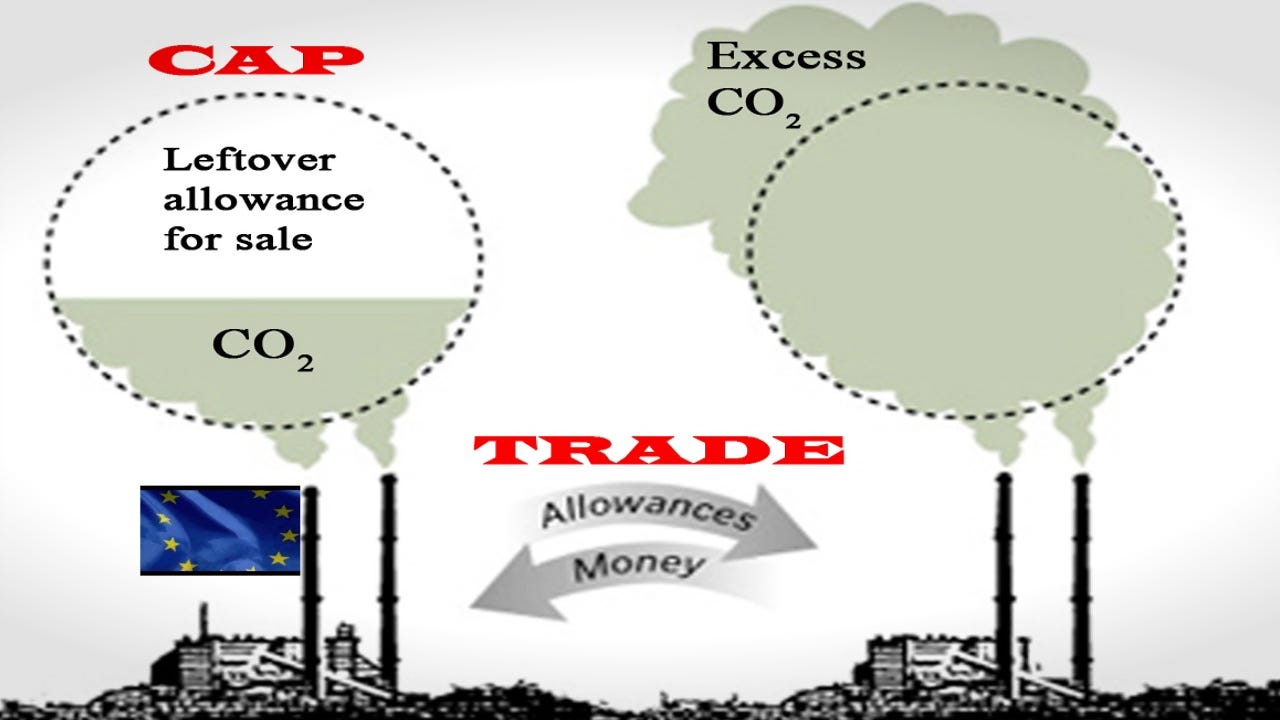
The cap-and-trade system was a huge success, bringing down overall sulphur dioxide emissions from US power plants by a whopping 36% in just 24 years, despite energy generation from these plants actually increasing by 25% over the same period.
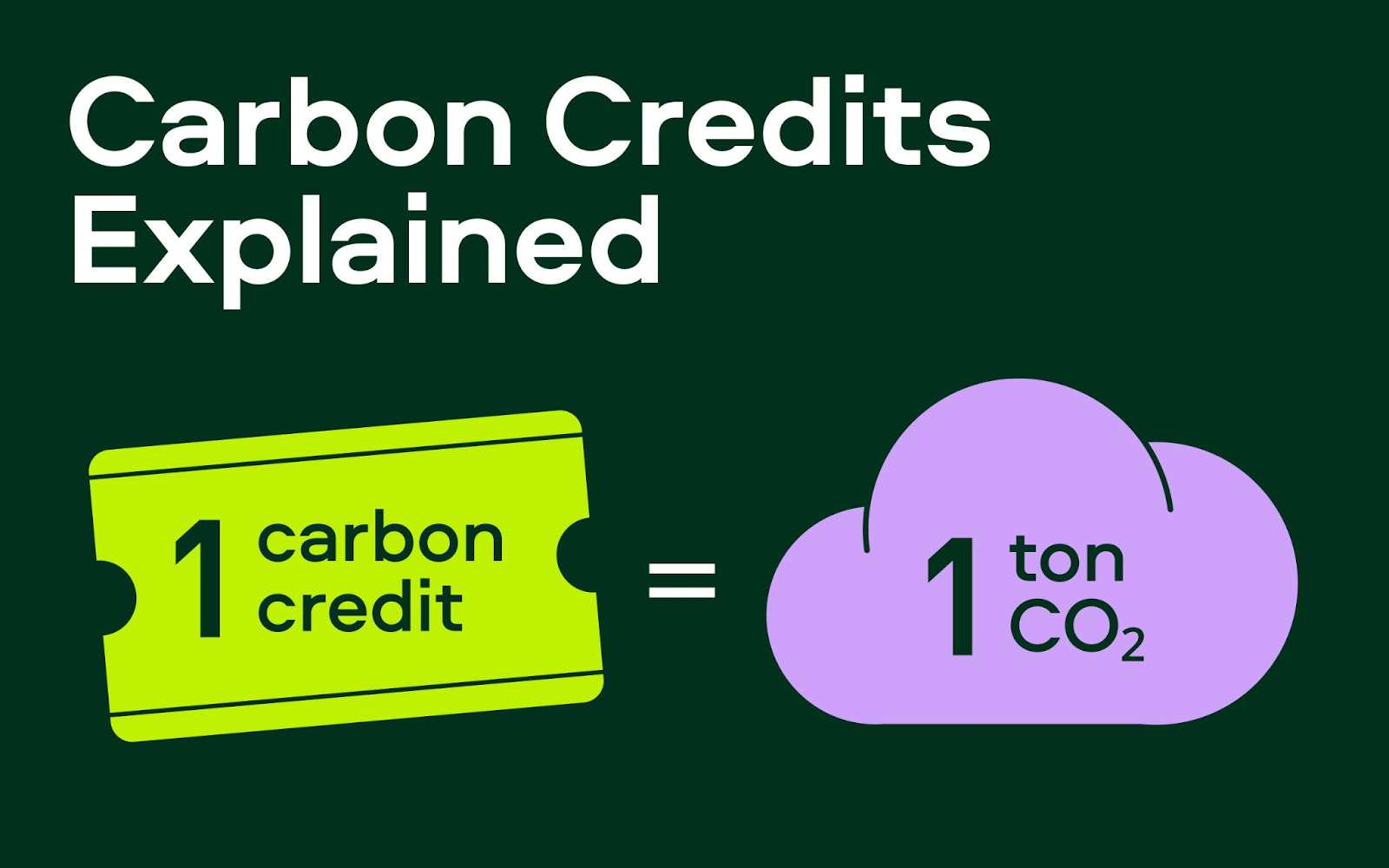
The 1990 Clean Air Act set global precedent as a successful system where you could offset your emissions by paying someone else to do it for you. A major advantage of this system was that since emission reduction costs can vary greatly across different industries, companies which would require more money to reduce emissions by changing their own processes could now just pay other companies to reduce emissions instead.
Thus, a cap-and-trade system could allow pollution control at minimum cost, as the overall emissions on the planet were still being reduced. It’s no surprise that seven years later, the 1997 Kyoto Protocol, which was the first major global summit for reducing carbon dioxide emissions, adopted the same cap-and-trade system for establishing a Carbon Emissions Trading (ET) mechanism.
The Carbon Emissions Trading mechanism established under the 1997 Kyoto Protocol was set to be implemented 2005 onwards, giving countries an eight-year time period to figure out implementation details.
This trade mechanism led to the creation of the world’s first and largest multicountry emissions trading system: the EU ETS (European Union Emissions Trading System). Covering about half of the European Union’s total CO2 emissions across 31 countries, creation of the EU ETS was a huge validation for emissions trading as an effective system to combat pollution.
How would the prices of these allowances be decided? The EU would set an emissions cap, and would then identify the companies whose emissions were below this cap. To these companies, the government would issue emission allowances, or carbon credits; which these companies could sell to other companies whose emissions were above the cap. In 2005, these carbon credits were issued by the government for free.
From 2005 to 2006, the allowance price per ton CO2 jumped from an initial €8 to as high as €30, because companies with emissions exceeding the cap were buying these allowances in huge amounts to offset their carbon emissions, anticipating greater compliance requirements and emission reduction targets.
As early as April 2006, the market crashed, the price dropping by more than half in just a week. To make matters worse, the next year of 2007 saw the allowance price per ton CO2 drop to…zero. Something was seriously wrong, because the price dropping to zero simply meant that no one was willing to buy carbon credits anymore.
The reason turned out to be inadequate emissions data: the EU’s estimates were way off, as a result of which, far more carbon credits were issued than required. As a result, in 2007, the year after which phase 1 of the EU Emissions Trading System would conclude, the prices of EU-issued carbon credits dropped to zero because there was no demand, and companies knew these would be worthless post 2007.
The 2007 carbon credit price crash led to three major changes in the EU Emissions Trading System (EU ETS) in the following phases, also setting an example for the rest of the world on what could potentially go wrong in carbon credits systems.
The first major change was allowing carbon credits banking. This meant that even after the second phase would end in 2012, any unsold carbon credits could be stored by companies for use in the third phase.
Second was the lowering of the emissions cap, leading to a lower number of carbon credits being issued and a greater demand, to counter the possibility of prices crashing.
Lastly, instead of issuing carbon credits for free, EU governments started auctioning these to companies.
Because of these measures in place, with the second phase of the EU ETS kicking off, the emissions allowance prices rose to €20 per ton CO2 again. Hence, it was a shock when the carbon credits prices crashed yet again in 2009, highlighting their volatility. This time, the reason was the 2008 recession, reducing energy demand, thus reducing demand for allowances.
After 2008, Carbon Credit prices in the EU ETS mostly kept floating between the €5 to €10 range till 2023, when the Russia-Ukraine war led to them crashing again, their prices reducing by over 10 times.
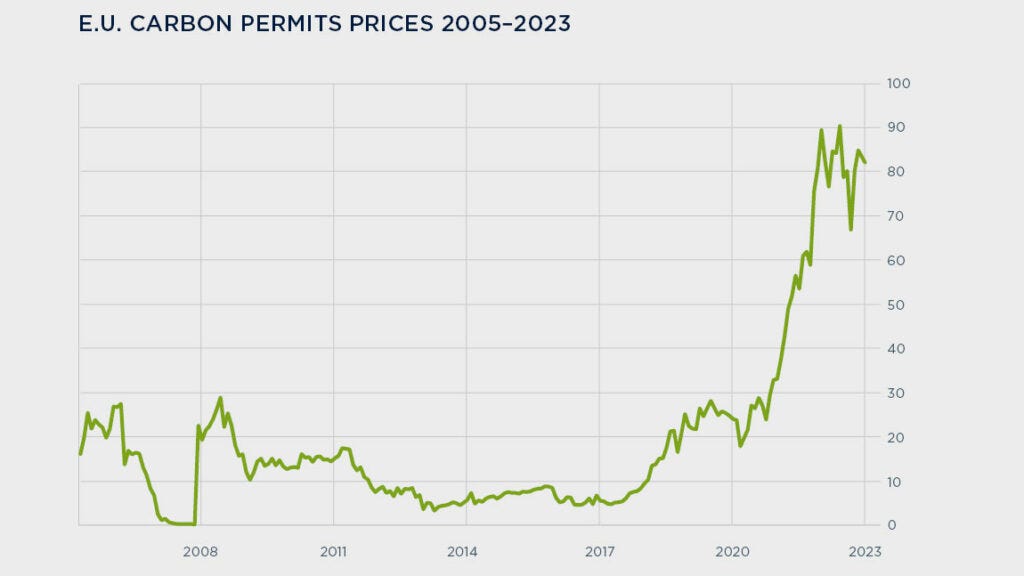
What we can conclude from this is that carbon credits can be a viable instrument for emission reduction, but there need to be safeguards in place to ensure that their prices don’t crash as much, and that the impacts of their price crashes are minimal.
Until recently, India had remained relatively untouched by the carbon trading market. Then, the Government of India rose to the occasion in 2023.
It started off in 2021: the 26th annual UN climate meeting (COP26) saw several countries announce their net zero emissions target. India declared 2070 as the year it would go net-zero on carbon emissions.
However, this target lies against the backdrop of India’s increased focus on industrial manufacturing. This is unlike both—the global West, which has been on a de-industrialisation trend since long, and China, where rise in wages and emergence of alternatives has recently started a de-industrialisation trend.
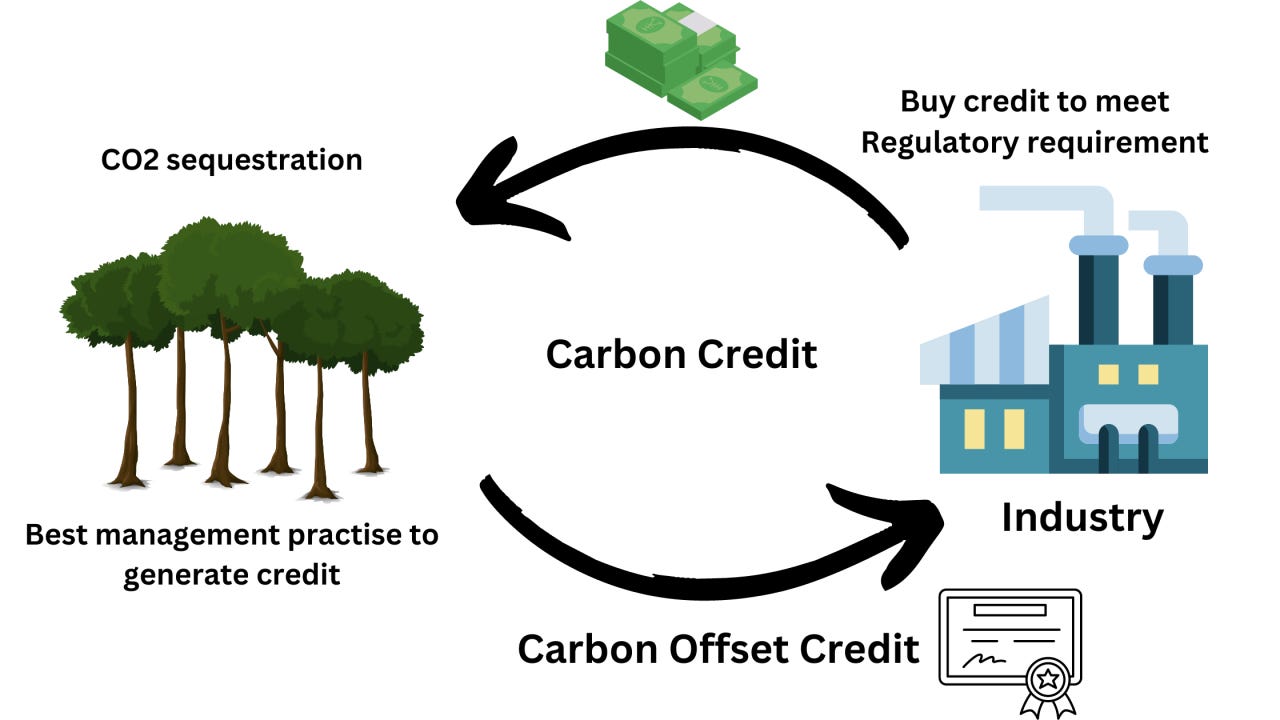
Thus, not only does India have to achieve its net-zero target, it also has to multiply its industrial output. These two things have, traditionally speaking, been antagonistic to each other, because industries are in fact the biggest sources of emissions.
Then comes a third challenge: exports. India’s import deficit has been skyrocketing in the past few years, which India is trying to change. In order to increase its exports, India needs to lower its manufacturing costs to become globally competitive.
Forcing industries to reduce their emissions raises manufacturing costs, and even if India doesn’t force industries to do so, developed countries, which are a market for India’s exports, are increasingly implementing Carbon Border Taxes. These are taxes on exports from those countries which do not force their industries to lower emissions. This again could raise export costs, making Indian exports less competitive globally.
Thus, India faces the three-fold challenge of meeting its net zero goals, multiplying its industrial output and increasing its exports. Therefore, India’s climate challenge is unlike any other major country. Can carbon credits be the solution?
There are two lessons that stand out from the 30 years of the world’s experience with carbon credits, and cap-and-trade systems in general. First, that these systems have proven to be environmentally effective and economically cost-effective compared to traditional compliance methods. Second, and most important, that the performance of cap-and-trade systems depends on how well they are designed and managed.
In 2023, the Government of India notified a scheme called the Carbon Credit Trading Scheme, creating an official market for carbon credits in India. The scheme aims to regulate a selected group of industries accounting for a majority of India’s carbon emissions and enable them to offset their emissions through carbon credits trading.
The impact is yet to be seen considering it’s too early, but there is no doubt that the carbon offsets industry has huge potential for India, if we get it right.
It’s a significant step towards India’s net zero emissions goal of 2070: enabling sustainable businesses to earn an extra penny and non-sustainable ones to pay for their sins; propelling us towards a sustainable future.
Comments
Nothing yet. Say the first thing.
Sign in to join the conversation.