

In the river of incoherent “takes” and information we are all made to swim in, this is my life raft: Every so often, I revise a list of facts that seem to point to more durable features of our political terrain. I include facts about public opinion if they appear to reflect a consistent and settled understanding.
I spent some time this week updating my list, so here’s a first take on the 2026 Midterm Edition of Essential Facts. These are not meant to be predictive of anything and are listed in no particular order:
Before the Iran War started, less than half of Americans had enough cash to cover an emergency $1,000 expense.
Research completed just last week shows Democrats have opened up an 8-point advantage on handling the cost of living. We were even with Republicans at the start of the year. Good, but it’s only 35-27 now.
This year, the share of our national income earned by workers hit a new low, while the share booked as corporate profits hit a new high. (I was surprised coverage of this in the Wall Street Journal (gift link) was not a bigger story.)
The most popular elected official among Democrats in America, by far, is Bernie Sanders (and he is not even a Democrat!). The second is AOC. Important when you try to make sense of primaries.
Half of Pennsylvania Democrats have a positive view of the Democratic Socialists of America. Only 15% have an unfavorable view. (Your support helped me access some private research I can’t link here. Thank you!)
Even though the DSA draws its votes mostly from highly educated voters, I am choosing to believe most of these Pennsylvanians don’t know that one of the chairs of the DSA just told The New Yorker that the mass slaughter, rape, and kidnapping of Jews in Israel on October 7 was “largely inevitable,” and reaffirmed her support for those who rallied for Hamas in New York the day after the attack.
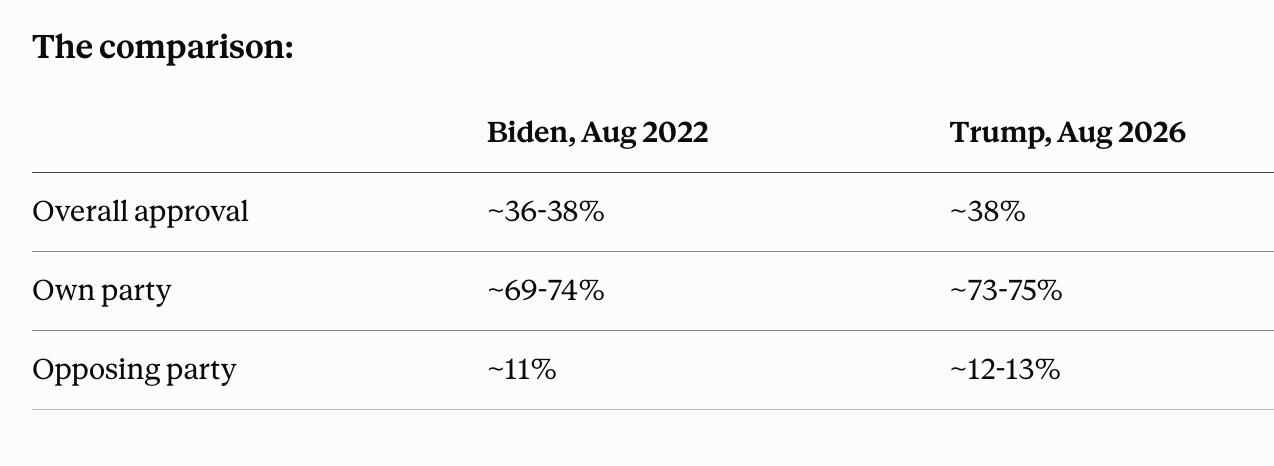
I asked Claude to make this table comparing Trump’s current popularity to Biden’s in 2022, and you can see how similar they are, with Trump actually holding his party slightly better. Notable since ‘22 was decent for Biden:
On the other hand, enthusiasm to vote among Republicans has dropped dramatically and seems to be worse than Democrats’ enthusiasm in 2022, and worse than Republicans’ own enthusiasm in 2018.
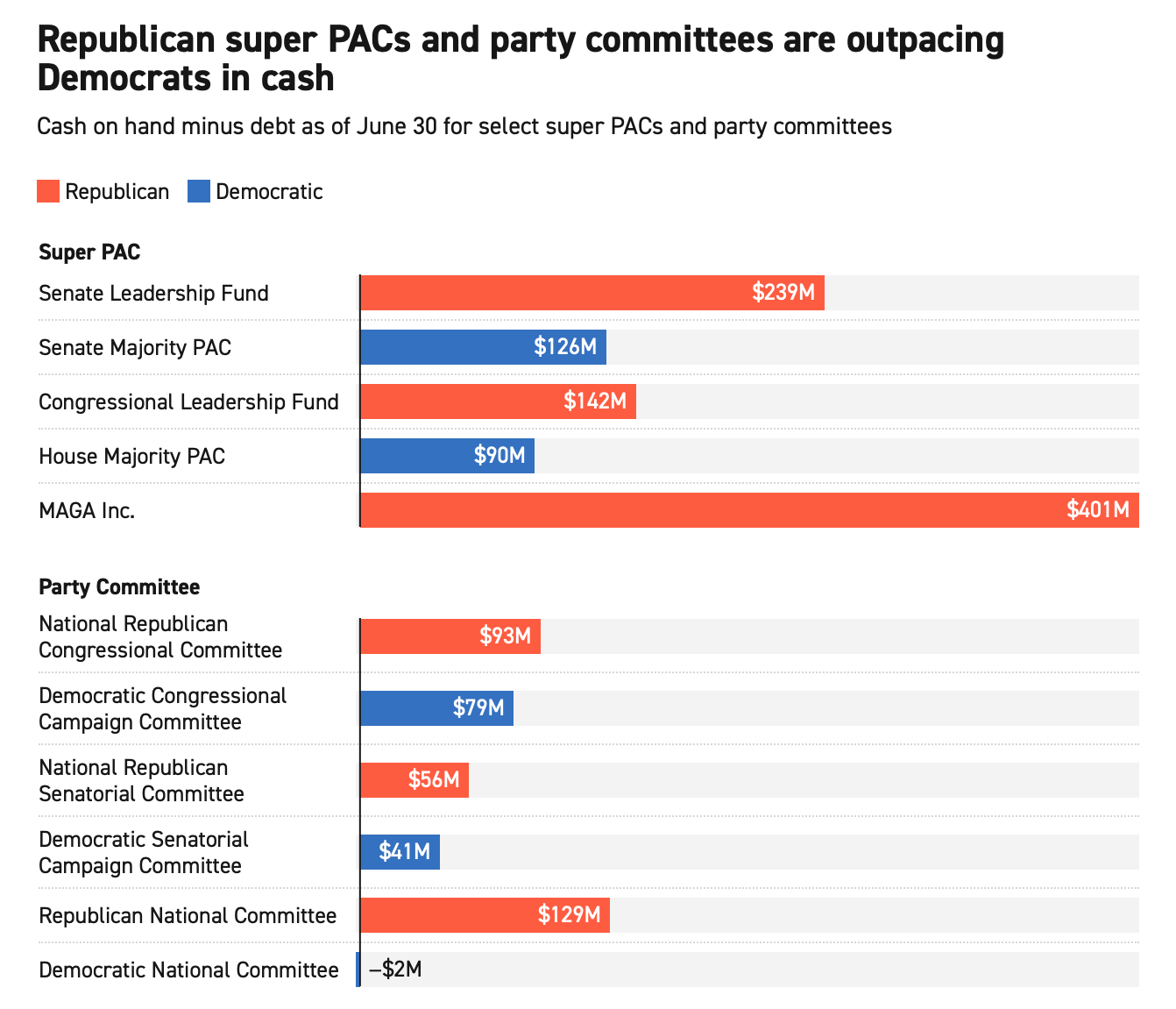
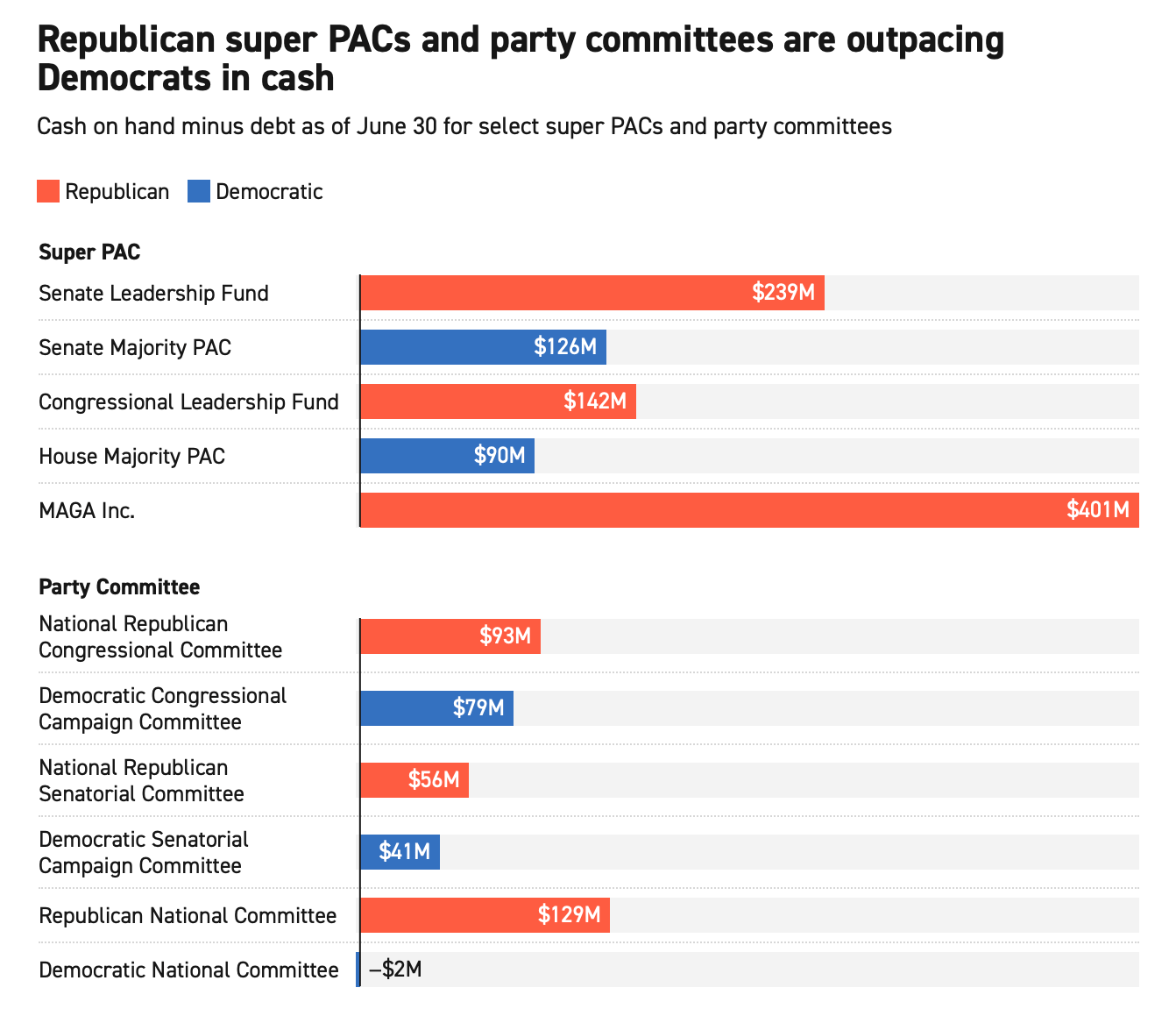
Can money buy back any of that enthusiasm? Outside of each side’s candidate campaign accounts, Republicans have at least three times as much money as the Democrats, which is different than previous cycles. This chart from Politico sums up it pretty well:
Some say a “wave” could overcome these dynamics, which is true, but people tend to forget that ticket-splitting still happens to a significant degree:
In 2020, Susan Collins (who won) got almost 57,000 more votes than Donald Trump (who lost), which was about 7%. Decisive.
Mid-term electorates are different, but note that in 2022 Democrat Josh Shapiro and Republican Brian Fitzpatrick each carried the same congressional district by double digits.
2022 also reminds us how the mid-term pattern of the President’s party losing power is a less dependable pattern for Senate races than for House races.
To take control of the Senate in 2026, Democrats need to hang on to both Michigan and Georgia, and win at least four of these six: Maine, North Carolina, Ohio, Iowa, Alaska, Texas. (Then, we’d need to hope Fetterman didn’t flip to become a Republican and give back control of the chamber.). A tall order.
While these states are hard to win, you should not think of them as one-off exceptions. They are the new map. The 2030 redistricting will shift more representation to the Sun Belt and make it impossible for Democrats to win the White House purely with its old “blue wall” strategy.
Education is emerging as the critical divide in American politics, with 2024 having the highest level of educational polarization seen yet.
Of the six states I mentioned above, five are below the national average in percentage of voters with a bachelor’s degree.
Yet Nevada is even further below the national average than these five, and Democrats control both of its Senate seats.
Two years ago, Democrats held a Senate seat in the state with the lowest percentage of bachelor’s degree holders in the entire country. His name was Joe Manchin.
A Democrat who succeeded with working-class voters more recently was definitely not a DSA member: In 2025, Gov. Abigail Spanberger won half of these voters, a significant number considering Harris won 42% in 2024.
Also in 2025, Cuomo beat Mamdani among voters without a college degree.
Last month, Susan Collins was beating Platner among working-class voters by more than 20 (he was getting 37%), and Stevens was beating El-Sayed by a similar amount.
Hope this is helpful. How about a quote from the late, great Senator Daniel Patrick Moynihan to close?
There is a center in American politics. It can govern. The [National Commission on Social Security Reform] is just an example of what can be done. First, get your facts straight. Everyone is entitled to his own opinion, but not his own facts. Second, decide to live with the facts. Third, resolve to surmount them. Because, fourth, what is at stake is our capacity to govern.
Comments
Nothing yet. Say the first thing.
Sign in to join the conversation.