
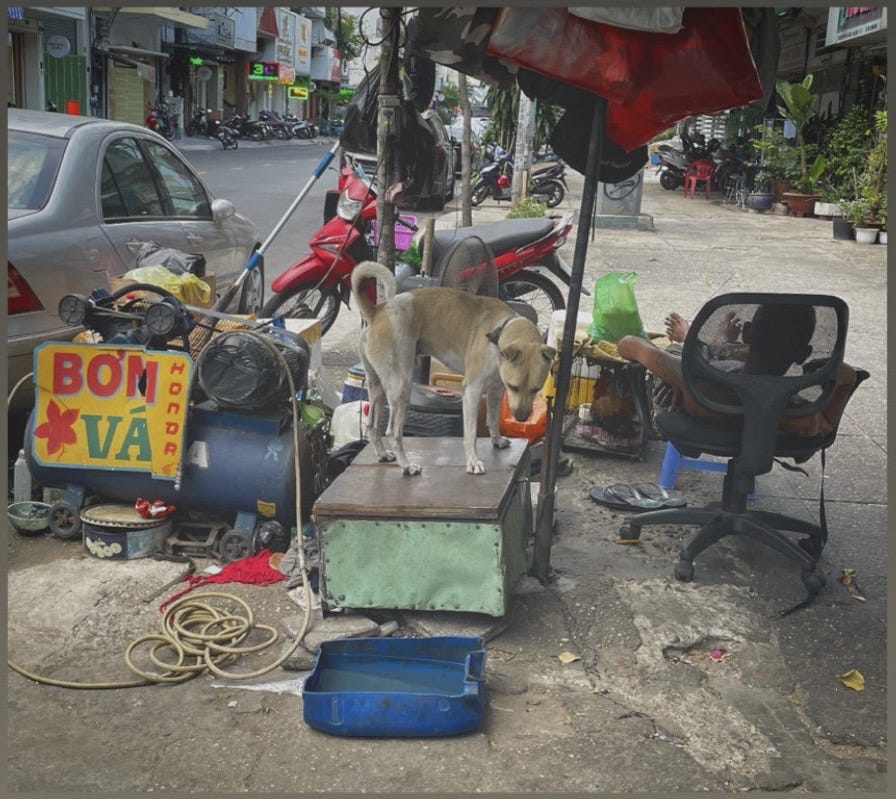
“Because, you don’t have to live in Ho Chi Minh City for very long to realise how quickly things can change. It’s far from unusual to discover something you cherish has disappeared overnight, and where you can easily find yourself getting nostalgic about the way things used to be, you know, like last Tuesday.”
That’s still true, and I imagine it will be for many years to come. Or perhaps forever.
As anyone who lives here knows, Ho Chi Minh City, née Saigon, changes rapidly, so rapidly that any essay or article one writes about it can quickly be out of date.
Over the years, every time I have been commissioned by a glossy magazine to pen a travel piece about the city, within a few months at least one of the small businesses I mentioned will have disappeared or relocated. Sometimes it only takes weeks.
And so it goes.
My book Falling for Saigon came out on May 1, 2025. One of the first things to date the text was a restructuring of the city’s addresses. There are now no city districts. Of course, in conversation people still say District 1, District 4, Bình Thạnh District, et cetera, but as of July 1, 2025, they no longer exist officially. The city is now divided into wards, not districts. As an official ward name, Đa Kao, a very historic neighbourhood mentioned in The Quiet American, and one I refer to more than once in my book, is now a memory. One chapter, ‘A Nearby Neighbourhood’, is also a paean to what I have always called Phường 19 (Ward 19). It too is no more, at least on paper. Many of us will carry the old neighbourhood names in our hearts for the foreseeable future, but they may be a mystery to newcomers and visitors.
Other architectural or physical characters from the book have been altered or removed. In the essay about the city’s fading heritage, ‘Falling for Old Saigon’, I mentioned the Hien & Bob’s building, the curved apartment block on the corner of Hai Bà Trưng and Đông Du. For years it was almost completely uninhabited. The only tenant, as far as I could tell, was on the ground floor, a cigar and cognac shop where Hien & Bob’s – a dusty tiki bar – had sat for nearly 30 years.
The building was so rundown that people assumed it would soon be razed, and in the book I used it as a symbol of sorts, one that suggested we cannot be too sentimental about “heritage” when it is a dilapidated, mouldering building that no one wants to live in anymore. Its time, I wrote, would soon be up. And so it goes.
But at the end of 2025, I saw signs of life. Under whose initiative I am not sure, it got a lick of paint, and then a couple of food and beverage tenants moved into the upper floors. It may be a temporary resurrection, but it is still good to see the place occupied, with some colour in its cheeks. At this stage I’m half expecting Hien to reopen a bar above the cigar shop.
In the same essay I also mentioned the idle land where the old Sabeco factory used to be, which faced the Hien & Bob’s building. A forty-floor tower dubbed the Sabeco World Trade Center was supposed to be developed there, many moons ago, but it never broke ground. As a result, this ‘golden land’ sat hidden behind a metal fence for years. I once wrote that the plot would make a fine beer garden, an appropriate use given the history of Sabeco, or so I thought. Tear the fence down, throw in some tables and chairs, then let the beer flow and the good times roll. It already had some trees, a view of the Saigon river, and most importantly, space. And now? Lo and behold – a huge open air seafood restaurant has opened on the premises, where beer flows freely alongside enormous tanks of shelled creatures. Whether you want to eat there or not, it has revived what had been a fallow, largely unseen plot. A skyscraper may yet rise there, but for the time being the restaurant is making hay while the sun shines and the city looks better for that.
All around District 1, or should I say Phường Sài Gòn, many of the temporary blue fences featured in a short essay called ‘Don’t Fence Me In’ have been taken down, and in some cases temporary parks have emerged. Elsewhere, more substantial parks have been unveiled, a welcome sight in a city that has long been short of greenness. The new Công viên Lý Thái Tổ, with its spectacular trees, fountain arena and elegant modernist villa, is well worth the trip to District 10. The site of the old Phan Đình Phùng Sports Center has also been transformed into a park, less striking but still nice to see. I might have mentioned Công viên Lý Thái Tổ had it opened before I put the book to bed but at least I had the timing to catch the metro, which opened the week before I completed my final edits in late December.
To be honest, I have not looked at the text in full since then, and I am sure there are many other details that have dated.
And so it goes.
Many of the essays were originally written some years ago, and although I updated them all, I always knew the book could not keep up with the times in a city that changes so fast. Still, should anyone who reads the book notice dated details, perhaps they can appreciate it as a document of its time, perhaps even a tribute to those times – especially if they were your salad days.
Over the last 12 months, I have also kept thinking of details I didn’t include but wished I had. The flower pots that hang on the walls in so many alleyways. The beauty of Lim xẹt as its yellow petals drift away in a breeze. The tall, pale trunks of the chò nâu trees. Walking toward a setting sun on Sương Nguyệt Anh or Tú Xương. The decorative wrought iron windows with ships, treble clefs or other motifs. The cool season in mid to late December, that brief spell when the temperature drops to 20 degrees overnight. Meeting a Cantonese or Hokkien family in the back alleys of Chợ Lớn. The five tigers of Đa Kao Ward. The Sicilian vibes of Cô Giang Ward. The way that busyness gives way to sleepiness just after lunch in every single backstreet, all across the city at exactly 1.30pm. The communal feel of a micro park in the evening. The night I watched a tug of war in Công viên Hòa Bình in District 5. The joy of eating goat curry on a breezy night in the rainy season. The city’s Grab drivers’ fondness for religious figurines, all the usual suspects. The wonky canopies. The Christmas or New Year decorations that don’t come down till July (if they come down at all). And a hundred other small (or not so small) things.
But in spite of the changes that date the book, and all the details I missed, I hope it still captures something of the city’s spirit and feel. Like all cities, buildings are flattened and businesses come and go, and in Ho Chi Minh City that rate of change is particularly dizzying, and the turnover of its population also adds to the sense of loss. If you stick around for a while, you’ll surely become very accustomed to raising a Parting Glass for a fond farewell to dear friends.
And so it goes.
But the city is still there, and if you lose yourself in a network of hẻm, or explore a neighbourhood, one you know quite well or one you don’t know at all, you are sure to still find oodles of that old Saigonese charm, as well as that place or thing you didn’t know you were looking for. The rainy season will still bring a touch of melancholy or cosiness, and a smile to an Irishman’s face. The food, in all its variety, will remain wondrous and continue to shape how people think about food and how they like to eat. The already countless cafés will somehow keep multiplying, and if you cycle through the inner or outer districts, you will still find stretches of calm and contentment, if not epiphany. The late afternoon drop in temperature will still draw people onto the streets, and the twilights, orange, pink, or blurred together, will remain beautiful. Old ballads will still be sung in tucked away bars. The nhậu restaurants will still be rambunctious and life affirming. And the city will remain as easy to fall for as it always has been.
And if you used to live in Saigon, I know your heart must yearn for it, yet you may worry: will it be the same when you return? Of course not, at least superficially. You will feel a pang when you find an old haunt is gone, or that a characterful building you loved has been bulldozed. But as I have tried to capture in Falling for Saigon, this sprawling city, always growing and regenerating, holds an enduring charm. All you have to do is venture back into it to be reminded that the pleasure of finding new places and having chance encounters never gets old. And anyway, who says you cannot fall for Saigon over and over again? Not me.
~ ~ ~ ~ ~ ~ ~ ~ ~ ~ ~ ~ ~ ~ ~ ~ ~ ~ ~ ~ ~ ~ ~ ~
Postscript: A sincere thanks to everyone who has bought a copy of the book (or more than one copy), searched high and low for it, lent it to someone, borrowed it from someone; ordered a copy for their library, found a copy in a library; written to me to share their feelings after reading the book, or sent me a picture of the book wherever in the world they were reading it (yet to get one from South America - hint, hint). It all means a lot to me. The book didn’t get permission to be distributed in Vietnam, which is a shame (if not wholly unexpected) so thanks to everyone in Vietnam who found a way (by hook, by crook, etc) and managed to get a copy; and thanks to Linh in Hỏi Ăn and Duong in Saigon for spreading the word(s). As a result of Trump’s reign of tariffs, the publisher also couldn’t get the book distributed in the US through the usual channels, which was pretty disappointing, so thanks to anyone in the US who ordered it in spite of a higher shipping fee. And for those who haven’t got a copy but wish to do so, the good news is a book often gets cheaper in its second year! Your local bookstore can order you a copy. And yes it’s also on Kindle. And Kobo! And seriously, if you’re in South America and have a copy, please send me a photo.
A Story from Connla is a reader-supported publication. If you like what you read, you can pay a small fee (up to you how much, or how little) via Ko-Fi or Paypal. Remember a well-caffeinated Connla is five times more productive than a normal one.
No posts
Comments
Nothing yet. Say the first thing.
Sign in to join the conversation.