
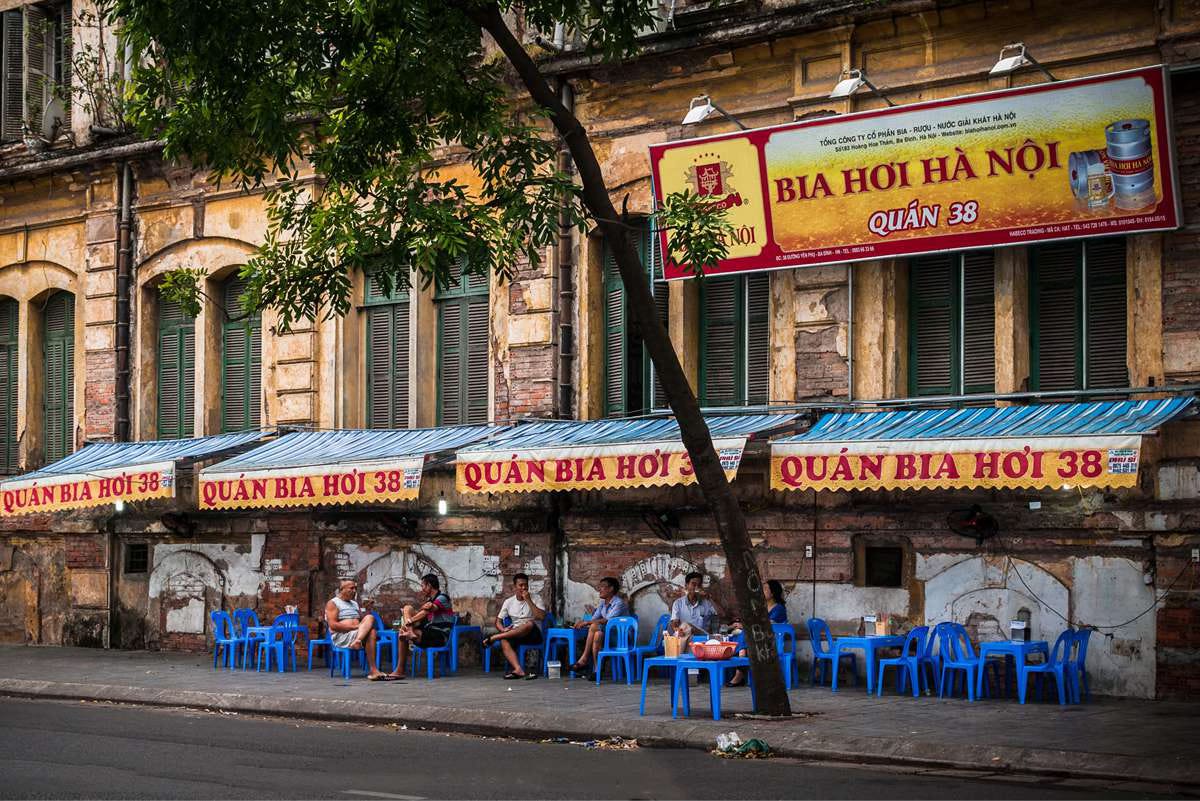
“In this way you too, waiting day after day, will become a part of her. You too will nourish the city.”
—Gianfranco Calligarich, Last Summer in the City.
A quick one-item glossary
Bia hơi – literally “fresh beer”; depending on context, may refer either to the lightly fermented draft beer itself or to the humble street-side establishment in which it is consumed. If confusion persists, please proceed immediately to the nearest bia hơi, order a bia hơi and consider reading this essay.
i: A note on identity and the basics of spotting
Who is the bia hơi spotter?
Let us suppose he is an everyman1 that may or may not be gainfully employed, and whatever it is that he does (or doesn’t do anymore), well, it is of no consequence to us.
The aim of this essay is merely to acknowledge his pastime (some might call it a vocation): roaming the streets in search of a pleasant bia hơi in the wilds of Hanoi.
A simple pleasure? Perhaps. But let us also not assume the spotter is a simple man – indeed, he may seek out a pleasant bia hơi for the very reason he is grappling with heavy existential questions. Then again he may have very little on his mind. Everyone is free to think about whatever they like while sipping a beer (or three) and watching the world go by in Hanoi.
There is also no need to picture how our spotter dresses. He might be disguised as a trader, a tradesman, a technician, a clerk, an apparatchik, a doctor, a xe om or delivery driver, an artist, a balladeer, a ne’er do well, a slubberdegullion, a pensioner, or a jogger…
Side note: if they prefer running alongside the traffic in Hanoi, rather than on a treadmill, runners make for very fine spotters. Indeed, one can only hope to someday read a 100km finisher’s memoir titled: What I Think About When I’m Running Is Stopping To Have A Nice Bia Hơi.
Whether his appearance is nondescript or conspicuous, we can assume the spotter has a beady eye always peeled for a bia hơi, a very fine bia hơi, perhaps even an exceptional bia hơi – one where he has never sat, or perhaps one that has newly appeared. Better yet – an establishment that he once frequented and no longer realised still existed, or wrongfully assumed had slipped into extinction, but no – there it is. Forgotten but not gone. Perhaps just as inviting as the day he first spotted it – snuggled up against a lovely old villa that sits under a melancholic tree, or placed in between a motorbike wash and a streetside barber, or tucked away on a leafy stretch of a side street.
Naturally, the spotter is well attuned to the sounds of the city he calls home. The dissonance of Hanoi can overwhelm many visitors, but not a veteran bia hơi spotter. He is impervious to the noise. Nor does the feral traffic faze him. Whether running, walking, riding on a moped, gamely pedalling a bicycle, or trapped inside a four-wheeled vehicle, he maintains an uncanny ability to spot a very fine bia hơi that might tempt him to kill an hour – if not at that very moment, then on another occasion, when the weather suggests it, or his mood demands it.
Wherever he roams, the spotter remains alert to the possibility of a rare sighting – a bia hơi of unusual splendour or intimate intrigue hidden in plain view. It might be a one-keg operation in or around the Old Quarter; a midsized establishment occupying a perfectly scenic patch of pavement; or a vast bia hơi with its own bike park, and a squadron of staff ensuring even the largest tables get swift service.
Keenly aware of the city’s geography, the spotter will not be deceived by a rather bland industrial frontage with a large sign advertising Bia Hoi Ha Noi or Viet Ha Bia Hoi, the two leading producers of ‘fresh beer’. Toward the back, he may correctly guess that an establishment opens up onto a view of an attractive lake that glistens in the sun.
But the spotter doesn’t need a shimmering lake to feel like he’s in the right place. He can be just as happy daydreaming over a glass of beer in the thick of the city with a view of the traffic. Each bia hơi has its place, and is the right place for whoever willingly flutters into its arms to sup on a glass (or three).
That’s not a rule (for there are no rules) but it is undoubtedly a truth.
ii: A note on moderation and communal drinking
For anyone who has jumped to the conclusion that the bia hơi spotter is an incorrigible binge drinker – well, shame on you. Some of the finest spotters are very much men of moderation. Finding a pleasant, if not excellent, bia hơi in which to kill half an hour in the late afternoon or at sundown may be more than enough.
Now, on occasion, has a bia hơi spotter been embroiled in a mighty session and supped not wisely but too well? Perhaps in the company of a victorious football team (or a not-so-victorious football team that nonetheless knows a thing or two about camaraderie), or a bunch of excitable colleagues or old college buddies, the kind who keep standing up to knock another beer down with increasing gusto? Why yes, such things may well have come to pass on occasion.
But the true bia hơi spotter is most probably happiest when he is free to sip his beer (a fresh, lightly pasteurised lager, typically just 4%, or thereabouts, in terms of ABV), admire his surroundings (whatever they may be) and contemplate existence in his own fashion.
And if he is sitting at a carefully chosen bia hơi at precisely the right hour, the spotter might almost be tempted to think he has it all figured out.
If only for a beer (or three).
iii: A note on the culinary staples at a bia hơi
When traversing the city, the bia hơi spotter might regrettably have another destination – his office, a bank, the abundantly furnished home of his in-laws, a children’s party, a wedding (and then another wedding), a funeral, a 5-a-side football pitch on the other side of town, a dentist, a clinic, a café where he and his wife have to listen to a real estate agent wax lyrical about an apartment project that he doesn’t want to live in, and so on.
No matter what duties have befallen him, or what errands he has to run over the course of a day, sooner or later the spotter will find himself both thirsty and peckish.
On a swift solo mission, should he wish to pull up a plastic chair and pay his respects to the city, his needs may indeed be simple: a frothy pale beer (chilled but never icy cold) and a small plate of lạc luộc (boiled peanuts). That is enough for a one-bia pit stop.
If his stomach is rumbling, he might nibble on a little mực khô (dried squid) or work his way through a bundle of nem chua (sour sausage wrapped in banana leaf) – a little protein, saltiness and fermentation. That would be more than ample, if he is between meals, to accompany a couple of light ales.
Perhaps the establishment’s culinary reputation demands a house specialty be summoned to the table. And perhaps this specialty has a little backstory or invokes a memory (for food so often does). A coarse salami from Cao Bằng, the mountainous realm where the owner was born? A fat Germanic sausage because the owner once studied engineering in Dresden? Or a dish of chân giò hun khói (smoked pork knuckle) with a fatty rind that might remind a foreign-born bia hơi spotter of a childhood Christmas dinner – and his mum.
If the spotter has convened with a friend, one whiff of mắm tôm (fermented shrimp dipping sauce) might tempt them to order a plate of lòng – for the Hanoi-born-and-raised bia hơi enthusiast eats with relish the inner organs of beasts and fowls2. Yes, a dish of lòng rán, crisp from the wok – that could be just the ticket. Or perhaps a plate of gan cháy tỏi, liver scorched with garlic? Or how about some thick slices of dồi huyết – blood sausage studded with herbs and peanuts, served with rau răm and mắm tôm: rich, salty, earthy, and sublime with beer.
But as the repertoire of many bia hơi establishments is vast and varied, a table of drinkers may choose from a hundred (or more) different dishes: Chim câu xào hành răm (stir-fried pigeon, served heads and all, with onion and coriander), Triều Khúc-style pork cracklings, dạ dày luộc (boiled pig stomach, sliced thin and dipped in fish sauce with ginger or green mustard), tai heo ngâm chua (pickled pig ear), thịt bê xào sả ớt (veal stir-fried with lemongrass and chilli)...
And because no Vietnamese man forgets his greens, a table may also order rau muống xào tỏi (stir-fried water spinach with garlic), cải mèo xào tỏi (mountain mustard greens stir-fried with garlic), ngọn su su luộc (boiled chayote shoots served with sesame salt or fish sauce), or rau cải xào gừng (mustard greens stir-fried with ginger) – for even the most devoted bia hơi enthusiast understands the importance of maintaining some semblance of equilibrium amidst the offal, fatty cuts of meat and beer.
It is true that foreign-born bia hơi spotters – a tribe of faithful Hanoians who know the city like the back of their hand – may veer away from the innards and orifices, preferring more familiar-looking (in their eyes) cuts of flesh and morsels: pork ribs with a five-spice rub, bò lúc lắc (cubed beef with onion and bell pepper), mực hấp gừng (steamed squid with ginger), mực chiên bơ (breaded squid pan-fried in butter), cánh gà chiên nước mắm (fish sauce chicken wings), or some good old-fashioned khoai tây chiên bơ – a plate of chips.
They play it safe, and there is no judgement in that. The bia hơi is all things to all people. If there were a prime directive – and there is none – it would simply be this: order whatever you please to accompany a beer (or three).
iv: A note on freedom, attire and the sound of breaking glass
A bia hơi spotter may or may not have read the works of philosophers who have mulled the subject of liberty late into the night, but he knows this to be true: to sit at a bia hơi in Hanoi is to experience a joyous sense of freedom.
One is not merely free to order whatever one wishes from the menu without judgement. At the bia hơi, one is largely free to be whatever sort of character one wishes to be. Someone arriving in rollerblades with silver trousers and a bright green mohawk might turn a few heads, naturally, but ultimately nobody cares very much what you wear, or what is on your feet: leather shoes, trendy runners, military boots, football or badminton shoes, Crocs, flip-flops, or dép tổ ong a.k.a. house sandals.
No one cares what you do (or do not do). No one cares how much money you make (or do not make). In larger venues, no one cares how loud a table of revellers becomes, whether you and your friends stay for two beers or twelve, or whether you accidentally drop a glass (or two) that disintegrates into fine particles of sand (for dust it is and to dust it shall return, amen, etcetera). Although dropping three might be pushing it.
The bia hơi, ultimately, is a utilitarian concept. If you do not enjoy one bia hơi because it is too loud, its lighting too fluorescent, its beer too inconsistent, or its toilet too otherworldly3, do not despair. In this vast, thirsty city there are literally thousands of others to choose from, and to find one more suited to your mood, all it takes is a little exploration, which brings us neatly to the matter of field equipment.
v: A note on field equipment
The bia hơi spotter does not need a field guide, a compass or camouflage when moving through his natural habitat. Nor does he require binoculars, a torch or a whistle (although he is free to bring any of them, if he wishes). He does not need a wide-brimmed hat or a spare pair of dry socks. Then again, if riding a motorbike through the drizzle season or a summer storm, the latter might not be the worst idea.
Ultimately, no field equipment is necessary. In his pockets (let us assume he has some), all he truly needs is a little cash, although in this day and age he may simply use his phone to quét QR. He may claim to possess a map, but it exists only in his head: a constellation of the finest spots for a bia hơi (or three) scattered across the city.
Through the latter years of the Golden Age of Bia Hơi Spotting, roughly March 1995 to November 2005 [citation needed], the spotter had a growing number of digital tools at his disposal. Mobile phones, digital maps, social media, and so forth. Did these so-called technological advances make him a superior spotter?
Many old-school spotters would say no.
In the pre-digital bia hơi spotting era, the element of surprise invariably supplied the magic. Each urban exploration, whether planned or unplanned, carried the possibility of a random discovery. A spacious and inviting bia hơi with all the right elements to catch the eye: ample shade (artificial and/or natural); something delicious being grilled by a couple of floppy-haired teens with rolled-up trousers; an attentive dispenser of beer with a stack of spotlessly clean glasses, pouring each beer with a kind of dead-eyed, automated accuracy.
The spotter might shake his head and smile at the thought that he almost passed such a grand emporium without noticing its splendour.
Once upon a time, out there in the wild, armed only with his beady eye, there might even be a sighting of a lesser-spotted species such as Việt Pháp Bia. Or perhaps a small, low-key bia hơi tucked away in a leafy nook (the technical term for a hard-to-see bia hơi is a “skulker”) with a view of some mottled but charismatic old gaff, a near-perfect place to watch the world go waltzing by…
Truth be told, there were fewer surprises left for the veteran bia hơi spotters as the 21st century progressed in Hanoi. They had traipsed the city far and wide and knew where these rare species dwelled, and on a whim they might ride across town simply to appreciate them: a small shed of a bia hơi along a dusty Red River track, where one might drink under a tarpaulin and count another man’s chickens; an establishment situated beside one of the city’s less heralded lakes (there are about a hundred of them), or around the corner from one of Hanoi’s most famous tourist attractions; or even a low-key but highly appreciated bia hơi not far from a spotter’s humble abode (such a bia hơi is known as “home turf gold”).
In short, the spotter will trust his instincts over any navigational tools or, God forbid, a Google Review.
vi: Some notes on spotter parlance
In spotter parlance, the technical term for a dreamy looking bia hơi that appears, from a distance, to tick all the boxes only to disappoint upon closer inspection is a “mirage.”
A “pilgrimage bia hơi” refers to a bia hơi so respected that a man will willingly ride forty-five minutes or more through Hanoi traffic merely to drink there for an hour.
A “keeper” is a newly discovered bia hơi that the spotter instantly recognises as worthy of repeat visitation, perhaps even a long-term relationship.
A “holy grail” or “lifer” is a bia hơi encountered for the very first time in one’s life, especially after years or even decades roaming Hanoi and hearing the lore surrounding it. Such a sighting can produce intense excitement in veteran spotters, who may have believed no unseen specimens remained within the urban boundaries.
A “salad days bia hơi” refers to a bia hơi that vanished years ago but continues to live vividly in the memory of veteran spotters, who frequented the establishment in their own personal golden age.
A “sundowner bia hơi” is, mercifully, a self-explanatory term.
A “breath of fresh air bia hơi” is a bia hơi that has somehow commandeered a surprisingly large and spacious courtyard in the middle of a congested city.
As already noted in the text, “home turf gold” refers to a splendid bia hơi in the spotter’s own neighbourhood that he has somehow overlooked for years, and which leaves him feeling like a bit of a nitwit for not noticing it sooner.
vii: A note on names (official and unofficial)
In most (if not all) cases, the spotter does not know the official name of the bia hơi, if it even has one. Throughout the history of bia hơi spotting, establishments have more commonly been identified by their street: Bia Hơi Quán Sứ, Bia Hơi Yên Phụ, Bia Hơi Lý Thường Kiệt, Bia Hơi Trần Phú, et cetera. Yes, it is certainly true that most of these streets, if not all, contained more than one bia hơi, but most of the time everyone knew exactly which one was being discussed.
During the Golden Age of Bia Hơi Spotting, a crew of foreign-born bia hơi enthusiasts coined their own descriptors, transmitted via Hotmail, Yahoo! and FPT email accounts or sent by text message on primitive mobile phones: “See u at squid bia hoi” referred to the institution at the bottom of Tông Đản Street famed for its crumbed squid; “parachute bia hoi” referred to an establishment beneath a vast canopy on Tăng Bạt Hổ; “opera bia hoi” referred to a venue facing, yes, no need to guess, the Opera House.
Did different individuals each have their own personal favourites? Of course they did. To each his own little corner, and there can be no claims of perfection. Indeed, the bia hơi spotter may at times find himself struggling in the elements at one bia hơi or another that he has chosen himself. It is too hot. Too humid. The beer is neither fresh nor frothy. Somewhere down the road a construction site is in full swing. An angle grinder. A hammer drill. A concrete saw. They are all going at once. Or perhaps a newly opened mobile phone shop has stationed loudspeakers on the opposite pavement to bombard its environs with techno-pop.
But over the years, the spotter will have experienced disappointment in the field many times and learned to accept what sociologists might call the Emotional Curve of Bia Hơi Spotting. What can the spotter do? He keeps his peace, finishes his beer, and changes location. He is, if nothing else, a stoic man.
viii: Notes on weather, seasons and migratory urges
As already noted, a bia hơi spotter is not necessarily a die-hard consumer of beer. He may even hibernate for much of the winter, when more hardy bia hơi enthusiasts huddle around hotpots, or sit grimacing in their winter clobber and drink a beer (or three). During these cold months, the spotter may suppress his migratory and exploratory urges.
His wife, girlfriend or partner, if he has one, may or may not notice a certain restlessness. A slight agitation perhaps, or merely a distracted look, as though he is staring into the distance at an imagined bia hơi on a fine spring afternoon, when the returning sun encourages one and all to sup on a cool (but not icy cold) beer.
This “zugunruhe”4, as a German ornithologist might put it, may or may not place a strain on a marital or pre-marital relationship. But more often than not, the spotter is a patient man. Perhaps he even sees a certain beauty in the deferral of satisfying his urges. For what could be sweeter, more idyllic, than that first glass of bia hơi in a very fine bia hơi on the first sunny day of spring?
Anyone who has endured the four seasons of Hanoi knows that it becomes a different city in the sunshine. After a cold winter, the season of drizzle may prolong the agony. But when the sunshine finally returns, the grey drabness is transformed by a kind of meteorological alchemy.
Stepping outside his door in such weather, a smile will surely come to the face of the spotter. Perhaps he revisits a well-established favourite, a place that ticks all the right boxes. Somewhere he returns to every spring, for the spotter can also be a creature of habit. Indeed, his migratory patterns will often be linked to the seasons. He might be seen peregrinating toward a breezy lakeside bia hơi on Tây Hồ as the heat ratchets up through April or May; a sprawling open-air beer garden with industrial-sized fans labouring away in the thick of a blazing summer; a sun-dappled pavement bia hơi in September; or a roadside bia hơi that catches the winter sun when it hangs low in the sky in December…
At any bia hơi, the snacks and specialties will also change with the weather. In spring, he might see (and then order) ốc luộc (boiled snails with ginger, lemongrass and dipping sauce), rau cải xào (stir-fried mustard greens), or perhaps a plate of đậu sốt cà chua, fried tofu simmered in a light tomato sauce.
In early summer (đầu hè), a table might be heard calling for xoài xanh chấm muối ớt (green mango with chilli salt), a tart and refreshing beer snack, or a bowl of ngao hấp (steamed clams). In high summer (mùa hè), a gathering of bia hơi drinkers may feast on chân gà nướng (grilled chicken feet), nộm bò khô (green papaya salad with dried beef) and dưa chuột chẻ (sliced cucumber with dipping sauce), while declaring with considerable satisfaction that the beer has “mát ruột” (“cooled their guts”).
Through autumn (mùa thu), a cycling vendor selling cốm (young green rice flakes) might be cooed over to a table or, with any luck, a bia hơi kitchen may be frying up seasonal chả rươi (ragworm omelette). As the evenings grow colder, ốc nóng (hot snails), khoai nướng (roasted sweet potato), ngô nướng (grilled corn) or hạt dẻ nướng (roasted chestnuts sold by vendors) warm some street-side punters up, and if the cold is really biting, a bottle of rượu trắng (rice liquor) will infiltrate proceedings to further warm the cockles.
By charting these seasonal pleasures, and welcoming their return, the bia hơi spotter comes to savour, rather than lament, the passing of time.
ix: A note on the golden age of bia hơi spotting
In the late 1990s, a young Vietnamese man who had spent many years in a distant land returned to Hanoi, a little reluctantly at first, only to realise it was where he wanted to live for the rest of his life.
There were many details and facets to the city that he loved: the food, the cafes, the lakes, the dreaminess of the mornings, the laconic rhythm of daily life. But nothing felt more Hanoian to him than a bia hơi. At a time long before cocktail bars, craft beer taprooms and generic sports bars mushroomed across the city, these low-cost joints were the heart and soul of social life.
In the golden age of bia hơi spotting, spotters travelled light. This returnee was no different. He would leave the house with half a pack of cigarettes, a couple of keys, and enough cash for an evening of bia and grub. No fixed plans. No appointments. He would simply drift around, sometimes for an hour or more, pondering the meaning of life, or thinking of nothing much at all, until he saw the right spot. Then he would park on the pavement and take his place among the assorted drinkers in their plastic chairs.
And wherever he sat, he felt as though he had something to look at. Even a view of the traffic felt hypnotic. Naturally, he established a number of go-tos. The wide and spacious pavement bia hơi on Lý Thường Kiệt, where the deep-voiced chị (big sister) teased his Vietnamese, for he still sounded a little like a child when speaking his mother tongue, having left Vietnam as a six-year-old boy.
The small but always busy spot beneath the train tracks on Phùng Hưng, where middle-aged and elderly men were kept in check by an attractive em (younger sister) who wore, in all weather, long sun sleeves, a floppy hat and a matronly jacket that gave her a certain medical authority.
There was also a fine bia hơi on the Dyke Road, where local men sat, rain or shine, beneath tilted canopies with their backs to an old French-period building. Conveniently, it was right beside a rửa xe, so the returnee spotter would drink a bia (or three) and nibble on lạc luộc or nem chua while his motorbike was washed.
On one idyllic autumn day, he came across a rare bird: the lesser-spotted Việt Pháp bia hơi being poured at a small venue on Dã Tượng Street, just around the corner from the old Supreme People’s Court on Lý Thường Kiệt. It was a low-key gem. Both a skulker and a keeper. The beer was perfect, fresh, frothy, and properly chilled. The clientele, seated happily beneath the shade of a phượng vĩ tree, were mellow and affable gents. The woman running the show made sure the simple things were done very well. Boiled peanuts. Fried tofu. Grilled squid. Last but not least, the street itself, Dã Tượng, was central but small, and never overrun with traffic.
On another occasion, he followed a Hanoian pal to what he would later refer to as the Army Bia Hơi, not an actual name. Imagine a wildlife enthusiast suddenly realising he or she has been riding past a magnificent safari for years without noticing it. That is how he felt when he walked through a bike and car park on Hoàng Diệu Street and discovered a hidden ‘holy grail’ of a bia hơi. Completely shielded from the noise of the city and shaded by towering xà cừ trees, the punters at this characterful bia hơi had a ringside seat to a muddy football pitch made for Sunday-league miskicks, as well as a cluster of old French-built army buildings. The beer was served in pitchers. The whiff of mắm tôm was strong. The lòng rán superb. More than one table of middle-aged characters was usually in garrulous form, though mostly content to entertain themselves. Naturally, the odd red-faced gentleman would occasionally stray from his table to shake hands and propose a down-the-hatch toast with anyone and everyone.
At some stage, the returnee spotter realised he no longer wished to live anywhere else. It felt as though Hanoi had been part of him all along, patiently waiting for him to return and take his place among it all. The sticky heat, the damp winters, he did not care for them, but then again, who did?
Sitting at one bia hơi or another, however, he often felt unmistakably content with his lot. There was also a freedom inherent to the bia hơi that he struggled to explain to friends overseas. Free from ceremony, fashion, reservation times and calculated ambience, one could simply sit and exist. Once accustomed to spending evenings this way, many bars and pubs elsewhere in the world began to feel strangely overdetermined, stuffy, and, well, a bit shit.
The bia hơi, he mused to his Hanoian pals, who somewhat took what they had for granted, was perhaps Hanoi’s purest expression of happiness. Whether one chooses to sit meditatively attentive, alive to the sights, scents and sounds, or partake in a lively group session, that is purely a matter of preference. But wherever one sits, one may enjoy a glass (or three) and tip one’s hat to the city.
Not everyone, of course, remains faithful to the bia hơi forever. Some may feel they have outgrown it. They are too busy, too prosperous, or simply too tired after a game of Padel. Yet even those who believe they have left the bia hơi behind may occasionally find themselves passing a particularly inviting spot at sundown and think…
x: A parable of sorts…
One evening, a bia hơi spotter was sitting at a convivial bia hơi near the train line on Đường Thành. It ticked all the boxes: solid beer, delicious bì chiên giòn (fried pork skin), an excellent chân giò hun khói, and a decent view of the traffic.
As a red sun sank into the smoggy haze, a Rolls-Royce pulled up right in front of the bia hơi. The rear door opened and a man stepped out. Clearly a senior executive, although he had already discarded the tie for the evening.
He leaned back into the car to give a few instructions to his driver, who slowly rolled around the corner in search of somewhere to wait. Then, much to the surprise of the other customers, the man pulled up a plastic stool, ordered a bia and began absent-mindedly nibbling on lạc luộc.
The spotter acknowledged him with a single nod. There was no need for frivolous banter or a flurry of questions. Here, the spotter recognised a kindred spirit and perhaps a man attempting to reclaim a taste of his salad days, when he was a young graduate sitting roadside with friends, their Honda scooters parked on the pavement.
The man took a large gulp of bia. God, it was good. Just as he remembered it: perfectly fresh, delicious.
His home was perhaps a duplex penthouse in one of the city’s fanciest towers, one bearing the name of a French king called Louis, an elite English grammar school, or a skyscraper in Manhattan. Or perhaps a villa so enormous it might reasonably be mistaken for a fortress by any Don Quixote-style character roaming the hinterlands of Hanoi. Inside waited a beautiful wife, more stunning than the day he met her, along with his gifted children: a daughter who played Chopin on a baby grand and a six-year-old son capable of defeating grown men at chess. Rare scotches and Japanese whiskies lined his top shelf. Fine wines rested in the cellar.
He was, by most reasonable definitions, a man who had everything.
And yet the spotter sensed that the millionaire, perhaps even billionaire, pined for something irretrievable: those old carefree evenings when he had nothing but a beat-up Honda Dream and just about enough cash for a tray of beers and a few snacks with his friends.
It was never a Bacchanalian feast. Merely a modest spread of nem chua, lạc luộc, grilled morsels and free-flowing beers. But somehow the evenings stretched beautifully, and now, quite understandably, he wanted a quick taste of bia hơi to remind himself how little he once needed to feel unquestionably happy.
xi: A concluding note on the passing of time, change and the city
By many metrics, one could convincingly argue that the capital of Vietnam is now a superior city to the Hanoi of twenty or thirty years ago: better healthcare, better education, gleaming infrastructure, a more globally integrated (and increasingly cosmopolitan) city. But it might be difficult to convince a veteran bia hơi spotter that he ever had it better than ‘back then’.
The overseas Vietnamese spotter, who returned to Hanoi, fell under its spell, and stayed, is prone to bouts of nostalgia, just as much as the next man. He can still vividly recall one of his earliest and most magical pilgrimages back in the late 1990s. The season was beginning to turn. Quả hồng (persimmons) were stacked in roadside pyramids, cycling vendors were roasting chestnuts, the lộc vừng leaves were turning red – it must have been late October. He rode along Hoàng Hoa Thám beneath the old xà cừ and sấu trees edging the Botanical Gardens and, somewhere along the way, noticed clusters of old men lingering outside the old Nhà Máy Bia Hà Nội.
It was here, more or less, that bia hơi, as Hanoi knows it, was born. The old French brewery had become wholly Vietnamese by the late 1950s, after the French had been sent packing, and turned its attention to producing a fresh, affordable beer for the masses. Ideally, whatever was brewed would be consumed that very day. No pressure then, lads, but drink up.
Curious to taste the beer at its source, the returnee spotter parked his motorbike and wandered into the Mother Ship.
Even in those days, one still bought paper tickets at this bia hơi – a ritual harking back to the subsidy-era economy, when all commodities were regulated. Rice. Fabric. Sugar. Kerosene. And beer. At the factory, the tickets could be exchanged for bia, lạc luộc, nem chua and, if someone was making a meal of it, plates of chim quay (served heads and all). Sitting outside to catch the sun, the old men would nod approvingly as the fresh bia arrived frothing at the rim of the glass.
“Bia hôm nay được đấy (today’s beer is good),” one might say.
And if another took a long gulp, he might reply with a small sigh of appreciation:
“Ừ, trời này bia vào quá.” (Yeah, it goes down easily in this weather).
From men such as these, the returnee spotter learned the unpretentious vernacular of bia hơi appreciation:
“Bọt đẹp.” (Nice foam.)
“Đủ lạnh.” (Cold enough.)
“Mát, tươi, tốt.” (Cool, fresh, good.)
“Bia này uống êm.” (This beer goes down smoothly.)
Of course, over the years, many of the old bia hơi institutions have disappeared. The Army Bia Hơi, Lý Thường Kiệt Bia Hơi, the “squid bia hơi” – they’re all long gone. Even the bia hơi by the factory is no more. But the returnee spotter does his best to resist becoming trapped in nostalgia. He also experiences moments in the present when, seated at a very pleasant, if not excellent, bia hơi, he concludes there is no use worrying about Time when, at that precise moment, he still possesses everything he needs.
And by now, “spotting” is simply in his nature. On a fine afternoon, no matter where he has to go, or what duty calls, he will step into his natural habitat, sniff the breeze and look up at the sky, then quickly conclude that it is a very good day for a bia hơi.
The only question is where.
A Story from Connla is a reader-supported publication. If you like what you read, you can pay a small fee (up to you how much, or how little) via Ko-Fi or Paypal (just click your preferred button below). Or you can become paid subscriber (monthly or yearly subscriptions available). Remember a well-caffeinated Connla is five times more productive than a normal one.
© Connla Stokes. All rights reserved.
The bia hơi spotter is a literary creature rather than a demographic survey. Historically, the culture was overwhelmingly male, especially in the era this essay romanticises, though female spotters may exist too. The piece simply follows a familiar comic tradition of the wandering urban male archetype – part flâneur, part beer lover, part philosopher, part daydreamer. Or something like that.
“Mr. Leopold Bloom ate with relish the inner organs of beasts and fowls” is the famous opening line of the ‘Calypso’ (fourth) chapter in James Joyce’s Ulysses. I have no doubt Mr. Bloom would have enjoyed satisfying his appetite, and curiosity, at a bia hơi in Hanoi. Joyce, too.
Some veteran bia hơi spotters may have their own opinion about which establishment possessed “The Worst Bia Hơi Toilet in the World”, but Tong Dan Bia Hoi, a.k.a The Squid bia hơi, (RIP), is likely on the shortlist of anyone who experienced it. In my memory it was a slithering primordial creature, a living and breathing entity, and one that may haunt my dreams forever.
Pronounced tsoog-oon-roo-uh, and meaning ‘migratory restlessness’.
No posts
Comments
Nothing yet. Say the first thing.
Sign in to join the conversation.