
In prisons, in emptied-out towns, and in the streets of Port-au-Prince, organized crime isn't just breaking the law — in places across Latin America and the Caribbean, it's replacing the state altogether. We revisit three investigations that expose how criminal groups have built parallel governments, economies, and territories, while official authorities look away or, in some cases, quietly collaborate.
Banished by the Narcos
Forced displacement events in Mexico jumped 160% in a single year, from 25 cases in 2022 to more than 40 in 2023, spanning at least 11 states, as cartels expel entire communities to seize land, mining, and drug and migrant smuggling routes.
This is a silent problem that has been stacking up for decades. We investigated this back in 2024 with Mexican outlet Proceso, and found the last reliable figure was a 2020 census showing 251,513 people displaced by criminal violence between 2015 and 2020, while independent monitors estimated 386,000 people displaced as of late 2023 — nearly half the population of the state of Colima.
The form of displacement varied from state to state. We talked with displaced communities in six states, from recent ones fleeing drone attacks carried out by narcos, to decades-old cases still waiting for a solution.
Our journalism is committed to protecting democratic values, reporting unbiased facts, verifying and contrasting, being independent.
In other words, #InvaluableJournalism
Haiti: The Government of Gangs
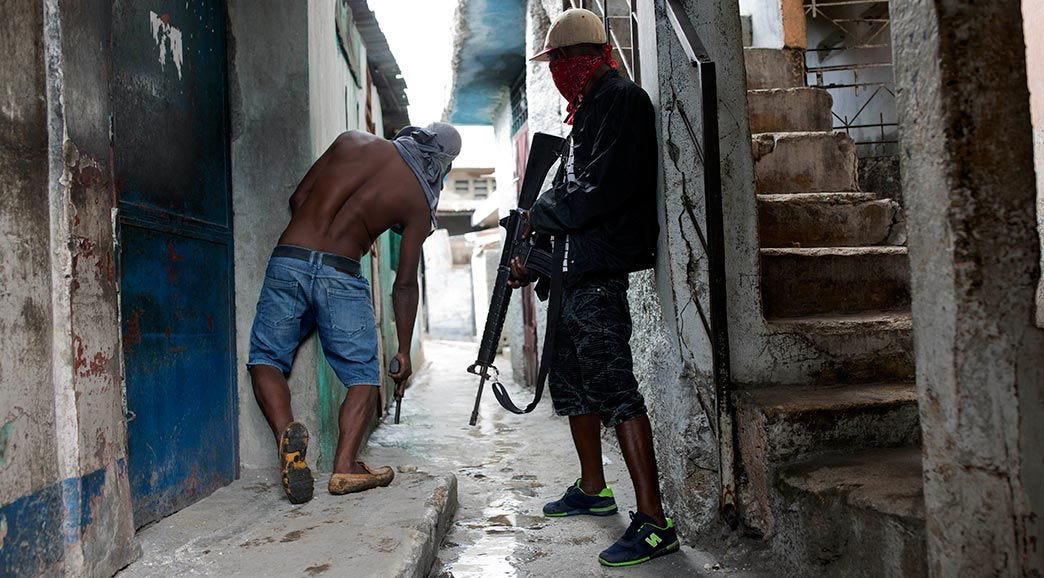
The current gang problem in Haiti has its roots in the explosion of violence that took place in the country six years ago. We reported on it in alliance with Ayibopost: Kidnappings in Haiti surged 200% between January and May 2020 compared to the same period a year earlier,, with over 1,000 cases reported that year.
Gang alliances like the G9, led by former police officer Jimmy Cherizier (”Barbecue”), have operated with open ties to government officials—including a prime minister who publicly admitted having the phone number of a gang leader accused of massacres.
Impunity is near-total: despite a valid arrest warrant, sanctions from the U.S. Treasury, and links to two massacres that killed dozens, Cherizier’s gang federation controls key neighborhoods and reportedly helped distribute government aid.
Your contribution makes a difference. Support CONNECTAS’s investigative journalism.
Venezuelan Prisons: Independent Republics of Crime
Before a government raid retook the Tocorón prison in September 2023, more than half of Venezuela’s prison population lived in facilities run by pranes—crime bosses who operate nightclubs, pools, delis, and even boxing promotions inside the prisons.
Prisoners had to pay the causa, a mandatory “tax” for inmates just to remain safe. It generated over USD 100,000 a month in prisons like Tocorón and Tocuyito—money used to fund weapons, extortion rings, and businesses that operate outside prison walls too, we found in this collaborative investigation with Runrunes.
These criminal networks have gone transnational: Tren de Aragua, which ran the Tocorón prison, has been linked to sex trafficking in Chile, extortion in Colombia, and arms trafficking into Brazil.
Comments
Nothing yet. Say the first thing.
Sign in to join the conversation.