
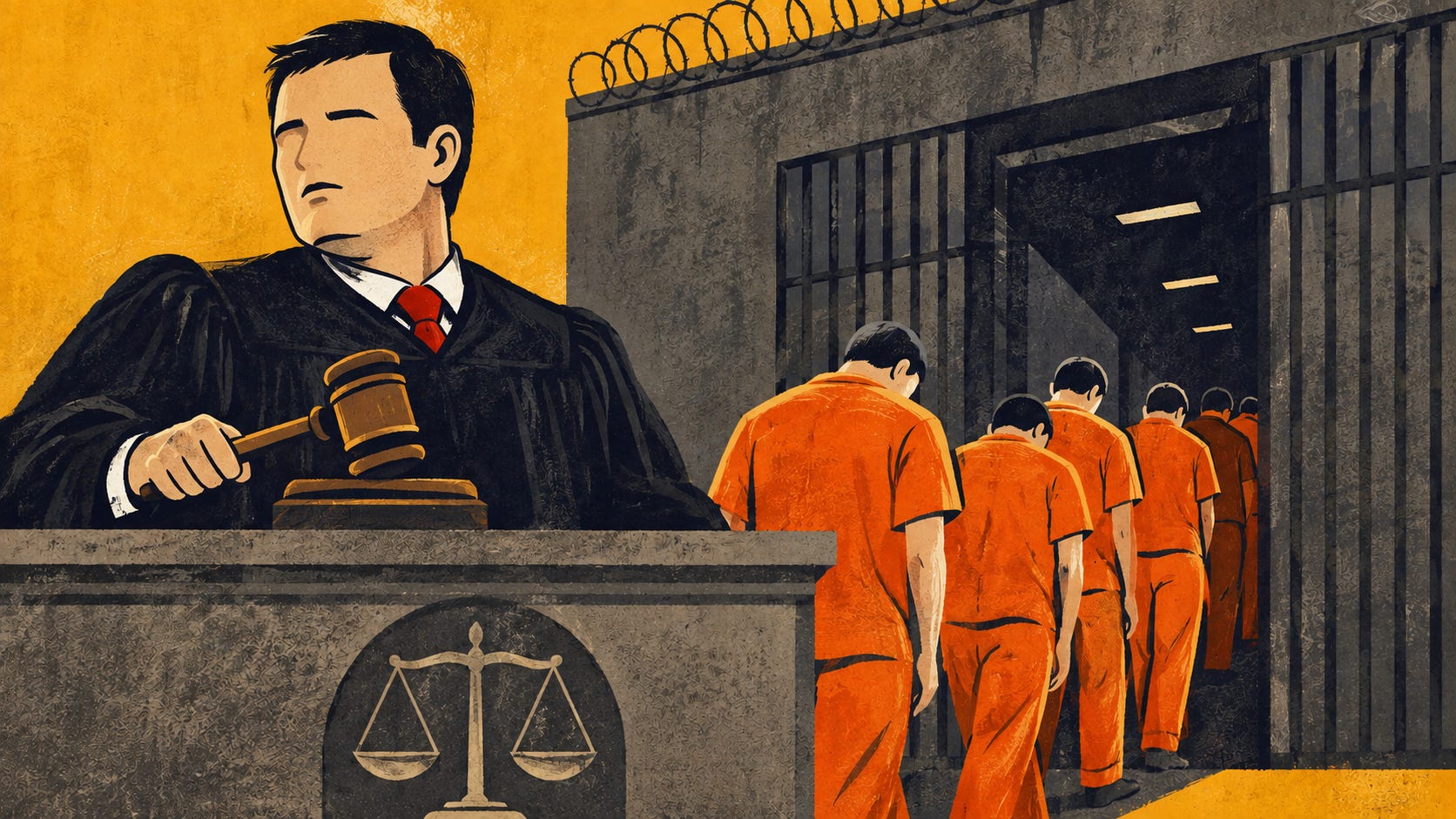
In January, Chile’s president-elect, José Antonio Kast, landed by helicopter at El Salvador’s Terrorism Confinement Center (Cecot). Before touring its cell blocks, he said his country needed to “import good ideas and proposals to fight organized crime, drug trafficking and terrorism.” Months later, now in office, he transferred 400 high-risk inmates to La Laguna prison.
Though not new (it has operated for a year) and not really a megaprison, Kast staged a scene nearly identical to the one Salvadoran President Nayib Bukele produced in 2023 when he unveiled the Cecot: hundreds of inmates lined up on the floor, hands forward, heads bowed.
That image has proven so powerful that in three years, the presidents of Colombia, Ecuador, Peru, Costa Rica, Panama, and Guatemala have all promised a megaprison of their own. Each wants to replicate the success of the “iron fist” that helped Bukele cut El Salvador’s homicide rate from 54 per 100,000 people in 2019 to just 1.9 in 2024, the lowest in three decades.
Our journalism is committed to protecting democratic values, reporting unbiased facts, verifying and contrasting, being independent.
In other words, #InvaluableJournalism
But the model casts serious doubt. Several factors explain those figures and make El Salvador’s experience nearly impossible to replicate elsewhere. First, the murder rate was already falling before Bukele took office: having peaked at 108 per 100,000 in 2015, it kept dropping. By the time the self-styled “world’s coolest dictator” came to power, the rate had already been halved.
Other factors matter too. El Faro‘s investigations have shown that Bukele’s government struck a pact with the gangs during his first year in office to bring down the murder rate. The mass incarceration of suspected gang members that followed was possible only because of a state of exception — now in its fifth year — that has locked up nearly 2% of the Salvadoran population, many of them possibly innocent and denied due process.
Even so, the megaprison model still appeals to voters across Ecuador, Colombia, Chile, Costa Rica, Panama, Peru, and Argentina. Robert Muggah, a crime-prevention expert and co-founder of the Brazilian think tank Igarapé Institute, believes the concept resonates because it makes state power tangible. “They take something abstract, like fear of crime, outrage at the gangs or frustration with impunity, and turn it into something literally concrete. You can see the prison, you can see thousands of detainees, you can see the state apparently reasserting control.”
He adds that this carries enormous political weight, and that the mere announcement of a megaprison delivers real electoral value. “When people are scared of extortion or gang violence, they want to see the state act. It’s not easy to photograph better prosecutors, more effective investigations or a more professional police force, but you can photograph a prison. That’s what makes megaprisons such powerful political symbols.” That may explain why Bukele holds a 68.7% approval rating seven years into office, defying the wear and tear most leaders suffer by that point.
Colombia and Peru’s new presidents have recently joined the megaprisons fan club. In Colombia, Abelardo de la Espriella campaigned for a more punitive security model that includes building megaprisons “meant to hold those who pose the greatest threat to public safety.”
In Peru, Keiko Fujimori has pledged to build at least four megaprisons plus a special facility for “the most hardened criminals.” In a recent interview, she said her prison-building plan would move faster than Bukele’s in El Salvador, and did not rule out seeking security advice from the Salvadoran leader or Ecuador’s Daniel Noboa.
Experts consulted by CONNECTAS say the obstacle to replicating the Bukele method is arithmetic, not ideological. El Salvador has 6.5 million people, and 2% of them are behind bars, the highest incarceration rate on the planet. Marcelo Bergman, a sociologist specializing in urban crime, says applying that same ratio elsewhere is essentially impossible. “Imagine a country like Colombia, with 47.4 million people. Two percent of the population would mean jailing a million people. Same with Argentina, and don’t even ask about Brazil, with 200 million. They’d have to imprison nearly four million people to match El Salvador’s rate.”
The structure of the criminal gangs Bukele confronted adds another wrinkle often left out of political speeches. Muggah notes that Salvadoran gangs had centralized command, evident when their leaders ordered truces and demobilizations under a secret deal with the government. That chain of command let Bukele dismantle the gangs relatively quickly and easily, but it doesn’t exist in the decentralized criminal networks of Colombia or Ecuador. “That makes it far harder to reproduce the institutional and political conditions that allowed El Salvador’s security gains,” says the Igarapé Institute co-founder.
Your contribution makes a difference. Support CONNECTAS’s investigative journalism.
Worse still, nothing guarantees that megaprisons won’t eventually become new universities of crime. Muggah argues the essential question any president building a megaprison must answer isn’t how many inmates it can hold, but who controls it. He notes that several criminal organizations were born in prisons and still operate from behind bars, including Brazil’s First Capital Command (PCC) and Comando Vermelho, and Venezuela’s Tren de Aragua, some of the continent’s most sophisticated and feared groups. “If you pack tens of thousands of people into a place you can’t govern, you haven’t solved the organized crime problem. You may have just concentrated it.”
To prevent that, Cecot inmates are held in total isolation, with no contact with the outside world. But as Bergman notes, crime is sustained by an illegal market whose players, the criminals, will always be replaced as long as the business stays profitable. Meanwhile, that total isolation violates basic due-process guarantees and, with them, access to timely and balanced justice, without any guarantee that this sacrifice of democratic values will actually make crime disappear.
Another factor makes the Salvadoran model even harder to replicate: the institutional wear caused by an indefinite state of exception. Bukele’s government suspended civil guarantees in March 2022, an extraordinary measure meant to address a sudden spike in homicides. Today it remains in force after more than four years of uninterrupted extensions, despite documented reports of arbitrary detentions, deaths in state custody, and mass trials without basic guarantees.

Nayib Bukele@nayibbukele
Esta madrugada, trasladamos a más de 2,000 pandilleros desde los penales de Izalco, Ciudad Barrios y San Vicente, hacia el CECOT. Ahí pagarán por los crímenes cometidos contra nuestro pueblo; incomunicados con el exterior, sin posibilidad de salir, ni de ordenar crímenes desde
11:54 PM · Jun 11, 2024 · 5.17M Views
3.19K Replies · 8.75K Reposts · 53.1K Likes
On this last point, defense lawyers and human rights organizations question the process itself. They say El Salvador’s government has effectively dismantled the right to a fair trial: lawyers cannot access their clients’ case files and can do little to defend them. “I don’t know a single judge who has had the courage not to convict someone, even when they know the person is innocent,” a lawyer told the Spanish newspaper El País. Cristosal, a Central American human-rights group, warns that these mass trials will produce thousands of wrongful convictions.
The question is whether other leaders in the region will dare dismantle their democratic institutions to fight crime, and whether their citizens will allow it. Ecuador’s president, Daniel Noboa, has repeatedly invoked states of exception since November 2023. In Honduras, then-president Xiomara Castro kept civil guarantees suspended from April 2022 until January 2026, when she left office. Her successor, Nasri Asfura, has not ruled out reinstating the measure, though only in areas with the highest crime rates.
For Muggah, the danger is that a state of exception becomes a permanent way of governing. “The warning signs are when emergency powers keep getting renewed, when oversight erodes gradually, when due process becomes more and more the exception, and when a government’s political legitimacy starts to depend on the emergency continuing. That’s the point where the exception starts to become the operating system.”
And there’s no turning back once citizens link their newfound security to the state’s extraordinary powers. At that stage, restoring ordinary institutional limits becomes politically costly.
None of the seven presidents now promising megaprisons has explained how they plan to keep that promise without paying the same institutional price El Salvador did: a captured legislature, a reshaped Supreme Court and a presidential reelection the constitution once banned. So far, Bukele’s imitators have copied the promise and the staging. Whether they’re willing to pay the same price remains to be seen.
This text was translated with the assistance of AI.
Comments
Nothing yet. Say the first thing.
Sign in to join the conversation.