
It worked for Norway.
Can any of the right-wing loudspeakers explain why publicly owned investment capital became a model of national prudence in Norway but was declared a failure in Britain before the British fund had even completed an investment cycle?
Probably not. This is one heck of an oligarch operation, and it kills two birds with one stone. It attacks public investment—and the idea that citizens should retain a financial stake in national development—while taking another swing at one of the gang’s oldest targets: the United Kingdom.
The loudspeakers have already declared the British National Wealth Fund a failure.
Let us examine that claim.
The fund recorded a pre-tax loss of £85.6 million in the 2023–24 financial year. That increased to £152.2 million in 2024–25. The combined accounting loss over those two years was therefore £237.8 million—not an insignificant amount.
But neither is it evidence that the fund has failed.
By January 2026, the fund reported that it had:
Deployed £8.4 billion.
Invested in more than 70 companies, projects and local authorities.
Mobilised more than £17 billion in private finance.
Used approximately 30% of its £27.8 billion capacity.
Take a very close look at that £17 billion.
That is private money pulled into British companies, infrastructure and industrial projects—capital that might otherwise have remained on the sidelines or gone elsewhere. Moreover, the £237.8 million reported across the two financial years was an accounting loss containing expected-credit-loss provisions and unrealised writedowns. It was not £237.8 million in cash that simply disappeared.
The same gang would barely blink if that money had been funnelled through tax breaks, sweetheart contracts or subsidies that ultimately enriched a handful of oligarchs. But use public capital to mobilise more than £17 billion across British industry, and suddenly every provision and paper writedown becomes proof of catastrophic failure.
Apparently, the problem is not that money was lost. The problem is that the gains, ownership and investment were spread across the economy instead of trickling neatly into a few carefully selected pockets.
Where does Mark Carney enter this story?
Carney did not create or manage Britain’s National Wealth Fund. In March 2024, Rachel Reeves appointed him to a private-sector taskforce advising Labour on its design. Its job was to determine how limited amounts of public capital could attract substantially larger private investments into ports, clean steel, hydrogen, carbon capture and manufacturing.
The taskforce was chaired by Green Finance Institute chief executive Rhian-Mari Thomas. Carney served alongside senior figures from Barclays, Aviva, NatWest and other financial institutions.
This is where Norway enters the discussion—but the comparison must be made carefully.
Norway’s Government Pension Fund Global is a genuine sovereign wealth fund. The Norwegian parliament established the original Government Petroleum Fund by law in 1990. The first transfer—approximately NOK2 billion—was made in May 1996. In 2006, it was renamed the Government Pension Fund Global.
Norway transfers the state’s net petroleum revenues into the fund. The money is invested almost entirely outside Norway in global equities, bonds, property and renewable-energy infrastructure. The purpose is to convert a finite underground resource into a permanent portfolio of financial assets.
The Norwegian government can draw from the fund through the national budget, but its fiscal rule says withdrawals should, over time, remain close to the fund’s expected real return—currently estimated at approximately 3% annually. The objective is to preserve the fund’s inflation-adjusted value so that future generations continue benefiting after the petroleum itself has been extracted.
Norway therefore provides the proof of concept: strategic national assets can be converted into permanent public wealth.
It does not, however, provide an exact operating blueprint for either Britain or Canada. Britain’s National Wealth Fund is primarily a domestic policy bank. Canada’s proposed fund would begin as a domestic strategic investor, predominantly taking equity positions in Canadian projects and companies.
That is not a reason to abandon either project. If anything, both countries should press further in this direction.
Britain needs patient public capital to rebuild industrial capacity, modernise its infrastructure and relieve some of the immense economic pressure created by Brexit. Its fund can finance projects that Britain needs but that private investors, operating on shorter timelines and narrower return requirements, may be unwilling to carry alone.
Canada’s need is even more strategic.
The country is preparing for a wave of investment in oil and gas, critical minerals, pipelines, ports, electricity, data infrastructure and new trade corridors. Canada needs foreign investment to build many of these projects. But foreign participation does not require surrendering control over the assets on which Canadian sovereignty will depend.
Part ownership is welcome. Private investment is essential. But in certain critical projects, Canada should retain an equity position, board representation, emergency access rights or some combination of the three.
There is also a financing gap that private markets cannot solve by themselves.
A project can offer an inadequate commercial return while still producing an enormous national-security return. Private investors calculate revenue, cost and risk. They do not receive the full value of supply-chain security, emergency capacity, economic independence or the ability to keep an essential system operating during a war.
That does not make the project worthless. It means the public value is larger than the private cash flow.
Consider the case we made earlier today at The Concis. We are pushing Canada to begin constructing strategic oil-and-gas reserve capacity—both at home and on allied territory.
Which private company will build and maintain storage capacity that may remain partially unused for years? Why would it tie up billions in tanks, terminals and inventory for an emergency that may or may not arrive? And even if a company agreed to do it, why should Canada place its emergency energy security entirely in that company’s hands?
The Canada Strong Fund could take an ownership position in the storage facilities. The Canadian government and participating allies could then pay long-term capacity fees in exchange for guaranteed emergency-access rights. Fuel could be rotated commercially to prevent deterioration, while contractual minimum inventories remained available for a crisis.
That arrangement would separate the two returns properly. The alternative is to surrender control and hope for the best.
What happens if a foreign billionaire eventually acquires the company controlling a strategically important storage terminal, pipeline, mine or supply chain? What happens when that owner begins using control over essential infrastructure as political leverage while campaigning publicly for a more accommodating Canadian government?
Canada can review or block certain foreign acquisitions. But a defensive veto is not a substitute for ownership. By the time a hostile transaction reaches the review stage, Canada is already reacting to somebody else’s move.
A sovereign investment fund gives the country another option: enter early, retain a strategic stake, establish governance rights and ensure that indispensable assets cannot be quietly consolidated under oligarchic control.
That is the deeper purpose of the Canada Strong Fund. It is not merely another pool of government money. Properly designed, it would give Canada the ability to convert strategic development into public ownership—and public ownership into national freedom of action.
The safeguards must be hardwired from the beginning: an independent board, a published investment mandate, commercial return requirements, full disclosure of holdings, parliamentary audits and clear separation between strategic investment and political patronage.
With those protections in place, this fund would not expand oligarchic power. It would place a barrier in front of it.
That is also why the project is attracting such a targeted attack.
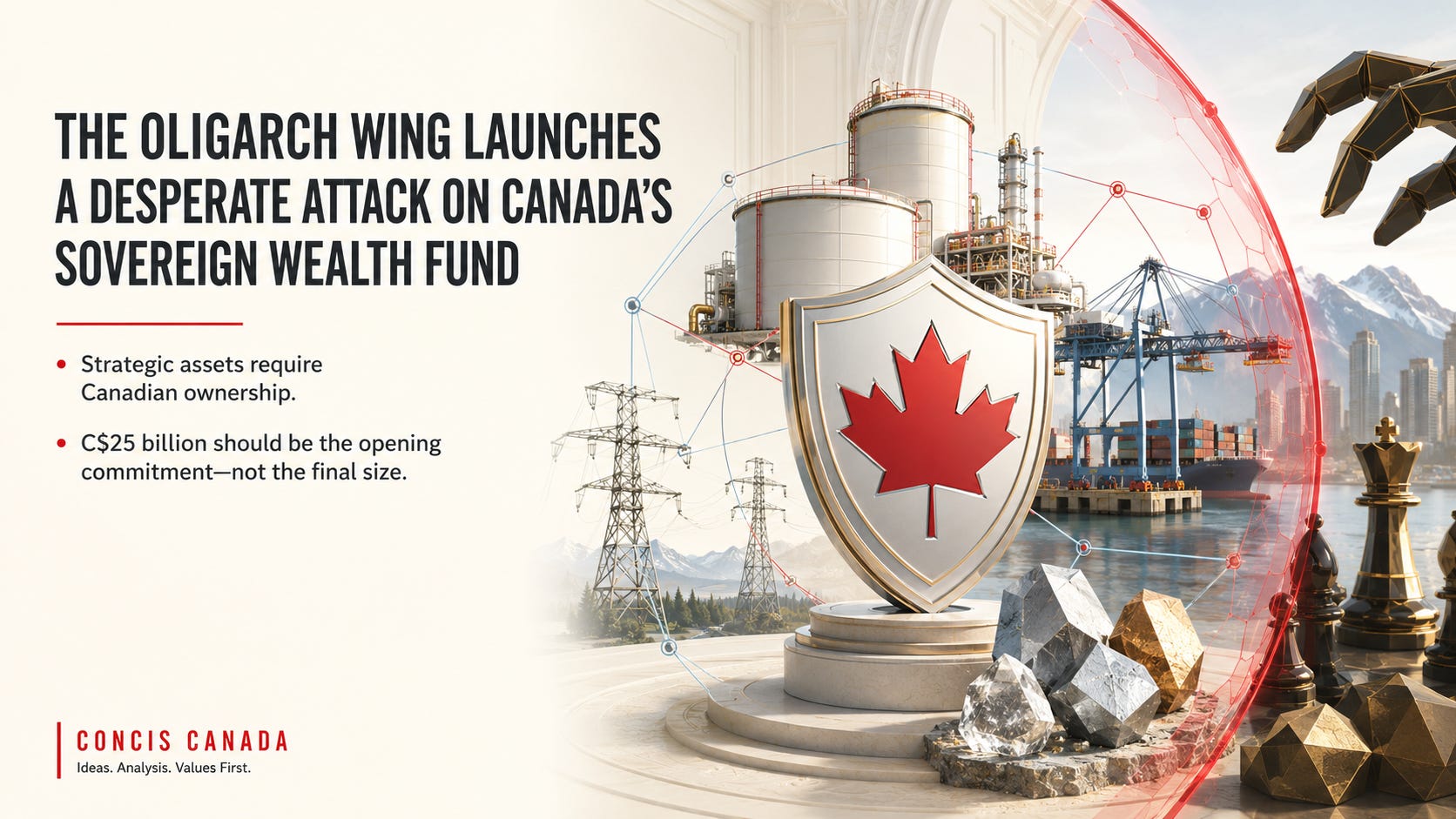
The Canada Strong Fund must move forward. But the C$25 billion announced by Carney is not sufficient for the scale of the energy, mineral, infrastructure and supply-chain transformation now beginning across the country.
It should be treated as the opening commitment—not the final size.
Canada should double it to C$50 billion.
Concis Canada has fewer than 2,000 subscribers.
That is not scale.
That is where the algorithm decides to dig, bury and landfill the story.
In the current media environment, getting reality in front of people is extraordinarily difficult. Every free subscription expands our reach. Every paid subscription strengthens this desk and gives stories like this the visibility they need.
No posts
Comments
Nothing yet. Say the first thing.
Sign in to join the conversation.