
TL;DR (AI-powered): The famous Forming-Storming-(Norming)-Performing model was built for therapy and training groups, not modern work teams. Many organizations assume stable, long-lived teams are inherently superior — but this belief is weaker than we think. While stable teams improve ownership and long-term thinking, they often create capacity imbalances and strategic misalignment. We need a better balance: one that keeps deep “basecamp” ownership to some extent combined with real flexibility to pivot and explore. Thanks to advancing technology, we may not need as much rigid specialization as we once did. The future of effective work might be more fluid than the current paradigm suggests.
What if I told you the well-known Forming-Storming-(Norming)-Performing model by Tuckman had a much more specific context and bias (therapy and training groups), and therefore can’t be taken for granted as a general heuristics to group development (at least not implying a relevant amount of time to go through the phases)?
What if I told you that particularly teams with a common mission and shared culture, like what happens when people do work together within an organization, groups can come together and start performing fairly quickly (in a matter of hours or a few days)?
That is to say – some of the very fundamentals of why we, today, tend to prefer long-lived stable teams might not be as well-established and backed by research as we think. That it can be kind of a myth.
What would that change in terms of your perspective of how to organize and execute work?
I can tell you it has mine. But also in a rather nuanced way, since I am not one that typically leans towards throwing the baby out with the bath water (so to speak). I am persuaded that at the very least we need some rebalancing.
We might have, as often is the case, taken the pendulum too much to the other side through the best of the last several decades by now. We came a long way from project-based execution, forming teams around a deliverable where all the incentives were on short to medium term, and thus often at the expense of long-term sustainability. It was the paradise of shortcuts and “for as long as it works now and I don’t really care what will happen down the line” kind of thing.
So we came up with a better idea. What if we rather have teams which are put around a part of the mission, responsible for fairly well-defined piece(s) of the puzzle of how we need to make work happen, and they stay fairly stable over time? Wouldn’t that help to make better choices and trade-offs when it comes to dealing with some of those challenges of short to medium term focus?
Wouldn’t we be in a better position to not sacrifice too much long-term sustainability through a series of choices when incentives used to lean otherwise? The most honest answer, or expectation, for that was a resounding YES!
That takes us to today, with that paradigm now being largely the norm of how work gets done, especially in knowledge work. And we do our best to define sound topology of teams so that we hopefully give the teams more autonomy and reduce dependencies. So that they largely can make progress with little to no constraints.
A very laudable goal and nice problem to have, for sure! But aren’t there also costs and trade-offs we should be aware of?
Some of the big ones that come to mind immediately:
An imbalance of capacity and focus that can be given to certain bodies of work in comparison to what the organization needs to accomplish now, strategically. Some teams have way too many valuable things to work on, while others might be suboptimally adding value.
A mismatch of what is strategically important to accomplish now and how teams have been organized. Leading either to suboptimal setup of how work gets executed (in misalignment with strategic intent), or need to constantly reshuffle either how teams are composed (the actual topology of the teams) or keep moving teams that stay together but have a new mission way too often.
I think those are more than valid trade-offs and considerations to be aware of – I believe they are in part what justifies some of the dysfunctions we observe in the workplace these days. And one way of looking at that is that, fundamentally, organizations often will fail to truly plan and optimize for their demand (what they really need to strategically accomplish).
I have been persuaded for a while that we need a new perspective, at a bare minimum, as I wrote even before here, one that could be described as the need to balance code ownership with flexibility:
Basecamp: what you are (part of the group) responsible for and thus an expert on.
Exploration: able to pivot and do what it takes now, to move the organization forward in some way you can (and have some ability to contribute).
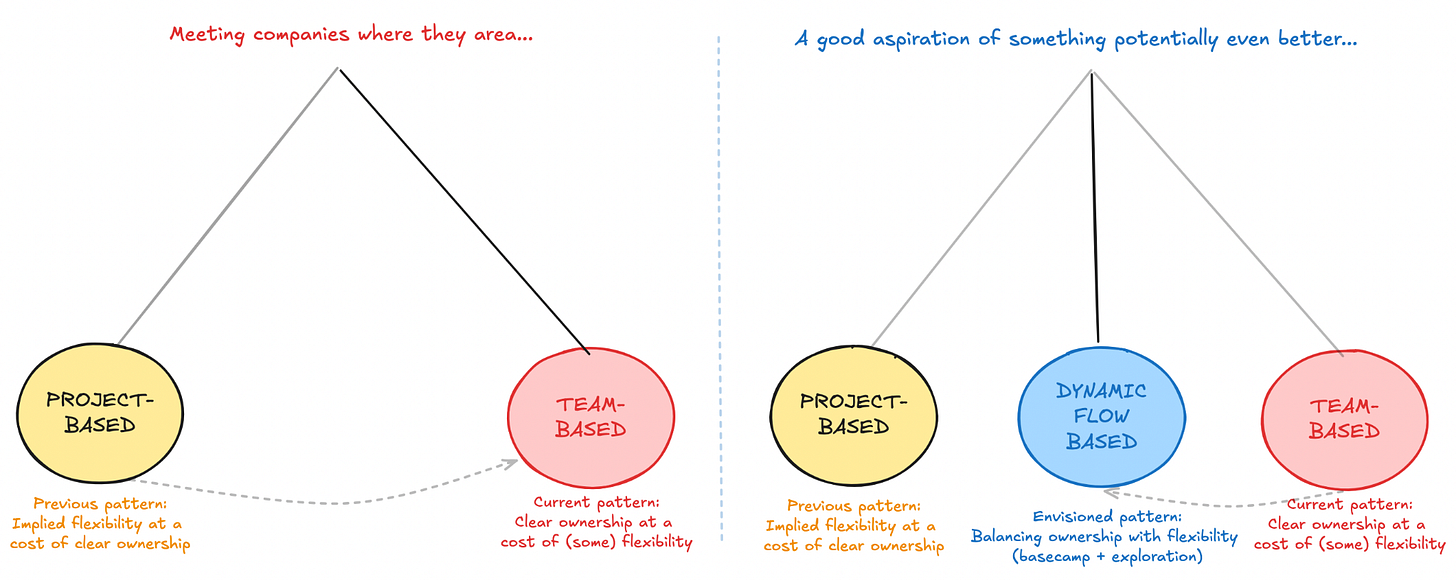
But if we add to the mix how much the advances in technology has lowered the barrier to understanding and learning new contexts, then I believe one could even make a rather strong argument that we might not even need so much of an explicit basecamp setup (at least not one that needs to stay fairly long with that focus). That somehow everyone can be a bit of both, and it will take the village to take care of making the right choices and trade-offs, but that still, at the end of the day, we can truly plan and optimize in line with the pressing demands for the organization.
I even feel like that way of operating might come in rather handy when it comes to cross-pollinate and grow the maturity of adopting emerging technology (at least in comparison to the alternative of each team figuring out its own way in silos).
That’s it for today – short and sweet. With more questions and provoking thoughts than real answers. In the best spirit of “thinking out loud” – and I would love hearing other perspectives to it, by the way!
By Rodrigo Sperb, feel free to connect, I’m happy to engage and interact. I’m passionate about leading to achieve better outcomes with better ways of working. How can I help you?
No posts
Comments
Nothing yet. Say the first thing.
Sign in to join the conversation.