
The below discussion reproduces some elements of Alice Helliwell’s new chapter “Creativity, Agency, and AI”, published in the new collection Philosophy of Artificial Intelligence: The State of the Art (2026) (Edited by Vincent C. Müller, Leonard Dung, Guido Löhr & Aliya Rumana). This is an edited collection of works that were first presented at the Philosophy of AI conference in 2023, representing a series of excellent papers across a variety of topics in the Philosophy of AI.
There is a common barrier to the possibility of creative AI - agency. The argument is roughly as follows: creativity requires agency. Agency requires the capacity for intentions, which are a kind of mental state. AI cannot have mental states - so AI can’t be creative.
However, the agency argument against the possibility of AI creativity is not so secure (or so I argue in my chapter). This is because there are common assumptions embedded in several premises, which need defending against possible objections. In this paper, I aim to highlight these assumptions and draw attention to another possible understanding of the agency requirement for creativity which would fulfil the requirement without barring AI (or, indeed, animals) from achieving it.
We could formulate the agency argument against AI creativity as follows:
P1 Creativity requires agency
P2 Agency requires the capacity for intentional action
P3 Intentional actions require intentions
P4 Intentions require mental states
P5 AI cannot have mental states
C Therefore, AI cannot be creative
Whilst this may seem an easy route for those who wish to deny the possibility of AI creativity, in order to put forward this argument, one would need to defend each of these premises. However, for several of these premises, we can suggest objections. For example:
P1: Creativity requires agency
Not all accounts of creativity require agency. For example, the evolutionary account of creativity does not require agency, and neither does Margaret Boden’s account.
P4: Intentions require mental states
Not all accounts of intention require mental states. Defending such an alternate account would thereby sever the link between mental states and intentions. For example, G E M Anscombe’s position that intentions are not mental states, but rather are a form of knowledge.
P5: AI cannot have mental states
Whilst many find this position convincing, many have also argued (particularly contra Searle’s famous Chinese Room argument) that AI could indeed have mental states.
If any of these premises in the agency argument against creativity fail, then the argument itself may fail.
In my chapter, I focus on two premises: P1 (creativity requires agency) and P2 (agency requires the capacity for intentional action).
To start, I examine why some have argued that creativity requires agency. In short, creative processes are things we do, and these processes (and their outcomes) are things for which we can be praised or blamed (see Stokes, 2011).
We can break down the agency argument against creativity further, adding a step (P0) into the formulation of the argument:
P0 Creative processes are things we do, for which we can be praised or blamed
P1 This requires (creative) agency
P2 (Creative) agency is the capacity for intentional action
P3 Intentional actions require intentions
P4 Intentions require mental states
P5 AI cannot have mental states
C Therefore, AI cannot be creative
Now we can turn our focus to P2: (Creative) agency is the capacity for intentional action. Here, I argue that a more minimal account of agency could satisfy the requirements of creativity without invoking intentional action.
This move is not new - such a suggestion has already been made by Stokes & Bird (2008), and defended in relation to their “Drawbots”. They designed small robots that had basic perceptual capabilities and that (armed with pens) could draw lines beneath them. Rather than merely executing commands from their human programmer, these “embodied robots” responded to environmental stimuli. With the use of artificial neural networks (ANNs), they “evolved” in their responses and developed novel responses to environmental stimuli, including the lines that they drew (Stokes & Bird, 2008).
Using this kind of system, Stokes and Bird were able to create agential robots as per their definition:
These individuals are agents on the broad construal suggested … When we hold the starting conditions and testing arena constant, different agents respond differently (where agents are individuated by their artificial neural network controllers). Indeed some of the agents act in behaviourally novel ways.” (Stokes & Bird, 2008, p. 239)
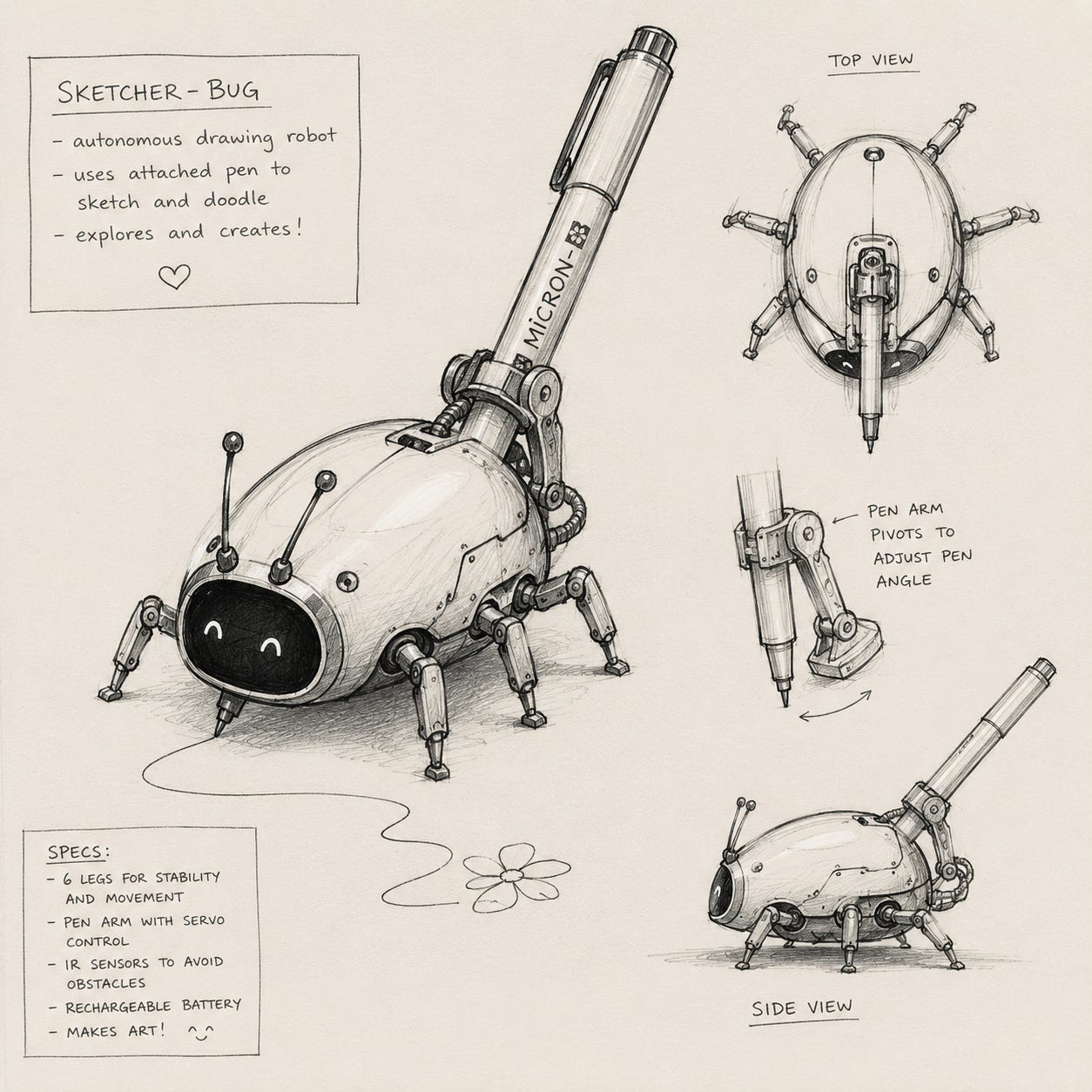
Stokes and Bird are confident that their robots are agential by their definition, and therefore provide the basis for future creative robots. In theory, if the lines drawn by these robots fulfilled all other conditions of creativity, they should be creative.
In terms of the agency argument against AI creativity, we could update the premises to reflect Stokes and Bird’s account of agency as follows:
P0 Creative processes are things we do, for which we can be praised or blamed
P12 This requires minimal agency
P22 Minimal agency does not necessitate intentional actions
In order to defend the agency argument, then, one would need to refute P12 and P22.
Whilst this minimal account of agency may accommodate the Drawbots, I am not convinced this is sufficient for creativity, even in a very minimal sense. If we follow Stokes, in order to assign responsibility to the robots we ought to be able to praise them. Can we praise the robots for the patterns they make on the floor? They are programmed to draw lines where there are none, and they sometimes do so in novel ways. They have no overall goal, and no clear awareness of the ‘image’ that they are making. The drawbots’ ‘evolutionary’ nature means that there is no goal in how they change their actions, and it is done with no aim to a final outcome. They may be ‘acting’ autonomously in the sense that they are not entirely controlled by an external system (like a remote-controlled robot), but without purpose this ‘action’ is of a very weak kind. It is unclear how these actions, even if behaviourally novel, could be considered to demonstrate any meaningful sense of agency such that we could assign responsibility. The drawbots are just responding to environmental input. The reactive nature of the robots suggests that there is no purpose to what they do i.e., no reason, aim, or goal for their behaviour.
In short, the minimal account of agency Stokes points to is, I argue, too minimal. I instead put forward a teleological minimal account of creativity, whereby a creative actor must be aiming at an end in their creative process.
What does this argument mean for the agency argument against creativity? If we are willing to accept the proposal make in the full chapter, that internally directed, purposive doing could provide an adequate substitute for agency in the case of non-human creativity, then we could reformulate the premises of the agency argument to the following:
P0 Creative processes are things we do, for which we can be praised or blamed
P13 This requires minimal teleological agency
P23 minimal teleological agency requires a capacity for internally directed purposive doing
This no longer necessarily leads us to a requirement of intentionality, despite still requiring a (minimal) form of agency.
One does not need to accept the proposal here; however, in order for someone to properly defend the argument from agency one needs to establish that a more minimal account cannot satisfy the agential role in a non-human definition of creativity. One would also need to respond to the other potential objections for each premise.
Stokes, D., & Bird, J. (2008). Evolutionary robotics and creative constraints. In B. Hardy-Vallée & N. Payette (Eds.), Beyond the brain: Embodied, situated, and distributed cognition (pp. 227–245).
Stokes, D. (2011). Minimally creative thought. Metaphilosophy, 42(5), 658–681.
No posts
Comments
Nothing yet. Say the first thing.
Sign in to join the conversation.