RSS Amplifier

Periodycal – The Compound Interest Newsletter · Oct 31, 2024

Periodycal #24: Halloween special

0
Sign in to vote or save

Andy Brunning · Periodycal – The Compound Interest Newsletter

Welcome to a Halloween special of the Periodycal newsletter! This edition is packed with Halloween chemistry infographics, old and new. From vampirism to candy corn, skeletons to spider webs, there’s something spooky for all. Plus there’s the usual round-up of chemistry news stories that I’ve found interesting and more!
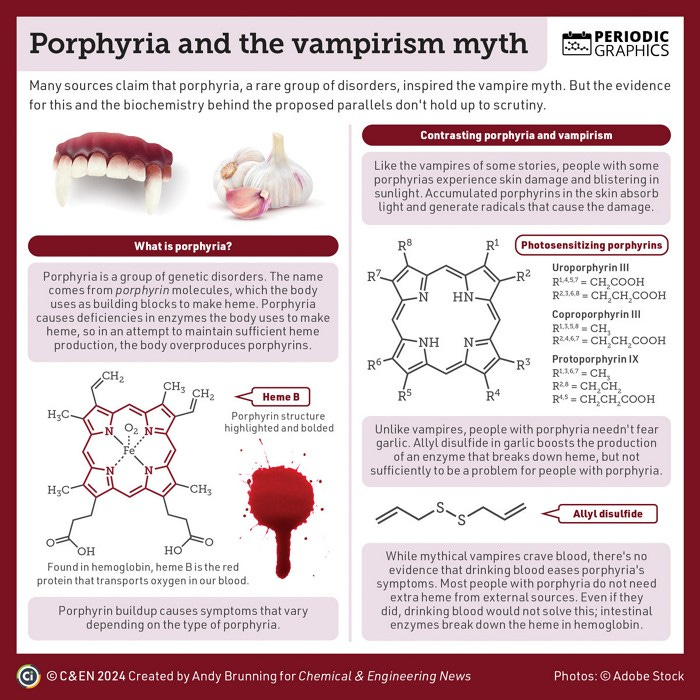
Infographic on porphyria and its historic links with vampirism.Many sources claim that porphyria, a rare group of disorders, inspired the vampire myth.Porphyria is a group of genetic disorders. The name comes from porphyrin molecules, which the body uses as building blocks to make heme. Porphyria causes deficiencies in enzymes the body uses to make heme, so in an attempt to maintain sufficient heme production, the body overproduces porphyrins. Porphyrin buildup causes symptoms that vary depending on the type of porphyria. Like the vampires of some stories, people with some porphyrias experience skin damage and blistering in sunlight. Accumulated porphyrins in the skin absorb light and generate radicals that cause the damage.Unlike vampires, people with porphyria needn't fear garlic. Allyl disulfide in garlic boosts the production of an enzyme that breaks down heme, but not sufficiently to be a problem for people with porphyria. While mythical vampires crave blood, there's no evidence that drinking blood eases porphyria's symptoms. Most people with porphyria do not need extra heme from external sources. Even if they did, drinking blood would not solve this; intestinal enzymes break down the heme in hemoglobin.
Click to view the full graphic on the C&EN site

When it comes to myths and monsters, we like to try to rationalise the superstitions of old and come up with logical explanations that are more grounded in fact. Sometimes, though, these explanations aren’t the perfect fit and can even create stigmatisation.

A classic case in point is the conflation of porphyria, a group of genetic disorders, with vampirism. Many sources claim that porphyria inspired the vampire myth, but the evidence for this and the biochemistry behind the proposed parallels doesn’t hold up to scrutiny.

In fact, the link between vampirism and porphyria appears to have been largely stoked by one man, David Dolphin, a porphyrin chemist. In 1982, in a talk at the Royal Society, he postulated the link, and followed this up with numerous other talks and interviews.

As this edition of Periodic Graphics shows, in reality, there’s little to tie porphyria and vampirism together, and this story highlights that science communicators should perhaps think twice before tying real diseases to mythical monsters.

For more Halloween chemistry, we’ve built up quite the archive in Periodic Graphics over the past few years:

Aside from Periodic Graphics, there’s also this graphic on the chemistry of blood.
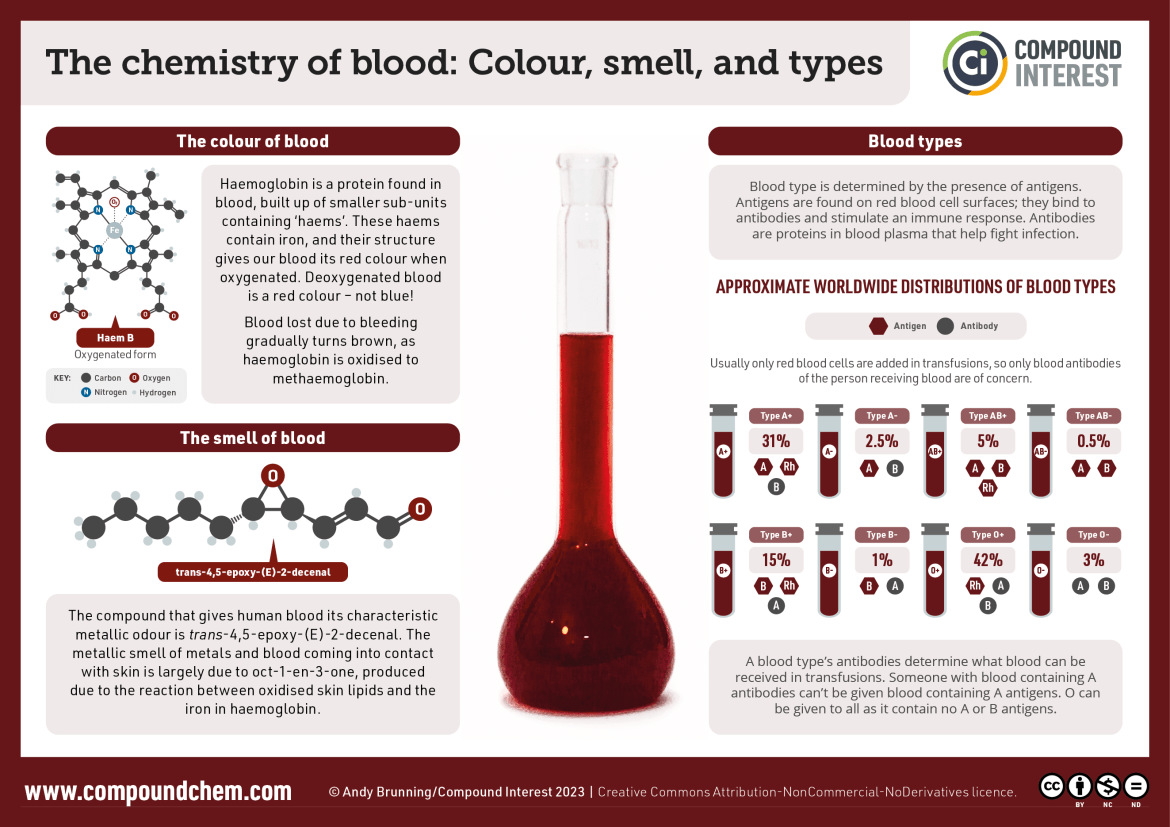
Infographic on the chemistry of blood. The colour of blood is caused by haemoglobin, a protein found in blood which carries oxygen, and when oxygenated appears red. When deoxygenated, it's deep red. The metallic odour of blood is due to trans-4,5-epoxy-(E)-2-decenal. Blood types are determined by the presence of antigens on the surface of red blood cells. Different blood types contain different antibodies, which determine which blood types can be received in transfusions.
Click to view and download on the Ci site
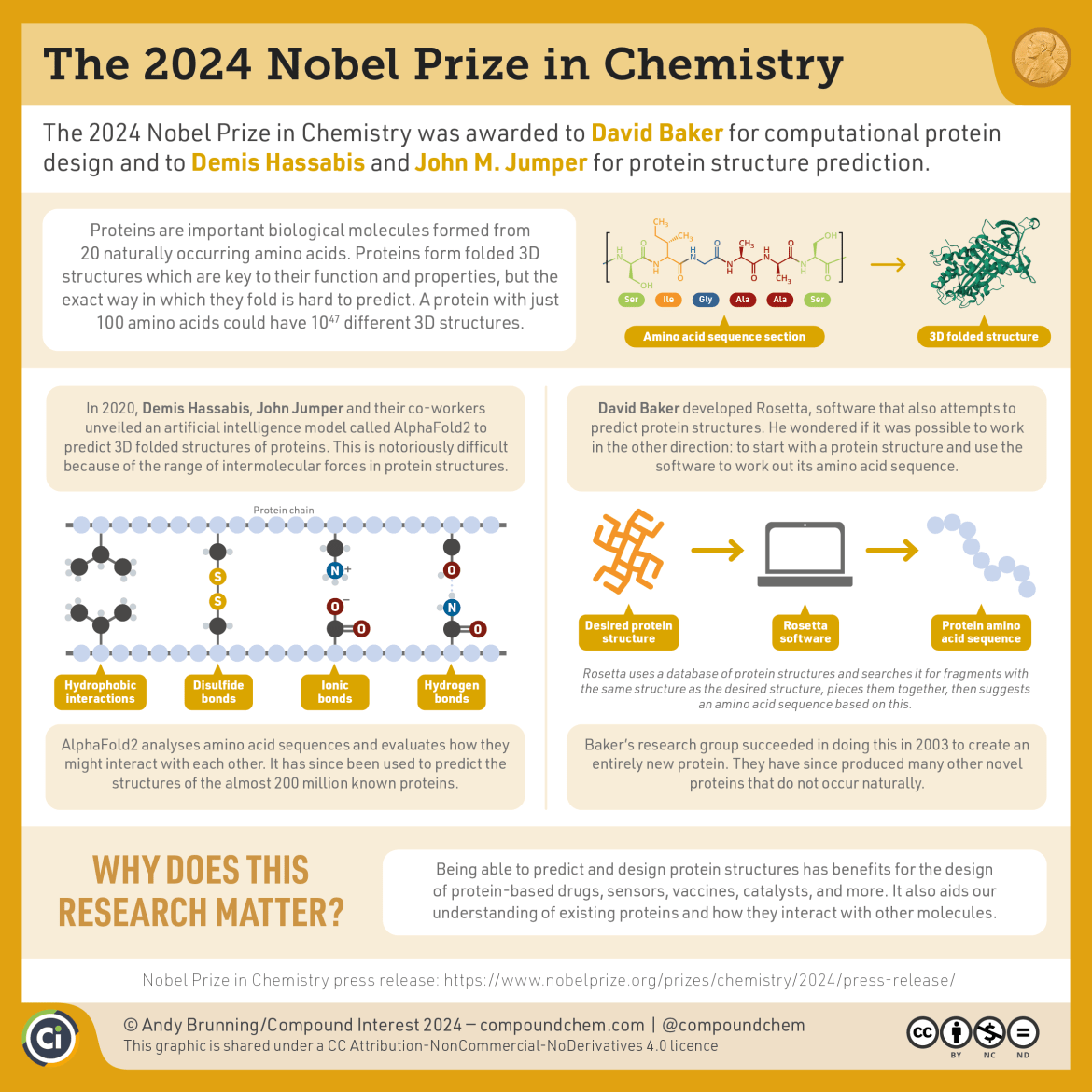
The 2024 Nobel Prize in Chemistry was awarded to David Baker for computational protein design and to Demis Hassabis and John M. Jumper for protein structure prediction. Proteins are important biological molecules formed from 20 naturally occurring amino acids. Proteins form folded 3D structures which are key to their function and properties, but the exact way in which they fold is hard to predict. A protein with just 100 amino acids could have 10^47 different 3D structures. In 2020, Demis Hassabis, John Jumper and their co-workers unveiled an artificial intelligence model called AlphaFold2 to predict 3D folded structures of proteins. David Baker developed Rosetta, software that also attempts to predict protein structures, and used it to start with a protein structure and use the software to work out its amino acid sequence. By doing this proteins that do not occur naturally can be produced. Being able to predict and design protein structures has benefits for the design of protein-based drugs, sensors, vaccines, catalysts, and more. It also aids our understanding of existing proteins and how they interact with other molecules.
Click to view and download on the Ci site

Earlier in the month this year’s Nobel Prizes were awarded. The 2024 Nobel Prize in Chemistry was awarded to research that uses artificial intelligence to predict protein structures, as well as using similar AI models to design proteins that don’t occur naturally. The key points are summarised in this infographic.

Here’s the regular selection of chemistry news and features I’ve found interesting over the past few weeks:

  • Sulfur hexafluoride in old shoes – I didn’t realise before reading this that Nike used to pump sulfur hexafluoride gas into the soles of their trainers to provide additional cushion. If you don’t know, sulfur hexafluoride is a greenhouse gas thousands of times more potent than carbon dioxide. This article highlights issues in the carbon offset approach Nike uses today related to their historic use of sulfur hexafluoride, (which frankly went a little over my head).

  • Traces of tobacco in bones reveal details of 18th Century smokers – Recent research looked at compounds left behind in bone as a result of tobacco smoking. Their results unsurprisingly showed a much higher rate of smoking in the 1700s and also showed women smoked much more than contemporary sources suggest.

That’s all for this edition of Periodycal. Coming up on the website this month are further infographics on mushroom chemistry and more!

Thanks for reading,

Andy

Read the original on compoundchem.substack.com

Comments

Nothing yet. Say the first thing.

    Sign in to join the conversation.