
Welcome to October’s edition of the Periodycal newsletter! This month’s content includes a look at the history and mysterious workings of superconductors, a refresh of a classic graphic on the colours of autumn leaves, and a look back at last year’s Nobel Prize-winning research as this year’s awards kick off. Plus there’s the usual run-down of chemistry tie-ins for events in the coming month and a round-up of selected chemistry news stories and features.

First, we can get the answer to that subtitle question out of the way: It’s complicated. Researchers know how some superconductors work, and for others, it’s anyone’s guess. But this latest edition of Periodic Graphics in C&EN does its best to pull together an overview of what we know about the mysterious science behind superconductors, coupled with a brief history. It also highlights some superconductor applications which we probably can’t quite call everyday (unless you commute on a MagLev and happen to be reading this) but still provide some contextualization.

Last year’s Nobel Prizes managed the distinction of not all being awarded to old, white men, thanks entirely to the prize for chemistry, which included Carolyn Bertozzi amongst its awardees. The chemistry prize was awarded for work on click and bioorthogonal chemistry, which had been tipped for the prize for several years.
The work to make mRNA vaccines was touted as a possible winner this year, before it won today’s Physiology or Medicine prize! I started writing this newsletter before today’s announcement, and did originally write here: “That said, it feels like [mRNA vaccines] could easily end up winning the Physiology or Medicine prize instead.” So if I’d posted this a day earlier, I could have claimed a lot more clairvoyance than I legitimately can now.
Luckily, I have some graphics stocked up on mRNA vaccines, so you can choose between one on how RNA vaccines work, or one on how they’re made in the first place.

If you want to attempt a smug ‘I told you so’ moment for this year’s chemistry prize, drop your prediction in the comments. And keep an eye on the website later in the week when I’ll post the usual graphical summary of the research that wins the prize.
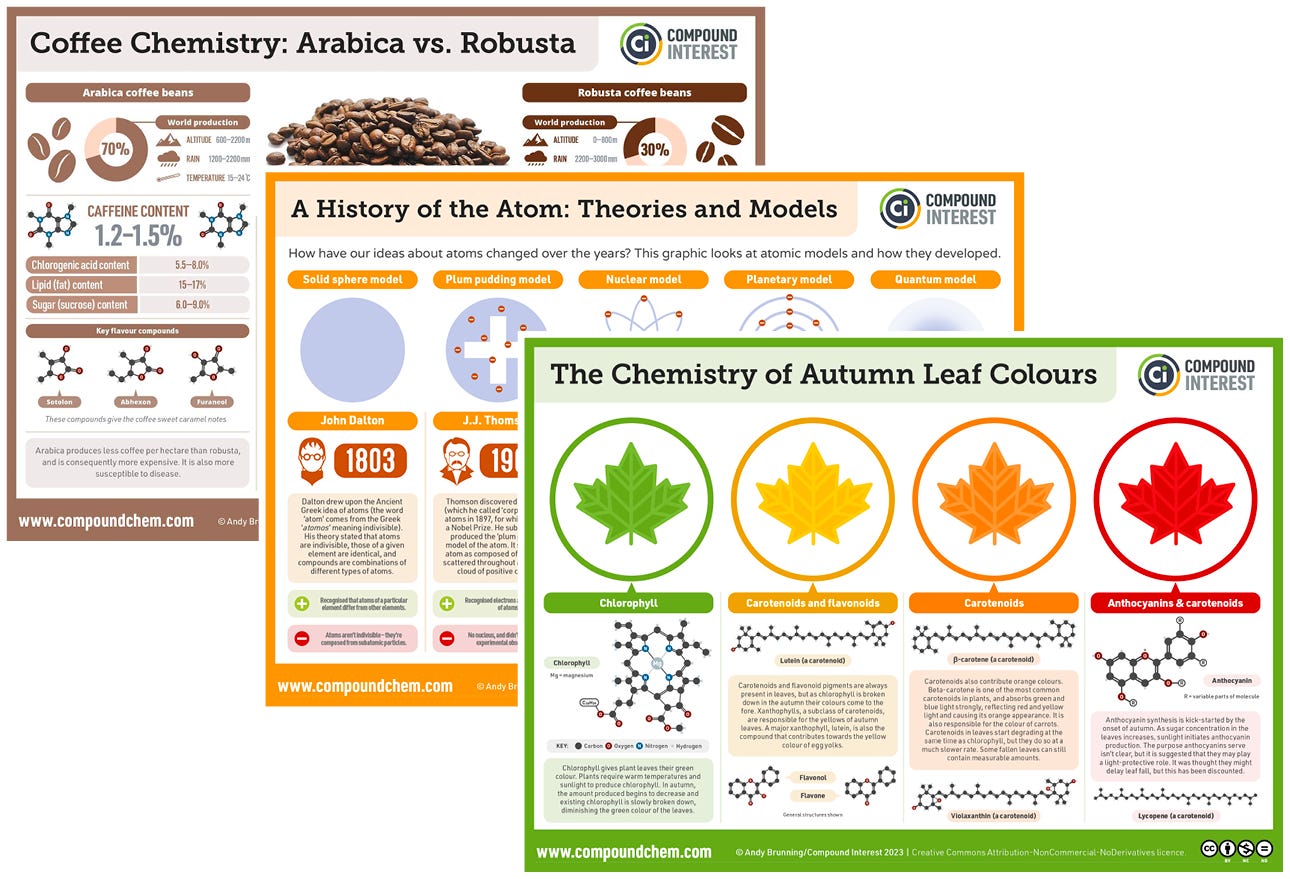
As with previous months, I’ve been updating some older graphics on the site as and when opportunities to reshare them roll around. The following graphics have all had a graphical rejuventation this month:
Here’s a quick run-down of upcoming events or days and links to some relevant chemistry graphics from the archives:
4 October: National Vodka Day — The chemistry of vodka
7 October: National LED Light Day — A basic guide to how LED lights work
8 October: Le Chatelier’s birthday — Reversible reactions, equilibrium, and Le Chatelier’s principle
9 October: National Nanotechnology Day — Everyday uses of nanotechnology
10 October: World Porridge Day — The science of making porridge
14 October: National Fossil Day — How did ammonite fossils form?
16 October: World Anaesthesia Day — A history of anaesthetics and how they work
19 October: International Gin and Tonic Day — The chemistry of gin (and tonic)
23 October: National Mole Day — Avogadro and the mole
26 October: National Pumpkin Day — The chemistry of pumpkins
31 October: Halloween — Halloween chemistry archive
Here’s the regular selection of chemistry news and features I’ve found interesting over the past few weeks:
Making Lego bricks more sustainable is proving challenging — Lego’s plan to make its bricks more sustainable by switching to recycled plastics to manufacture them has hit a snag as they determined that bricks made from recycled PET bottles would actually have a larger carbon footprint.
Fifty years since a furore over ferrocene — Every year, a lot is made over the Nobel Prizes’ custom of only rewarding a maximum of three researchers. This article highlights that, even when fewer than three are rewarded, they can still omit significant contributors.
How air pollution across Europe compares — This map of particulate air pollution across Europe shows a stark contrast between western and eastern European countries.
That’s all for this issue! I might even manage to make it back to a newsletter every fortnight this month, so hopefully look out for another edition midway through October. In the meantime, send any comments or suggestions my way below!
Thanks for reading,
Andy
Comments
Nothing yet. Say the first thing.
Sign in to join the conversation.