
Welcome to the September edition of the Periodycal newsletter! This month’s newsletter features new graphics on polymer chemistry through Barbie and kitchen hacks through chemistry, as well as a bounty of newly updated older graphics. Plus there’s the usual round-up of chemistry tie-ins for events in the coming month, along with a run-down of selected chemistry news stories.
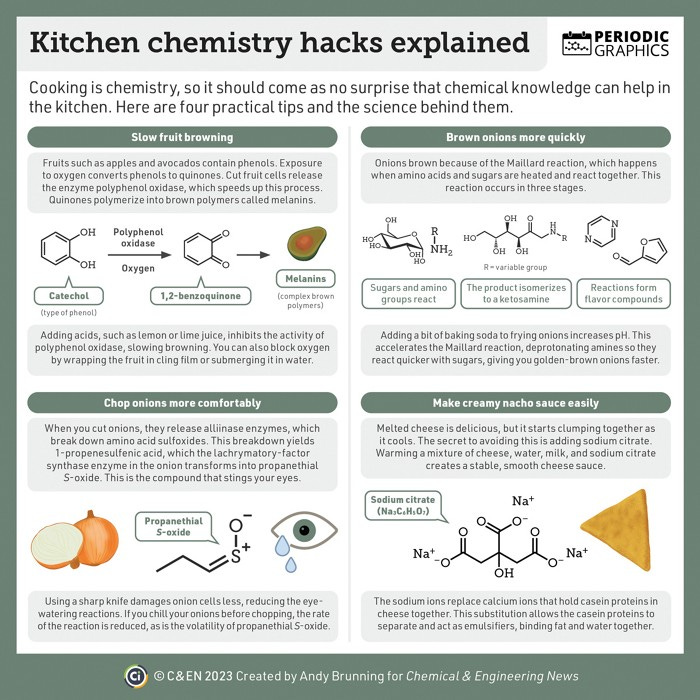
Food chemistry graphics are always some of my favourites to put together, perhaps just because they offer some form of tangible explanation for the food sensations and experiences we all encounter. So, for this latest edition of Periodic Graphics in C&EN, we’ve headed back to the kitchen to see how a little chemical knowledge can make preparing and cooking food easier.
All of these ‘hacks’ are common enough fare on any number of cooking websites, but these often skirt the chemical detail – and that’s the good stuff! So this is my attempt to put a bit more chemical meat on the bones, as it were. View and download the graphic here.
I’d quite like to make this a semi-regular series within the Periodic Graphics series, so if you’ve got some food chemistry hacks you want to see featured, let me know!

If you’ve been on the internet at all in 2023 you’ll be aware of the Barbie movie. This graphic isn’t so much jumping on the bandwagon as ambling after it some way behind, considering the delayed timing, but takes a look at the surprisingly large range of plastics that make up a Barbie doll.
Of course, the use of all of these plastics does raise the question of the sustainability of Barbie doll production. While recent news that Barbie will be going plastic-free was actually just a hoax, the environmental impacts and carbon dioxide emissions associated with the plastics used in Barbie dolls suggests that the days of her life in (oil-derived) plastics might be numbered…

I’ve been continuing to update some of the older graphics on the website this month. The following graphics have all been freshened up:
Got a favourite old graphic you’d like to see updated? Let me know!
Here’s a quick run-down of upcoming events or days and links to some relevant chemistry graphics from the archives:
4 September: World Sexual Health Day — The chemistry of condom materials
6 September: John Dalton’s birthday — John Dalton and his chemical symbols
7 September: August Kekulé’s birthday — August Kekulé and the structure of benzene
10 September: Port Wine Day — Port wine chemistry: types, colours, ageing and flavours
16 September: National Play-Doh Day — What is play-doh made of?
26 September: World Contraception Day — The chemistry of oral contraceptives
29 September: National Coffee Day — The chemical compounds behind the aroma of coffee
Here’s the regular selection of chemistry news and features I’ve found interesting over the past few weeks:
Peptides from ancient humans show antibiotic activity — It seems the hunt for novel antibiotics has scientists looking in increasingly strange places for antibiotic candidates. The latest edition of this theme is this story on the discovery that peptides ‘revived’ from the proteomes of Neanderthal and Denisovan humans by means of analysis of data had some antibiotic activity. The peptides weren’t particularly potent, however, so ancient humans are sadly unlikely to be the solution to the antibiotic resistance crisis.
Recycling wind turbine blades is a dilemma that I confess hadn’t even occured to me as an issue, but with the transition to greener energy, it’s one that poses a problem. Decommissioned turbine blades have to go somewhere, and until recently that somewhere was landfill. This is an interesting look at possible recycling solutions, including turning the blades into cement.
Predicting chemicals’ smells from their structures — AI continues its gradual creep into everything with this latest system which can predict a molecule’s smell from its structure, producing results close to that of human sniffers.
Thanks to all of you who confirmed that the chemistry playing cards featured in last month’s newsletter are very much of interest. I’m going to be looking into getting some prototype sets printed this month, so more updates once I’ve done that!
That’s all for this newsletter until next month. I’m always happy to hear your thoughts or suggestions, so do drop into the comments below with any ideas!
Share Periodycal – The Compound Interest Newsletter
Thanks for reading,
Andy
Comments
Nothing yet. Say the first thing.
Sign in to join the conversation.