
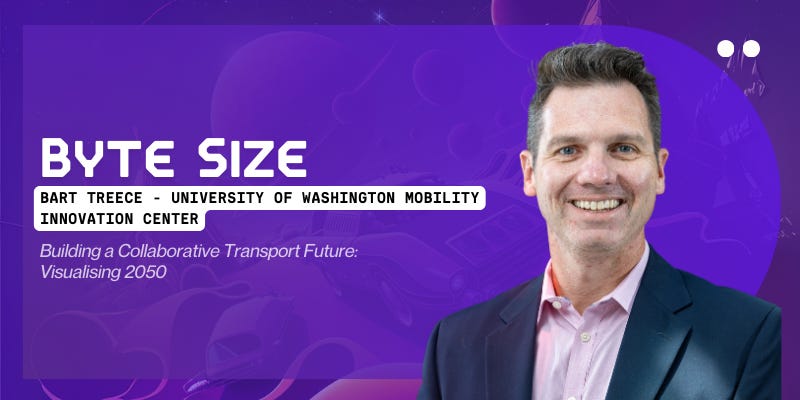
Bart Treece is the director of the interdisciplinary Mobility Innovation Center at the University of Washington, where he leads applied research projects that tackle near-term and emerging transportation challenges. Since 2022, he has worked across public, private, and academic sectors to match university expertise with real-world needs, supporting pilots, policy development, evaluation, and partnerships with transportation agencies, civic leaders, and technology companies. He also co-founded the Seattle Climate Innovation Hub and has recently overseen projects ranging from e-mobility infrastructure planning and bus base electrification to creating a digital twin of the I-90 floating bridge for operations and asset management.
Before joining the Center, Bart spent more than a decade at the Washington State Department of Transportation, contributing to project development, design, construction, operations, maintenance, and emergency response. He currently serves on the boards of Commute Seattle and ITS Washington, participates in national research panels and TRB committees, and holds degrees from Arizona State University and the University of Washington, along with certification as a Professional Transportation Planner (PTP).
Why data needs to be personal. If you want someone to care about something, we need to explain and visualise the value in a way that is personally meaningful to their life.
How Washington State is preparing for nearly two million new residents. Bart explains the pressures this growth brings to housing transport mobility and quality of life and how the 2050 scenarios help guide decision making.
What it takes to bring siloed datasets together. Learn why the Transport 2050 project exists, how combining scattered public datasets can reveal a previously hidden bigger picture, and what cross-sector collaboration looks like behind the scenes.
How to plan for a future that is uncertain. How agencies can avoid picking a single path and instead prepare for multiple possible futures while protecting quality of life and shared goals.
“The best feeling is getting everyone in a room and realising we’re all excited to do the same thing.”
“We don’t know exactly what 2050 looks like. But we know the decisions we make now shape whether we can keep the quality of life we enjoy.”
“You and I can have a conversation about a problem, but you cannot do that with millions of people. That is why visualization becomes powerful. It lets everyone see themselves in the story and understand why the future of the transport system matters.”
“The data has been telling us the same story for years, but it has lived in silos. By pulling it together in one place, we can finally see the full picture and understand the scale of the decisions ahead.”
“Innovation only works when it makes things safer and better for the public. That is why public agencies have to be part of the process.”
01:01 — Bart’s Background & Role at the Mobility Innovation Center.
He explains his journey from journalism → DOT → innovation facilitator.
03:44 — Introducing the Transport 2050 Visualization Project
How the idea emerged and why pulling siloed data together is essential. In particular, how this fits in with the State of Washington’s projected growth needs, while supporting quality of life that decision makers want to maintain
08:59 — Why 2050? Understanding Planning Horizons
How MPOs shape the long-range timeframe, and why 25 years is not actually that far away. Bart also talks to the variables that shape future scenarios, like population, hosuing, transport, and travel behaviours.
19:02 — Turning Complicated Data Into Personal Stories
“Why would someone care about this data?”
20:27 — Ingredients of a Successful Cross-Sector Partnership
How academia, government, and business each contribute, and what makes them succeed or fail.
28:44 — Data as a Compass for Policy
Using visualization to guide decisions that protect quality of life and shared outcomes
Mobility Innovation Center’s Website
Digital Twin Evaluation of the Homer Hadley Floating Bridge
Connect with Emily via email: emily@compassiot.com.au
Connect with Byte Size via LinkedIn
Connect with Compass IoT (the producer of this podcast) via our website
Comments
Nothing yet. Say the first thing.
Sign in to join the conversation.