
I’ve always been intrigued by the idea of masses of people going mad simultaneously. What could possibly have the power to cause sudden, widespread panic and fury?
I wanted to use this concept in COMMUNITY DAY.
So I stole some ideas from The Crucible.
And from White Noise.
Let me explain.
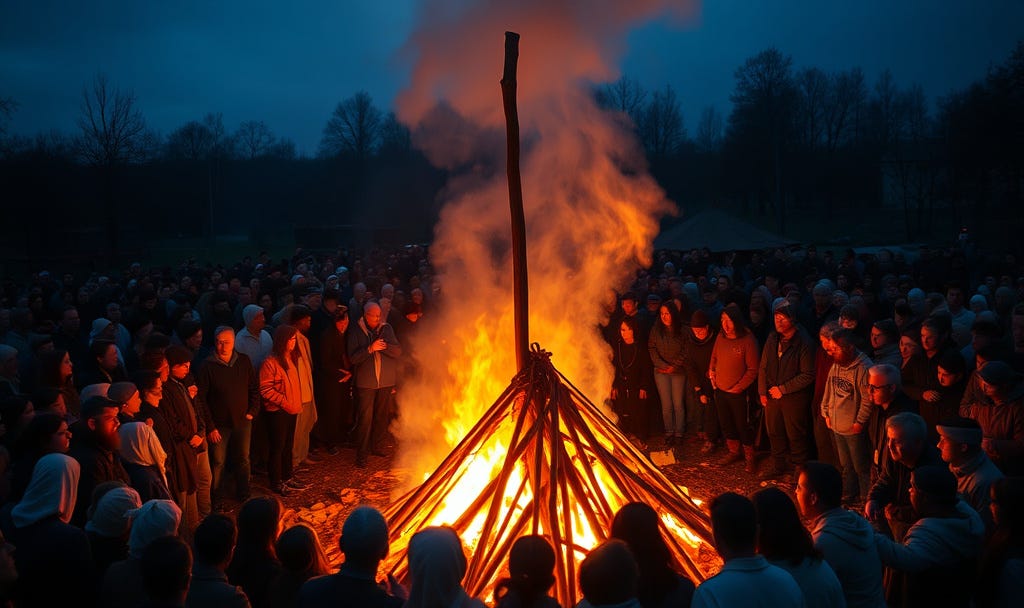
Sometime in the 2010s, America became less stable. The number of conspiracy theories multiplied, and more and more people took them seriously. Decades from now it will be hard to explain to younger people things like Pizzagate, QAnon, vaccine-microchipping, chemtrails, Charlie Kirk theories, Jewish space lasers, Sandy Hook theories…
At the same time, cancel culture metastasized into a kind of moral panic whereby online communities went hunting for and punished those who refused to get in line.
In other words, during our time, Americans got really worried about witches and started collecting firewood.
I believe that social conditions can make people more susceptible to conspiracy theories and moral panics. When we are isolated, feel lonely, lack meaningful interpersonal bonds, and become disconnected from the people and places close to us, we are primed to be afraid of distant, amorphous threats.
COMMUNITY DAY is set in a depressed, isolated, rural county. I wanted to show that its residents were unknowingly groomed by social conditions over years to be taken in by vague stories about dangerous forces.
So I created an episode wherein a character (Kim) tells everyone that evil but unknown people are spreading false rumors about her. She defends her reputation in repeated appearances before the county commissioners—speeches that are carried by the local cable-access channel.
No one much cares about the rumors related to Kim. But the entire county is sent into a tailspin by the possibility that invisible, nefarious forces might come for them next.
In the key section, I used multiple allusions to the Arthur Miller’s play The Crucible, which is—on its face—about the Salem witch trials. But, more broadly, it’s about an isolated rural town sent into a tailspin by stories of terrifying, invisible forces.
To make sure the reader catches the allusions, Chapter 18 is titled “Bewitched.” Here’s a passage (with some emphasis):
Her fanatics1 heralded her for surviving this crucible2, but in time they weren’t the only ones bewitched. Others began watching occasionally out of curiosity or voyeurism; soon they watched zealously.3 The longer Kim went on, the more people actually believed her allegations. Her repetition of false claims proved as powerful as evidence of true ones. More and more people grew terrified of the invisible forces terrorizing Kim. Before long, they worried that they might be next. This quiet rural town was morally panicked to the core. Thank heavens Goody Kim4 never named a tormentor; her disciples might’ve erected a county stake and collected firewood.
My view is that mass communication, especially social media, is the reason moral panics and conspiracy theories exploded recently. More people now focus on distant events and unfamiliar forces. And more and more people spread alarming, unverified stories.
The episode in COMMUNITY DAY occurs years before social media, so I describe the local cable-access channel as the distribution source of fear. And here I borrow from the novel White Noise, in which society is increasingly shaped by jarring, sensational messages on television. The author, Don DeLillo, creates an “airborne toxic event,” a cloud of hazardous material hovering above the town. It symbolizes the fearsome, unavoidable forces of modern technology.
This is how I describe the broadcasts of Kim’s fear-mongering speeches—and their effect on the community.
During the era of her presentations, local stores reported more shoplifting and returned merchandise, restaurants reported more excessive drinking and fights, churches reported fewer congregants and donations, and the police reported more run red lights and tip-line calls for suspicious behavior. The radio waves carrying Kim’s presentations to local televisions amounted to an airborne toxic event, spreading to homes a social contagion to which our county’s residents were unusually susceptible.
I have an idea for a relatively small character in the prequel. He’d exist largely outside of the main plot. But through occasional chapters that simply focus on this character—and seldom, if ever, include the novel’s other characters—I’d indirectly demonstrate the susceptibility of the city to fear-mongering.
This character, who’d been seen as a piddling political gadfly for most of his career, would give a drunken, intemperate speech at a small event that surprisingly excites the crowd. Emboldened, he would give increasingly intemperate speeches to larger events that excite growing crowds.
They were primed. And he identifies witches for them to hunt.

Chapter 1: Introducing Key Characters
Chapter 2: Forest and Breadcrumbs
Chapter 4: Heisting from Hamlet
Chapter 6: The Mysterious Stranger
Chapter 10: The Madness of Covid
Chapter 16: Split Personalities
1520s, “insane person,” from Latin fanaticus “mad, enthusiastic, inspired by a god,” also “furious, mad,” originally, “pertaining to a temple,” from fanum “temple, shrine, consecrated place,” related to festus “festive” (see feast (n.)). Meaning “zealous person, person affected by enthusiasm” is from 1640s. https://www.etymonline.com/word/fanatic
https://www.britannica.com/topic/The-Crucible
zeal(n.): late 14c., zele, “passionate ardor in pursuit of an objective or course of action,” usually desirable (faith, study), but also of wrath or vengeance; from Old French zel (Modern French zèle) and directly from Late Latin zelus “zeal, emulation” (source also of Italian zelo, Spanish celo). This is a Church word, from Greek zēlos “ardor, eager rivalry, emulation” This was “a noble passion” [Liddell & Scott], but the word also meant “jealousy.” It is reconstructed (Watkins) to be from a PIE *ya- “to seek, request, desire.” https://www.etymonline.com/word/zeal
See: https://www.sparknotes.com/lit/crucible/character/abigail-williams/ and https://homework.study.com/explanation/what-kind-of-person-is-goody-putnam.html;
No posts
Comments
Nothing yet. Say the first thing.
Sign in to join the conversation.