
As I’ve written in previous posts, my novel COMMUNITY DAY was absolutely, seriously, continuously, fundamentally informed by Greek myths.1
I even name-check The Odyssey a few times, including this bit from my Chapter 12:
My mind wandered. Wily and resilient. That could describe Odysseus trying to get home.
So I was excited to see Christopher Nolan’s version, which is dominating theaters worldwide.
I thought it was good. Even very good. Not great.
Two things in particular irked me. Both are related to fundamental aspects of Odysseus’s character in the play that were largely invisible in the movie…and those erased aspects of Odysseus’s character were central to how I formed the narrator in COMMUNITY DAY.
And both are front and center in Chapter 19
Let me explain.
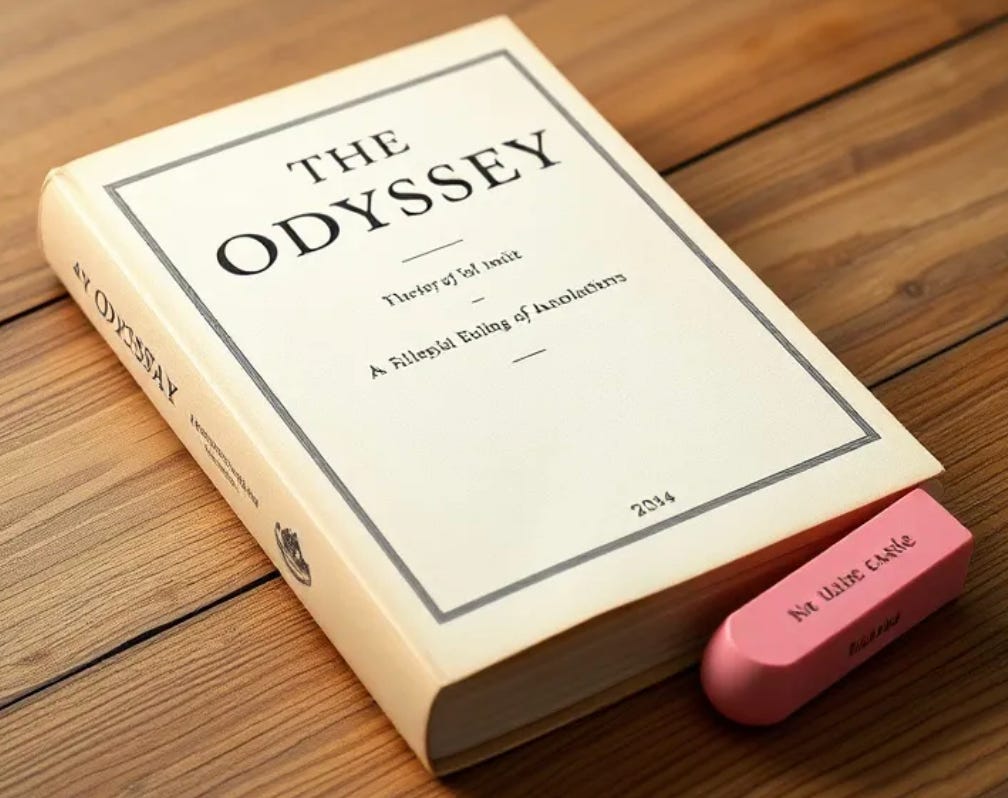
Odysseus is not the strongest or bravest warrior. But he’s been famous for 3,000 years because he’s clever. He outwits his opponents. He wins not because of muscle but because of his ideas, his schemes, his manipulations. (See this and this from Troy.)
Unfortunately, this simply doesn’t come through in the new film. His smarts related to the Trojan horse, his outfoxing of the cyclops, his management of the gods, his handling of Circe and the Sirens, and so much more are downplayed or cut.
The second problem is that Nolan reimagines Odysseus as guilt-ridden and traumatized, especially at the end of the film. This is epitomized by his lachrymose speech to Penelope after the castle battle and his subsequent self-imposed exile. In the play, Odysseus can be dramatic, but he does not regret his role in the war, nor would he consider abdicating his throne. He is singularly focused on getting home and returning to—and staying in—power.
In this way, Nolan’s erases a key aspect of the “monomyth” structure that The Odyssey gave to world literature—that the hero leaves home, faces trials, succeeds, and returns home to complete his life. The hero doesn’t regret overcoming obstacles, and the hero doesn’t abandon the home to which he had struggled to return.
The narrator of COMMUNITY DAY was designed to be Odysseus-like in his cleverness and schemes. He constantly makes up stories, bends facts, and buries inconvenient truths in order to accomplish his mission.
He was also designed to be remorseless in his efforts to win—to overcome his challenges and ultimately return home. As he says toward the end of the book, explaining his feelings after shooting the villain:
The God’s-honest truth is I can’t remember ever feeling better than I did in that moment. No pain in my leg. No worries. Nothing. Total peace. My only regret is that I didn’t get to kill him twice.
Chapter 19 of COMMUNITY DAY is dedicated to explaining the narrator’s Odysseus-like trials. His psychiatrist explains to his lawyer the abuse he suffered as a child, his teenage panic attacks, his history of self-medication, his hospitalization for schizophrenia, and his delusions prior to Community Day.
In Crime and Punishment, the main character Raskolnikov feels deep remorse for what he’s done, confesses, and accepts his punishment of years of hard labor in Siberia. That is, in a sense, the opposite of the “hero’s journey”: the main character leaves home at the end. I purposely chose NOT to have my narrator follow that path. My narrator was modeled on Odysseus.
Well, Homer’s Odysseus, not Nolan’s.
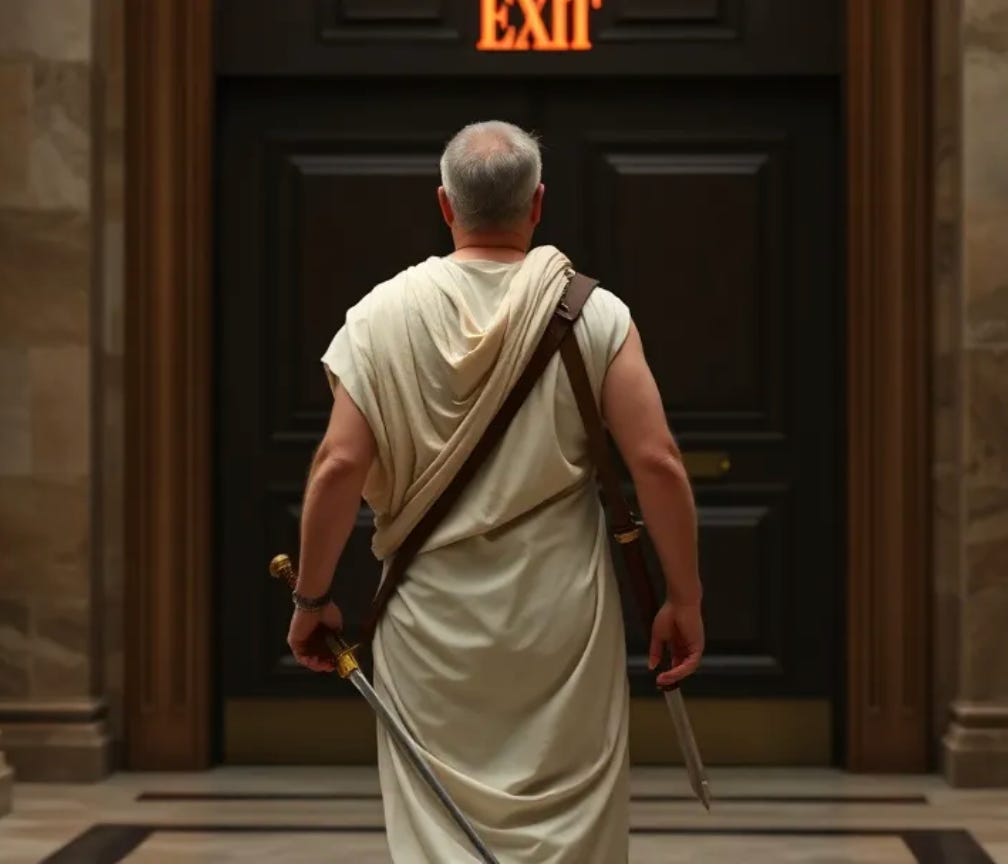
Since I began thinking about writing a prequel to COMMUNITY DAY, I’ve imagined an Odyssey-like element. In order to win in the end, the two main characters would need to travel to Richmond, Boston, and Pittsburgh—overcoming difficult obstacles in each—in order to win the big battle at home.
Thanks to Nolan’s literary apostasy, I’m doubly committed to this now. My two heroes will have no guilt about their righteous victory. And they’ll build a new life at home.
Chapter 1: Introducing Key Characters
Chapter 2: Forest and Breadcrumbs
Chapter 4: Heisting from Hamlet
Chapter 6: The Mysterious Stranger
Chapter 10: The Madness of Covid
Chapter 16: Split Personalities
I was a classics minor in college, so I read lots and lots of Greek and Roman plays. Understanding how societies create and pass down myths shaped my views on culture, history, and the human condition.
No posts
Comments
Nothing yet. Say the first thing.
Sign in to join the conversation.