
In contrast to bullion, gold shares are well below their 2020 peaks. But in recent days something significant has occurred.
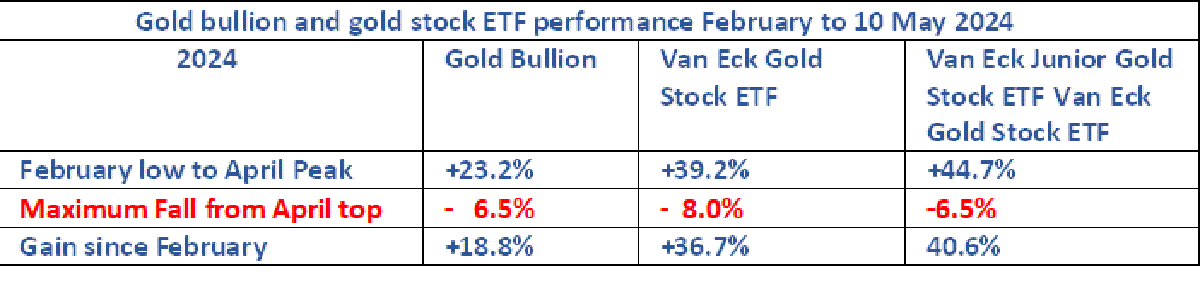
Gold bullion, as expected has fallen from its frothy $2432 all time high. It tumbled 6.5 per cent to $2276 an ounce, but has since recovered to $2365.
In previous years a decline would have caused a gold share collapse. On a rule of thumb basis, a bullion fall of say 5 per cent would precipitate a gold share slump of 10 to 15 per cent.
Not so this time. The table shows that the ETF of leading gold shares did not correct much more than the bullion price. Moreover, the more speculative “junior” gold stocks matched the bullion decline. In the past few days gold stocks have rallied with bullion. Indeed, since they began stirring in February, their gains have been more impressive than the metal.
Imaru Casanova, a portfolio manager at Van Eck believes that is a good sign. Relative to bullion, gold equities are cheap, she says.
Time will tell whether gold stocks will continue to run. Besides the dependence on bullion’s strength, the mines’ first quarter results are very important. The Van Eck charts indicate that the ETFs are encountering major resistance points. If gold fails to rise above $2,400, chartists and momentum traders may perceive a “ double top”. That may encourage profit taking. In any event history shows that gold tends to weaken during the northern hemisphere summer months. It then picks up towards the end of the year.
Bottom line it may be risky to chase gold miners and ETFs following their steep rallies. They can be purchased if and when gold settles at lower levels.
Longer term, miners follow the average gold price. So far this year, the average has reached $2150 an ounce and is rising towards $2200. This is well above the cost of gold mining. Despite that, gold shares are far below their 2020 peaks. The VanEck gold stock ETF charts illustrate this investment anomaly.
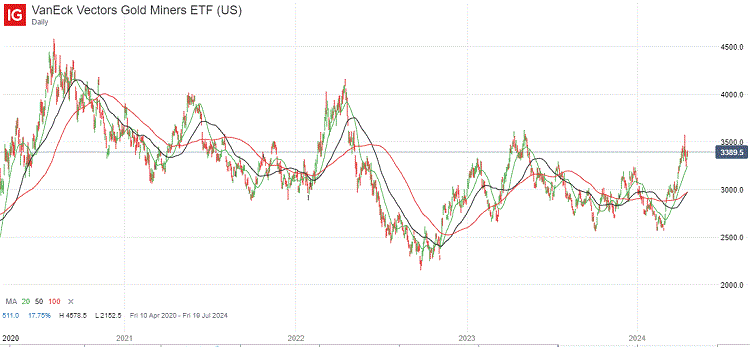
The above chart applies to the big gold producers. Notice the sharp 37 per cent rise this year. But as opposed to gold bullion. The ETF is 20 per cent below its 2020 high.
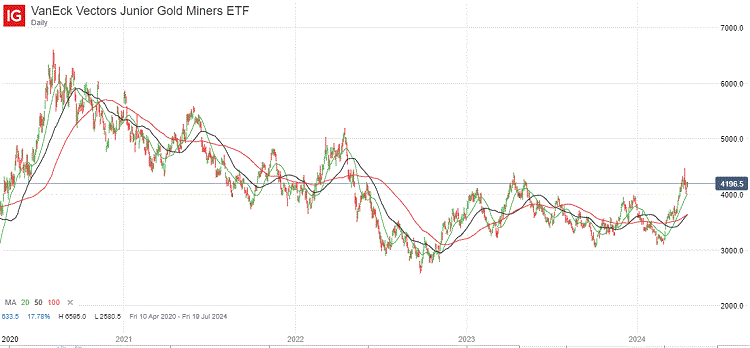
The rise of the junior smaller gold share ETF has been 41 percent from its 2024 lows. But the ETF is still 37 per cent below its 2020 peak.
Are gold shares good value?
As mentioned above both gold bullion and gold shares are overbought. But why have gold stocks failed to tag the metal and reach new peaks? Are they good value?
Recent Gold mine results illustrate that the main risk is cost inflation.
Metals Focus estimates that the sector’s average costs soared from $919 an ounce in 2019 to $1356 in the first quarter of 2023. The consultancy says that the 48 per cent increase encompassed “all sustaining costs” (AISC). They include production, administration, development and other expenses. In subsequent quarters costs declined. As a result the global average AISC for 2023 was $1,298 per ounce. Financing charges aren’t included. “Cash costs” --- the costs incurred to mine the gold--- were around $1100 an ounce.
Analysts and traders base their calculations on AISC. These may now be around $1300 to $1400 an ounce. Since average gold prices are around $2,150, the global average gross profit is around $750. This is an impressive 35 percent margin on gold sales.
Unfortunately, costs aren’t the only risks.
Gold mines tend to hedge against the possibility of falling prices. They lock in specific forward gold prices to insure themselves against uncertainty. They do so by selling gold futures and options.
The London Bullion Market Association surveyed analysts at the beginning of the year. None of them predicted the price surge in the first four months of the year. Nor did the miners. It is thus likely that mines hedged their sales prices at lower levels than present high gold prices.
Mines do well if their grades---the amount of gold they extract from the rocks-- are profitable. An increase in production also boosts profits. But there can be mining snags. These include floods, labour disputes and government interference. Many mines in Africa and other emerging markets are risky.
Impairment cost risks
Imaru Casanova warns that it is difficult to achieve “organic growth”. It is a lengthy, and capital-intensive process to find new gold deposits. To counter depleting gold reserves, companies buy mines to boost production.
The downside is whether the predators overpay. The target mines may fail to meet expectations. Newmont and Barrick are amongst companies that wrote off “impairment” losses.
Frank Holmes CEO, US Global Investors, favours gold royalty companies. They provide capital to mines and in return receive a royalty on their gold sales. But Franco Nevada had problems in Panama. Franco Nevada and Wheaton Precious Metals have steep price earnings ratios of 40 and above. Royal Gold’s PE is 33.
Bottom line gold equity exchange traded funds are safer than individual gold shares. But accumulation should only take place when the bullion price falls and stabilises at lower levels.
Disclosure: the writer has a small holding in VanEck Gold Miners ETF (GDX)
© Copyright Neil Behrmann All Rights Reserved
No posts
Comments
Nothing yet. Say the first thing.
Sign in to join the conversation.