
The first time I smelled tear gas was the summer of 2020. I was one in a crowd of hundreds in northern Indiana, in the middle of one of many protests resulting from the social upheaval that came from the Black Lives Matter movement. I had opted, amid the COVID-19 lockdowns, to stay on campus at Purdue University and had been itching to hit the streets when the call was made for nearby residents and students to take to the streets in protest of the police murder of George Floyd in Minneapolis, Minnesota.
For many in the crowd, it was the first entry point to anything resembling radical politics. Everyone from children to elders came out calling for accountability and some semblance of justice for not just Floyd and his family, but for the other countless Black Americans who had seen their lives and communities directly impacted by U.S. law enforcement. We marched from the university across a narrow bridge into the neighboring city, taking a route that went by nearby homes and the local police precinct, where an armed SWAT officer took a knee on the roof while brandishing his rifle. The people, many of whom were not socialists by any means, cheered at the sight.
It was not until the sun began to set along the horizon that a march turned into a mass dispersal. Attendees had marched back to the university, and upon realizing their crowd size, turned back yet again to continue a second round of protest outside of City Hall. The energy of the crowd was elevated, as was the energy of law enforcement officers who met us on the streets. For a brief period, people milled about and chanted, took photos, met other community members, and waited for a next step that no one seemed to know the details of.
One member of the crowd then decided to make a decision that changed the circumstances entirely. They walked up to City Hall, pulled out spray paint, and sprayed “Fuck 12” on the side of the building. The police response was immediate, as SWAT officers who had been waiting inside the building began deploying tear gas on the crowd. As the crowd was largely unprepared for such a response, conditions began to spiral. Many began to run; their footsteps were met with panicked screams as people realized what was happening.
Amid the panic, a man picked up a canister and threw it into the open front doors of City Hall before crumpling to the ground. SWAT officers had shot him with a less-than-lethal round, and he was incapacitated. A small group I joined quickly ran to him to surround him and pull him away from law enforcement as tear gas continued to be shot into the crowd. We coughed and wheezed as the smoke filled our lungs, and a few of us quickly took to pulling people out of the area. Within a few minutes, the crowd was a fraction of what it had been. One man I was with, a former Marine who had taken to the streets alongside our crowd and helped me carry a handful of people away from the tear gas, notified me that the local department was seemingly deploying a K-9 unit and that we needed to leave.
I walked alone across the bridge that night back to the apartment I was staying in on campus. By the time I got back, I only had enough energy to throw my clothes in the wash and shower off the smell of the gas and sweat before collapsing in my bed. Though not my first negative interaction with law enforcement by any means, it was the first time I had seen such a militant response to a movement that challenged the institution. By the end of the summer, it would be far from my last.
Our protest was not the first to meet violent state repression, and as the movement swelled nationally, so too did the militarized response from law enforcement. Slogans like “ACAB” became more commonplace in crowds, as did calls for abolition of the institution that was American law enforcement. Officers baring their teeth at crowds turned many in the crowds even more against them. It was not long until that negative polarization, coupled with decades-long organizing efforts, led to fairly widespread calls for major societal and institutional upheaval.
These demands, however, were not the only ones being made in the crowd. Many called for reform just as much as abolition, calls bolstered by Liberal actors and organizations which sought to infiltrate, steer, and ultimately defang a movement with a defined militant streak. It was not long before the call for abolition took a backseat to the call for defunding the police.
Today, many may have forgotten the distinction that was drawn as these conflicting demands came to a head. The call to defund law enforcement, to many on the ground, was framed as a moderate demand when compared to ripping the institutions up root and stem. Defunding law enforcement, according to those opposing the shift, was a good first step, but not one that solved core institutional problems that Americans, particularly Black Americans and Indigenous communities, had seen very clearly and experienced openly for centuries.
These distinctions may have seemed nonexistent to those outside of the movement space, but internally they created real divides that were never entirely bridged. Worse yet, alongside the shift toward defunding law enforcement were calls for reforms that did not even begin to challenge the status quo. Body cameras were one of many “solutions” posed by advocates who claimed that they would make police departments more accountable to the general public. The idea behind these changes was that the institution of policing was not actually truly unsalvageable. Rather, the problem was identified as being “a few bad apples” and the lack of proper equipment and practices. Unsurprisingly, alongside technological “solutions” were calls for more extensive training for police officers, as if the level of training was the core problem.
Thanks for reading Commie Corner! This post is public, so feel free to share it.
These shifts did not stop principled organizers from continuing calls for real systemic change, but they became one part of a much larger multi-tendency movement that was quickly being steered toward oblivion. Though police were being correctly identified by some as a white supremacist colonial occupation force, institutional forces moved to ensure that the majority were willing to accept a different framing, and much less than anything resembling abolition.
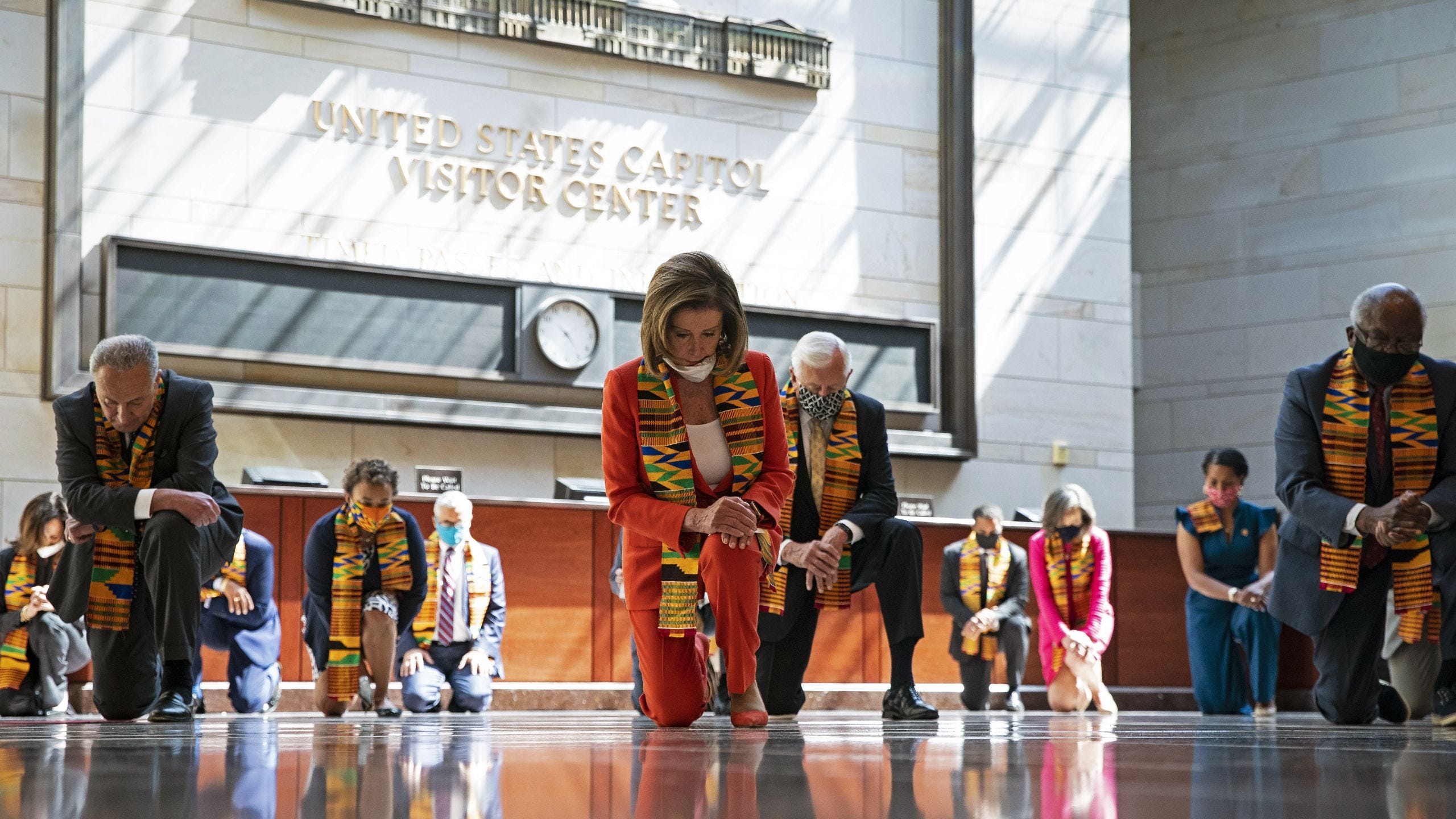
Elected officials, as one might expect, were quick to enter and co-opt the movement for their own means, all while doing everything they could to defang it to the point of absurdity. Nothing quite exemplifies the Liberal reaction better than the now-infamous photo of elected representatives taking a knee in kente stoles. It was widely ridiculed in Left spaces as being a hollow and performative stunt that was strikingly out of touch in the moment. It’s fair to say that such a description could be applied to many of the actions of the Democratic Party at that time.
While the right (and even many who considered themselves to be different from them) stood with law enforcement, openly criticizing protestors and calling for more police violence against them, Democratic officials took a different, though still oppositional route. They called for peaceful protests, working to create divides in the movement space between those engaging in direct actions and other activities deemed “violent” and “unsavory” and those choosing to show up, protest, and go home when they were expected to do so. The narrative of the “violent minority” became commonplace, a narrative that gave justification to the police amid their crackdowns that were more tactful than what was being spread by their Republican counterparts.
The result of the rightward shift in the discussion and efforts to crack down on the movement was best reflected in the legislation that emerged from it. The “George Floyd Justice in Policing Act”, named after a man executed by U.S. law enforcement in broad daylight, was the reformist effort to give the movement crumbs in the form of body camera prioritization, the banning of some harmful practices on a federal level, and, interestingly, efforts to give funding in the form of grants to some law enforcement agencies. Elected officials were clear: not only would they ignore the principled calls for abolition, but they were not even interested in the moderated demand to defund departments. Minor reforms were the most they were willing to offer.
In the years since millions hit the streets to protest the execution of Black Americans by U.S. law enforcement, budgets for departments across the country only continued to inflate. The movement did not die, but as the broader street movement receded, the reformists dropped even the discussion of their most asinine half-measures. Discussions around abolition and defund were dropped by Liberal talking heads, with political officials moving away from anything resembling police accountability or systemic change as soon as they were able to.
The Black Lives Matter movement and the growth of American consciousness that we saw as a result of it and the broader reality of the COVID-19 pandemic were memoryholed in many ways, brought up as a cautionary tale of Liberal infiltration and what it takes to sustain a spontaneous mass movement, or a nostalgic period in which organizers felt sometimes for the first time as if real change was on the horizon. For others, the period has become a sort of joke.
Among those making jokes are Alexandria Ocasio-Cortez, who, in an interview with Jonathan Karl on ABC’s ‘’This Week”, stated, “Woke 1 was crazy,” when answering questions about the positions of some on the Left in 2020. The phrase was not of her own making, first coming seemingly from New York City Councilmember Chi Ossé, though variations had been floating around online spaces for some time prior.
What seemed to some to be an innocuous joke to some read to others as yet another example of her putting careerist ambitions ahead of the movement she had claimed to be part of during her ascent to Congress years ago. AOC herself had been a proponent of the moderated demand of defunding the police only several years ago, but in the years since has seemingly moderated even further. One should ask why, and to whose benefit?
It would seem that AOC is one of many politicians who, even with “progressive” credentials, have been unwilling to wrestle with not just the reality of law enforcement, but proposals to curtail their influence and funding for the sake of reinvesting those dollars into our communities. The demand itself is fairly common sense, as it has been clear for years that despite the statements of police department talking heads, there is no correlation between police funding and community safety. As such, more funding to already bloated budgets does little to serve our communities, but does help law enforcement agencies, who at this point operate more as overglorified protection rackets, continue to militarize and pad their salaries.
Those who have been on the streets in the years since 2020 or who otherwise have had to interact with law enforcement in their day-to-day lives can likely immediately begin to see the problem. Money that should be going to bettering our communities is instead being siphoned by domestic occupational forces hell-bent on maintaining a violent and exploitative status quo in the name of protecting property and its owners. Now, even the calls to curtail such a reality are being talked about as “radical,” almost fanciful proposals.
In accepting this, the so-called “progressives” in office advocating against such solutions have shifted right in ways that mirror their establishment counterparts years prior. Law enforcement thus remains protected, now by those who rose to prominence in no small part due to their criticisms of the institution itself.
Some, such as New York City Mayor Zohran Mamdani, have gone a step further. In recent statements, he has not just walked back from a defund position, but affirmed that police and jails are tied to community safety. In doing so, he has accepted the right framing entirely, not even offering a critical perspective of an institution that, since its inception, has been tied to oppressive forces. When combined, the backtracking from defunding law enforcement and the rhetorical connection between law enforcement and safety only serve the institution itself, undercutting movement allies and providing legitimacy for the very body that has been critical in the suppression of progressive social and political movements across the U.S. throughout history. This seems much crazier than the demands that came out of “woke 1.0”.
We should ask ourselves, when analyzing the social and political upheavals of 2020 and the movement demands that came out of them, whether the demands were really that “crazy” or, rather, grounded, understandable, and correct. Was abolition of law enforcement crazy, or a demand rooted in centuries of analysis around the institution which concluded that it was incompatible with the safety of millions and was nothing more than a white supremacist occupational force? Were even the moderated calls for defunding law enforcement so that our communities could finally be prioritized over such an occupational force also “crazy”? Is any demand that even mildly disrupts the status quo and offers an alternative beyond our carceral system untouchable to those in power who claim to be from the movement? It is absurd.
Worse yet, it is harmful. As law enforcement agencies continue to crack down on movement organizers and communities nationwide, these elected officials are choosing to side with them over those they claim to be in solidarity with. For socialists, anything other than defunding law enforcement should be viewed as giving those trying to kill us the ammunition they need to load their weapons. When our political representatives walk back on these positions, it is more than a rhetorical shift; it is an act of betrayal that they will never see the full ramifications of. It is an endorsement of the very violence that is helping to quash and destroy movements fighting for a better future.
When I look back at 2020 and the movements that spontaneously arose from the conditions of the time, I see movements that, though chaotic at times and fractured, were far from crazy. The streets in 2020 may have actually been one of the more sober and rational places to be, and the demands continue to be rational to this day. What is crazy is the willingness to throw that movement under the bus for the sake of short-term electoral viability. Perhaps some “progressives” are more comfortable with such insanity, but those of us still organizing in the larger movement should not be.
Thanks for reading Commie Corner! This post is public, so feel free to share it.
Comments
Nothing yet. Say the first thing.
Sign in to join the conversation.