
The first time I laid my eyes on Cuba was from the air. The coastline of the island emerged from seemingly endless Gulf waters containing nothing but the white caps of waves vaguely visible from thousands of feet up. I had taken off from Miami in a small plane alongside activists, organizers, social media celebrities, and reporters on the Nuestra América Convoy. The person next to me, knowing I had never been to the island, offered to switch seats from the aisle to the window so that I could look out as we entered Cuban airspace. Within minutes of seeing the coastline, we were flying over the vast greenery of rural Cuba, a wilderness only broken up by the occasional field, a dilapidated barn, a tenement-style complex, or a small patch of solar panels.
As we got closer to the ground, I tried to hold in my excitement. I had planned for over a month to come to the island to join a humanitarian mission bringing thousands of pounds of desperately needed medical supplies and report on the state of the island. Only a few hours before, I had stood in the heart of empire, and now, as I heard the landing gear lower and felt the shake of our plane as we landed in Havana, I was in the capital city of a victim of decades of that empire’s imperialist violence.
As I pondered what this meant, a flight attendant came over the intercom, saying, “Ladies and Gentlemen, welcome to Havana, Cuba!” Her announcement was immediately met with cheers and clapping from the passengers around me. I kept staring out of the window, smiling, looking out at the tarmac and the small white wall that encased the airport itself. I picked up my backpack and slung it over my back before pulling my small suitcase from the storage compartment above me. I shuffled out of the plane and took my first steps into Cuba.
Far from feeling as if I was stepping into a new world, it seemed just like any other airport experience. Save for the bright, seemingly faded pastel colors of the airport and the warm Caribbean air, in contrast with the frigid Philadelphia wind I had grown accustomed to, it could’ve been any other flight. An advertisement for cigarettes, which I would smoke plenty of in the days to come amid conversations with Cubans outside of their homes and storefronts, hung in the hallway on the way to baggage claim, where I waited patiently for my small suitcase to appear.
Once I collected my belongings, I walked over to a customs officer for what must have been the fastest processing I have ever experienced traveling abroad. He checked my passport and visa, handed them back to me, and let me through in under two minutes. The hardest part was over, and I quickly left the airport to board a bus that was waiting for the countless Americans and international activists arriving alongside me. With us was a man from Havana who was to be our guide, who pointed out every sight and gave us the history of the island in the forty-minute ride into old Havana, where our hotel was (one of the few the U.S. government permits U.S. citizens to stay at, as it is privately owned and therefore not supporting the Cuban government with the money we spent on lodging, food, and transport).
I kept coming back to a quote I had once heard from Anthony Bourdain after his travels to Cambodia, where he said, “Once you’ve been to Cambodia, you’ll never stop wanting to beat Henry Kissinger to death with your bare hands.”
By the time we reached the hotel, the exhaustion from my trip began to set in. I had overnighted in Miami after getting in late, only sleeping for roughly two hours in what may have been the dingiest Red Roof Inn I have ever stayed in. Knowing I only had a few days on the island, however, I did not rest upon entry to my room. Instead, I dropped my bags off, went to the hotel bar, and ordered a coffee before I hit the streets. As my bartender completed my order, we struck up a conversation about the myriad rums and other alcoholic beverages stocked in the bar itself. I recognized some from home, but others, like the Havana Club rum, I had only read about in the books I read in preparation for the trip.
The bartender explained to me that it wasn’t surprising that I hadn’t come across it before, as Havana Club and other Cuban brands were banned from entry into the United States as part of the blockade. The brands, a national source of pride for the Cuban people, have been the site of a trademark and broader brand war among outside companies like Bacardi, former Batista supporters-turned-exiles, the state-owned rum enterprise Cuba Ron, and the French liquor giant Pernod Ricard. This was to be my first lesson in Havana, followed by the suggestion by the bartender that I spoon more sugar into my coffee. It seemed the only people to surpass my own sweet tooth were those in Havana. I finished my coffee, thanked the bartender in Spanish, and took to the streets, where I would remain over the next few days, only breaking up the excursions with a couple of hours in the hotel to recharge before hitting the ground again.
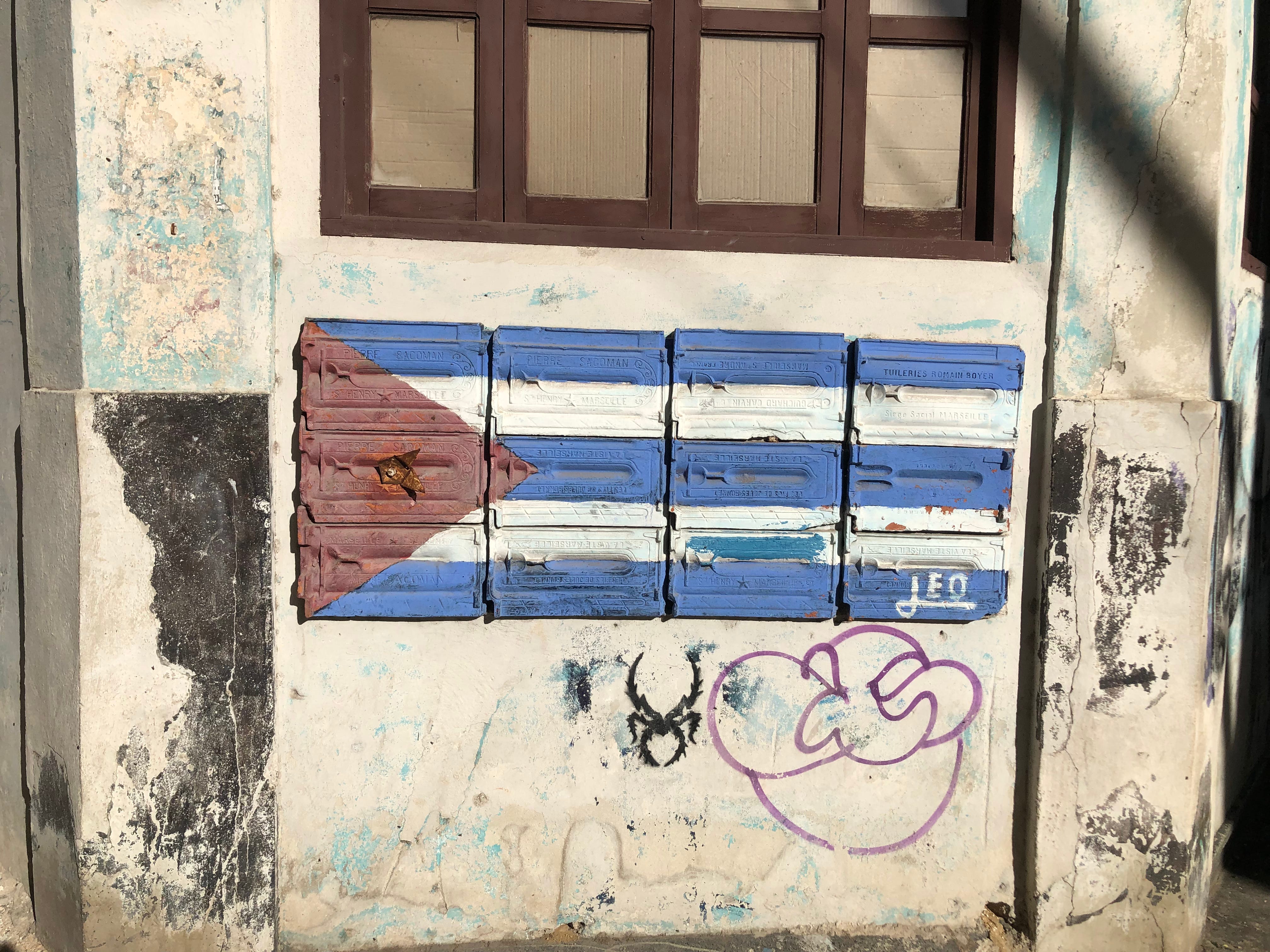
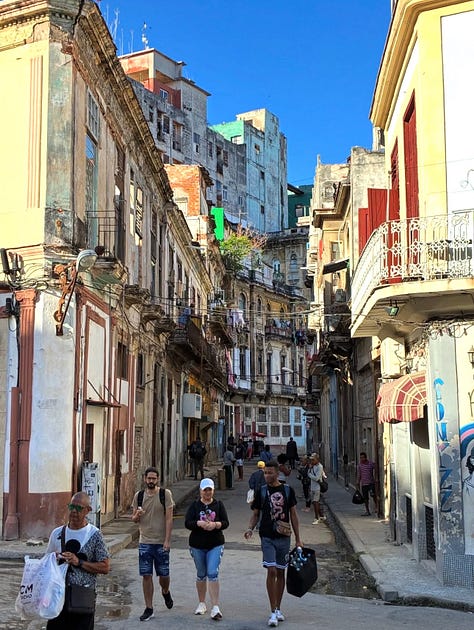
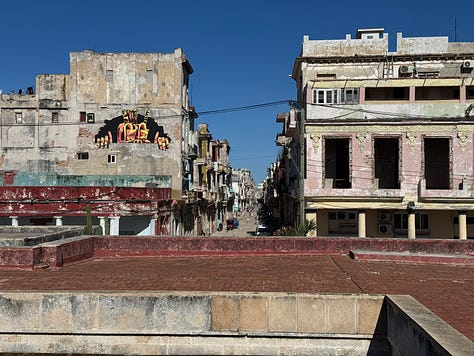
It is difficult to put into words what it felt like being in a nation besieged by my own, seeing every block the myriad ways in which the U.S. government has altered the lives of millions for the sake of its own imperialist ambitions. As I walked block by block across the island, I talked to Cubans and asked them about their lives and feelings about the state of things. Even their most positive words and stories were juxtaposed in my mind against the dilapidated, hollowed out buildings dotting every neighborhood, near-empty stores, lines of people in front of banks and food distribution sites, those begging on the streets for a dollar from every foreigner who passed by, and other signs of the severe poverty they had been forced into.
I kept coming back to a quote I had once heard from Anthony Bourdain after his travels to Cambodia, where he said, “Once you’ve been to Cambodia, you’ll never stop wanting to beat Henry Kissinger to death with your bare hands.”
What started as sorrow turned to rage as I walked along Havana, with every street giving me another reason to despise a government that had, for over six decades, tried to choke the life out of the Cuban revolutionary project. The imposition of an extraterritorial sanctions regime that mirrors, in some ways, Israeli policy in occupied Palestine has left the people of Cuba without consumer goods, medicines, construction materials, oil, and much, much more. Those who have not lived through a siege may not truly ever understand what that life entails.
Essentially, every single good that we might use in our day-to-day is facing shortages on the island, from the medications we use to the toothpaste we brush our teeth with and beyond. Cuban medical students told me that they would be happy receiving something as seemingly insignificant as Advil, an over-the-counter medicine that I could find in almost any store in the U.S., and Cuban people on the street repeatedly came back to the cost of milk, opting for powdered milk given their difficulties storing it amid rolling blackouts.
Those blackouts are something I cannot begin to describe. Those of us in the U.S. likely know at this point that Cuba has been facing increased blackouts amid the tightening of the noose that is the blockade under the Trump administration. Oil has become harder to come by than ever, and the island’s struggling power grid has been regularly failing despite the best efforts of Cuban technicians. We experienced rolling blackouts every single day, with power being restored temporarily in parts of Havana, but for some Cubans, the power did not come back. One man, an electrical engineering student working on the Havana grid, whom I spoke to briefly, noted that in his neighborhood, power was a luxury they didn’t expect to see back for the foreseeable future. As I walked with him and a guide who had lived in Cuba for several years, I was shown businesses operating without power, selling what they could inside of buildings that seemed borderline abandoned. People sat on their stoops, escaping the heat of their non-air-conditioned homes to chat with others and pass the time.
He explained that the blackout and blockade had effects well beyond simply powering a building. Food storage, he noted, had become a serious concern as perishable goods had become harder to come by and maintain without refrigeration. Lack of clean water was also a feature of many areas of the city, despite the government’s best efforts, according to him, in no small part due to power shortages and the materials needed to maintain the water infrastructure. He was the first man of many I spoke to who said I needed to see the “real Havana,” where he called home, and pointed me down the street. The next day, I made sure to frequent these neighborhoods, escaping the tourist area in Havana to see what conditions were like for those like him.
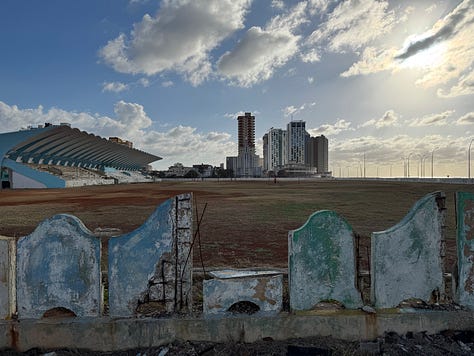
What I saw reminded me much of my former trips to Sarajevo, a city that bears the scars of war and siege and the poverty associated with the transition from a socialist project to that of a capitalist periphery state. Buildings were seemingly collapsing in on themselves, with some homes having as little as one couch in a room and nothing else. The people sat outside, smoking cigars and smaller Cuban cigarettes, as children ran around as happy as can be. One building we stumbled upon, an abandoned stadium, had an entryway guarded by two medium-sized dogs, likely guarding the people who had taken up residence inside. On the field, Cubans played soccer as the stadium seating behind them lay empty.
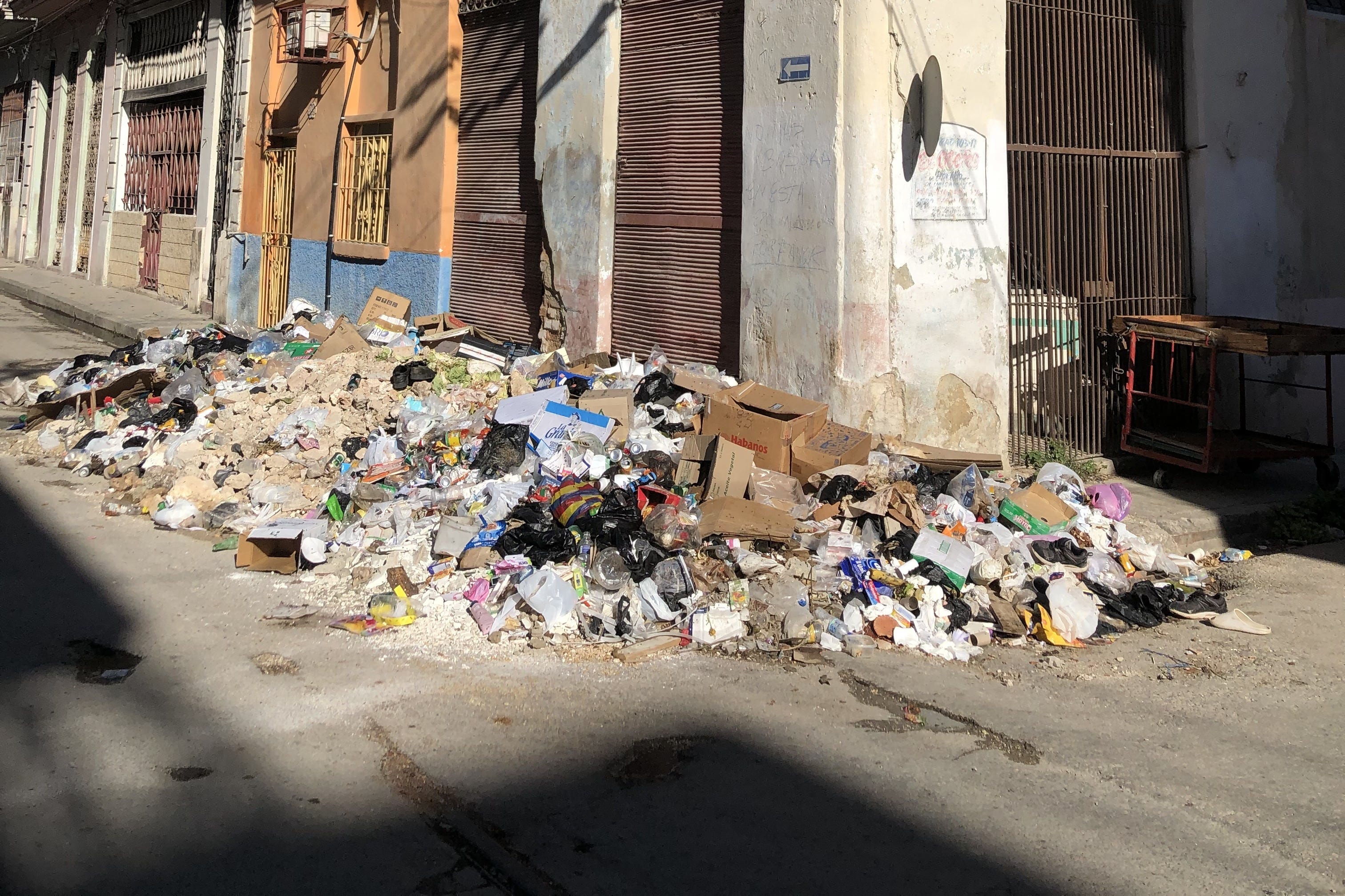
Broken-down cars without tires sat propped on cinder blocks every few blocks, with piles of trash everywhere to be seen. I watched as one man, braving the swarms of flies that buzzed around a particularly large trash pile, took a screwdriver and tried to take apart an old television screen, which might have some scraps worth something, anything. I learned later that many in Cuba were deeply embarrassed by the trash, a result of local municipal services lacking the fuel to keep garbage trucks going. They knew, as I did, that the sight of it was a blemish on what has historically been considered one of the most beautiful cities in the Caribbean.
But back to blackouts. The true scale of the horrors of the blockade didn’t set in for me, however, until an island-wide blackout occurred on the island during my second day in Havana. A small group I was part of spent the day traveling several miles on foot to the area of the city housing many of the embassies on the island. After getting into trouble with the Cuban police outside of the American embassy for taking photos where my friends and I gave our regards to the staff inside in the form of middle fingers and other crude gestures and trying to negotiate our way into the embassy of the Democratic People’s Republic of Korea, we were on our way back to the area near the hotel for a quick break before a night outting. Cubans we stopped to talk to as the sun went down cautioned us that there was no longer power and that it would be harder to navigate the dark streets as foreigners, before helping point us in the right direction back. As we trekked along the scenic El Malecón, a coastal walkway many Cubans treat as a therapeutic escape from the stress of day-to-day life, we gazed upon one particular building that stood out from the others.
The building, which we had walked past earlier in the day, was a hospital, the largest in Havana. As the city lay in darkness, only broken up by an occasional solar-powered street lamp or private business (which the U.S. government allowed to import oil for their own power generation), we stared at a major medical facility. It only had a handful of lights on. This facility and others, thankfully, have their own backup generators and solar power courtesy of the Cuban government, which has been focusing as many resources as possible on maintaining the robust medical system across the island. That did not stop us from the gut-wrenching realization, however, that those generators did not come on instantaneously, and there would have been a time when power was out, even with all backup systems working perfectly.
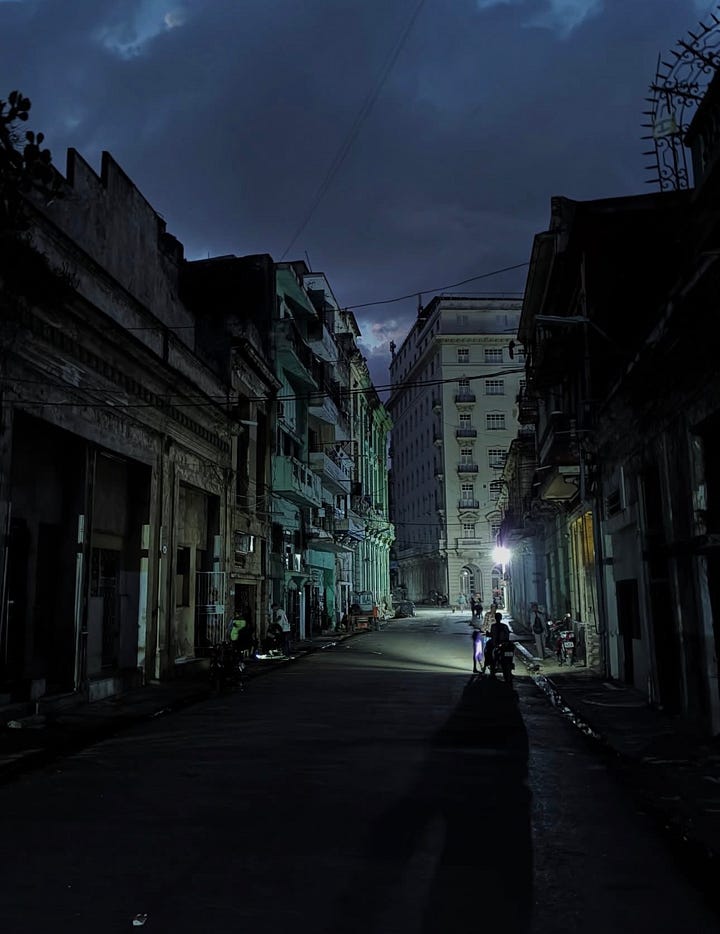
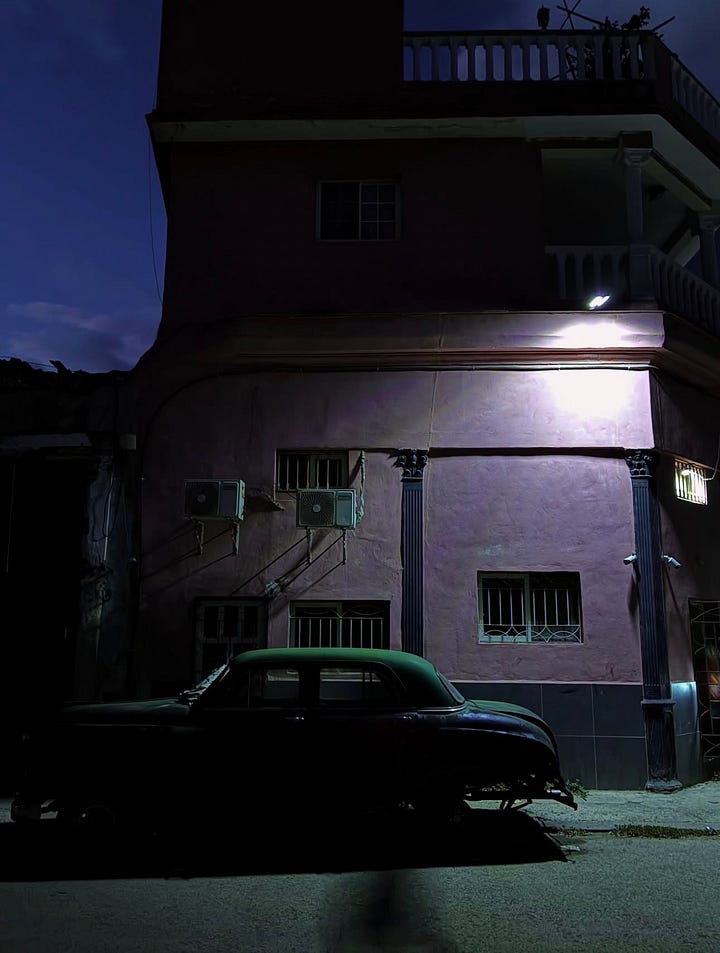
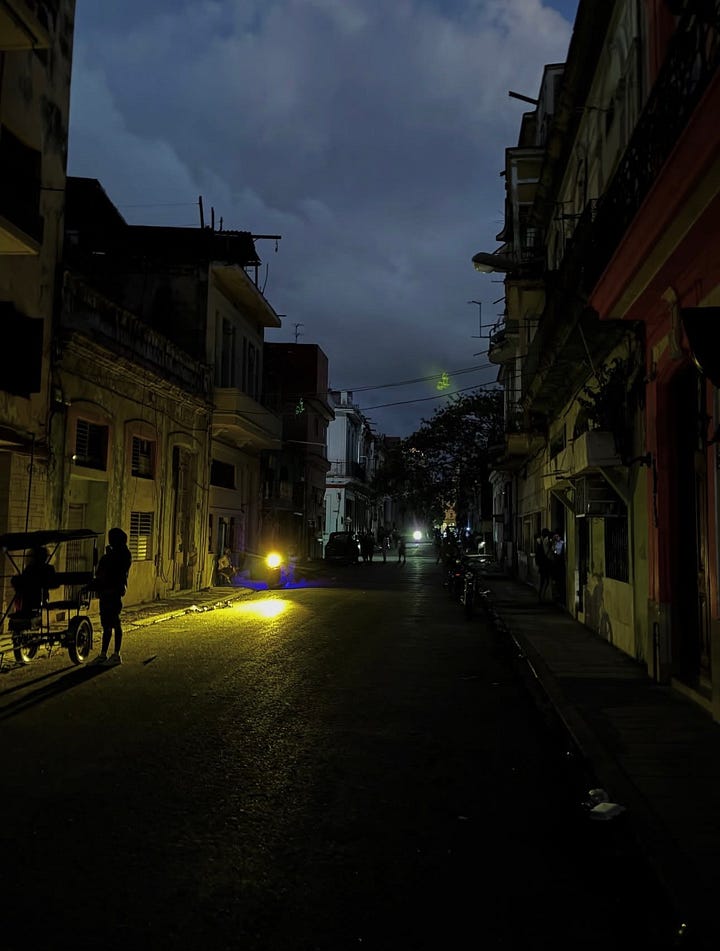
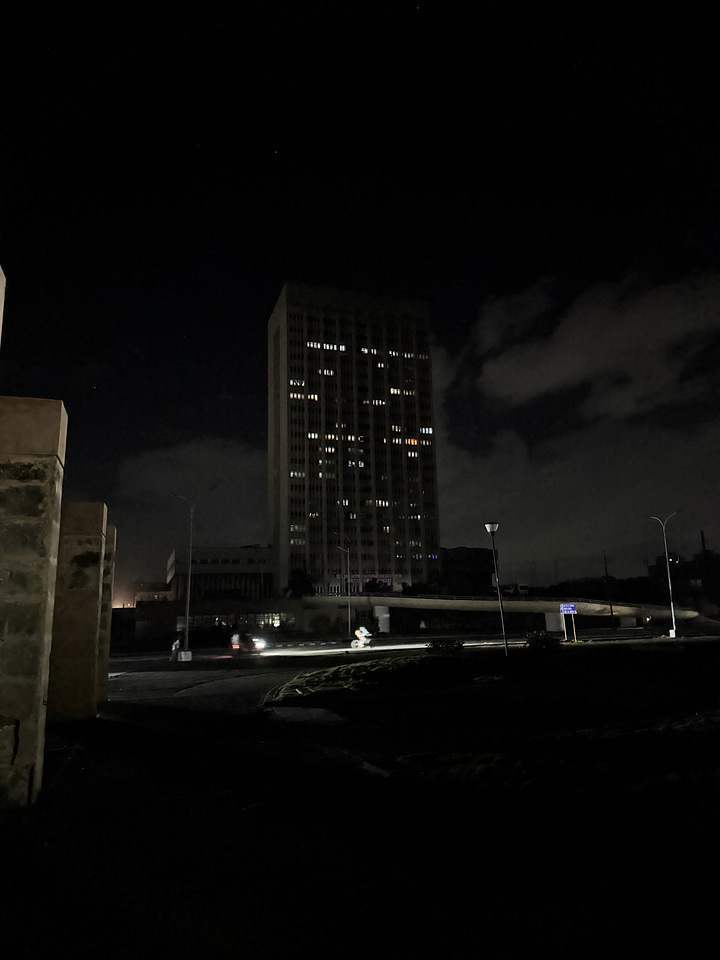
One of the people with me, a friend of mine I had met only a day earlier, questioned how this blackout might affect those getting dialysis. Another person quickly added that there were likely infants in the hospital’s neonatal intensive care unit (NICU). As we stood outside the hauntingly dark building, the list of possible patients affected by this continued to grow. I couldn’t stop thinking about what it would feel like to be a patient in a hospital room when the facility went dark, how I would, in that moment, have to wrestle with my own mortality if the conditions were severe enough. There would be Cubans in that hospital who would have to make peace with the possibility of their own deaths every time the lights flickered. Even upon coming home, that thought has not faded from my mind. I felt numb as we stood in silence for a time before continuing into the city.
We only returned to the hotel long enough to drink more coffee and gather more Americans to go on a night walk, which led us back to the Malecón. Cubans had gathered there with tables and chairs to talk and party in the dark, which some of us quickly joined in on, dancing and chatting in broken Spanish for an hour. I took the time to sit on the rock wall dividing us all from the powerful waves crashing into the rocks below, staring at the waves as they came in and occasionally looking up at the stars. My friends had noted the stars on the way home, as many of us had lived in cities for years and couldn’t remember a time we saw them so clearly. One friend, a horse wrangler from Wyoming, had somberly noted as we talked about how bright they seemed that this was likely only due to the blackout. I could not stop thinking about that. The stars we gazed upon were only visible because there was no light pollution to obscure them. Even the most beautiful sight was marred by the reality of the horrors of imperial violence.
Cubans I spoke to had a lot to say about these conditions. As one may imagine, they are human beings with opinions across the political spectrum, from hardline defenders of the revolutionary government to those few who said they wished Rubio and Trump could bring “freedom” to the island. In much of the political discourse around Cuba, I think we oftentimes forget that they are human beings like anyone else who are far from a monolithic body. Their frustration was understandable, especially as one Cuban medical worker told me, the Cuban people ultimately expect perfection from the government, which represents them (something that I had trouble grasping as an American who expects my government to enact harm on a global scale and work against the interests of the common man, no matter who may be in charge).
No matter who I talked to, however, with maybe only one or two exceptions, two throughlines existed. First, all Cubans spoke of their wish for an end to the U.S. blockade. Second, they spoke highly of the legacy of their socialist project, even if many had nuanced criticism of some of its officials from time to time. The popularity of socialism and the legacy of the revolution were no doubt a significant part of why these people had managed to keep their project alive amid decades of U.S. violence. Cubans repeated slogans such as “Venceremos”, or “we shall overcome” in English, and “Patria o Muerte”, homeland or death (a phrase which was put above buildings in the city and notably, outside of the U.S. embassy). As I heard these phrases repeated over and over again, I could not stop thinking about the parallels between them and the Palestinian concept of Sumud (steadfastness) or the Irish phrase “Tiocfaidh ár lá” (Our day will come). Other colonized people separated by an ocean, struggling under U.S. and British imperialism - all determined to outlast it, no matter the hardship.
What struck me most was that even in these conditions, those I spoke to gave the American people a level of grace many of us frankly do not deserve. Every Cuban who criticized the United States couched their critiques in clarifications that their disagreements did not extend to our people. Many of them explicitly talked about as kin—brothers and sisters—who they knew did not share the views of our government. On multiple occasions, I jokingly replied, “No, some American people as well”, which caused several of them to laugh and accept, knowing that even Trump had loyal supporters who also supported the collective punishment of the Cuban people.
We owe it to these people to end the blockade. Above all else, the Cuban people deserve to be able to live to their fullest potential, free from the tyranny of a U.S. blockade, and chart their own futures free of the machinations of imperialists who would sooner see them enslaved than have even a day of freedom.
Though we laughed, it was a difficult thought to shake. Many of us were at best ambivalent about the reality of the violence we were perpetrating on an island only 90 miles off our own coast, with many more outright supporting it. As they suffer, we shop. As they starve, we feast. As they endure shortages, many of us experience a material bounty that some on the island could only dream of. Coming home, even small things began driving me crazy, like someone leaving a light on or throwing away food after going out to dinner and being unable to finish what was upon our plates. To think that we live such vastly different lives from those in Cuba, for no other reason than where we happened to be born. Thoughts I had wrestled with amid the genocide in Gaza began to flow back into my mind, now combined with the memories of those in Havana. It’s enough to make one feel sick.
That being said, even amid the pain I witnessed in every corner of Havana, I also witnessed so much joy, with countless moments where I found myself smiling alongside those we met and laughing with them as we talked about whatever came to mind. People like a tour guide who slyly slid me an unfiltered cigarette, saying, “You’re going to die eventually, you might as well smoke something”, or the salsa instructor who took my friends and me to a small hole-in-the-wall bar deep in the city before buying us drinks and cigarettes so we could avoid the “yankee upcharge”, the Cuban police officer who rolled her eyes and snickered when I tried to explain that I was filming a Tiktok flipping off the U.S. embassy, the guard outside of the DPRK embassy who busted out laughing as we tried every excuse we could think of to justify going inside before giving us restaurant suggestions, the Cuban medical students who took us to one of the three Halal spots in Havana, the kids I briefly (and poorly) played soccer with, the man I lit a cigar for before teaching him the term “flexing” to describe his outfit, the waitress who spoke to us and suggested I try what turned out to be the best lemonade I have had in my entire life, the dozens of people who busted out laughing when we called Trump a pinga (local Cuban slang that I will not elaborate on), the Cuban educator and Fidelista who spoke at length to me about his thoughts on Palestine solidarity and broader Latin American politics, the engineering student who broke down the reality of the Cuban electricity grid to me, the fishermen who laughed as I asked them if they had caught anything, the kids who I learned knew about the 6-7 meme, the random man who came out of his home during the blackout to say “I may not have power, or food, or water, but I can dance!”, and more.
We owe it to these people to end the blockade. Above all else, the Cuban people deserve to be able to live to their fullest potential, free from the tyranny of a U.S. blockade, and chart their own futures free of the machinations of imperialists who would sooner see them enslaved than have even a day of freedom.
Cubans have been punished for generations for no other reason than breaking their chains and liberating themselves from a U.S.-backed dictatorship that cared more about the profits of Mafiosos than the well-being of the Cuban people. While our government exports death to every corner of the world, Cubans have spent their time exporting doctors and standing in solidarity with struggles in Guinea-Bissau, Cape Verde, Angola, Palestine, and elsewhere.
This blockade is an attempt to ensure that the alternative society and future they have spilled blood over never becomes viable in the eyes of the billions of oppressed people who inhabit this earth. We are told of a “failed system”, and yet it has survived decades of efforts by the world’s preeminent imperial power to bring it to its knees. We are told of a need for regime change in a nation many of us could not point out on a map. We are told that to bring freedom to a people, we must bring them to the verge of death. We cannot give in to such lies and obfuscations. These lines are fed to us by those who have accepted that to combat life, we must maintain a blockade of death. If we do not fight to bring an end to this barbaric siege, we are complicit in the horrors it brings.
The cause of Cuban liberation is a cause of life, of peace, of a fight for a better world.
Viva Cuba. Venceremos.
Thanks for reading Commie Corner! This post is public, so feel free to share it.
Comments
Nothing yet. Say the first thing.
Sign in to join the conversation.