
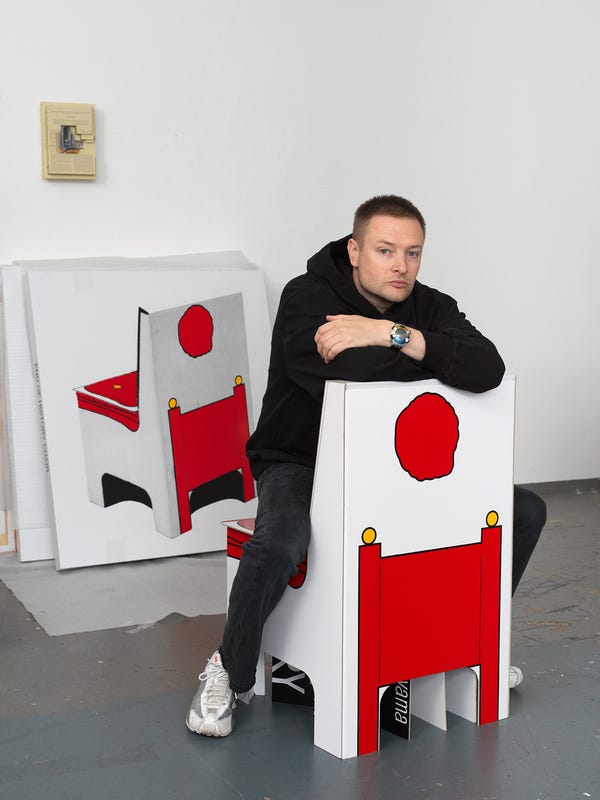
On the earliest acceptable day of January this year, in the early afternoon, the bare resemblance of sunlight we get in Berlin at this time of the year disappearing by 3pm, I made my way through iced pavements to the studio of Simon Denny in West Berlin.
Simon Denny is an artist known for artworks that unpack stories about technology and its relationship to power, contemporary culture and aesthetics. Using a variety of media - from painting to installation, print, sculpture and video - his work is shown widely at the world’s major art institutions such as MoMa PS1, Serpentine Galleries and the Venice Biennale. Denny is also a Professor of Time-Based Media at HFBK Hamburg (since 2018) and, in 2025, was recognised as a Member of the New Zealand Order of Merit (MNZM).
All that is to say that I’ve admired Simon’s work for a long time and believe it is urgent to the times we live in. Once I step inside the studio the busy whirl of plotters welcomes me. Thanks to the “Shenzhenification” of the world, as Denny calls it — a shorthand for the newfound affordability of cutting-edge technology that was out of reach for people like us before — a robot arm is working away while we greet each other, meticulously tracing generated patterns that will become one of the paintings Denny will exhibit at this year’s Venice Biennale. We walk to the next room where multiple stacks of books are resting on a desk: the history of futurism, pre-world war one literature, the biography of Pier Tommaso Marinetti.
Italian Futurism, the artistic and social movement started by Marinetti in the early 20th century, is Simon’s current obsession. Settled into gaming chairs, Simon explains why. We discuss how Marc Andreessen’s “Techno-Optimist Manifesto”, written in 2023 in the run-up to Trump’s second election, references Marinetti and frames technological progress as a moral good; how Denny’s recent exhibition “Forces of the Unknown” uses AI-generated imagery and plotter-painted canvases to draw connections between Italian Futurism and Silicon Valley’s current obsession with defence technology; and how Denny uses AI as an artistic tool and sees the role of the artist in this context.
(or listen on Spotify, Apple etc. by searching for “The Culture & Technology Podcast")
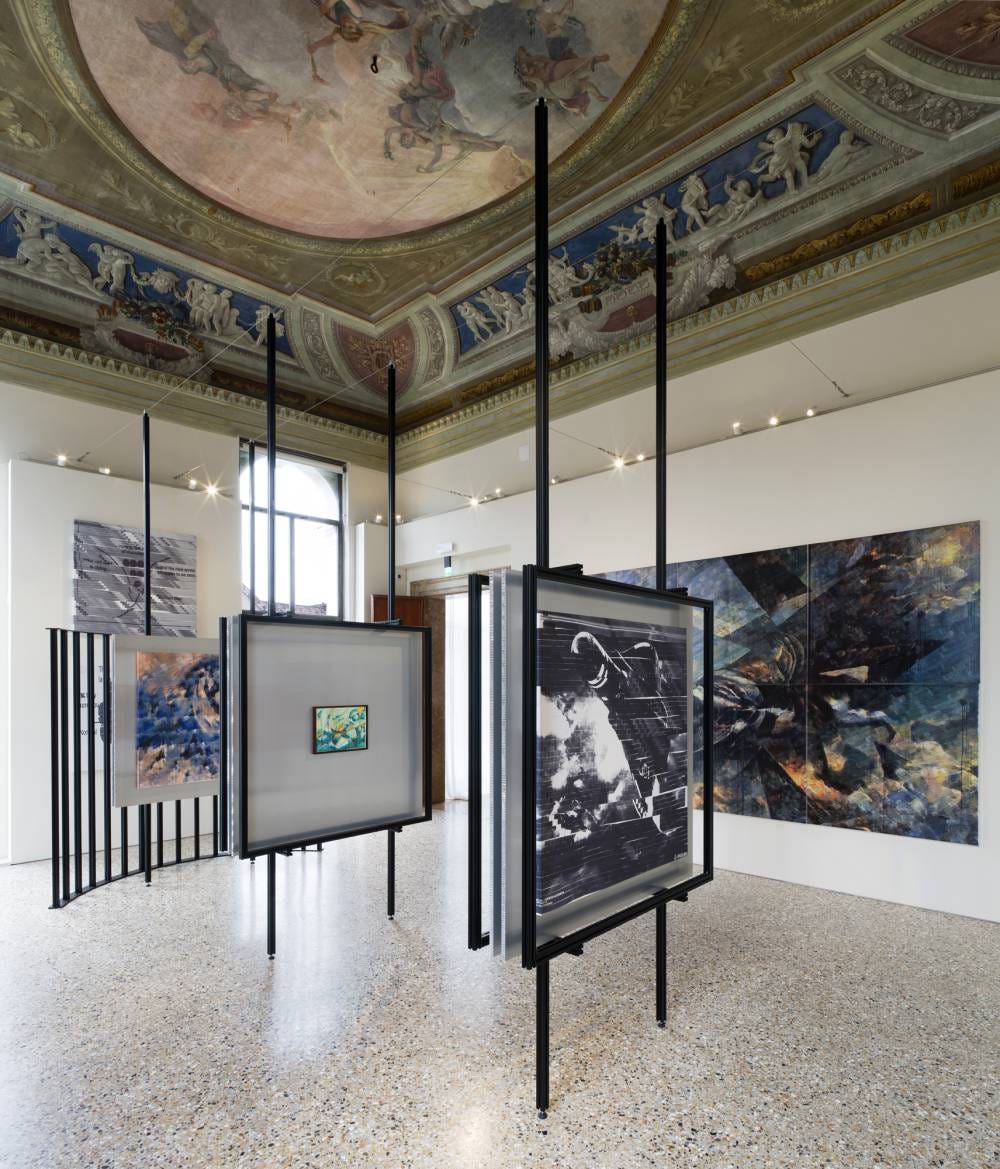
A lot has happened since our conversation earlier this year: Simon’s work was part of STRANGE RULES, the exhibition curated by Mat Dryhurst, Holly Herndon, and Hans Ulrich Obrist with Adriana Rispoli at this year’s Venice Biennale. Much like we discussed the process of working with generated art and automated plotters to create an artwork, the exhibition introduced the concept of Protocol Art where the artwork is not merely a final product, but the result of a process governed by instructions.
Preceding that exhibition, Denny laid out many of the ideas we discussed in the podcast in an article for ArtForum titled Epic Fury: The Dark Art of Defense Tech. An essential read if you’re interested in the context of the current moment where ideologies merge with aesthetics and VC-backed startups creating the military industrial complex of the near future.
Speaking of AI, the article “What is Post-AI Art?” from November 2025 is also a recommended read and has inspired some of the questions I was discussing with Simon in our conversation.
This is episode 3 of this season’s The Culture & Technology Podcast, created in collaboration with Vienna Business Agency.
No posts
Comments
Nothing yet. Say the first thing.
Sign in to join the conversation.