
Brief Clarification after the fact:
Something that I wish I would’ve communicated better, which I did say more or less in the essay, is that myself and Connie certainly believe that the argument extends past what it means to straight men and absolutely includes LGBTQ+ people. But that, despite not being the focus of this particular video from her, Elijah and David’s culture war informed response stopped them from being able to receive even the part of the argument that I think they should have agreed with that this particular video and essay was about.
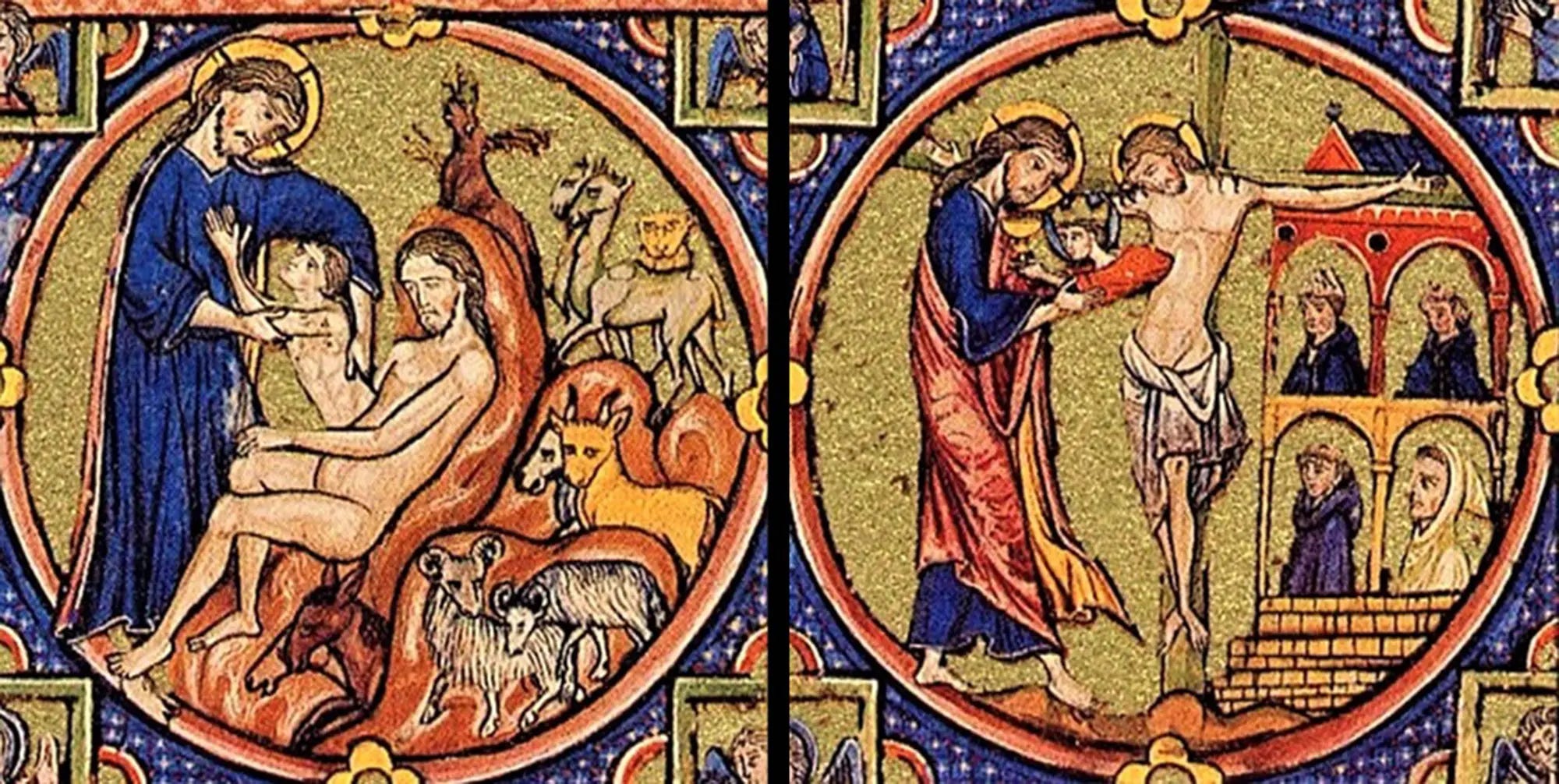
This week I had friends make a video critiquing another friend, and for a guy who really likes having friends and would prefer everyone else be friends too, that sort of thing is always a little stressful for me.
Everyone involved is somebody I like. Nobody here is a grifter. Nobody is arguing in bad faith. Elijah Lamb and David Latting clearly believe they are protecting something beautiful in Scripture from an interpretation that reduces it. I take that seriously and I have made the same defensive move myself about things I loved. I’m kinda doing it right now.
But this disagreement sits on top of some of the most interesting questions in Christian theology… what a metaphor is allowed to do, whether earthly marriage explains the union of Christ and the Church or participates in it, whether male and female belong to the eternal nature of humanity, who is permitted to discover new implications in Scripture, and underneath all of it, whether the Spirit is finished speaking through the revelation already given in Christ. And I couldn’t help but feel like we could all benefit from hearing these questions out.
So let me spill the tea.
My friend Connie Chen, a brilliant Harvard Divinity School–trained theologian, made a reel that begins:
“Did you know that the Bible ends with men in wedding dresses? That every man in the church is already in a queer marriage with Christ?”
From there she moves quickly… because it’s a reel. She talks about how the Old Testament repeatedly portrays God’s relationship with Israel as a marriage, and Israel includes men. And how Ephesians 5 identifies the union of husband and wife with the mystery of Christ and the Church. Finally, she points out that Revelation closes with the marriage supper of the Lamb, where the Bride is the New Jerusalem and every male believer is included within her.
The reel was promoting a longer essay on her Substack, that you should absolutely subscribe to, called Holy Shit. In the essay Connie argues that bridal identity is part of the grammar of salvation, and that this should do something to Christian men. A man who knows himself as Bride learns receptivity, surrender, tenderness, and covenantal intimacy. He can receive care without shame. He can stop calling domination protection and emotional withholding strength. He can desire closeness with other men without constantly investigating whether tenderness threatens his masculinity.
The essay ends with her saying,
“The male wife receives care without shame, desires tenderness and surrender and intimacy with other men. The male wife does not become less straight. The male wife becomes less compulsory.
The male wife is free.”
In response, Elijah and David, who are two of the smarter and more good faith conservative Christian content creators out there, made a somewhat harsh reel reacting to Connie’s video saying that they don’t think hers is an honest reading of the text. They argue, more or less, that Connie has made three mistakes. First, the Bride is the corporate Church, not each individual Christian man. Second, the union of Christ and the Church is an analogy drawn from male-female marriage, and Connie is illegitimately importing modern categories into an ancient image. Third, she has sexualized a spiritual metaphor, stopping at what Elijah calls its “fleshiest part” instead of seeing through the image into the greater divine reality it describes.
Underneath those objections is a larger theory of interpretation. Scripture, they argue, has thousands of years of accumulated meaning around it. It cannot be treated like “Play-Doh”, reshaped around contemporary culture, or made to say something new simply because a modern reader finds the new meaning compelling.
Put together, that sounds like a coherent case. The problem is that the entire argument begins with a misreading of their own. They hear the word queer and translate it almost immediately into sex.

Across their video, Elijah and David respond to Connie with phrases like “human sexual relationship,” “post-sexual-revolution views of love and eroticism,” “modern sexual categories,” “sexualization,” and “the fleshiest part of the metaphor.”
But that is not primarily what Connie’s video or essay is about. Connie explicitly mentions sexual orientation once, and only to say that being a male wife of God does not have to make you less straight. In this video and essay she does not sexualize the Christ-Church relationship or discuss sex acts. Her argument is about gendered posture, intimacy, power, and masculinity as enforced by our cultural context.
Her operative categories are receptivity, surrender, tenderness, shame, domination, emotional control, receiving care, and intimacy between men.
They accuse her of reducing the metaphor to sex because they have already reduced the word queer to sex.
Certainly the word includes gay, lesbian, bisexual, and transgender identities, and Connie is not hiding that her argument belongs within contemporary queer theology. But in a major stream of queer theory, queer also functions as a verb. To queer something is to expose the instability of an arrangement presented as natural, permanent, or compulsory.
By that definition the gospel queers nearly everything it touches. The first become last. The foolish shame the wise. A crucified criminal is revealed as the Lord of glory. Enemies are loved. The poor inherit a kingdom. Jews and Gentiles become one body. The social identities by which people know who is above and who is beneath are not merely reversed. They are judged from the vantage point of a new creation.
The gospel also changed what it meant to be a man. In the Roman world masculinity was organized around status, mastery, and who occupied the active or dominant position. A free man could sexually use a male slave without any loss of masculine honor, because the slave’s subordination confirmed his power. Paul’s prohibitions cut straight through that. Their effect was to remove a privilege that first-century masculinity had assumed as a birthright… the bodies of people beneath you in the social order were no longer available for your use. That reorganized what a man was, queering the masculinity of their time.
Connie is asking the same kind of question about the Bride. What happens when a man is placed in the position of the beloved, the one being pursued, cleansed, adorned, and drawn toward union? She is not asking whether Jesus is entering millions of separate sexual marriages with Christian men, but what it means for a man to participate personally in a corporate identity that Scripture represents as feminine and bridal.
The deeper charge underneath their whole response seems to be a conviction that Connie’s insistence, that the metaphor should inform our gender expression, is a modern imposition on a tradition that has always treated not only the biological distinction between male and female, but also the social roles society places on them, as fixed and eternal. The problem with that is it’s just not the whole story. Two of the most important voices in the tradition point the other way. Gregory of Nyssa distinguishes humanity’s creation in the divine image from the later division into male and female. For Gregory the Image of God itself is not sexed, because God is not sexed. Maximus the Confessor picks up Gregory’s point and goes further, insisting that in the eschaton the division between male and female is one of the five divisions Christ overcomes in creation on the way to deification.1 Maximus says that Christ:
“drove out from nature the difference and division into male and female,” a difference “which He in no way needed in order to become human, and without which existence would perhaps have been possible. There is no need for this division to last perpetually, for in Christ Jesus, says the divine apostle, there is neither male nor female.”
I have written about this in greater detail in another essay you can find here, so I wont say too much more about it. But, For clarity sake let’s hear from Maximus on this one more time. The human person, he says, is meant to reach God by “completely shaking off from nature the property of male and female, which in no way was linked to the original principle of the divine plan concerning human generation.”
Maximus has no concept of queer theory, no category of sexual orientation, nothing of our debates. But when he says the division of male and female is something Christ heals rather than perfects, and that the human being of the age to come is neither male nor female but simply human, he is saying that our present condition is not the last word about who we are. Theosis is God drawing the whole human person past the divisions we now take for fixed, until in the end the division itself is gone. If you want a contemporary word for a reality that will not sit still inside the categories we treat as natural and final, queer is not a bad one.
Neither of these church fathers was writing modern queer theory, they didn’t have access to our categories. But both refuse to treat present sexual difference as the eternal architecture of humanity, which is exactly the assumption the objection depends on.
Now, none of this obligates Elijah and David to agree with me and Connie or with Gregory and Maximus. After all the tradition doesn’t speak with one voice. Augustine insists in City of God that women rise as women in the resurrection. That is a real disagreement inside the tradition, and it should be honored as one.
But that’s my point. The accusation that Connie is bastardizing the text with modern sexual ethics and gender ideology, because she is reading a metaphor metaphorically and talking about how it might impact the way men’s masculinity is expressed, has to be either unaware of what Gregory and Maximus argued or pretend they didn’t. The idea that maleness and femaleness are fixed, ultimate, and eternal is not the neutral reading of Scripture or church tradition that a queer reading corrupts. It’s one reading among others that some of the tradition’s most serious minds came down on the other side of. To treat this as a settled door that only swung open after the sexual revolution is to not know your own house.
And just as a reminder, Connie doesn’t even go that far in the video they are reacting to or in the longer essay. She is simply insisting that men being included in the feminine role in the bridal metaphor, should impact the way Christian men live in the world, and explicitly says that this doesn’t have to mean your sexual identity. That Christian masculinity cannot be identical to secular masculinity because the Gospel queers us from worldly categories, we are a strange and peculiar people. Or at least we are supposed to be.
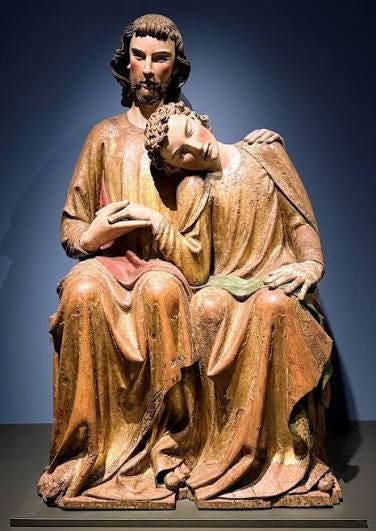
Elijah begins his response here:
“First of all, I am not the bride of Christ. I am not married to Christ. Christ is not my husband. We, the church, plural, we will be married to Christ in his coming.”
He is right that the Bride is corporate. Israel, the Church, the New Jerusalem, these are corporate identities. No individual Christian is the whole Bride. And Connie’s reel does move quickly from “men belong to the Bride” to “you are the wife” without showing every step. Short form content is not always the easiest place to show all your steps, thats why she wrote a longer essay that the video points to.
But corporate identity and personal participation are not rivals in Christian theology. I am not the entire Body of Christ, and Paul still calls me a member of it. I am not the whole temple, and Paul still tells the Corinthians their individual bodies are temples of the Holy Spirit. The corporate reality is what the individual participates in and it is supposed to change us.
That is also how the tradition treated bridal imagery. Origen and Gregory of Nyssa read the Bride in the Song of Songs as both the Church and the individual, and Bernard of Clairvaux preached that identification directly to a monastery full of men 86 times over 18 years, he was kinda obsessed with it.2 The word queer is contemporary. The individual Christian man inhabiting the position of the Bride as a part of the corporate body is not.
So the corporate point clarifies Connie’s language, but it does not defeat her argument. A male Christian is not one of Christ’s millions of separate wives. He personally participates in the one bridal body. The real question is what that participation is allowed to mean.
Elijah explains the analogy:
“The union between Christ and the church is analogous to what we experience down here on earth between men and women in marriage. So no, there is not a queer marriage happening in heaven, but rather the father created humanity as a gift to the son and that we will experience perfect union with Christ and in Christ in new creation such that it mirrors what we call weddings and marriages on earth.”
There is a sense in which the first part is true. We learn through realities we already know. We have been to weddings, so the wedding imagery gives us language for covenant, fidelity, and union with God. That is the direction in which we come to understand the mystery.
But I think Elijah is treating the union as only a metaphor, a picture borrowed from marriage to help us imagine how much God loves the Church, and I think that is a little backwards. Paul doesn’t use marriage to illustrate something alone. In Ephesians 5 he quotes Genesis about two becoming one flesh and says, “This is a great mystery, but I am speaking about Christ and the church.” The word Greek Paul uses for mystery is mystērion, which Latin renders sacramentum, this is where we get the word sacrament. The union of Christ and the Church is not a figure of speech or an illustration about weddings. It’s what the church believes weddings are pointing to. Yes, earthly marriage gives us language for it. But earthly marriage is the sign, and the union with with God in Christ is what the sign participates in and is exceeded by.
This is why the church calls marriage a sacrament and not simply a metaphor. A sacrament is not a picture or representation of an absent thing. It is a real, partial participation in a greater reality, the way the bread is not a prop standing in for an absent Christ that we remember. Christian marriage is a foretaste of a union in which we become one in and with and through Christ. Even still the meal is not fully captured by the foretaste, it nourishes, but it also increases our hunger for it. Kinda like Everette in Oh Brother Where Art Thou telling Delmar that a third of a gopher would only arouse his appetite without having another to bed her back down. Elijah’s framing risks keeping the whole thing safely inside “analogy,” he is making the sign smaller than it is, treating a genuine anticipation of our future in God as though it were a helpful comparison we could set down once we get the point.

The Fourth Lateran Council teaches that between the creature and the Creator no similarity can be noted without a greater dissimilarity having to be noted between them. However much the union of Christ and the Church resembles a marriage, in other words, it is more unlike our marriages than like them. The sign is real, and the reality it signifies overflows it.
I don’t want this to sound like it’s just a quibble over metaphysics or me correcting Elijah for no good reason other than to do it. If the union of Christ and the Church is only an analogy, a picture of something that will happen to us someday, then it makes no claim on us now. We can admire it, look forward to it, and go on being whatever we already were. But if Christian marriage is a real participation in that union, a foretaste we are already tasting, then the union is not waiting for us in the age to come. It has reached back and taken hold of us in the present, and it is already at work changing what we are. Elijah keeps the whole thing at arm’s length by calling it a simple analogy. In doing so he takes the most transformative image in the New Testament, our participation in the very union of God, and turns it into a comparison we can appreciate without being altered by it. That is the real cost of stopping at metaphor. Not that he gets the mechanics wrong, but that he defuses the thing before it can do to him what it is for. Which is why Connie insists that we let the future reality of men being a part of the bride, inform what kind of men we are today. Will the bride prepare herself for her wedding or will she show up looking like a hot mess?
There is one more piece of that sentence worth noticing. Elijah says the Father “created humanity as a gift to the Son.” That is a beautiful line that I have no problem with. But it's a synthesis of several passages about the Father giving a people to the Son, drawn together into a systematic claim… the kind of theology often associated with the Reformed covenant of redemption. I only bring this up to note that Elijah has read a whole systematic structure into the text in the very sentence where he insists that Connie cannot say more about the union than the text explicitly says. He is already doing the thing they are about to tell Connie she may not do.
David compares Connie’s interpretation with Rudolf Bultmann’s program of demythologization and says that Bultmann’s work was a response to the rise of postmodernism. But his history is off by a little… postmodernism wouldn’t be around for a few more decades. Bultmann dropped “New Testament and Mythology” in 1941, responding to modern scientific consciousness and Heidegger, his colleague at Marburg.3 But the real problem is that Connie is doing the opposite of what he describes. She isn’t removing the mythic image. She stays inside it, with its gender, clothing, bodies, and desire. She refuses to let “Bride of Christ” collapse into “God loves the Church very much.” And the accusation David makes, that Connie is forming the text around the culture to make it more palatable, gets the direction backwards. Our culture is at war with itself over sex and masculinity, so there is no single audience to flatter here. What Connie is actually doing is letting the strangest, most mythic parts of the text keep their power to unsettle us, which is the opposite of sanding them down to fit the moment.

David says we cannot treat Scripture like Play-Doh or “read something new into the text.” But Christianity could never have survived on a rule that strict. The examples are far too numerous to list. Paul reads Hagar and Sarah and turns them into two covenants. He points at the rock the Israelites drank from in the wilderness and says that the rock was Christ. Ephesians 5, as we have already read, takes a Genesis text about marriage and makes it about Christ and the Church. And Peter stands up at Pentecost and references the oracle in Joel saying, “This is that.”
Origen, and most of the church after him, read The Song of Songs, a book of erotic poetry about two lovers, as Christ and the Church, a book whose plain sense mentions neither. Gregory of Nyssa did not think he was suffocating the Song by finding the ascent of the soul in it. He thought the Spirit had made it deep enough to say more to us than it does explicitly.
That is the founding hermeneutic of Pentecostalism. As a fourth-generation Pentecostal pastor’s kid I grew up watching preachers read ancient Scripture and declare that the Spirit was disclosing their meaning for this room, in this moment. From what I understand Elijah and David are also Pentecostal, or at least Charismatic. Pentecostals and Charismatics reject cessationism because they believe the Spirit still heals, speaks, and surprises the Church. But a theology in which the Spirit may still heal a body or give a word, yet may not disclose a previously unrecognized implication of the revelation already given in Christ through the Scripture, is just hermeneutical cessationism.
Remember Elijah’s own words about humanity being a “gift to the Son,” a beautiful systematic construction he read into the text. That is how theology works, and everyone does it. It’s not a question of wether or not we can we move beyond the direct wording of individual verses, but whether the movement is faithful to Christ, accountable to Scripture, and able to bear good fruit.
This is why David Bentley Hart describes tradition as apocalyptic. It’s not a settled quantity deposited in the past and handed forward unchanged… tradition is determined by the final unveiling of Christ toward which the Church is still moving. If it were, the doctrinal history of the church would have to be read as a history of corruption, because it’s full of genuine novelty. Tradition is something whose identity is set by an end that hasn’t arrived. Fidelity to it looks like an expectation and openness to the Spirit that is still revealing the mysteries, not mere curation of what has been settled. Christ has been fully given, but Christ has not yet been fully received.
Which brings us to the most revealing moment in the video. Elijah says:
“This recurring biblical description that puts human beings and creation and the church on the feminine side of the relationship with God does not infringe upon my masculinity in any way. I feel like a beautiful little flower in the hand of God. That doesn’t make me feel insecure. I have no problem with that.”
I love that sentence. There are entire denominations where a man could not say he feels like a beautiful little flower in the hand of God without immediately reaching for a joke.
But the sentence concedes almost everything Connie needs. Scripture places human beings, creation, and the Church on the feminine side of the relationship with God. Men are included. The gender role crossing is there. The disagreement is no longer whether a man can inhabit a symbolically feminine position, because Elijah just said he can. The disagreement is what that position is allowed to do us.
Elijah lets the image describe how a man stands before God. Connie asks whether that posture should also reorganize how he stands among other men. Does the man who is pursued, received, and loved as Bride become less invested in authority and domination? Can he receive care without reading it as weakness, or surrender without reading it as defeat, or want tenderness from other men without opening an investigation into whether he is still masculine enough?
What many Christians call biblical masculinity is not a pristine thing carried intact from the apostles into the present. Ancient patriarchy, a century of American breadwinner ideology, and everything in between have contributed to the man many churches now present as timeless. But a modern evangelical man who marries for love, doesn’t own his wife as property, and cannot assert himself sexually onto his male slaves would not be recognizable as masculine in the eyes of a first century Roman citizen. Connie hasn’t added culture to a culture-free reading. But she has exposed that their reading was cultural the whole time. She made the invisible assumption visible. She let the gospel queer our identity on it’s way to being transfigured.
Elijah’s flower is not a refutation of her argument. It’s where her argument begins. The man who truly knows himself as a beautiful little flower in the hand of God should become a different kind of man among other people. I hope he does decide to let the Scripture’s description of him as a part of the bride infringe on his carnal masculinity, and in the little bit I’ve gotten to know him I suspect he already has because he’s a pretty good dude.
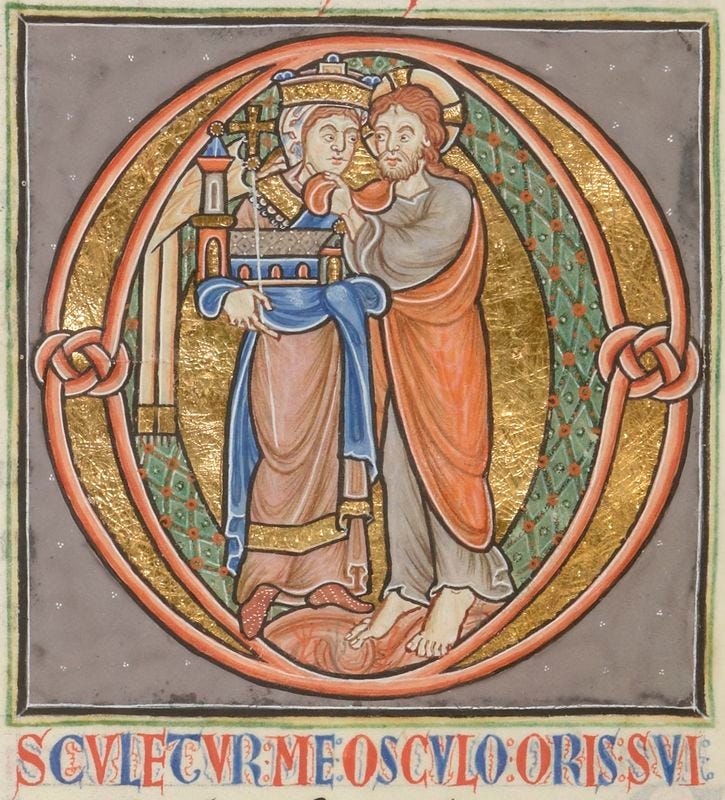
Interestingly, there are a few things the fellas could have disagreed with Connie on that I might have been inclined to agree with them about. For example, “Chosen family” is a warm but imprecise description of a Trinity whose relations are eternal and constitutive of each hypostatic identity rather than a post hoc election made by self possessed individuals. There are 2 or 3 other real points a critic could press in her essay.
Elijah and David do not press them. The missed chance at the Trinity challenge is especially interesting, because Elijah is currently doing really great work on the Trinity, check out his most recent Substack article on it here, it’s a banger. Instead they go after the strongest thing she said and leave the weak things alone. They reject the interesting claim… that men participate personally in a feminine bridal identity, and that this participation might change how Christian masculinity is imagined.
They say she has shrunk something beautiful into a “weak, puny version of the real thing”. But which reading is smaller? One says the bridal image communicates spiritual intimacy with God and leaves our worldly categories of masculinity and hierarchy undisturbed. The other says humanity is being drawn into a union earthly marriage can only partly anticipate and sample where men are scandalously included on the receptive side, that present worldly hierarchies are exposed as provisional, and that masculinity is opened to tenderness and dependence.
David is right when he says in the video that people today hunger for myth, saints, and mystery. But a true myth is not safe decoration. As Tolkien argued to his friend Jack on a late-night walk, and as Jack later put it in his own words, "the story of Christ is simply a true myth: a myth working on us in the same way as the others, but with this tremendous difference that it really happened." It works on us, it rearranges the world, it queers our identities including our masculinity. To refuse to let it is to do the work of demythologizing. Connie’s reel and essay took the image of the Bride and played it at full volume, and it made people uncomfortable, because that is what a living symbol does.
So before we accuse her of suffocating the metaphor, we should sit with the possibility that we have allowed the Bride to breathe only so long as she promises not to change us.
I didn’t write this to “own” Elijah or David. The truth is that I suspect I haven’t really taught them much of anything in this essay, beyond maybe a clarification about the timeline between Bultmann and postmodernism. David and Elijah are genuinely smart dudes who are in seminary themselves. They make great content all the time about a lot of the things I talked about in this essay. It was a recent clip I saw of David that reminded me of the conversation between C.S. Lewis and Tolkien that I used two paragraphs ago. But, I think they made a fundamental yet understandable error by interpreting Connie’s reel to be about sex when it wasn’t, ironically reading things into her text that aren’t there, and inviting, as of the time of writing this sentence, 150,000 people to mock and ridicule her unfairly. And I think that colored their entire commentary, blurring their vision and creating a few errors they otherwise might not have made. This is why before writing this I asked them if it would be ok for me to do so and suggested that their disagreement might be rooted in a misunderstanding.

That being said, I do think there are good reasons to extend some of this into the questions that pertain specifically to LGBTQ+ affirmation. I don’t think the bridal language in Scripture is enough to do all of that on it’s own and I would probably roll my eyes at a video that tried to argue it is. But, I have written other essays about those questions that you can find in my recent posts, so I’m not going to get into it now.
For now, I will leave you with an excerpt from Connie’s essay:
Male wives, you are invited into liberation
The Church taught men to read Ephesians 5 as a job description: Husbands, love your wives, lead your households, be the head. But the text stops mid-argument to say that it points to somewhere else, to Christ and the Church, to a bridegroom and a bride.
How do you become who scripture already says you are? Man, you were always the wife. You were always the beloved, the one God is proposing to.
A husband who knows himself as a wife stops performing the script of stoicism, authority, and emotional control. The male wife can no longer call domination and control protection, can no longer call withholding strength. The male wife loves from proximity instead of distance, not to secure an investment, but to risk being changed—loving like the shore that cannot keep the waves. The male wife receives care without shame, desires tenderness and surrender and intimacy with other men. The male wife does not become less straight. The male wife becomes less compulsory.
The male wife is free.
Thanks for reading Kensington Koan. If you like what you read, or hate it enough to want to keep tabs on me, please consider subscribing to get my new posts sent directly to you. They are all free for the first 6 weeks. After that the full archive is available to paid subscribers. If you became a paid subscriber, it would really help me to keep producing this work. If you really want access and $8 a month is just too much right now (trust me I’ve been there most of my adult life), send me a direct message and we will work something out. <3
If you want to check out any of the books I recommend in my content, consider purchasing them through my Bookshop.org store instead of Amazon. You can choose a local bookstore to support with your purchase and help support my content as well.
https://bookshop.org/shop/coltenbarnaby
Sources Cited and Consulted:
On the church fathers reading the Bride as both the Church and the individual soul: Origen’s Commentary on the Song of Songs starts the tradition, and Gregory of Nyssa’s Homilies on the Song of Songs (trans. Richard Norris, SBL, 2012) carries it forward. Bernard of Clairvaux’s eighty-six Sermons on the Song of Songs are where a man preaches it directly to a room full of monks.
On sexual difference in the age to come: the Maximus passages are from Ambiguum 41, in Nicholas Constas’s translation (On Difficulties in the Church Fathers, Harvard, 2014). Gregory of Nyssa’s On the Making of Man (ch. 16–17) is where the divine image comes apart from the male/female division. I worked through all of this at much greater length in my earlier essay.
On women rising as women: Augustine, City of God 22.17.
On the greater dissimilarity between Creator and creature: the Fourth Lateran Council (1215), Canon 2.
On Bultmann: the lecture is “New Testament and Mythology” (1941). David Congdon’s “Demystifying the Program of Demythologizing” (Harvard Theological Review, 2017) is good on why it wasn’t the crude myth-deletion project it’s remembered as.
On tradition as apocalyptic: David Bentley Hart, Tradition and Apocalypse (Baker Academic, 2022).
On queer as a verb rather than an identity: the framing traces to David Halperin, Saint Foucault (Oxford, 1995), and gets worked out theologically in Gerard Loughlin, ed., Queer Theology (Blackwell, 2007). For the patristics-and-gender material Connie and I are both drawing on, Sarah Coakley’s God, Sexuality and the Self and Eugene Rogers’s Sexuality and the Christian Body are both worth reading.
On Roman masculinity and sexual status: Craig Williams, Roman Homosexuality (Oxford, 2nd ed. 2010).
On the “true myth” line: it’s C.S. Lewis, from his October 18, 1931 letter to Arthur Greeves, recounting the late-night Addison’s Walk conversation with Tolkien and Hugo Dyson. Humphrey Carpenter’s J.R.R. Tolkien: A Biography reconstructs Tolkien’s side of that night.
Comments
Nothing yet. Say the first thing.
Sign in to join the conversation.