
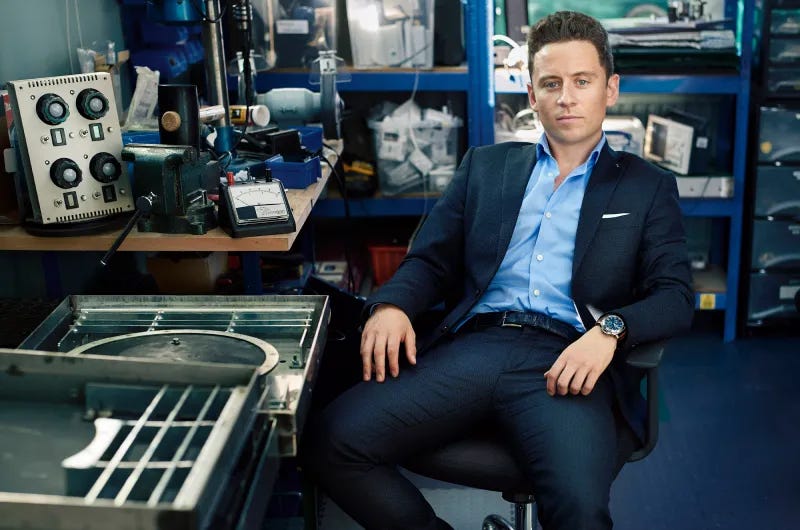
Laurence Kemball-Cook believes in the power of people.
Not in a cringey, kumbaya-esque, “let’s all hold hands and change the world” kind of way—at least not only that. He believes in human beings’ literal power: the potential to harness kinetic energy from human movement to generate electricity.
That may sound like a vaguely wild notion; perhaps like something the AI overlords might use humans for once they’ve taken over. But, if that’s the case, you probably aren’t familiar with the company Kemball-Cook founded, and where he serves as CEO, Pavegen.
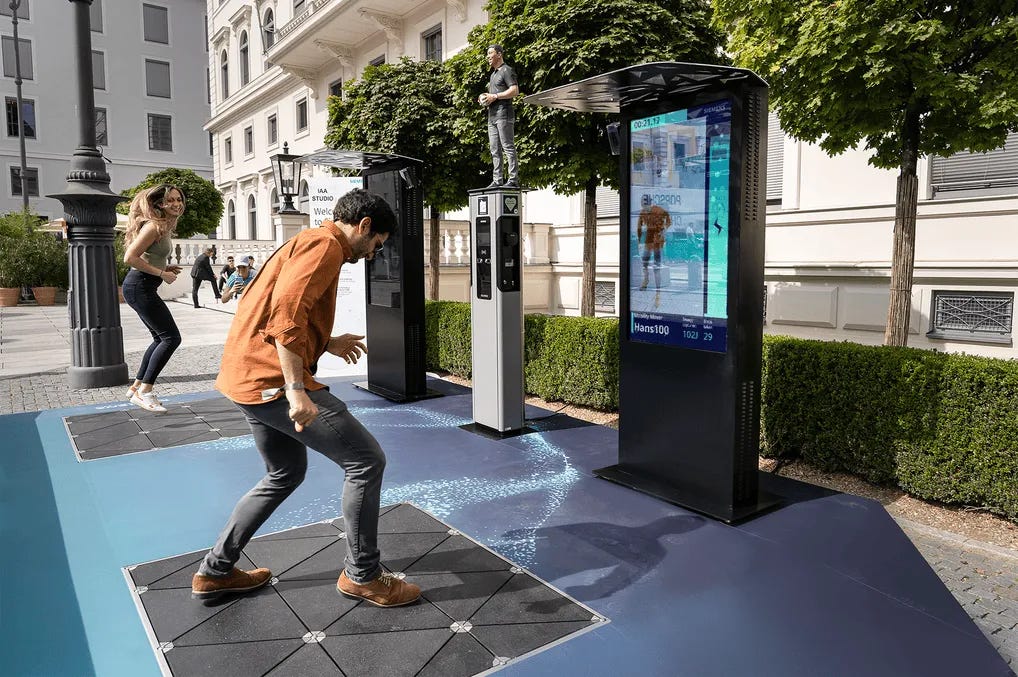
We’ll cover the intricacies of how Pavegen’s technology works and its diverse array of applications in a future installment of “It’s Ingenious,” our vertical devoted to such innovations. But to give our loyal readers a quick preview: Pavegen installs tiles connected to electromagnetic generators in building floors, sidewalks, and other locations. Each step on a Pavegen tile causes it to move downward by 10 millimetres; that vertical motion is converted into rotary motion and then transformed into electrical potential energy through electromagnetic induction.
Deep breath. Everyone got that? That’s a bit more technical than we generally like to get in an Essential Eight.
Now, that energy can then be used to power everything from LED lighting to phone chargers, among numerous other use cases. The environments in which Pavegen tiles are installed cover everything from office properties to running tracks. To date, they’ve completed more than 250 installations in 37 countries.
In his Essential Eight interview, Kemball-Cook explained the inspiration behind Pavegen and touched on numerous other topics, including how to gamify sustainability and the possibly illegal methods he employed to complete his inaugural installation.
How did you initially get involved with the real estate industry?
I’m an industrial design engineer and I was asked to work at the largest energy company in Europe. When I was there, they said to me, “Laurence, find us a new form of sustainable power in cities.” So, I started the journey looking at solar in cities, looking at wind in cities, and it didn’t work. And the reason it didn’t work is that wind worked great in a field on top of a mountain or in the sea, but it doesn’t work well in dense urban environments. And solar worked particularly well in the desert on these huge flat areas and on huge rooftops, but not necessarily in dense urban areas.
So, I kept thinking about this problem. Then I got fired, and I still kept thinking. And I said, “Well, if I can’t use the sun, and I can’t use wind, what about I use an energy source that’s literally all around us right under our feet?” And that was how the idea that generating kinetic energy could make a difference on this planet was born. That’s when I started the company and started developing the technology.
I used to break into building sites in my evenings and illegally install the technology in the ground to show that human power could actually make a difference.
When everyone wouldn’t believe me, and said, “It’s not possible.” I was like, “Well, it’s working outside your office right now. Take a look.” And then they could see it. You probably would get in a bit more trouble in America than England for doing that. I was lucky I was in London because people don’t mind that kind of thing. But that’s how we got to the first proof point in our technology.
What’s the most unexpected aspect of how your career has evolved?
Initially Pavegen was engineered as an energy product for cities, but then I realized after installing it in the city that people love walking on our product. I saw old ladies jumping up and down there with small children. I saw kids in schools running up and down the corridor having fun.
I realized that I created the gamification of energy. And that was a huge pivot for us. Because initially we were all about energy, and then we pivoted and we realized that the most important thing about sustainability in cities is people. People, people, people. We need to build for community, not for technology. And Pavegen is a key tool now at bringing people together around urban spaces— helping them have fun, helping them connect, helping them share emotions. And that’s been a big shift really from what I initially set out to do that was based on how people reacted to the product.
What advice would you give to someone entering the industry today?
I think the emphasis is on the word “today.” So, I think the world’s changed a lot and I think that people need to be really advanced users of AI on a professional level. I think that’s really vital, and it can really help you get ahead.
Never before has a building been like a piece of software. You can plug into a building and connect to it. And so I think using and understanding these technologies is really critical. And then, above all else, I think it’s never take no for an answer and keep hustling. Whatever you do, hustle to meet people, hustle to get to where you need to get to, because that’s what I had to do to start Pavegen.
What has surprised you most about how the built world and the real estate industry have changed since your career began?
I think that cities used to be built by banks to make money, and it was about how many floors they could put in and how much yield they could generate. But that’s really changed.
Now people are more interested in creating places that people want to spend time in. They want to create these beautiful environments. Think about some of the Thomas Heatherwick structures in New York and the beautiful places that people want to come together in. And there’s this real emphasis on smart buildings, connected environments that are beautiful.
I think we’ve seen community projects really becoming more important because COVID proved that no one wants to live in cities if there’s nothing to do there. We all had this shock where everyone decided to leave the city. So, we need to make cities fun again and make cities places where people really want to spend time.
A good example is Canary Wharf, the financial capital of London. It was a whole lot of concrete. And a couple of years ago they redeveloped it to be like a green oasis because they realized people don’t want to be surrounded by concrete every minute of every day. Sometimes, they want to be surrounded by a rainforest, and effectively that’s what it is now. I think that’s a really insightful development where people are being put higher up the priority list. It’s not number 10 anymore. People are pretty much number one, I would say.
What’s your favorite aspect of working in the real estate industry?
I think of all the industries, real estate is one that has an impact on everyone’s life. No matter who you are, what you do, what part of an organization you’re in, everyone has an opinion about it and everyone experiences it. We all know what it feels like when a friend complains about being too cold because the AC was on all day, or being too hot in summer. It just touches everyone, whether or not they are directly involved, because everyone’s got a different experience that they want to share about what real estate means to them.
What’s your least favorite aspect of working in the real estate industry?
Sometimes it’s quite slow. Things take years and years—even decades. Obviously you can’t build a tower block in New York in a week—it’s a slow process. And with Pavegen, we are not the first thing to go in. You need a foundation to go in, you need flooring finishes to go in, and then you need Pavegen. It just takes a long time. That’s what frustrates me. But it is what it is.
What do you think is the biggest challenge facing the industry today?
I think it comes back to my earlier point, that COVID showed that people don’t really want to live in cities. And so we are seeing a massive shift in the way people are consuming cities. A lot of people would prefer to live outside of a city and commute in. Not as many young people want to buy properties in cities anymore and have all that debt, especially with high interest rates.
I think there’s a reorganization of urban spaces going on. We’ve all heard stories of these tower blocks being sold for next to nothing because they don’t have a need anymore and being repurposed as we-live style solutions. I think there’s a complete reorganization of the urban stack as we know it. There’s been 30 years of work that is now being reprogrammed to work for how people want to live and work now.
Some of my friends in the UAE and America joke that everyone in the UK sits in a shed because everyone’s building these garden sheds. All these consultants are sitting there and he’s like, “All I do is speak to guys and they’re in sheds.”
That’s an example of how cities are changing: everyone sits in their gardens working rather than the tower block.
So, a reorganization of the fundamental DNA of what constitutes a city is happening.
What makes you optimistic about the future of the built world?
Sustainability is not going anywhere. Sustainability is still a critical aspect of our future cities. And we’ve created a really unique way to connect people to sustainability using the power of a footstep. One footstep can now power lights in the entrance of your building, and can now be stored in batteries to be used at a later date.
The effects of global warming are real.
I sit here right now in a heat wave in London. I’m sure there’s all sorts of examples in America right now of climate change issues affecting people, especially things like wildfires. So, I guess I’m optimistic that sustainability will be more baked in from a carbon perspective into new builds and new developments, despite maybe the tailwinds of our friend, Mr. Trump, not necessarily fully supporting it. CEOs still make their own decision, and I’m really optimistic about the sustainability investments being planned over the next five or 10 years.
This interview has been edited for concision and clarity.
Comments
Nothing yet. Say the first thing.
Sign in to join the conversation.