
I read a stat this week that stayed with me. “The most plugged-in workers are now interrupted every 2 minutes during the workday.” Whoa…2 minutes! Y’all, that adds up to around 275 times a day.
And it’s exactly what I keep hearing from the leaders I coach. They have never had more information. Live dashboards, real-time metrics, a Slack that never sleeps, updates from every corner of the business at every hour. Yet, it’s not helping them to see things more clearly.
A few weeks ago, one of them put words to it. “I have never had more data, and I have never felt more behind.” She didn’t need another dashboard, she needed some space to think.
This is not a personal failing, as easy as it is to treat it like one. Our environments are built to prevent us from thinking. And the numbers are worse than we admit:
68% of people say they never get a single stretch of uninterrupted focus
People short on time and energy are 3 ½ times more likely to struggle with strategic thinking
Here is what I have come to believe. The pace we’re in today, floods us with signal and starves us of the time to make sense of it. Leaders don’t fail because they missed the signal. They fail because they made sense of it too late.
Neuroscience shows us why it feels physical. If you run flat out day after day, your brain slips into a low-grade fight-or-flight. That’s useful for a sprint but harmful as a way of life. In that state, your attention narrows to whatever is loudest, and the part of your brain that turns information into judgment goes quiet. You cannot make sense of your world while SPRINTING through it.
AI isn’t going to fix this, it is pouring fuel on it. It’s extraordinary at multiplying the signal. Every tool that makes work faster makes more of it…more output, more updates, and more to react to than any human can absorb.
And meaning is the one thing it cannot hand you. Sense-making still comes from a person who stops long enough to ask… “What does all of this actually mean?” And that is precisely why it’s so important to build pauses into your day. The pause is the switch that turns your thinking back on, and the moment signal becomes meaning. It’s also how you climb out of the current long enough to see the whole system you are in, instead of being swept along inside it.
When I watch leaders use a pause well, three moves are happening:
Shift. Change your state, not your calendar. You cannot think while you are still reacting, so the first move is to get out of reaction mode. Sixty seconds is enough: stand up, take a breath, step out of the room, and let your body register that nothing here is actually on fire. The point is not to relax, it is to get your thinking back online before you use it.
Scan. See the system, not the symptom. At full speed, you only see the loudest thing in front of you. A pause pulls you up out of the moment so you can see the whole system it sits in, the people, the pressures, the incentives, the history actually shaping it. What is really going on underneath the thing shouting for attention?
Steer. Find the lever. Once you can see the system, the question changes. It is no longer, “What do I fix first?”. It is, “What is the one thing that, if I moved it, would make everything else easier?” That is the difference between getting swept along in the system and actually changing it.
A pause can look many different ways. Sometimes it is sixty seconds before you reply, fifteen minutes a day to reflect, thirty minutes to map the system or name the real problem, or a full day to step back. The size depends on the stakes. And the most important pauses are often not solo acts. They are the ones you take with your team, so a whole group stops reacting and starts seeing the system together.
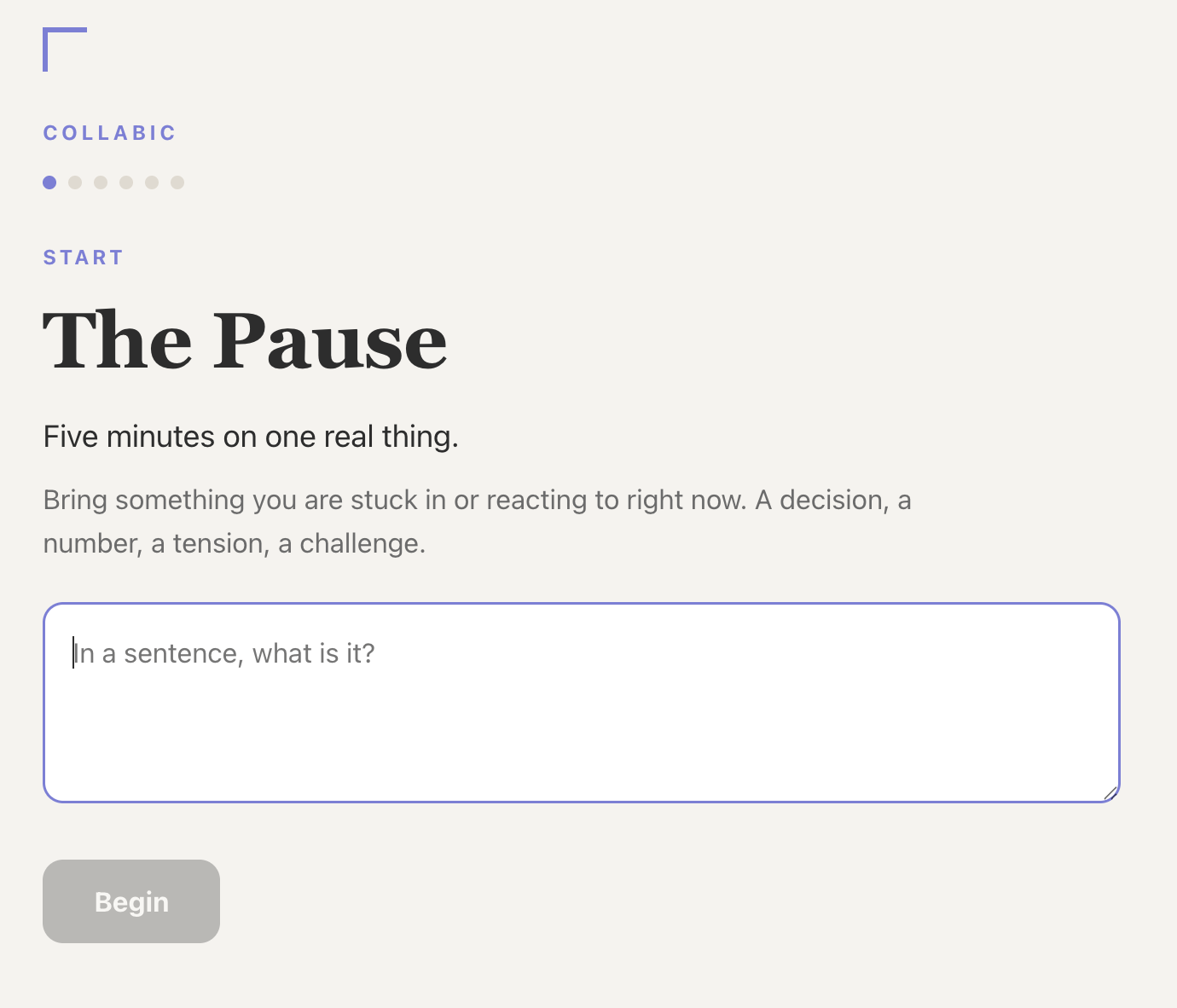
Want to give The Pause a whirl? Spend 5 minutes on one real thing you are stuck on, and it walks you out of the reaction, up to the system, and down to the one lever that moves it.
Try it here
Before you go, one last number… In a Harvard study, people who spent 15 minutes each day reflecting on what they had learned performed 23% better than those who did not. The others were not slacking, they spent those same fifteen minutes working, and still fell behind.
The most impactful leaders aren’t sprinting 100% of the time. They know the pause is what makes the sprint count.
Collabic helps leaders and teams keep moving while protecting the thinking their work depends on. Find us at www.thecollabic.com or Hello@ the collabic
Sources
Microsoft, Work Trend Index Special Report: Breaking Down the Infinite Workday (2025).
Microsoft, Work Trend Index: Will AI Fix Work? (2023).
Gino, Pisano, Di Stefano, and Staats, Learning by Thinking: How Reflection Aids Performance (Harvard Business School, 2014).
Comments
Nothing yet. Say the first thing.
Sign in to join the conversation.