
In my last article I talked how governments could respond to the fuel crisis as a result of the Trump-Netanyahu war on Iran. In this second instalment I want to point out how the recent Federal Government budget missed a couple of very good opportunities to reduce Australia’s vulnerability due to reliance on overseas-produced fuels and to cut our greenhouse gas emissions.
Fuel storage or fuel demand reduction?
The recent budget established a $3.2 billion government-controlled Australian Fuel Security Reserve, to hold around 1 billion litres of diesel and jet fuel. Could that money have been better spent reducing our demand for diesel instead?
What if the government had directed that $3.2 billion towards subsidising the introduction of new electric trucks? Let’s look at the figures.
One of the biggest and fastest growing electric truck brands is Windrose. Its long-haul semi-trailers cost $450,000 and can haul up to 49 tonnes (a new diesel truck of a similar size could cost up to $350,000).
To make these new electric trucks more affordable and encourage uptake, a government subsidy of $200,000 could be offered. At that level of subsidy, the $3.2 billion spent on the fuel reserve could see 16,000 new electric trucks on the road.
Diesel semi-trailers travelling 100,000km per year (quite common in Australia) use about 50,000 litres of fuel. So, replacing 16,000 diesel trucks with electric trucks would save 800 million litres of diesel.
It isn’t clear how much of the 1 billion litres to be stored in the Australian Fuel Security Reserve will be diesel and how much jet fuel, but we can presume that the 800 million litres saved through the electric truck subsidy is more than is to be stored in the fuel security reserve.
We might think that the $200,000 subsidy is too high, and that it need only be $100,000. That may well be enough for many trucking companies to switch over to electric vehicles. In that case, we can double the amount of diesel saved to 1.6 billion litres.
Clearly the benefits from reducing diesel consumption far outweigh the benefits of increasing storage. But there would be further benefits from the subsidy program for electric trucks. Improving the uptake of the trucks would help to drive down their price, leading to even more uptake and even more fuel savings. Reducing diesel pollution would improve Australia’s emissions performance, given that transport emissions are continuing to rise and are likely to be the nation’s biggest source of greenhouse pollution by 2030. One quarter of those transport emissions are produced by long-distance trucks.
Particulate pollution from diesel burning causes significant health problems, including cancer. Reducing its use would reduce the health costs to individuals (including truck drivers), communities and health systems. Truck noise, which is a major problem in built-up areas, would be greatly reduced. This, too, would be a real benefit to drivers.
Without the cost of fuel, electric trucks could deliver goods more cheaply, reducing cost pressures throughout the economy and relieving inflation pressures.
Wouldn’t it be good if our governments could think a little laterally and stop automatically defaulting to a policy of protecting the fossil fuel industry?
It’s time for a national strategic shipping fleet
For many years, Australian unions warned about the risks of allowing domestic fuel refining infrastructure to be closed. The MUA also warned about the dangers of an island nation essentially eradicating its own national shipping fleet.
We seem to have learned few lessons. We must wean ourselves off fossil fuels, so rebuilding a sovereign oil refining capacity is probably largely now a waste of time and resources. Those resources would be far more gainfully employed reducing demand for polluting fossil fuels, as I describe above. The best way to reduce exposure to the geopolitical risks and price shocks associated with fossil fuels is to reduce reliance on them. But we do have to rebuild a sovereign shipping capacity, not least because moving to a fully renewable energy system will depend on it.
What, you may ask, do ships have to do with renewable electricity? Offshore wind. There are plans to build offshore wind farms off several parts of Australia’s coast, starting in Gippsland. Offshore wind is an important part of the energy transition. It has many benefits. It is not hampered by conflict with other land uses. Its capacity factor – that is, the amount of its capacity that actually gets used in real life – is higher than onshore wind; because of the reliability of offshore winds, electricity generated by offshore wind farms is less intermittent than onshore wind or solar farms. Its generation profile – when it is producing most effectively – is perfect, especially in Bass Strait, for hot Australian summers. Wind speeds off the Gippsland coast reach their optimum levels just when solar farms are starting to shut down on those hot summer nights when air conditioners, TVs, cooking and other household appliances are creating spikes in peak demand. The scale of offshore wind farms can be enormous. The Victorian Government’s offshore wind target is 9GW by 2040, more than the capacity of the state’s remaining three coal-fired power stations. Offshore wind, in both construction and operations phases, will be a good source of skilled jobs, and an excellent opportunity for offshore oil and gas workers to transition into.
To build offshore wind farms requires specialist vessels, including jack-ups, which jack themselves up off the ocean floor during the installation process. There are currently fewer than 20 such vessels capable of installing the new, larger turbines in the world. Growth in the offshore wind industry, especially in Asia and Europe, suggests the need for around 200 of these vessels by 2030. Getting hold of a jack-up ship will be a major challenge for Australian offshore wind developers. The demand from big players in other parts of the world is strong, and support for the Australian industry, especially by the Australian government, has been tepid. The cost to charter them is, accordingly, high, and if you’ve booked one for months and then find that poor weather conditions interrupt turbine installations and the ship sits around doing nothing for an extended period, you lose a lot of money.
The obvious solution to this, especially if Australia wants to turn offshore wind into an industry with wider benefits in the development of local manufacturing capacity, rather than a series of one-off developments reliant on overseas equipment, production and expertise, is for Australia to acquire its own installation vessels as part of an Australian strategic fleet. Unions have been calling for this for years. So far the calls have fallen on deaf ears at Commonwealth level.
Once again this demonstrates how skewed government priorities are. We can afford to spend hundreds of millions of dollars to improve US submarine building capacity and create jobs in US shipyards, and spend billions more on submarine facilities in Australia. Yet no-one thinks it worthwhile to order a ship or two that would enable us to develop our own offshore wind industry, providing platforms for skilled seafarer work and giving the industry greater independence from global supply chains.
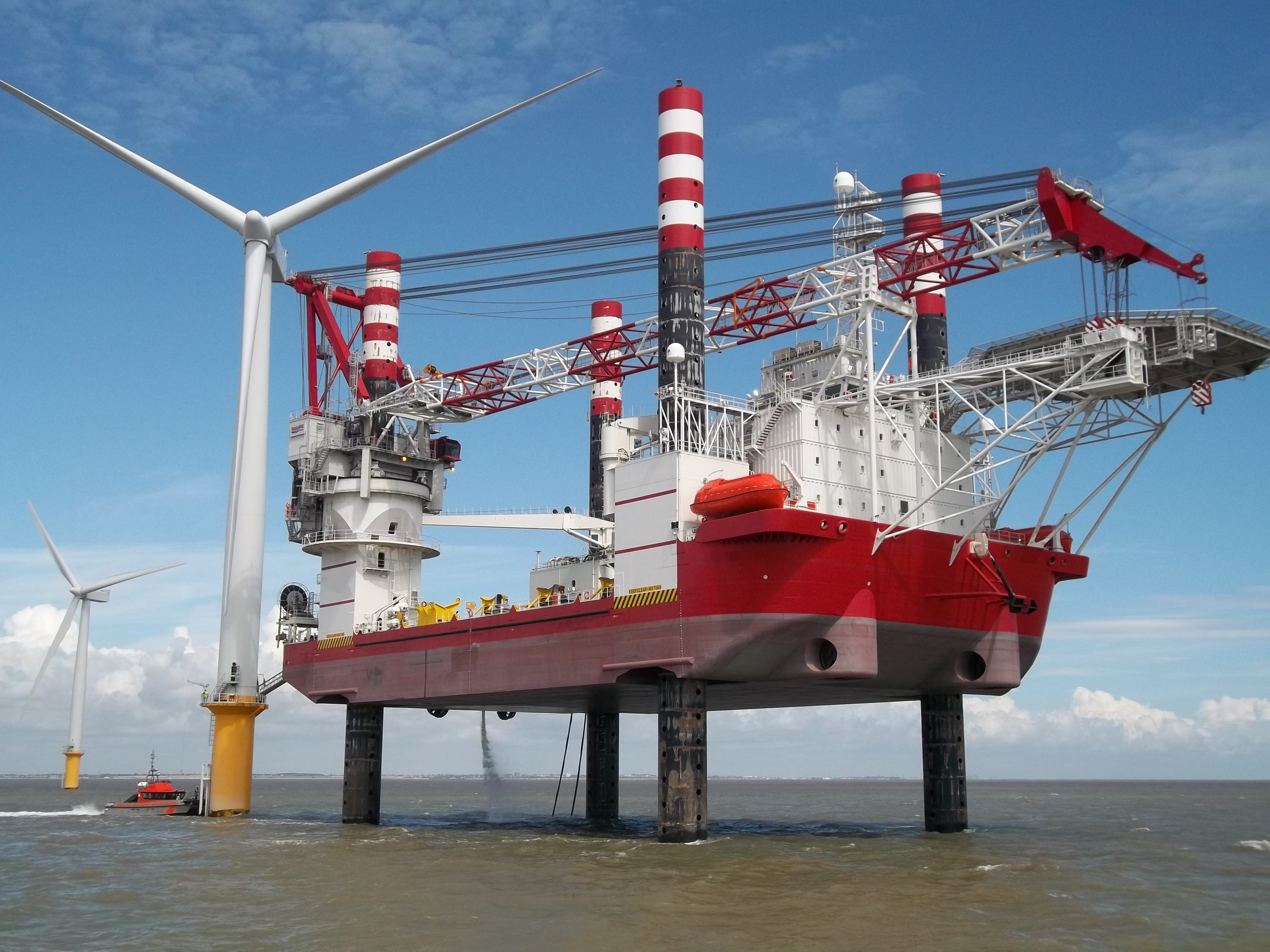
A jack-up ship installing offshore wind turbines. Image: Italgroup
Comments
Nothing yet. Say the first thing.
Sign in to join the conversation.