
The Australian Federal and state governments have been put in an invidious position by the Trump-Netanyahu attack on Iran, although decades of home-grown efforts to undermine our own fuel and shipping sovereignty certainly contributed to making Australia so vulnerable.
There has been a variety of responses to the crisis by our governments. Mostly these have involved efforts by the Commonwealth to reduce the price of fuel and by some state governments to make alternatives to car usage more attractive.
The Commonwealth’s efforts have largely consisted of attempts to ensure that the effects of the Trump-Netanyahu crisis have as little impact on existing fuel and energy use patterns as possible. Efforts to secure fuel supplies from Asia have been necessary and welcome. Cuts to fuel excise are designed to take the edge off the big price increases caused by the US-Israeli aggression. An advertising campaign has encouraged individual motorists to be “responsible” in their use of fuel.
The Commonwealth’s approach, then, has been a combination of an emphasis on individual consumer responsibility and a determination to manage the effects of the crisis without any concerted effort to change the nation’s reliance on fossil fuels. To be clear, fuel prices are a major challenge to household and business budgets and some government action was required to ameliorate the price shock. But it is odd that a government that is otherwise so committed to market forces and market-set prices in everything from electricity to housing decided to intervene to try to reduce prices for liquid fuels. According to market advocates, prices are determined by and crucial to the management of supply and demand. An interruption to Australia’s fuel supply drives up prices. This in turn should reduce demand. Ordinarily, according to the theory, it would also encourage new entrants to the market, attracted by the high prices, and this new capacity would eventually drive down prices. This doesn’t apply in the case of oil as the limitations on new entrants in the Australian market – the cost of new refining infrastructure, the lack of economically viable reserves, the time frame for establishing any new production of refining capacity – essentially rule it out.
As Australia faces a fuel supply crisis, reduction in demand should be the government’s focus. Ordinarily, in a market-based system, demand reduction is largely achieved by price increases. Yet the Australian government chose to ameliorate the demand reduction effect of prices by reducing excise. I get that for many households and businesses there is little alternative to fossil fuel vehicle use. Not everyone can switch to an electric vehicle overnight, and public transport is woeful for many in the suburbs of Australian cities and non-existent in regional areas. Goods transport has been allowed to be dominated by road transport for years, with a concomitant running down of rail networks.
But rather than thinking of the problem for people as being one of high fuel prices, it would have been more constructive to think of it as a cost of living problem. When you view the problem as high fuel prices, you seek ways to reduce fuel prices, even if this contributes to the original problem – an imbalance in the supply and demand of fuel. When you treat the problem as households and businesses experiencing price shocks that impact their ability to make ends meet, your options for dealing with it substantially expand. Are there other ways to reduce household costs that don’t increase demand for fuel? Vehicle Registration cost reductions, as the Victorian Government has implemented? These could be funded by the Commonwealth, rather than allowing state governments to take the full budgetary hit. A temporary increase in the tax-free threshold for lower income Australians. An increase in social security payments. Payroll tax reductions for transport companies. Increased incentives for electric vehicle purchases. A one-off allowable tax deduction of $1000 (or whatever was considered useful) for all tax-payers at the end of this financial year (30 June). Free public transport – again, this has been implemented by Victoria and Tasmania, but to the cost of their budgets, when it is the Commonwealth that has the unlimited fiscal firepower to do this. Improvements to public transport – I will deal with this in greater detail below.
It is entirely understandable that a government faced with the kind of crisis inflicted on it by the US-Israel aggression would try to ameliorate the immediate effects. But it should also keep an eye on the opportunities for long-term solutions to the problem of reliance on fossil fuels. Reliance on oil for so much of our energy undermines Australia’s sovereignty, exposes us to geopolitical instability and increases cost of living pressures on ordinary Australians. Australia’s implication in the global gas market also drives up costs for domestic energy. The refusal of the Albanese government to properly tax the extraction of the nation’s gas resources, even while gas companies make windfall profits from war, indicates the government’s unwillingness to seize the moment to really advance the energy transition. It looks likely to be an opportunity lost.
The Victorian government has been more adventurous. Its free public transport is a great initiative, as is the reduction in car registration fees. But here too there is a risk that opportunities for bigger structural change are being missed. Free public transport is great for those who can use it. The reality is that in much of Melbourne and regional areas, public transport is either non-existent or services are so infrequent that it is not a realistic alternative to car use. Here is a list of things that could be done to make improvements to public transport in Victoria that would long outlast the current crisis and reduce the impact of future fossil fuel crises. No doubt similar improvements could be made in other states.
· Improve regional public transport services by, for instance, reopening the train line to Mildura and other regional towns, electrifying the lines to Geelong and Ballarat (this would have the additional benefit of reducing demand for diesel and improving air quality at Southern Cross Station), improving bus services in regional cities, increasing the frequency of trains to regional centres.
· Start planning for serious improvements to public transport within Geelong, not just between it and Melbourne. Is there scope for a metro system, or lightrail/trams? Many European cities of Geelong’s size or smaller have metros or comprehensive light rail systems. Again, wider benefits from this would include opportunities to reduce population pressure on Melbourne, if Geelong had more of the infrastructure and amenity of its big sister.
· Improve bus services in Melbourne’s outer suburbs. Buses that run once or twice an hour and not at all on Sunday or after 9pm are not public transport. They’re a joke. Fortunately, the Victorian government has made some good recent announcements about this.
· Electrify suburban buses. The fleet of diesel buses clattering around Melbourne are polluting and noisy. They destroy the ambience of places where there are major bus interchanges. China has electrified 80% of its bus fleet. Why can’t we? Australia still has a bus manufacturing capacity, unlike cars. We could expand it and greatly reduce the demand for diesel while creating good jobs.
· Investment in the Metro Tunnel and the Suburban Rail Loop is welcome, although the latter needs to be sped up. But there are more prosaic improvements to be made. The inner city is well served by public transport. Outer suburbs much less so. Stations like Craigieburn are, let’s be frank, shitholes. They don’t feel safe. They’re bleak and uninviting. People in those suburbs deserve better.
· Improve train services between the state capitals, starting with the Sydney-Melbourne line. It’s beyond time that a fast train line was built between Australia’s two most important cities. Stare down the road transport lobby and Qantas and just get on with it.
· Build the Tullamarine airport rail link. Again, stare down the vested road interests like Transurban (and its industry super fund investors) and just get on with it.
I’m keen to hear from readers if I’ve missed anything, or if you have additional ideas.
In addition to the kinds of measures suggested above, there needs to be a concerted effort by governments to rethink the way Australia thinks about mobility and urban planning. For decades, the development industry, with support from state government planning policies, has been allowed to get away with building car-dependent suburbs. Take a trip to any of the greenfield city fringe developments in Australian cities and you will find hectares of low-density housing (with black, solar-absorbent roofs!), with no local shops in walking distance, serviced by shopping centres dominated by big-box retailers, where the local restaurant is a McDonalds and the car parks take up more space than the shops. These places seem almost deliberately designed to maximise social isolation and increase household exposure to high fuel costs.
And finally – all subsidies and incentives that encourage the use of large, petrol and diesel utes as family vehicles need to be eradicated. Now!
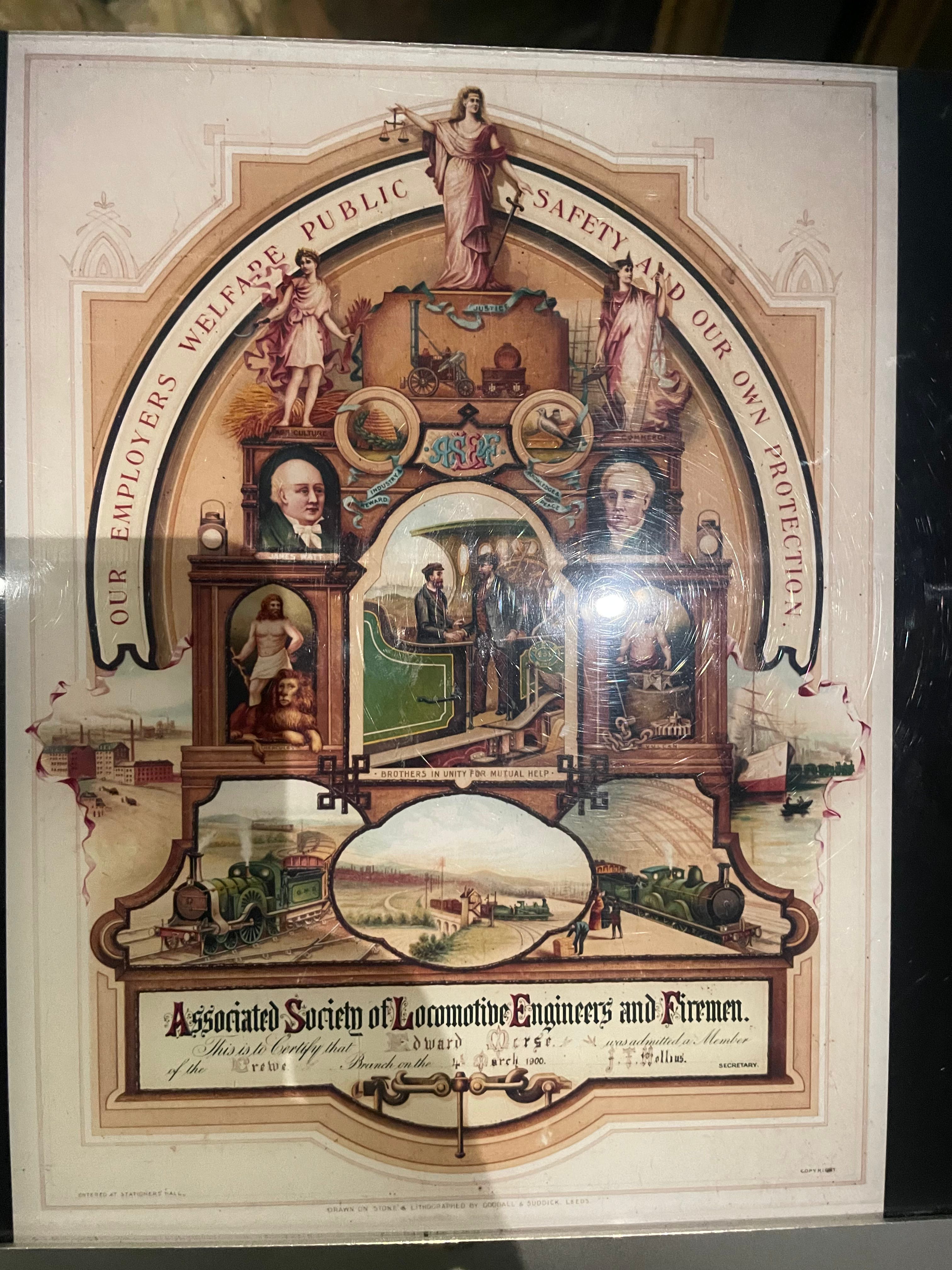
A nice Locomotive Engineers and Firemen Union sign, on display in the House of European History in Brussels.
Comments
Nothing yet. Say the first thing.
Sign in to join the conversation.