
Today marks the tenth anniversary of the final legislative step in Ireland’s Gender Recognition Act – the law that permits any individual in Ireland to self-declare their gender and be legally recognised as that gender.
This legislation was introduced with little, if any, public debate or scrutiny but it has had enormous implications. In the decade since its passing, the effects of the act have become increasingly visible and, in some areas, devastating.
Women’s rights have been eroded in practice and in law. Men who identify as women are now counted as women in official statistics, are housed in women’s prisons, play in women’s sports, sit on ‘all-women’ panels, and are celebrated on International Women’s Day. Meanwhile children and adolescents, particularly neurodivergent young people, are being led to believe that they can change their biological sex with long-term consequences that very few understand.
In 2012, as my personal world was falling apart in the wake of a relationship break-down, I found myself returning to something I had loved briefly in my twenties and thus came back to writing poetry. By 2018, I’d had a few poems published, taken part in a few poetry workshops, and been longlisted in some high-profile competitions. I felt the road was opening before me, that I was on my right path and had found the work I wanted to dedicate my life to.
But something happened later that year. At a pro-abortion1 rally in Dublin that autumn, a friend of a friend ‘peaked’ me - this is the term used to describe the moment that something clicks and the contradictions inherent in gender identity become apparent.
It felt natural, with my love of poetry, to process the complexities of the issue through writing. I wrote a short, light-hearted poem called Woman. It was in rhyme and was playful in tone and it posed the question What is a woman? I threw in a few conundrums to get people thinking. I was completely naïve however and totally unprepared for what followed.
The backlash was swift and completely shocking. Two people I loved, one of whom I considered a ‘best friend’, cut me off completely. They unfollowed, unfriended, and blocked me, and told me they no longer wanted anything to do with me. Then, on Christmas Eve, a local writer started an online campaign calling on everyone in the writing community to unite in opposition against me.
The two ‘friends’ that cut me off were people I really admired and had been so important to me in my life. One had stood by me during many important moments including helping me find a wedding dress. I was looking for a cheap second-hand dress but she insisted I choose something beautiful and bought me a stunning gown with lace and exquisite beading and a brown velvet ribbon at the waist and, even though I’m usually not into fancy dresses, I adored it.
She had also gotten on well with my lovely gentle mother who died in 2009. Mam loved patchwork. After her diagnosis of inoperable cancer, she cried in the car all the way home from hospital, not just because of the cancer, but because she’d no longer be able to sew.
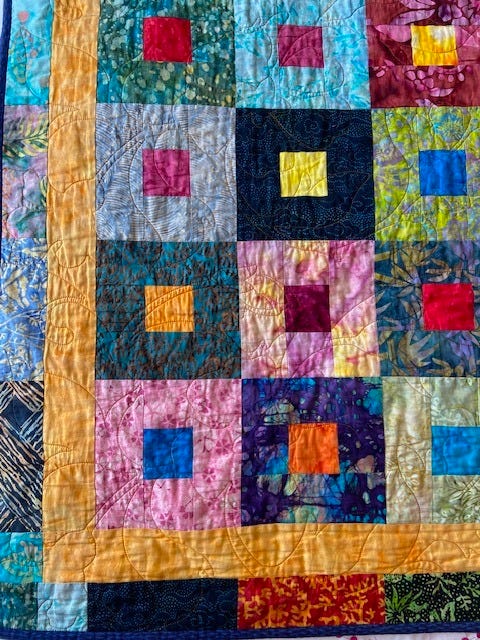
As mam’s health deteriorated, she lay on a couch beside a big wide window at the far end of the family kitchen. It was summertime and she was anxious to organise completion of three quilts she was unable to finish. Two fellow-patchworkers took on two of these quilts and I offered to do the third. Mam was thrilled. She instructed me on how to cut the colourful fabric squares, piece them together and sew on the golden border. When I finished it I brought it to mam to show her. ‘Now the Sun is Shining’ she said. That became the quilt’s name.
Mam had a few sewing machines but she gave her most prized one to me. A few years after she died, I gave it on to that same friend who was an artist. I thought she would make greater use of it than I would, and mam had been very fond of her. I never imagined that that friend would later cut me off completely.
The other person who cancelled me was a male friend for whom I had a silent love for many years. It was, for me, a kind of deep soul-attraction. He worked in the music industry and I met him in my mid-twenties when in the same circles in the Dublin music and arts scene. I liked his brooding melancholia, his argumentativeness, wit, and the way he stood so intently listening to the music at gigs. He was one of the people I admired most in the world. He also cancelled me.
Both of these ‘friends’ and that local writer who organised the campaign were in the Irish arts world. That world is, in my experience, almost fully captured by gender identity ideology. Most in the arts world who do not subscribe to gender identity belief do not speak publicly about their disbelief or rejection. They know the risks.
In the years that followed, dozens of poets distanced themselves from me – unfollowing, unfriending, staying silent. I continued writing, but I sent off fewer poems. What’s the point of submitting a poem to a competition when I know the judge once gave a reading where she stood on the stage loudly repeating the mantra ‘TRANS WOMEN ARE WOMEN’?
Happily, I did also have a number of extraordinary and unexpected successes so it’s important to remember that all opportunities are not completely closed off. I was, for example, thrilled to win the New Irish Writing September 2024 poetry award and to have been shortlisted in the New Irish Writing Best Poetry for 2024. I also had a poem published in Propel magazine and in Unbridled Women’s Poetry anthology.
I’m just an ordinary Irish mother and woman who loves poetry and who spoke up early on this issue. I knew, following the response to Woman that there was no going back, and so I have continued to speak up. Over the years many people have written to me to say they agree with my points but who are terrified to say anything publicly.
One woman emailed me last year saying the (very large) organisation she works with is forcing women to share changing rooms with men who identify as women. But she and her colleagues are too afraid to raise the issue publicly. This is the climate of fear, silence, conformity and isolation that we now have in Ireland.
The Arts Council of Ireland mirrors and perhaps even creates this culture of censorship and ideological conformity. Their August 2023 report on ‘disability, ethnicity and gender’ in awards states that ‘On average individuals who identify as non-binary apply for and are granted the highest award value’. In addition, the Arts Council collects information on gender identity rather than on biological sex thus reinforcing the idea that sex is irrelevant and gender self-declaration is all that matters.
The Arts Council Strategy (2016-2025) lists ‘Freedom of thought and of expression’ as one of their core values. But does that freedom extend to those who question or critique gender identity theory? In today’s Irish arts world the cost of disagreement can be exile and it’s too great a risk for many to take so the censorial climate is reinforced.
Ten years after the Gender Recognition Act was quietly passed in Ireland, it’s time to bring the consequences of that Act out into the open. The prioritisation of gender identity above biological sex has reshaped policies, institutions, and people’s lives and there has been little to no open discussion or democratic scrutiny.
The arts should be a space for exploration, dissent, truth-telling, playfulness, and open honest inquiry. Instead, it has become a battleground where conformity and silence is often rewarded and where many artists who do not subscribe to gender identity theory silence themselves out of fear and sometimes necessity.
It’s time to restore honesty and courage in our public conversations. This is not just for the sake of women and children, but for the sake of art, thought, and our shared humanity.
I used the term ‘pro-abortion’ in my original draft (posted a few days ago) and I’ve been thinking about this since. In my focus on gender identity I used the phrase ‘pro-abortion’ without giving it due consideration. I am not in favour of abortion in any and all circumstances. The rally I attended was specifically to support repeal of an Irish law (‘the eighth amendment’) that gave equal status to the life of the pregnant mother and the child and thus potentially put mothers’ lives at risk if they suffered conditions such as sepsis, ectopic pregnant, cardiac failure, or cancer. In addition, for decades, women in Ireland travelled to England to avail of abortion facilities thus leading to medical risks with a potential lack of medical after-care.
No posts
Comments
Nothing yet. Say the first thing.
Sign in to join the conversation.