

A hint of terfery broke into mainstream Irish news this week with coverage of a new Femtech report from the Health Innovation Hub Ireland (HIHI). Femtech, short for ‘female technology’, is a rapidly growing sector focused on women’s health needs. Despite growing pressure from gender identity activists in recent years to separate the word ‘woman’ from female biological processes, this report dares to link women explicitly to biological realities such as menstruation and menopause. Perhaps most surprisingly however, Minister for Health Jennifer Carroll MacNeill, a known adherent of gender identity belief, endorsed the report and wrote an appreciative foreword.
Many of us embroiled in the gender identity debate have developed a hound-like capacity to sniff out terfery and its opposite - genderism. Terfery refers to the acknowledgement of the importance of sex differences, whilst genderism is the belief that an internal, invisible, scientifically unfalsifiable, sense of gender identity should be prioritised above biology in law and policy.
One of the key markers of terfs – more politely called gender critical or sex realists – is the acknowledgement that women’s biological realities matter. Conversely, one of the hallmarks of genderists (also called trans rights activists or TRAs) is the attempt to erase acknowledgement of links between the word ‘woman’ and female biology.
Arguably the most well-known Irish example of trying to remove the word woman from associated biological reality was in 2020 when the Health Service Executive (HSE) removed the word ‘woman’ from its cervical cancer screening information and replaced it with ‘anyone with a cervix’ or ‘people with a cervix’.
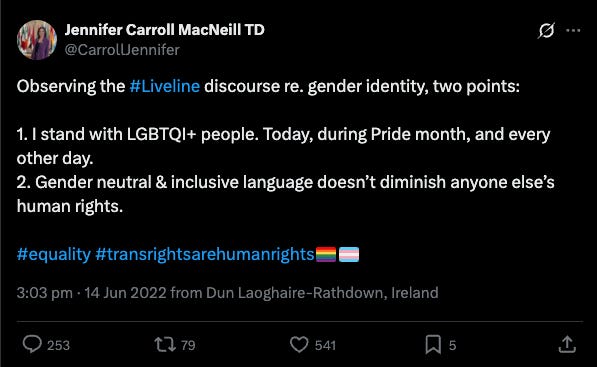
Jennifer Carroll MacNeill is one of Ireland’s most prominent politicians who is an open adherent of genderism. After the hugely controversial three-part Joe Duffy Liveline shows on gender identity in June 2022, she tweeted her support for genderism including for gender neutral and inclusive language.
Minister MacNeill is also an outspoken proponent of healthcare for people with gender identities with her department providing hundreds of thousands to develop a new model of trans healthcare in Ireland. (Trans healthcare involves the medical attempt to alter the body so that it aligns with the person’s gender identity, and this can include treatments such as cross-sex hormones and the removal of healthy sexual organs such as breasts, penises, testicals, wombs and ovaries.)
The optimistic reading of Minister MacNeill’s endorsement of the Femtech report is that she now acknowledges biology’s importance for women. However, this is unlikely especially since her foreword says the report informs the Department of Health’s ongoing initiatives such as the Women’s Health Action Plan – a plan which explicitly uses the word ‘women’ to refer to anyone who identifies as a woman.

The Femtech report also uses the Venus symbol next to word ‘Femtech’. This symbol in the past has been viewed as excluding those who identify as trans men or as non-binary. The most famous example of this was in 2019 when the symbol was removed from Always sanitary towels following pressure from trans activists.

The Femtech report highlights the need to increase funding, research and innovation in women’s health. With the female technology market projected to reach $97 billion by 2030, Ireland could reap economic benefits by supporting the sector. But can it do so while continuing down its current path of so called ‘inclusive’ practices that often result in ignoring the connection between the word ‘woman’ and women’s specific biological needs?
Although the report acknowledges Ireland’s progressive and inclusive policies, it does not mention gender identity or transgender issues. Instead, it acknowledges the historical exclusion of women from clinical trials and highlights underfunding for conditions uniquely impacting women, such as endometriosis, polycystic ovary syndrome, and postpartum depression.
The report also stresses that researching sex and gender differences is important for scientific accuracy, medical advancements and healthcare equality. The acknowledgement of both sex and gender is telling as ‘gender’ has often become synonymous with gender identity whilst ‘sex’ is commonly associated with biology. In Ireland, to date, the discourse in recent years has centered on the importance of gender whilst ‘sex’ has been overlooked.
The Femtech report story, covered (complete with the biological emphasis) was featured on the Irish Times and on Ireland’s public service broadcaster, RTÉ, this week and was a welcome and refreshing development where a news story, likely generated from a press release, led to rare terfy rhetoric on Irish media outlets.
We can expect activists to push for a more ‘inclusive’ framing of the Femtech sector. This would, again, tiresomely, involve prioritising gender identity above biological sex. But let’s hope that HIHI holds firm, and that Minister MacNeill also stands her ground in her support of the report, and that they continue to acknowledge that women’s biological realities matter.
No posts
Comments
Nothing yet. Say the first thing.
Sign in to join the conversation.