
Where Crypto Capital Flows Meet Market Intelligence.
🗓️ Tuesday, June 30, 2026 | Est. read time: 7 minutes
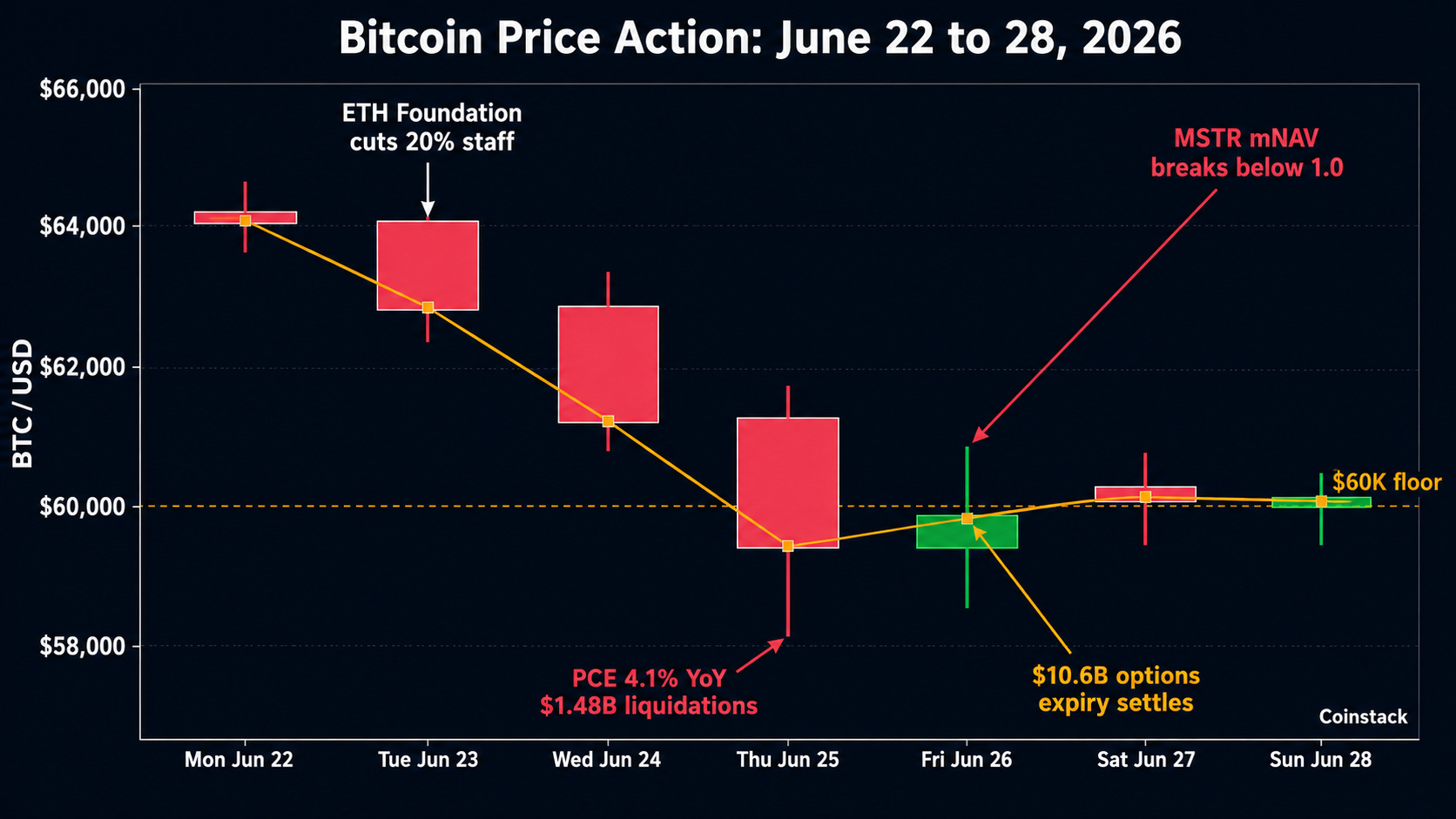
Bitcoin closed near $60,000, down 6.3% on the week and roughly 52% from the October 2025 all-time high.
May PCE printed 4.1% headline and 3.4% core on June 25, the hottest read since April 2023, triggering $1.26 billion in liquidations.
Strategy’s enterprise mNAV broke below 1.0 on June 26 for the first time, severing the equity accretion channel for its 847,363-BTC treasury.
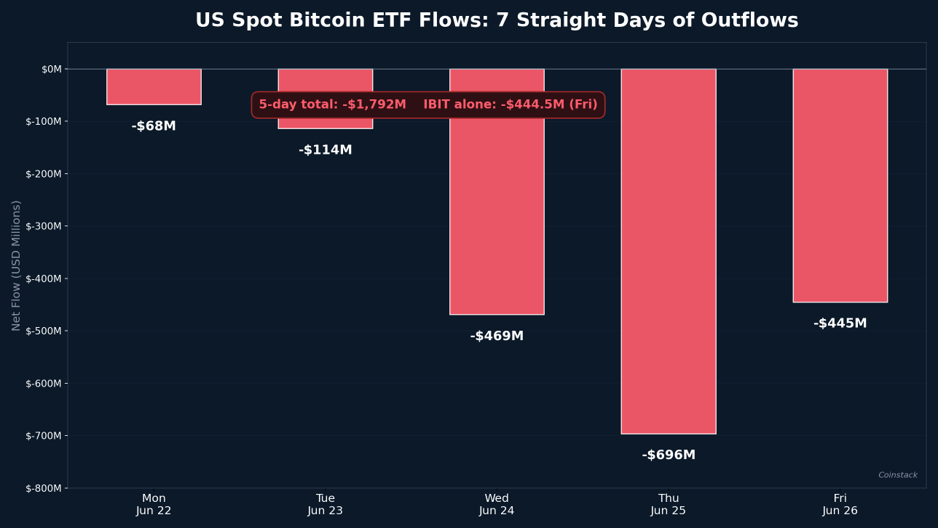
US spot Bitcoin ETFs bled seven straight sessions, redeeming $1.79 billion Monday to Friday; IBIT alone shed $445 million on Friday.
The Ethereum Foundation cut 20% of staff and 40% of its 2026 budget on June 23 as ETH closed near $1,576.
A $10.6 billion Bitcoin options expiry settled Friday with roughly 80% of contracts out of the money.
Week ahead: June Non-Farm payrolls (July 2), MiCA enforcement (July 1), FOMC minutes (early-to-mid July), H1 close.
Crypto closed H1 2026 trading like a leveraged macro asset, not a sovereign hedge. Bitcoin opened the week near $64,000, printed $58,000 on the May PCE shock, and finished the weekend at $59,000-$60,000.
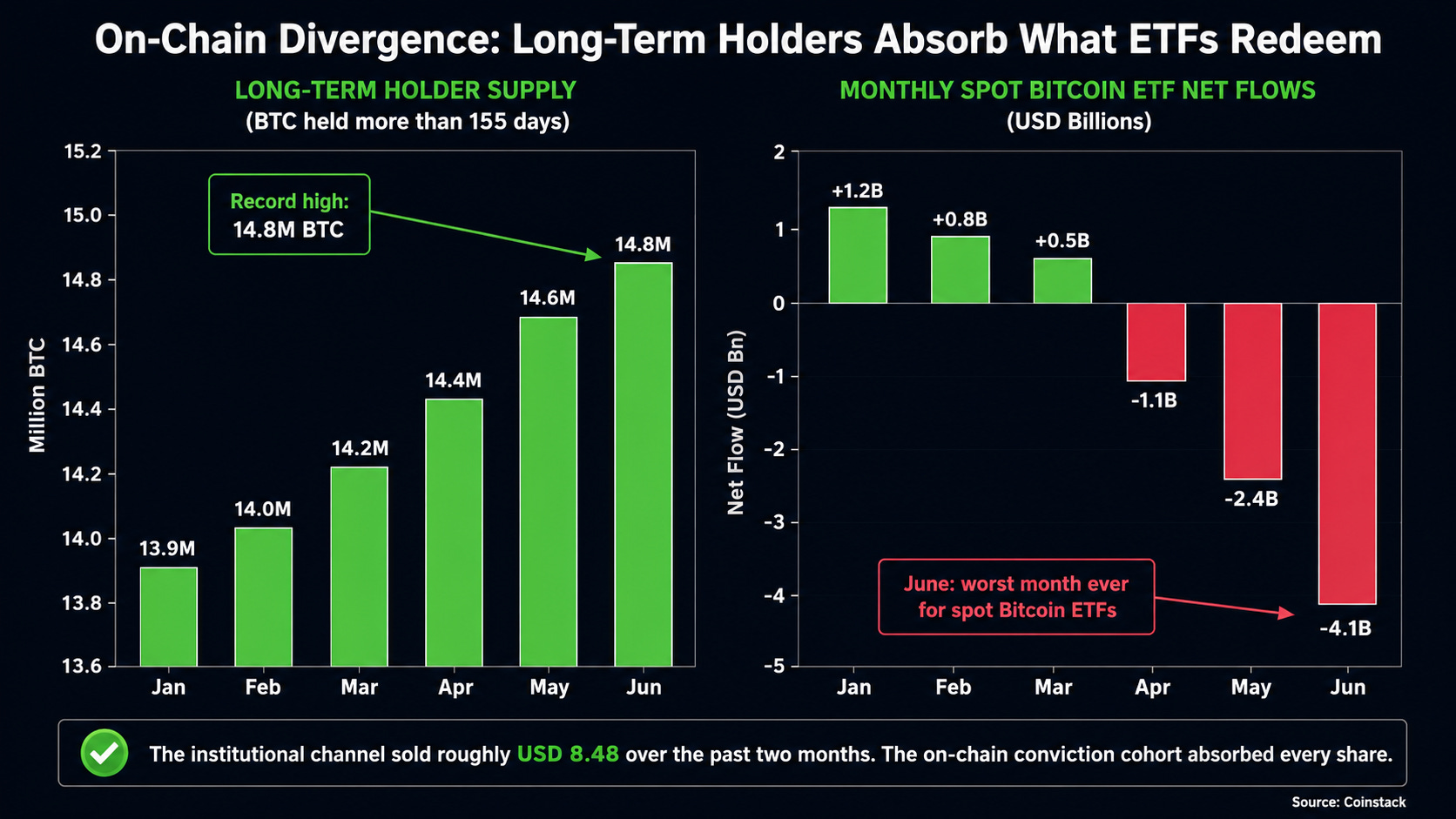
Strategy’s enterprise mNAV cracked below 1.0 on Friday, signaling the equity accretion flywheel powering corporate Bitcoin treasuries has stopped turning. Long-term holders quietly absorbed every share the ETFs sold, lifting wallet-aged supply to a record 14.8 million BTC.
Here’s what crypto investors should understand about the week ahead…
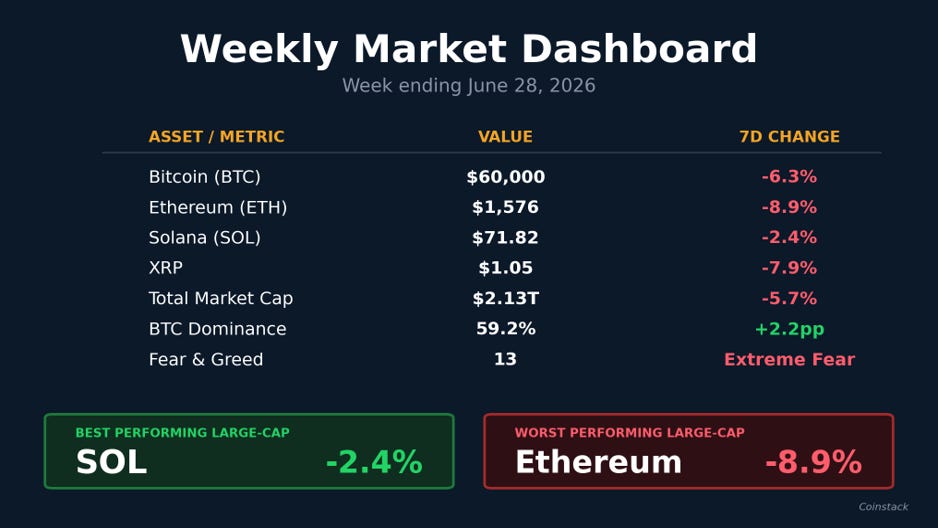
Solana held up best among majors, supported by $1.06 billion combined spot ETF AUM across Bitwise’s BSOL and Fidelity’s FSOL, and testnet activation of the Alpenglow consensus upgrade.
Ether fell hardest after the Foundation announced a 20% workforce cut and 40% budget reduction. ETH is on track to close three consecutive negative quarters for the first time in its history.
Three forces compounded. May PCE printed 4.1% on Thursday, eliminating the 2026 rate cut bid. Strategy’s mNAV cracked below 1.0 on Friday, closing the equity accretion channel for the largest corporate BTC buyer. Spot Bitcoin ETFs bled a seventh straight session.
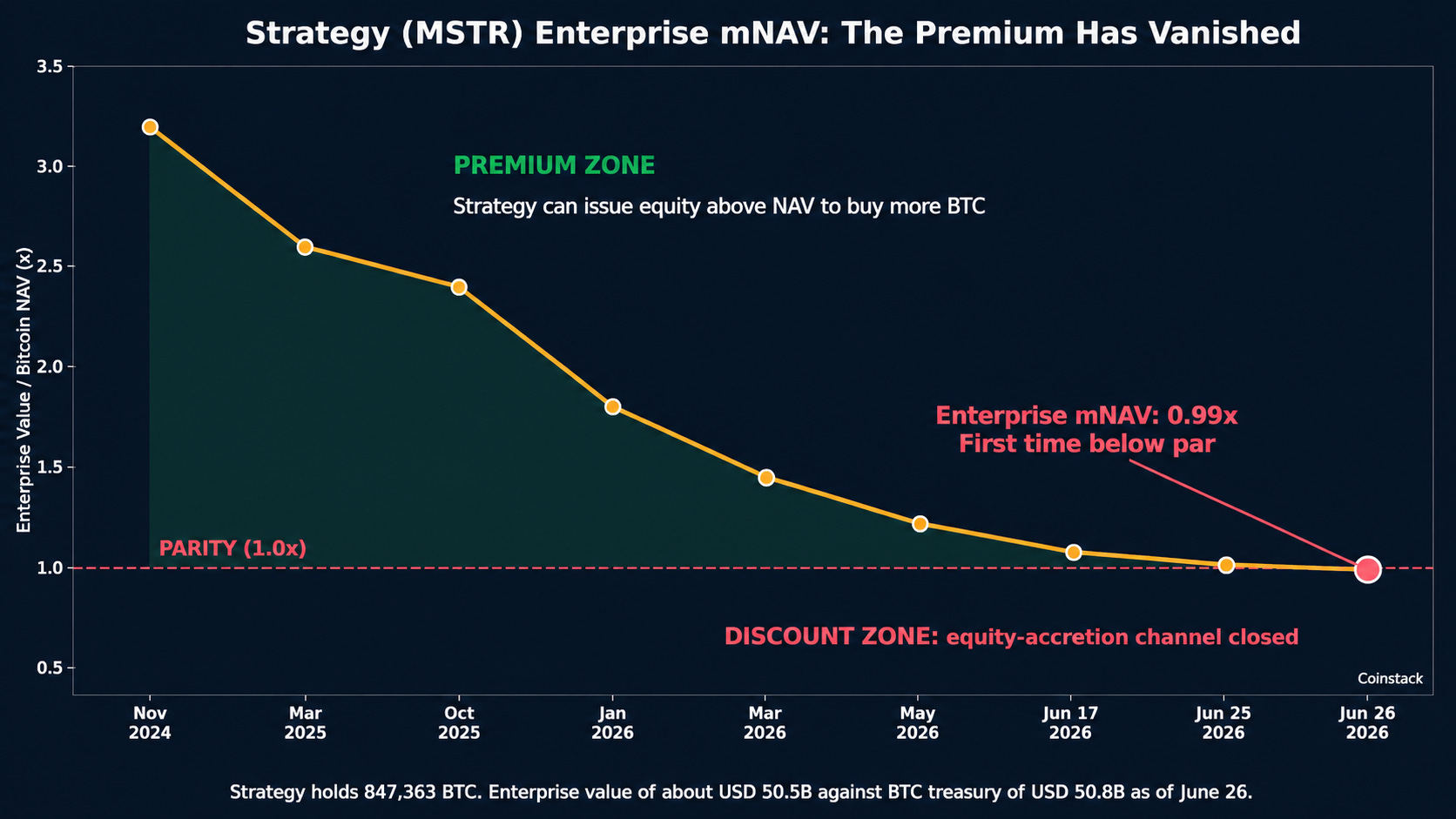
Strategy’s enterprise market-to-net-asset-value ratio closed below 1.0 on June 26 for the first time. With BTC near $60,000, the 847,363 coins it holds (as of June 22) are worth roughly $50.8 billion. Enterprise value, comprising $29.3 billion in equity, $6.75 billion in convertible debt, and $15.5 billion in preferred stock outstanding, came to approximately $50.5 billion, putting enterprise mNAV at 0.99x. MSTR closed at $82.31, a 52-week low and a 36% decline across eight sessions. STRC hit $71-$73 intraday, 26% below par. Annual preferred dividend obligations have quadrupled to $1.2 billion since January as cash reserves fell 38%.
The Strategy flywheel was one thing: issue equity at a premium to NAV, buy more BTC, raise BTC per share. A sub-1 enterprise mNAV breaks that machine. The company now holds $50.8 billion in Bitcoin, backed by $22.3 billion in senior claims that cannot be diluted. Rosen Law Firm has opened a securities investigation. According to Strategy Purchase Tracker, the company bought just 520 BTC on June 22, its smallest pace of the cycle.
Watch enterprise mNAV at every Strategy disclosure, not just BTC price. A sustained sub-1 multiple forces three choices: dilute common into a discount, sell Bitcoin to defend the preferred, or restructure the stack. Each path reprices the broader treasury cohort.
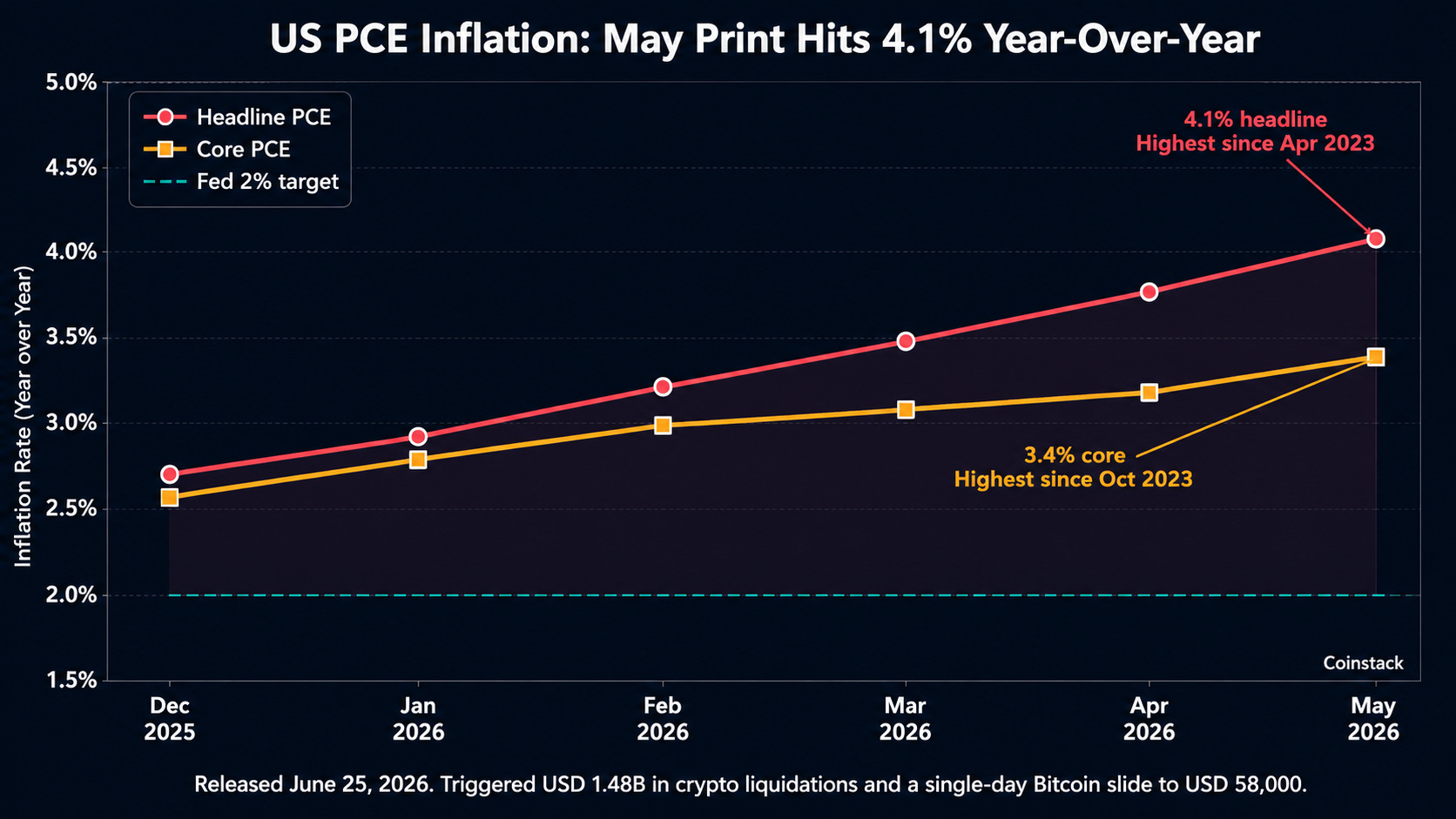
The Bureau of Economic Analysis (BEA) reported May headline PCE at 4.1% year over year, the hottest since April 2023. Core PCE rose to 3.4%, the highest since October 2023. Bitcoin dropped to $58,188, triggering $1.26 billion in liquidations.
The print landed in line with consensus rather than significantly above, and core PCE remains contained. Fed Funds futures still price one to two cuts by mid-2027.
Headline PCE has risen for five consecutive months. Warsh has retired forward guidance, and former Fed officials are openly discussing a 2026 hike.
Spot Bitcoin ETFs recorded a seventh consecutive session of outflows on June 26. The five trading days redeemed $1.79 billion, with Thursday’s $696 million and Friday’s $444.50 million leading. June total redemptions reached approximately $4.06 billion, the worst month in the product’s history.
BlackRock deposited $257 million in BTC and ETH to Coinbase on June 24, suggesting custody rebalancing rather than fund-level capitulation.
IBIT absorbed nearly the entire June 26 redemption, its largest single-day exit since launching in 2024.
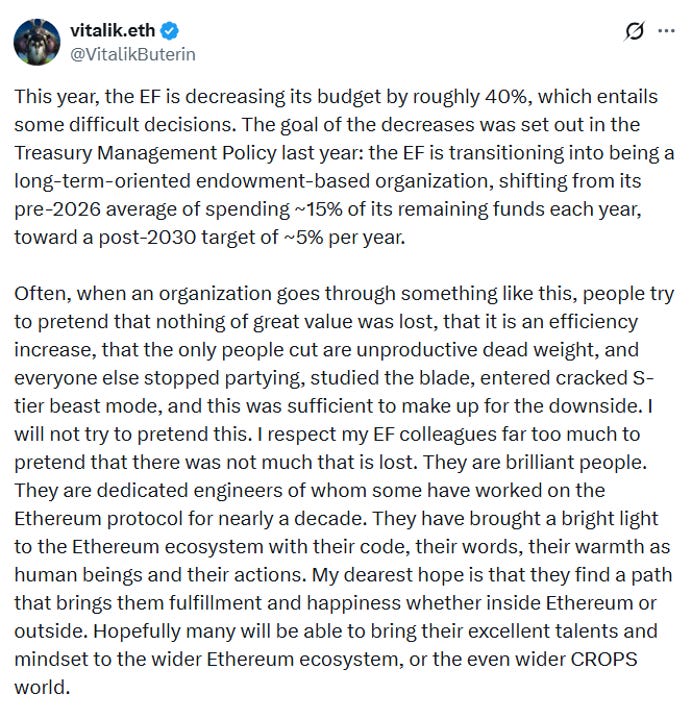
The Ethereum Foundation announced on June 23 that it has cut roughly 20% of its 270-person workforce and is reducing its 2026 budget by 40%. Vitalik Buterin posted that the Foundation will reorganize into five clusters: protocol, access, user, community, and institutional. ETH fell 5% on the day.
A leaner endowment-style model preserves Ethereum’s treasury during the drawdown. Bitmine added 52,203 ETH last week, lifting its corporate treasury toward 5% of supply.
ETH is on track to close three negative quarters in a row, a first in its history. Treasury cuts during a price drawdown read as a concession.
👉 Read the Ethereum Foundation Blog Post: Here.
Wallets aged more than 155 days now hold approximately 14.8 million BTC, an all-time high and roughly 74% of the circulating supply. Nearly 11 million BTC sit at unrealized losses relative to their acquisition price, the largest underwater cohort since 2022.
Spot Bitcoin ETFs sold approximately $4.06 billion in June while long-term holders absorbed every share. The pattern has historically preceded cycle lows, not tops, but those resolutions required a macro catalyst. With forward guidance retired, the catalyst now has to come from data.
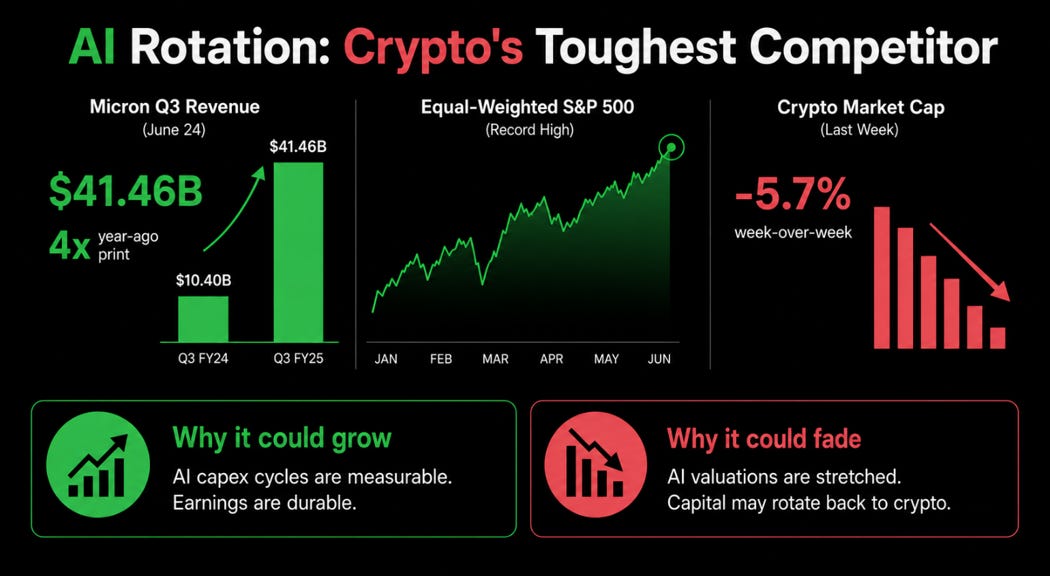
Marginal institutional capital that once flowed reflexively into Bitcoin is now flowing into AI and semiconductors. Micron printed $41.46 billion in Q3 revenue on June 24, four times the year-ago print. The equal-weighted S&P 500 reached a record high last week even as the crypto market cap fell by 5.7%.
👉 Read the Micron Press Release: Here.
AI capex cycles are measurable, with earnings durable enough to underwrite. Crypto post-Warsh has no equivalent forward visibility. CZ named AI rotation, geopolitics, and the four-year cycle as causes of the 50% drawdown.
AI valuations are stretched. Analysts argue the next leg of crypto buying may come from institutions reallocating gains from overheated AI trades into Bitcoin.
The Strategy mNAV break has split the Bitcoin treasury cohort in two. Companies with cleaner balance sheets and disciplined cash reserves still trade above NAV. Those over-engineered for premium issuance now trade at discounts. Underweight discounted treasury models; overweight spot BTC or treasuries with conservative capital structures.
Q2 disclosures begin mid-July. Any preferred dividend cut, asset sale, or capital raise at a discount will reprice peers. Strive’s SATA dividend reset is the next pricing signal.
A clean BTC rally above $65,000 restores premium across the cohort and unwinds the differentiation trade quickly.

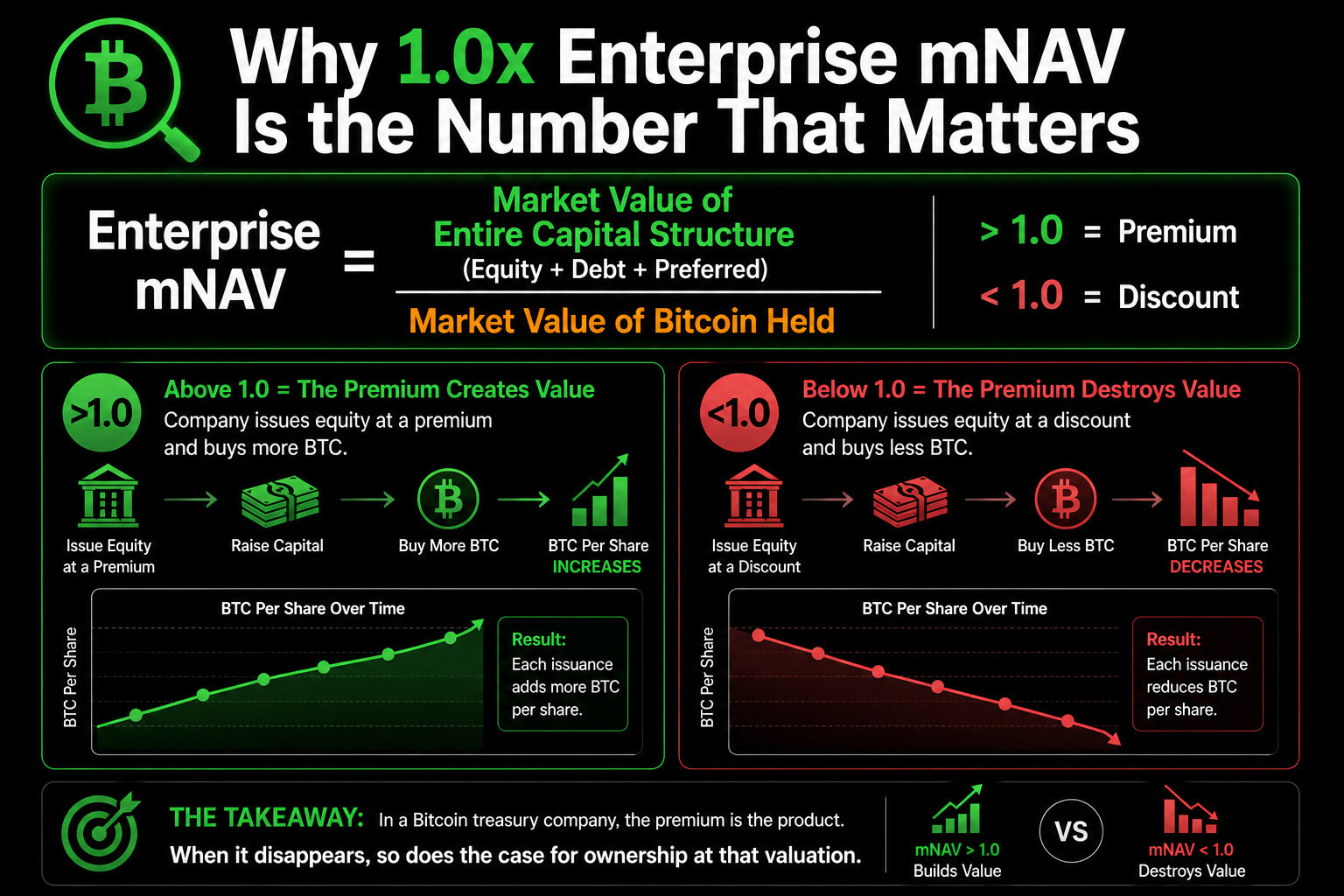
Enterprise mNAV is the market value of a treasury company’s entire capital structure, including debt and preferred stock, divided by the market value of its Bitcoin. Above 1.0 is a premium over the coins. Below 1.0 means the market values the company at less than its Bitcoin.
The premium does the financial work. As long as enterprise mNAV stays above 1.0, the company can issue new equity at a multiple of the BTC it buys, raising BTC per share with each issuance. Below 1.0, the arithmetic reverses. New equity destroys BTC per share rather than creates it.
The takeaway: In a Bitcoin treasury company, the premium is the product. When it disappears, so does the case for ownership at that valuation.
Ripple CEO Brad Garlinghouse, in a CNBC interview, criticized Strategy’s preferred-stock funding model as financial engineering that hurt crypto.
ICE and OKX announced a 50/50 joint venture on June 22 to operate as a US-registered broker-dealer and FCM, giving OKX’s 120M customers access to NYSE tokenized equities and ICE futures.
Franklin Templeton completed its acquisition of 250 Digital and launched Franklin Crypto, a dedicated active digital asset management unit.
21Shares reaffirmed a $100,000 Bitcoin year-end target, arguing the drawdown is consistent with prior post-halving pullbacks.
Kalshi opened a new funding round at a roughly $40 billion valuation, nearly double its prior $22 billion mark.
Two of the three pillars holding the 2026 thesis together cracked in one quarter. Forward guidance is gone. The Strategy flywheel is broken. Only long-term holder conviction has held, with wallet-aged supply at a record 14.8 million BTC.
Whether June marks a capitulation or a deeper reset depends on three reads in July: payrolls, MiCA enforcement, and the H1 close. The institutional model now has to buy what conviction wallets are quietly hoarding.
Coinstack is published every Tuesday. Nothing in this newsletter constitutes financial or investment advice. All information is sourced from publicly available data and should be independently verified.
© 2026 Coinstack. All rights reserved.
Comments
Nothing yet. Say the first thing.
Sign in to join the conversation.