
Solana Consumer Day in Miami saw 30+ builders. 5 minutes each across predictions, payments, agents, vaults, orderbooks, comic books and more.
This piece is about what the room was saying when you stopped listening for product names and started listening for patterns.
Nine currents stood out.
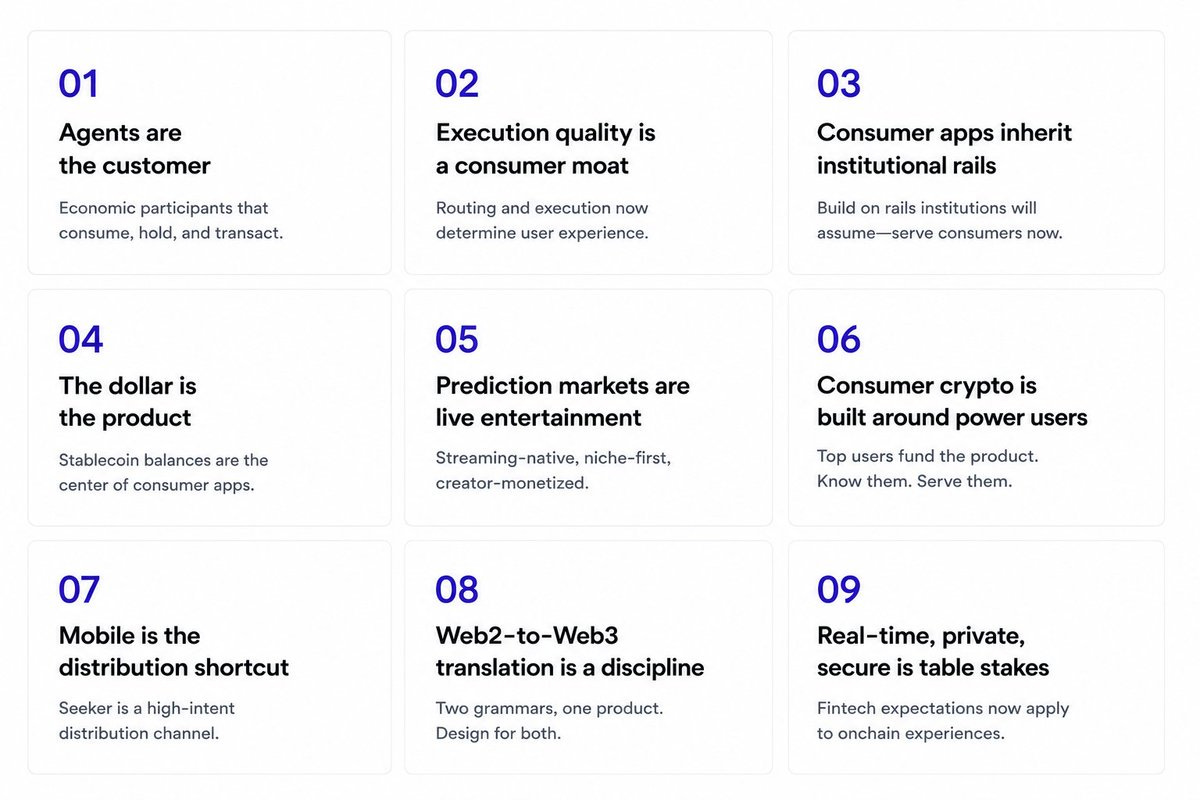
AI agents are no longer being treated as chatbot skins. They are being treated as economic participants: entities that consume APIs, hold balances, place orders, and increasingly get tokenized themselves.
@birdeye_so cited roughly 15M agent-driven transactions on @solana and has shipped x402 support for pay-per-request APIs. Humans want dashboards. Agents want rate-limited, machine-payable APIs with predictable schemas.
Builder read: If your product surfaces data, payments, or actions, ask whether an autonomous agent could be your customer, employee, or inventory.
Retail swap execution on Solana has moved from sloppy to institutional-grade for the assets that matter most to mainstream consumer apps.
@dflow is the cleanest data point. Coinbase made DFlow its primary Solana router; trade failure rates fell from roughly 1-in-30 to 1-in-250, quote errors dropped 88%, and DFlow began handling around 60% of Coinbase’s Solana trading volume.
As flows move from memecoins toward stablecoins and tokenized stocks, orderbooks and options matter again.
Builder read: Execution is now consumer UX. A user’s first swap inside a Solana app either feels like a centralized exchange or it does not. Routing is not a vendor decision anymore. It is a product decision.
The cheapest endpoint may quietly cost you retention.
The friction: real-world yields often come with monthly or quarterly redemption windows, while DeFi users expect instant exits. So if it lets a retail user click “earn yield on my dollars” without discovering two weeks later that they cannot withdraw for a quarter, it is a poor UX.
Builder read: The wrong read is “build for institutions.” That is usually too slow. The better read is: build on rails institutions will assume, while serving consumers now.
Users will not care about the machinery. They will care that the product works.
For most of crypto’s history, stablecoins were plumbing. Consumer Day suggested the opposite: the dollar itself is becoming the product.
There is no dominant daily consumer app built around using a stablecoin balance. In 2021, the consumer product was the token. In 2026, the consumer product is the dollar held on Solana.
Builder read: Yield, payments, cards, treasury, LP fees, and automation are what you build around that balance.
If stablecoins only appear at deposit and withdrawal, you are probably leaving the product on the table.
Prediction markets are no longer only pitching themselves as better information aggregators. They are becoming session-based entertainment. Winning products are often the ones with the best engagement loops, not just the best odds.
Builder read: The entertainment thesis is right. But teams are pricing engagement and underpricing distribution. The regulated head of the market is being won through legality and access. The crypto-native opportunity is probably the long tail: creator-driven, niche, streaming-native markets.
Choose your end of the barbell. Regulated head or viral tail. The middle is where undifferentiated products disappear.
Consumer crypto is brutally top-heavy, and the products that win are the ones that admit it.
As of mid March, Hyperliquid’s top 100 addresses accounted for 81.3% of trading volume, with 1.7M remaining addresses splitting the rest.
Builder read: Consumer crypto is a high-ARPU, low-DAU business pretending to be the opposite. Founders optimize for DAU because it looks better in decks. Survival often depends on revenue per top-tier user.
Know your top 100 users by name, balance, behavior, and pain point.
Cherry Fun and @magicblock pointed at @solanamobile as not just another device. It is a different distribution channel.
Seeker is still closer to a concentrated beta channel than a mass market product but it sidesteps the Apple and Google’s hostile economics.
“Our @solanamobile launch resulted in thousands of new users who deposited around half a million USD of SOL in the first two weeks.” - Sanctum
Builder read: Solana Mobile users spend and retain at multiples of equivalent web users. When your product has a natural mobile form factor, lean on Seeker’s install base for discovery and retention instead of fighting the existing App Store dynamics.
Bringing mainstream users onchain is not just a marketing problem. It is a translation problem.
@ComicBook’s Andrew Burkowitz made this explicit. The challenge is running two grammars for the same product: one for crypto-native users who understand SPL tokens and provenance, another for people who just want a graded comic in the mail.
Builder read: “Onboard the next billion users” has been a slogan for years. Translation is what it means in practice. It happens in settings, confirmations, errors, support, and vocabulary.
Ask of every screen: would a crypto-native user feel patronized, and would a mainstream user feel lost?
@magicblock’s ephemeral rollups showed high-frequency interfaces where users can drag a stop-loss line and have the order update in real time, plus encrypted USDC payments where transfer details are hidden while settlement remains onchain.
Builder read: Users will compare Solana apps to Robinhood, Venmo, and Cash App, not to other onchain apps.
They are consumer fintech expectations. The onchain part will not compensate for slower, leakier, scarier UX.
The strongest pull at Consumer Day was fintech-adjacent: trading, betting, payments, treasury, RWAs, and agent-mediated versions of all of them.
The winners of 2027-2028 will likely share four traits:
they treat the dollar as the substrate
design for agents and humans
match Web2 fintech on execution and trust
treat translation as a design discipline.
What fades: speculation without durable balances, undifferentiated DeFi forks, “institutional” pitches without consumer surfaces, single-language crypto UX, mid-stack prediction markets.
What grows: stablecoin-native accounts, tokenized equities inside mainstream fintech, agent-mediated commerce, Seeker-first distribution, translation-first onboarding, and power-user-aware product design.
Builders should have @SuperteamBlack on their radar. Its @Superteam’s founder success program for high traction solana teams
Thank you for giving me your time and reading this piece. @its0xRay
No posts
Comments
Nothing yet. Say the first thing.
Sign in to join the conversation.