
$5B+ in onchain transaction volume across 200K+ devices shipped to 50+ countries.
Not a new handset cycle. Not another attempt to brute-force a crypto phone into the mainstream Android market.
At MWC Barcelona on March 2, Solana Mobile opened its mobile stack to third-party Android manufacturers as a licensable, modular integration.
For two years, the market read
as a hardware bet. Sell enough branded devices, build a category, hope crypto phones become normal.
That was always the wrong benchmark.
Saga sold ~20K units. Seeker scaled past 150K pre-orders.
Those are meaningful numbers for a new product line, but tiny against an industry where large manufacturers ship tens of millions of devices per year.
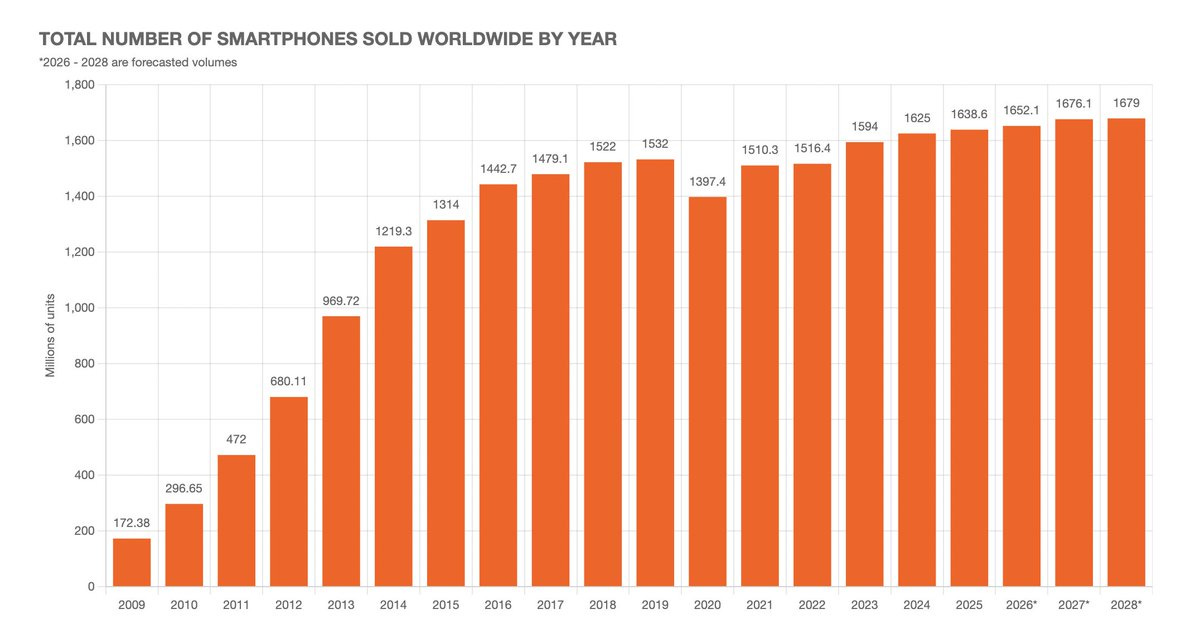
h/t: SellCell
Android already has its power structure. Google owns the operating system. Chip vendors own the silicon. OEMs compete on retail reach, price, and whatever software layer can help them stand out.
Solana Mobile is offering OEMs the financial layer without asking them to build the wallet, app store, and verification system themselves.
The rough cut attached to mainstream app distribution is still ~30%.
Below the top tier, most Android manufacturers don’t control much of that value. They sell hardware, take the margin once, and move on.
The first customer is probably not Samsung or Xiaomi. Those companies already have payments infrastructure, distribution, and security brands big enough to build in-house.
The more natural buyer sits further down the supply chain.
Tier-2 and tier-3 manufacturers, often shipping price-sensitive devices on MediaTek, need differentiation that pays for itself. A crypto wallet alone is not enough. A branded app store alone is not enough.
A store with 0% platform fees and ~85K weekly active users already holding capital on-device is different. So is distribution inside a catalog of 750+ apps instead of the statistical void of Google Play. Guardian operators curate what gets listed. That’s the discovery mechanism that survives the store outgrowing.
The appeal is simple. A phone that used to monetize once at checkout can keep generating revenue as users transact, stake, and use financial apps.
For manufacturers competing mostly on price, recurring software revenue is worth more than another camera feature.
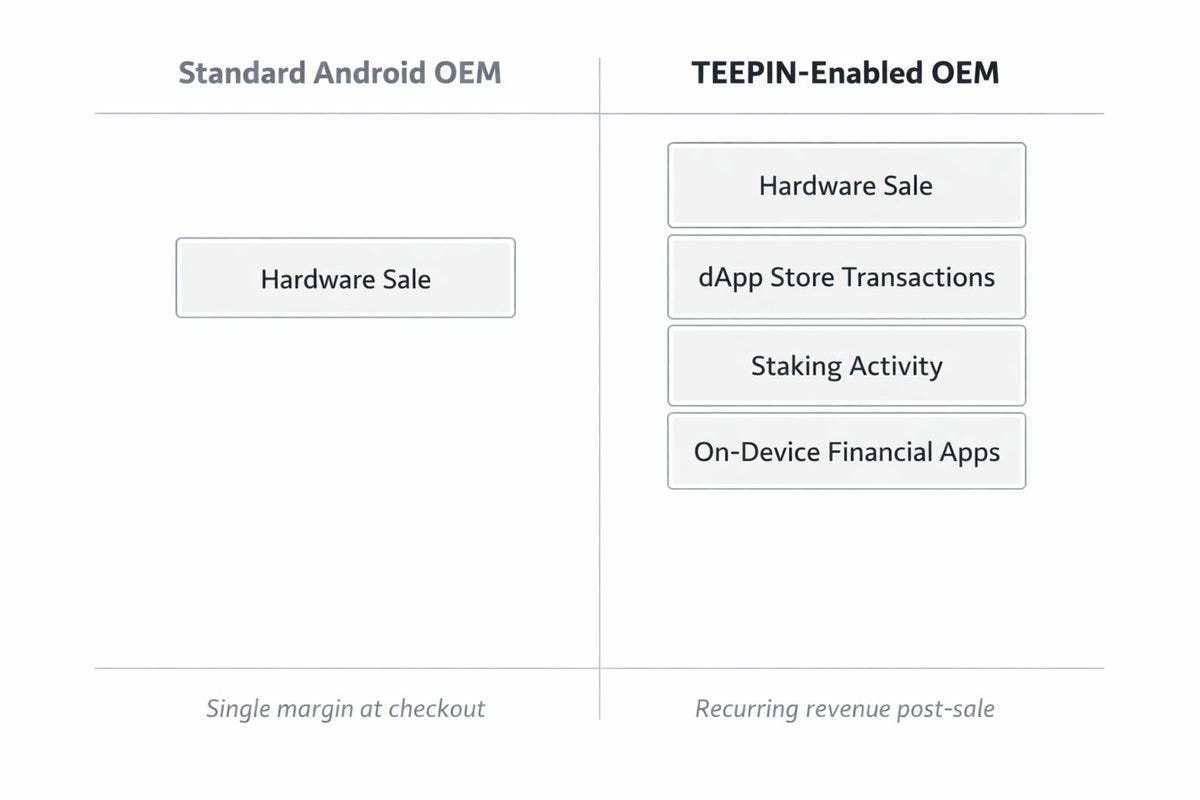
The mobile industry already has secure hardware, app stores, and wallet apps.
What Solana Mobile built is the integration layer between them.
The package is called TEEPIN, TEE + DePIN. In practice, that means hardware-isolated key management tied to wallet UX, dApp distribution, device verification, and token incentives in one licensable stack.
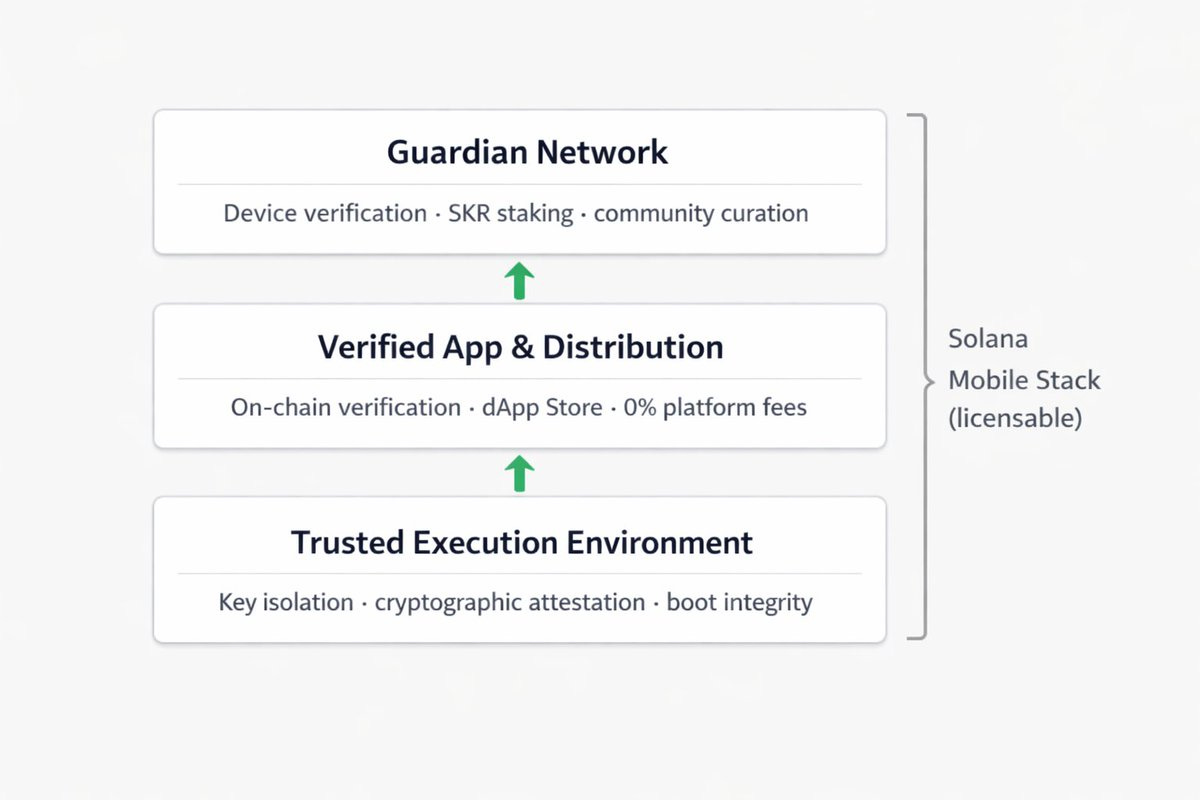
No single component is impossible to copy.
The harder part is assembling the whole thing, shipping it, and proving people use it.
The stack runs production-ready on MediaTek chipsets, includes Qualcomm support, and integrates Trustonic’s Kinibi TEE for GlobalPlatform-compliant security.
Seed Vault is the clearest product surface. Keys stay outside the operating system, and signing flows through biometrics. That makes self-custody feel closer to tap-to-pay than seed phrase management.
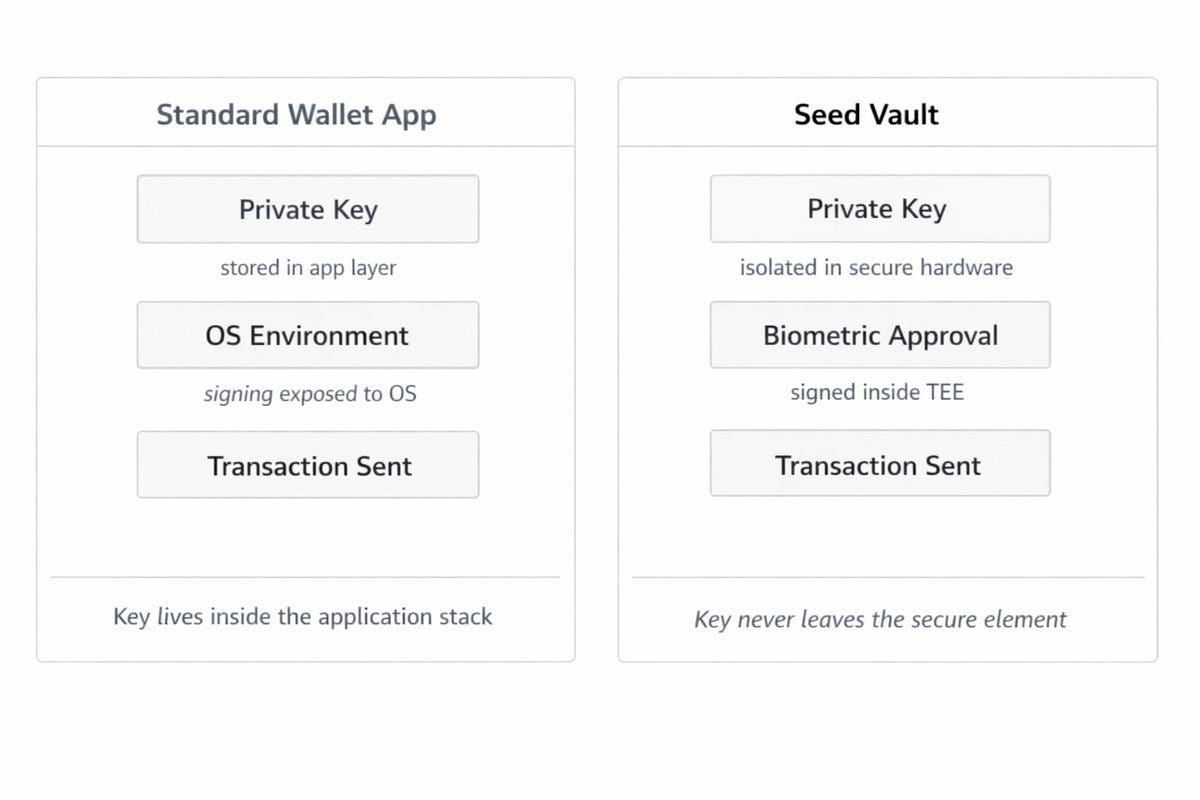
That same hardware-isolation is also the primitive AI agents would need to sign transactions without keys touching application code. Different auth flow, same cryptographic rail.
SKR launched in Jan with 10B total supply. 30% was allocated to community airdrops. More than 75K users claimed at launch, and 46% staked immediately.
The token turned phone ownership from passive eligibility into active network participation.
Saga’s original mechanic was passive. Hold the device, receive the drop. SKR moved to active staking, where users delegate to Guardian operators that verify device integrity and help curate the dApp Store.
That gives Solana Mobile a live alignment layer before any third-party OEM ships the stack.
It also comes with a clock.
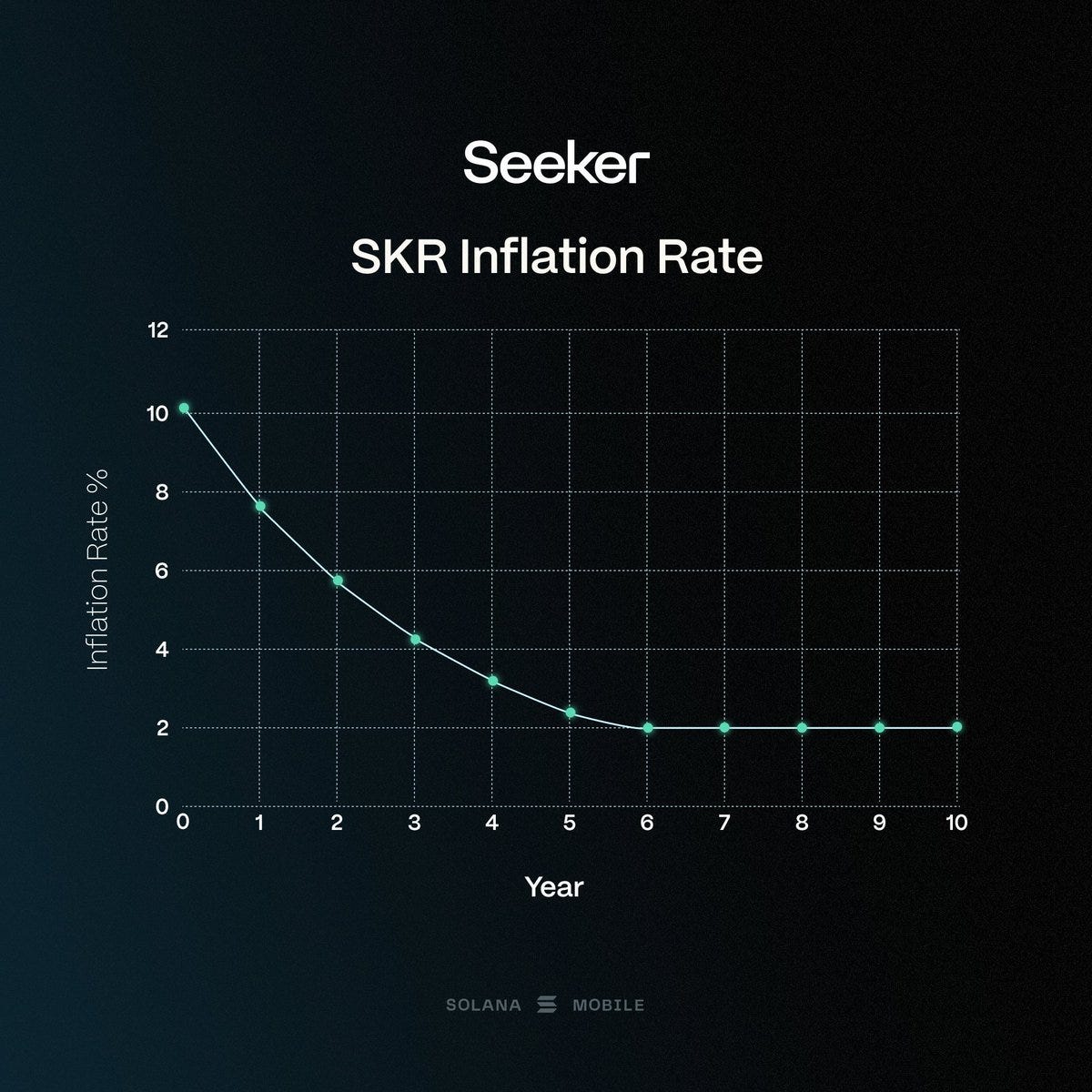
Inflation starts at 10% in year one and decays 25% annually toward a 2% floor. The yield keeping capital locked today will be lower in two years. By then, users need a reason to stay that isn’t denominated in APY.
OEM distribution is the cleanest way to bridge that gap.
When the stack ships pre-installed on third-party devices, users are no longer buying a phone for an airdrop. They are getting financial capability as a default feature on the Android device they already wanted.
That path starts with default distribution instead of airdrop-driven demand.
No OEM names are public. Licensing cycles are slow. Token incentives decay. Google still controls the outer boundary of Android. Regulation differs by market.
But the test has changed. Solana Mobile is no longer testing whether a branded crypto phone can find an audience.
It is testing whether financial capability can ship silently, inside devices people already wanted.
If that happens, crypto on phones stops being a niche product decision.
The winning crypto phone may never be sold as a crypto phone at all.
No posts
Comments
Nothing yet. Say the first thing.
Sign in to join the conversation.